](https://deep-paper.org/en/paper/2410.01488/images/cover.png)
Introduction
In the last few years, the landscape of software development has changed efficiently. Large Language Models (LMs) like GitHub Copilot, StarCoder, and GPT-4 have become indispensable assistants for developers. They autocomplete functions, write documentation, and even scaffold entire applications. However, this convenience comes with a hidden cost: security.
Recent studies have shown a worrying trend. Because these models are trained on massive repositories of open-source code (like GitHub), they learn the bad habits present in that data along with the good ones. Investigations have found that approximately 40% of the code generated by popular coding assistants contains security vulnerabilities.
Imagine a developer asking an AI to write a function to handle a database query. If the AI was trained on insecure code, it might generate a function susceptible to SQL injection. This creates a massive bottleneck for deploying AI in security-sensitive domains like banking or healthcare.
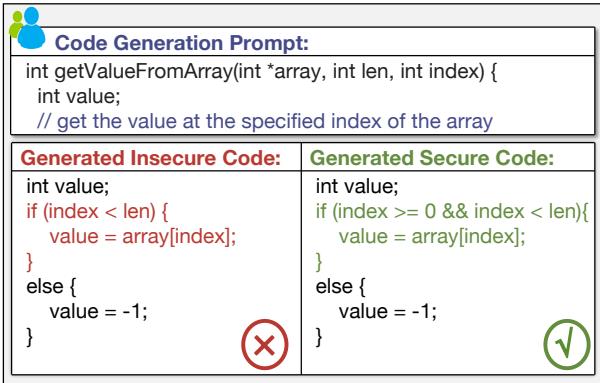
As shown in Figure 1 above, the goal is to take a standard prompt (like “get value from array”) and ensure the model generates the “Secure Code” (checking array bounds) rather than the “Insecure Code” (which could lead to a buffer overflow).
In this post, we will deep dive into a research paper titled “SecCoder: Towards Generalizable and Robust Secure Code Generation.” This paper proposes a novel method called SecCoder that steers models toward writing secure code without needing expensive retraining. It utilizes a technique called In-Context Learning (ICL) combined with a Dense Retriever to show the model “safe demonstrations” in real-time.
The Core Problem: Generalizability and Robustness
Before understanding the solution, we must understand why previous attempts to fix this have fallen short.
Existing methods often rely on fine-tuning. This means taking a pre-trained model and training it further on a dataset of secure code. While this works for the specific bugs included in the training set, it suffers from two major limitations:
1. Lack of Generalizability
There are hundreds of types of software vulnerabilities (categorized by the Common Weakness Enumeration, or CWE). A model fine-tuned to fix SQL injections might still be terrible at handling buffer overflows. If the model encounters a “test case” (a coding scenario) that is different from what it saw during fine-tuning, it often fails to apply security rules. This is known as mismatched generalization.
2. Lack of Robustness
The second issue is even more concerning. Models can be “attacked” or “poisoned.” If an attacker introduces malicious data during the training phase, the model can be taught to intentionally write vulnerable code. Existing defenses are often fragile; if a model has been effectively poisoned, simple prompt engineering is rarely enough to stop it from outputting bad code.
The Solution: SecCoder
The researchers propose SecCoder, a framework designed to be both generalizable (works on new, unseen scenarios) and robust (works even if the underlying model is flawed).
The core philosophy of SecCoder is: Don’t just tell the model what to do; show it how to do it.
Instead of changing the model’s internal weights (fine-tuning), SecCoder leverages In-Context Learning (ICL). ICL is the ability of Large Language Models to learn a task simply by looking at examples provided in the prompt. SecCoder retrieves a relevant, secure code snippet and pastes it into the prompt before the user’s request. This “demonstration” guides the model to follow a secure pattern.
The Framework
The SecCoder framework operates in a four-step pipeline. Let’s break down the architecture.
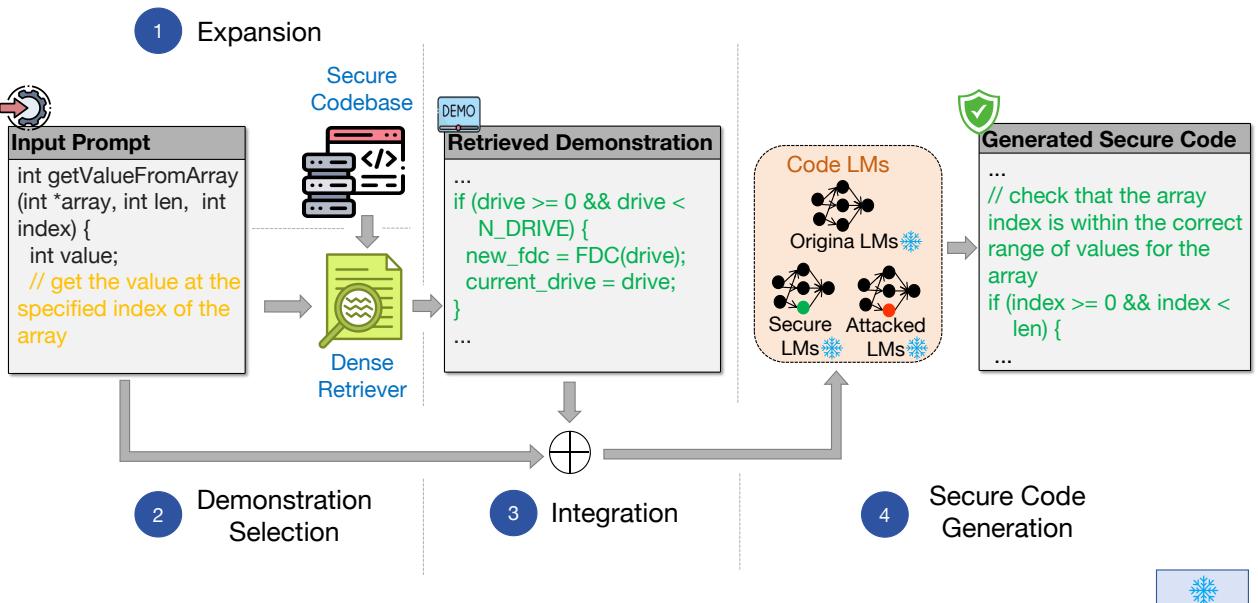
As illustrated in Figure 2, the process moves from expanding a database of knowledge to selecting the right knowledge, integrating it, and finally generating the code.
Step 1: Expansion (The Knowledge Base)
First, we need a source of truth. The system maintains a Secure Codebase (\(S\)). This is a collection of code snippets that are known to be secure. When new vulnerabilities are discovered and fixed, these fixes are added to the database. This allows the system to update its “security knowledge” instantly without retraining the AI model.
Step 2: Demonstration Selection (The Retriever)
This is the most critical step. We cannot simply feed any secure code to the model; it has to be relevant to what the user is currently asking for. If the user wants to write a file-handling function, showing them a secure network socket function won’t help.
To solve this, SecCoder uses a Dense Retriever. Unlike simple keyword search (which looks for matching words), a dense retriever uses a pre-trained embedding model (specifically “INSTRUCTOR” in this paper) to understand the semantic meaning of the code.
Here is the mathematical process for selecting the best demonstration:
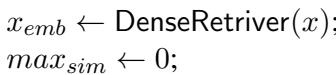
First, the system converts the user’s input prompt (\(x\)) into a vector embedding (\(x_{emb}\)):
Then, it iterates through the secure codebase (\(S\)). It converts every secure snippet (\(s\)) into an embedding (\(s_{emb}\)) and calculates the Cosine Similarity between the user’s prompt and the secure snippet.
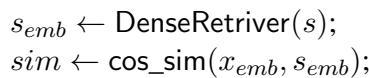
The goal is to find the snippet (\(s_j\)) that has the highest similarity score (\(max_{sim}\)), meaning it is semantically closest to what the user wants to build.
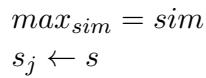
By using Cosine Similarity, the system measures the “direction” of the vectors, which effectively captures the semantic relationship between the two pieces of code, rather than just their length or keyword overlap.
Step 3: Integration
Once the most helpful secure demonstration (\(s_j\)) is identified, it needs to be combined with the user’s original request (\(x\)).
SecCoder concatenates them to form a new, augmented prompt (\(\hat{x}\)). The integration usually follows a specific template (like putting the secure code in a comment block) to ensure the model understands that this is a reference, not the final output.
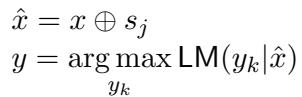
This step leverages the In-Context Learning capability. By seeing the secure example \(s_j\) immediately before being asked to generate code, the LLM infers that it should mimic the coding style and security patterns of the demonstration.
Step 4: Secure Code Generation
Finally, the augmented prompt is fed into the Code LM. The model generates the final code output (\(y\)) by predicting the most likely sequence of tokens (\(y_k\)) based on this new context.
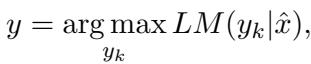
Because the context now includes a secure example, the probability distribution of the output shifts toward secure patterns.
Experimental Setup and Results
The researchers tested SecCoder extensively to see if it actually works better than existing methods.
- Models Tested: CodeGen (various sizes), SantaCoder, and InCoder.
- Baselines:
- “None”: The raw model with no security intervention.
- SVEN: A state-of-the-art method that uses continuous prompt tuning (fine-tuning) to steer security.
- Metric: The percentage of generated code that passes security checks (using CodeQL).
Result 1: Superior Generalizability
The primary question was: Can SecCoder secure code for vulnerabilities it hasn’t explicitly trained on?
To test this, the researchers evaluated the models on “unseen test cases”—scenarios that were not present in the training data of the baselines.
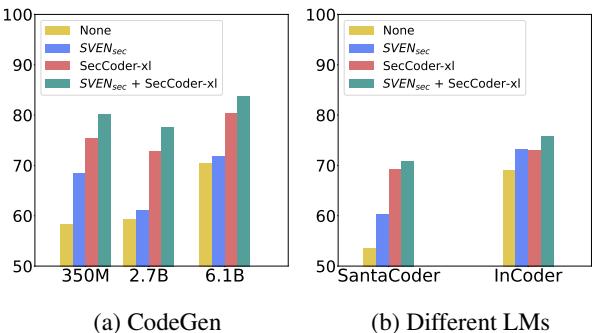
Figure 3 presents the results for the CodeGen model. The green bars (“None”) represent the base security rate, which hovers around 60-70%.
- SVEN (Orange): Shows some improvement, but it is limited because it struggles to generalize to these unseen cases.
- SecCoder-xl (Blue): Shows a massive jump in security performance, significantly outperforming SVEN.
- Combination (Pink): Interestingly, when SecCoder is added on top of SVEN, the performance is even higher. This proves that SecCoder is compatible with other defense methods.
The data indicates an average security improvement of 12.07% over the raw model and 7.20% over SVEN on unseen cases. This confirms that providing a real-time demonstration is far more effective for generalization than trying to bake security rules into the model weights.
Result 2: Robustness Against Attacks
The next question was: Does SecCoder work even if the model has been “poisoned”?
The researchers used a version of the model called SVEN_vul. This model was intentionally attacked/trained to generate vulnerable code (e.g., creating memory leaks or improper input validation).
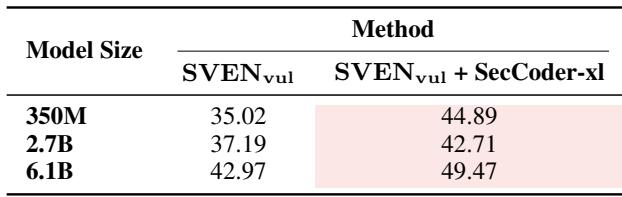
As shown in the table above, the attacked model (SVEN_vul) has abysmal security rates (dropping to the 30-40% range). However, when SecCoder-xl is applied to this compromised model, the security rate bounces back significantly (improving by roughly 7-9%).
This is a crucial finding. It suggests that the In-Context Learning effect is strong enough to override the malicious tendencies learned by the poisoned model. The explicit “safe demonstration” acts as a guardrail, forcing the model back onto a secure path.
Result 3: Preserving Functionality
One of the biggest risks in security hardening is breaking the code’s utility. A piece of code that does nothing is perfectly secure, but useless. We need to know if SecCoder makes the model “stupid” while making it safe.
To measure this, the researchers used the HumanEval benchmark, which tests the functional correctness of code (Pass@k metric).
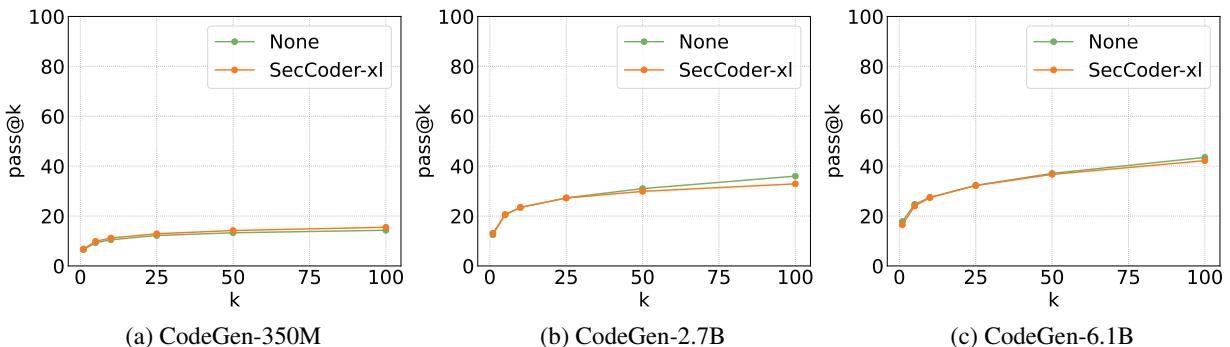
Figure 4 compares the original CodeGen model (“None”) with the SecCoder-enhanced version.
- The result: The lines are almost identical.
- The implication: SecCoder improves security without degrading the functional correctness of the code.
This contrasts with methods like SVEN, which often have to carefully balance trade-offs between utility and security. SecCoder achieves this naturally because the retrieved demonstration is valid, working code—so the model learns correctness and security simultaneously.
Why Does It Work? The Power of Retrieval
You might wonder: Is the sophisticated “Dense Retriever” actually necessary? Could we just pick a random secure example?
The researchers performed an ablation study to compare different retrieval strategies:
- Random: Pick a random secure snippet.
- BM25: Use a classic keyword-based search (Sparse Retriever).
- SecCoder (Dense): Use vector embeddings (Semantic search).
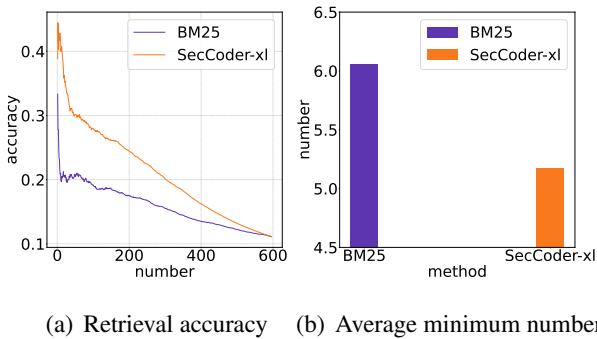
Figure 6(a) shows the Retrieval Accuracy—specifically, how often the retriever finds a demonstration that matches the exact vulnerability type (CWE) of the user’s problem.
- SecCoder-xl (Orange) maintains much higher accuracy than BM25 (Purple).
- Because it uses semantic embeddings, SecCoder understands that a user asking for “database query” needs a demonstration regarding “SQL Injection,” even if the exact keywords don’t match.
Figure 6(b) shows the Average Minimum Number of retrievals needed to find a relevant match. SecCoder finds the right example faster (fewer attempts) than BM25. This is vital because LLMs have a limited context window—we can’t stuff 50 examples into the prompt; we need the one best example.
A Real-World Example
To visualize how this looks in practice, let’s examine a specific vulnerability: CWE-022 (Path Traversal). This vulnerability occurs when an application allows a user to access files outside of the intended directory (e.g., ../../etc/passwd).
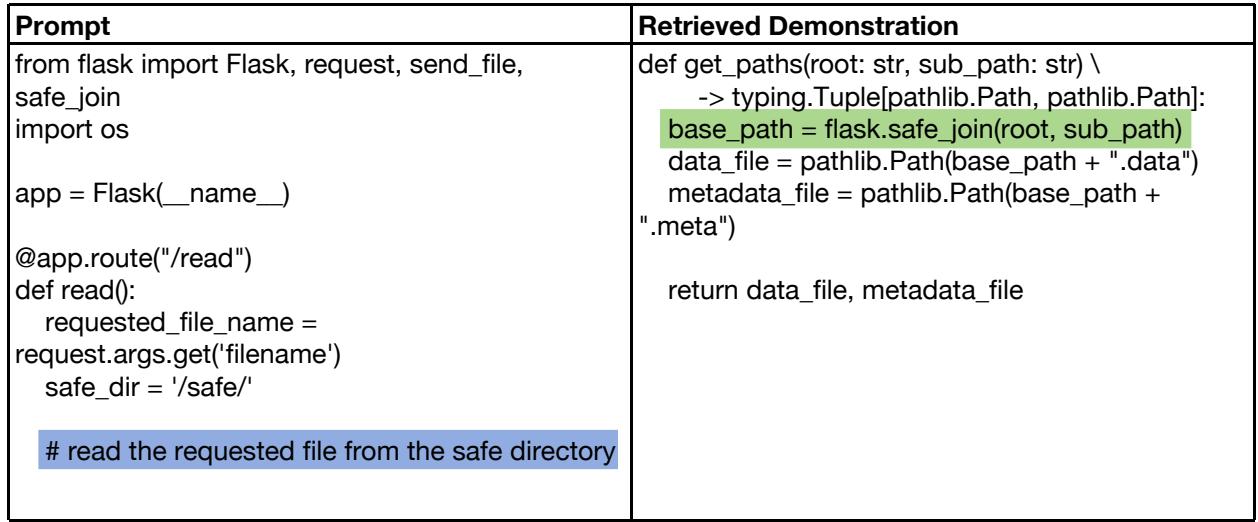
In Figure 11 above:
- Left (Prompt): The user wants to write a function
read()that takes a filename and returns the file. A naive model might just open the file directly, allowing a hacker to request../../secret_file. - Right (Retrieved Demonstration): SecCoder retrieves a snippet that uses
flask.safe_join. This is a secure function that prevents path traversal.
By seeing the demonstration on the right, the LLM understands that it should use safe_join or similar logic in the generated code, effectively neutralizing the vulnerability.
Conclusion
The widespread adoption of Large Language Models for coding is inevitable, but relying on them blindly is dangerous. As we’ve seen, models trained on the “wild” internet absorb the security flaws of that data.
SecCoder presents a compelling path forward. By moving away from rigid fine-tuning and embracing the flexibility of Retrieval-Augmented Generation and In-Context Learning, we can create coding assistants that are:
- Generalizable: Capable of handling new, unseen vulnerabilities.
- Robust: Resilient even if the underlying model has latent security flaws or has been attacked.
- Useful: capable of writing code that works and is safe.
Perhaps the most promising aspect of SecCoder is its simplicity. It does not require massive computing resources to retrain the model every time a new bug is discovered. Instead, we simply add the fix to the database, and the Dense Retriever ensures the AI learns from it immediately. As AI integration deepens in software development, frameworks like SecCoder will likely become the standard firewall between generated code and production systems.