](https://deep-paper.org/en/paper/2410.01490/images/cover.png)
Introduction
Imagine reading a mystery novel, but by the time you reach the final chapter, you’ve completely forgotten the clues introduced in the first few pages. This is the reality for many Large Language Models (LLMs). While models like LLaMA-2 are powerful, they are often trained with a fixed “context window” (e.g., 4,000 tokens). Ask them to process a 10,000-token document, and they hit a wall.
To solve this, researchers don’t want to retrain these massive models from scratch—it’s too expensive. Instead, they try to “stretch” the model’s existing capabilities to handle longer texts during inference. Common techniques involving Position Interpolation (PI) or methods like YaRN have made great strides, but they often rely on heuristics or “gut feelings” about which parameters to tweak.
In this deep dive, we are exploring a fascinating paper: “Extending Context Window of Large Language Models from a Distributional Perspective.” The researchers propose a theoretically grounded method to extend context windows by analyzing the distribution of rotary angles inside the model’s embedding layer.
The result? A smarter way to stretch the context window that outperforms existing methods on long-text benchmarks while keeping the model sharp on short tasks.
The Background: The Geometry of Language
To understand how this new method works, we first need to understand how LLMs know “where” a word is in a sentence. Unlike humans who read linearly, Transformers process tokens in parallel. They need a coordinate system.
Rotary Position Embedding (RoPE)
Most modern LLMs (including LLaMA) use Rotary Position Embedding (RoPE). Instead of just adding a number to a token to mark its position, RoPE rotates the token’s vector representation in a geometric space.
Mathematically, for a token at position \(m\), its vector is rotated by an angle \(m\theta\). The rotation matrix looks like this:
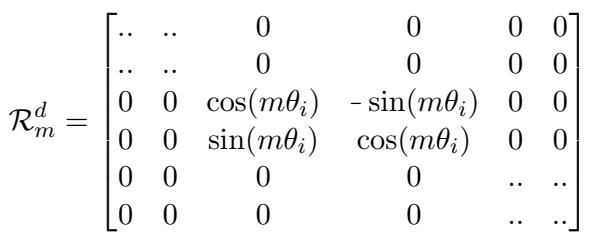
Here, \(\theta_i\) determines the frequency of rotation for different dimensions of the embedding. Some dimensions rotate very fast (high frequency), while others rotate very slowly (low frequency).
The Extension Dilemma: Interpolation vs. Extrapolation
When we want the model to read lengths longer than it was trained on (e.g., going from 4k to 8k tokens), we face a dilemma regarding these rotation angles.
- Direct Extrapolation: We just let the position index \(m\) keep growing (\(4001, 4002...\)).
- The Problem: The model has never seen these higher rotation values during training. It gets confused, and performance collapses.
- Position Interpolation (PI): We “squish” the new positions so they fit into the old range. If we want to double the length, we divide the position indices by 2.
- The Problem: While this keeps the positions bounded, it changes the distance between tokens. It introduces rotation angles that lie between the angles the model learned during training.
The researchers illustrate this trade-off beautifully in the following figure.
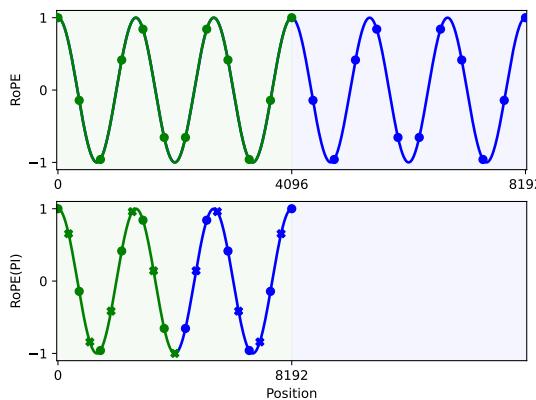
In the bottom graph (Interpolation), you can see the “cross points”—these are new rotary angles the model never encountered during pre-training. These are Out-Of-Distribution (OOD) angles.
The Core Insight: A Distributional Perspective
Existing methods like YaRN try to mix interpolation and extrapolation based on heuristics (e.g., “high-frequency dimensions should be extrapolated, low-frequency ones interpolated”). But the authors of this paper asked a deeper question: Can we mathematically prove which dimensions prefer which strategy?
They approached this by looking at the Rotary Angle Distribution.
During pre-training, the model sees a finite set of rotation angles. If we treat these angles as a probability distribution, we can visualize what the model “knows.” When we extend the context window, we change this distribution.
The authors discovered that different dimensions react differently to extension.
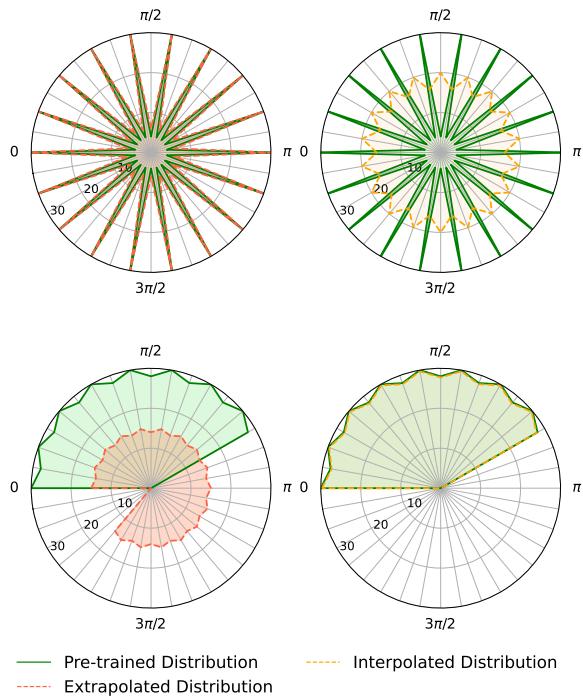
Look closely at Figure 1 above:
- Left (a): In this dimension, Extrapolation (dotted red) aligns perfectly with the Pre-trained distribution (solid green). Interpolation creates a messy, dense distribution the model isn’t used to.
- Right (b): In this dimension, Interpolation (dashed orange) preserves the structure better, while Extrapolation introduces chaos.
This visual evidence suggests there is no “one size fits all” strategy. We need to choose the best strategy per dimension.
The Method: Minimizing Disturbance
The researchers formalized a method to automatically select the best strategy for every single dimension in the model. The goal is to minimize the Distributional Disturbance—effectively keeping the new context window looking as familiar as possible to the pre-trained model.
Step 1: Discretizing the Angles
First, they estimate the distribution of angles. Since the angles are continuous, they chop the circle (\(0\) to \(2\pi\)) into \(b\) discrete intervals (buckets).
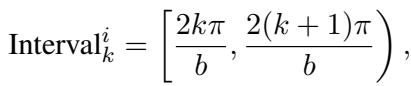
They then count the frequency of angles falling into these buckets during pre-training vs. extension.

This gives them a probability density function (\(P_L\)) representing what the model learned during training.

Step 2: Visualizing the Shift
To see this math in action, look at the frequency plots below. The “Pre-trained” line (orange/green) has specific spikes—these are the “safe zones” the model knows.
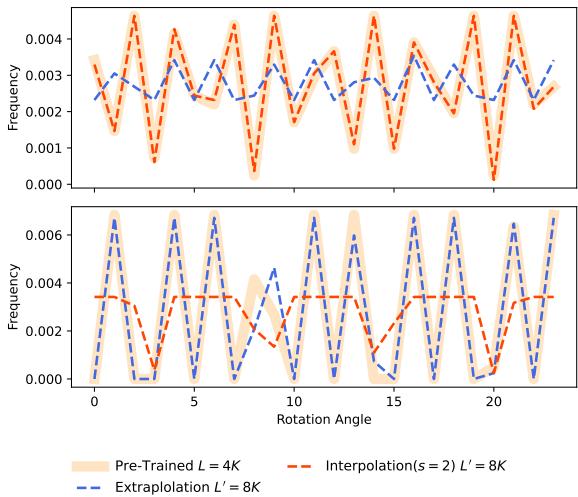
- Top Graph (6th Dimension): The Interpolated distribution (dashed) aligns reasonably well with the Pre-trained spikes.
- Bottom Graph (22nd Dimension): Interpolation introduces frequencies where the Pre-trained model had zero (OOD angles). This is bad news for model stability.
Step 3: Calculating Disturbance (KL Divergence)
To quantify exactly “how bad” an extension strategy is for a specific dimension, they calculate the Disturbance (\(\mathcal{D}\)). They use KL Divergence, a standard statistical measure of how much one probability distribution differs from another.
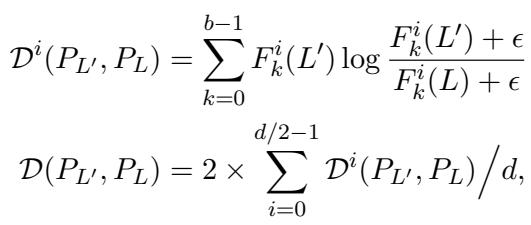
If \(\mathcal{D}\) is high, it means the new strategy (Interpolation or Extrapolation) is forcing the model to process angles it rarely or never saw before.
Step 4: The Selection Strategy
Finally, the algorithm makes a choice. For every dimension \(i\) in the embedding:
- Calculate Disturbance if we use Extrapolation.
- Calculate Disturbance if we use Interpolation.
- Pick the winner.

This results in a hybrid model where some dimensions are stretched (Interpolated) and others are extended (Extrapolated), optimized mathematically rather than guessed.
Experiments and Results
The theory sounds solid, but does it work? The researchers tested their method against the strongest baselines, including PI (Position Interpolation) and YaRN, on the LLaMA-2 family of models.
1. Long-Context Performance (LongBench-E)
They evaluated the models on LongBench-E, a benchmark designed to test understanding of long documents.
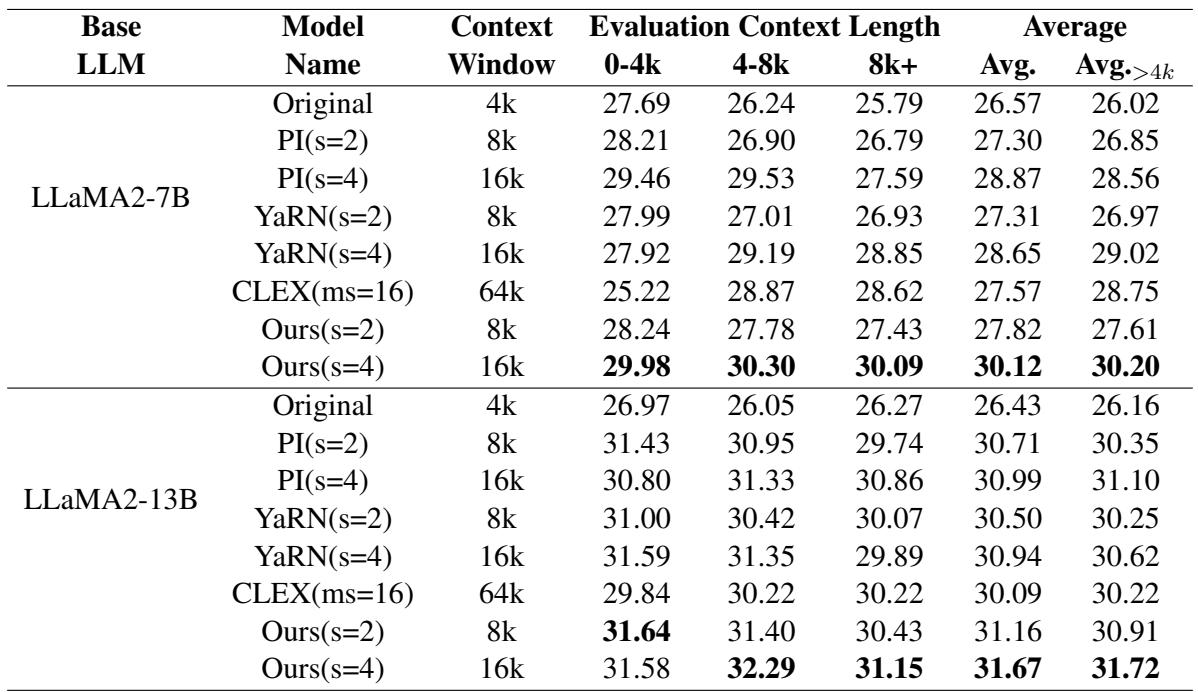
As shown in Table 1, the proposed method (“Ours”) consistently achieves the highest average scores.
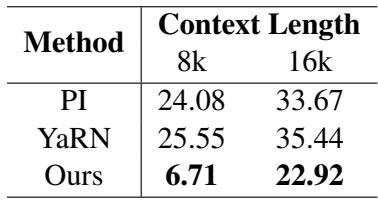
- 72% Reduction in Disturbance: When extending LLaMA2 to 8k, their method drastically reduced distributional shift compared to baselines.
- State-of-the-Art: It outperformed YaRN and PI, particularly in the “8k+” category, proving it handles the extreme lengths better.
2. The “Needle in a Haystack” Test
One of the toughest tests for a long-context model is Passkey Retrieval. The model reads a massive amount of garbage text, and hidden somewhere inside is a 5-digit passkey. It is then asked to retrieve it.
The results in Figure 4 (top chart in the image above) are striking.
- The Green Line (Ours, 16k) stays at 100% accuracy almost indefinitely.
- The baseline models (Blue/Orange) crash to 0% once the text gets too long.
This proves the model isn’t just processing text; it’s effectively attending to specific information over long distances without getting confused by the “noise” of extended positions.
3. Comparing Disturbance
Why did it perform better? The analysis confirms that performance is directly tied to minimizing that “Disturbance” metric we defined earlier.
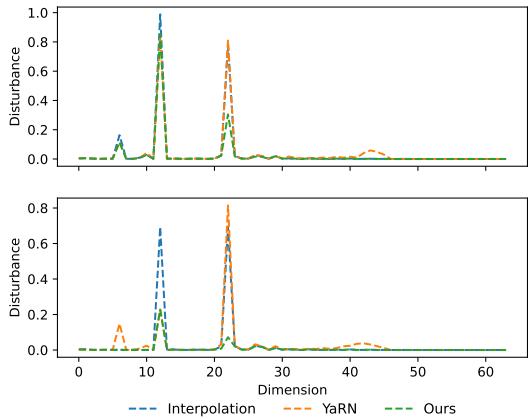
In Figure 8, the green line represents the proposed method. You can see it consistently maintains lower disturbance across dimensions compared to YaRN (orange) and PI (blue).
4. Does it Break Short Context?
A common failure mode in context extension is that the model becomes “dumber” on normal, short tasks. The researchers checked this using the standard Hugging Face Open LLM Leaderboard (TruthfulQA, MMLU, etc.).
Their method showed negligible performance fluctuation (-0.12 to +0.22). Essentially, you get the long context capabilities for free, without sacrificing the model’s core intelligence.
Why This Matters
This paper represents a shift from empirical engineering to theoretical understanding in the world of LLMs.
- Interpretability: Instead of asking “What hyperparameter works best?”, we are asking “What is the mathematical distribution of the embedding?”
- Generalization: Because the method relies on distribution analysis, it doesn’t need to be manually tuned for every new model architecture. It adapts based on the data.
- Performance: It simply works better. By respecting the geometry of the pre-trained model, we allow it to generalize to unseen lengths much more naturally.
Conclusion
The quest for infinite context windows is far from over, but “Extending Context Window of Large Language Models from a Distributional Perspective” provides a crucial stepping stone. By visualizing and minimizing the distributional shift of rotary angles, the authors have given us a robust, mathematically sound way to let LLaMA read longer books, analyze larger reports, and remember deeper conversations.
For students and researchers in NLP, the takeaway is clear: when in doubt, look at the distribution. The answers are often hidden in the geometry of the embeddings.