](https://deep-paper.org/en/paper/2410.01946/images/cover.png)
Every day, the scientific community publishes thousands of new papers. From quantum computing breakthroughs to novel epidemiological studies, the sheer volume of knowledge being generated is staggering. For researchers, digital libraries, and search engines, organizing this deluge of information is a massive challenge. We need automated systems that can read an abstract and instantly categorize it into precise topics—like “Cryptography” or “Software Engineering.”
Standard machine learning models can do this, but they usually require thousands of labeled examples to learn effectively. In rapidly evolving fields, we simply don’t have that much labeled data. Who has time to manually label 5,000 abstracts just to train a model to recognize a new sub-field of AI?
This brings us to a fascinating solution presented in the paper “SCIPROMPT: Knowledge-augmented Prompting for Fine-grained Categorization of Scientific Topics.” The researchers propose a framework that allows language models to classify complex scientific texts with very little data (few-shot) or even no data at all (zero-shot). They achieve this not by making the model larger, but by making it smarter—specifically, by injecting external domain knowledge into the prompting process.
In this deep dive, we will unpack how SCIPROMPT works, why standard methods fail at scientific jargon, and how this new approach bridges the gap between general language models and expert-level categorization.
The Background: Why Prompting?
To understand SCIPROMPT, we first need to understand the shift from “fine-tuning” to “prompting.”
Traditionally, if you wanted to classify text using a model like BERT, you would add a classification layer on top of the model and train it on a labeled dataset. This is effective but data-hungry.
Recently, researchers have pivoted to Prompt-based Fine-tuning. Instead of changing the model structure, we rephrase the task as a “cloze” (fill-in-the-blank) test, which is exactly how these models were pre-trained.
For example, to classify a movie review, you might feed the model:
“This movie was terrible. The sentiment of this review is [MASK].”
The model (Masked Language Model or MLM) then tries to predict the word at the [MASK] position. If it predicts “bad,” we map that to the “Negative” class. If it predicts “good,” we map it to “Positive.”
The Problem with Science
This method works famously well for simple sentiment analysis. However, it hits a wall with scientific literature.
Scientific categorization is fine-grained. Identifying a paper as “Computer Science” is easy; identifying it as “Cryptanalysis” versus “Information Theoretic Security” is hard.
The core component that bridges the model’s predicted word (the token) and the actual class label is called the Verbalizer.
- Label: “Cryptography”
- Verbalizer: Maps the word “crypto”, “encryption”, or “secret” \(\rightarrow\) “Cryptography” class.
In standard approaches, these verbalizers are often handcrafted. But in science, manual mapping is impossible. A paper on “Cryptography” might contain terms like Hill cipher, symmetric encryption, or ciphertext. If the verbalizer doesn’t know these specific terms map to “Cryptography,” the model fails.
This is where SCIPROMPT enters the picture. Instead of asking humans to write lists of keywords for every scientific field, SCIPROMPT automates the creation of a “Knowledge-Augmented Verbalizer.”
The SCIPROMPT Method
The framework is designed to operate in low-resource settings (few-shot or zero-shot). It operates in two main phases: Scientific Knowledge Retrieval and Model Prediction.
Let’s look at the high-level architecture of the system:
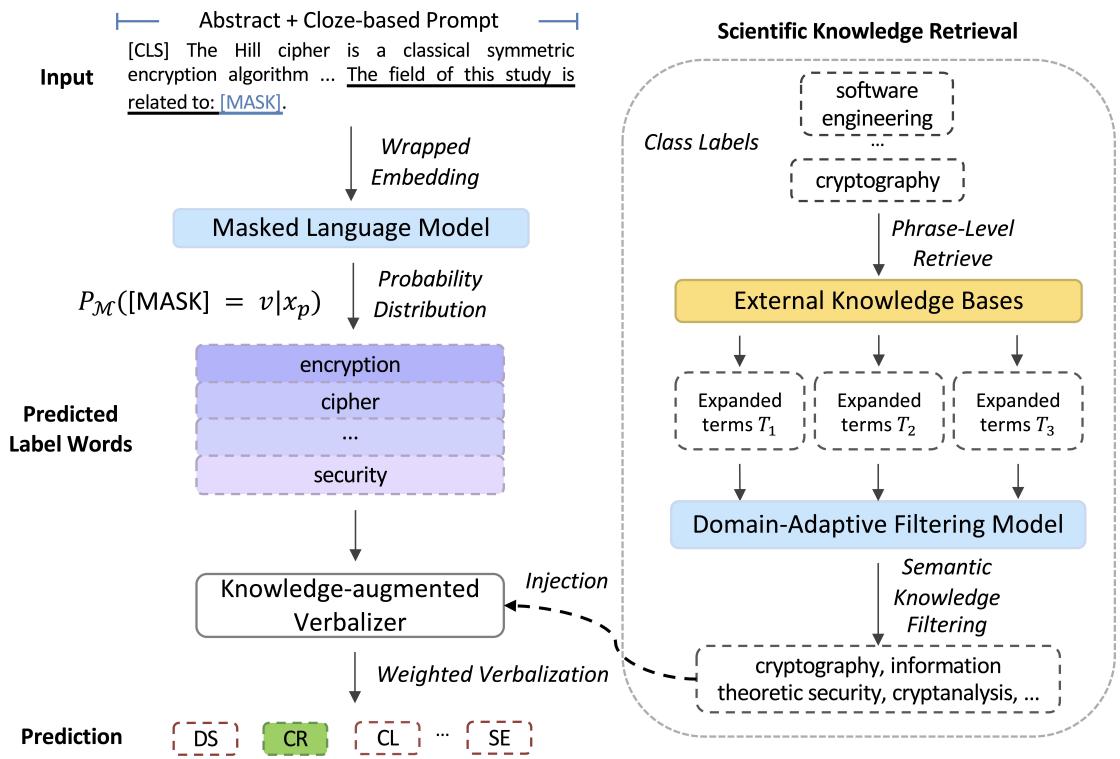
As shown in Figure 1, the left side represents the standard prompt interaction with the language model. The right side represents the novel contribution: a pipeline to retrieve and filter scientific terms to help the model make better decisions.
Let’s break down the three distinct stages of this method.
Stage 1: Scientific Knowledge Retrieval
The first step is to expand the model’s vocabulary regarding a specific topic. If the class label is “Cryptography,” the model needs to know that “decryption” and “cipher” are related synonyms or sub-concepts.
The researchers use the class labels as queries to search external knowledge bases (KBs). They utilize two specific sources:
- Related Words: Finds terms based on vector similarity (like Word2Vec) and ConceptNet.
- Reverse Dictionary: A search engine that finds words based on definitions. This is crucial for finding phrases (e.g., “Networking and Internet Architecture”) that simple synonym lookups might miss.
This step generates a raw list of “Label Terms”—potential candidates to populate the verbalizer.
Stage 2: Domain-Adaptive Filtering
Retrieval is noisy. If you search for terms related to “Network,” you might get “social network,” “neural network,” and “computer network.” For a paper on distributed computing, “social network” is noise.
To clean up the retrieved terms, the authors employ a filtering mechanism using Natural Language Inference (NLI). NLI is a task where a model determines if one sentence entails (implies) another.
They use a dataset called SciNLI to fine-tune two types of models:
- Bi-encoder (\(M_{be}\)): This converts sentences into embeddings (vectors). It is fast and used for an initial semantic search to calculate similarity scores between the class label and the retrieved terms.
- Cross-encoder (\(M_{ce}\)): This processes pairs of sentences together. It is computationally heavier but much more accurate. It re-ranks the terms to ensure they are contextually relevant.
The filtering process is essentially a binary classification task for the NLI model:

Terms that don’t meet a specific similarity threshold are discarded. The result is a curated list of high-quality, domain-specific phrases for each class label.
Stage 3: Weighted Verbalization
Now that the system has a rich, filtered list of terms (e.g., for “Cryptography” it has {encryption, cipher, security…}), it needs to use them to classify a new abstract.
The system uses a Cloze-style Prompt. An abstract \(a_n\) is fed into the model with a template:
“[Abstract]. The field of this article is related to: [MASK].”
The Masked Language Model (\(\mathcal{M}\)) predicts a probability distribution for words to fill the mask.
Calibration
Before making a final decision, the system applies calibration. This is a statistical trick to remove bias. Some words are just naturally more common than others, regardless of context. The system adjusts the probability of a predicted term by dividing it by its “prior” probability (how often it appears generally).

The Final Prediction
The core innovation in the prediction phase is the Weighted Verbalizer. In traditional methods, every word in the verbalizer counts equally. In SCIPROMPT, the terms are weighted based on the semantic similarity scores calculated during the filtering stage (\(w_l\)).
This means if the model predicts “cipher,” and “cipher” is highly correlated with “Cryptography,” it pushes the classification strongly toward that class.
The probability of a specific class \(y_i\) is calculated using the following equation:
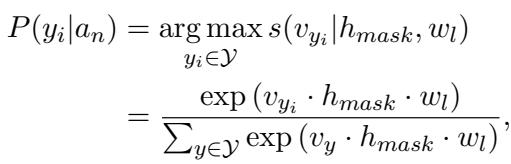
Here, \(v_{y_i}\) represents the label term embeddings, \(h_{mask}\) is the hidden state of the [MASK] token, and \(w_l\) is the semantic weight.
SCIPROMPT-Soft: Vector-Based Mapping
The authors also introduce a variant called SCIPROMPT-Soft. Instead of mapping discrete words to classes, this method aggregates all the retrieved label terms into a single vector representation for the class. It optimizes this vector during training, allowing for a “softer,” more flexible boundary between classes.
Experiments and Results
The researchers tested SCIPROMPT against several baselines, including:
- Fine-tuning SciBERT: The standard (non-prompt) approach.
- Prompt-tuning (Manual): Using just the class name as the verbalizer.
- KPT (Knowledgeable Prompt-tuning): A state-of-the-art general domain method.
They used three major scientific datasets: SDPRA 2021 (CS papers), arXiv (53 sub-categories), and S2ORC (19 disciplines).
Few-Shot Performance
In “few-shot” learning, the model sees only \(K\) examples per class (where \(K\) is 1, 5, 10, etc.).
The results, detailed in Table 1 below, show that SCIPROMPT consistently outperforms the baselines.
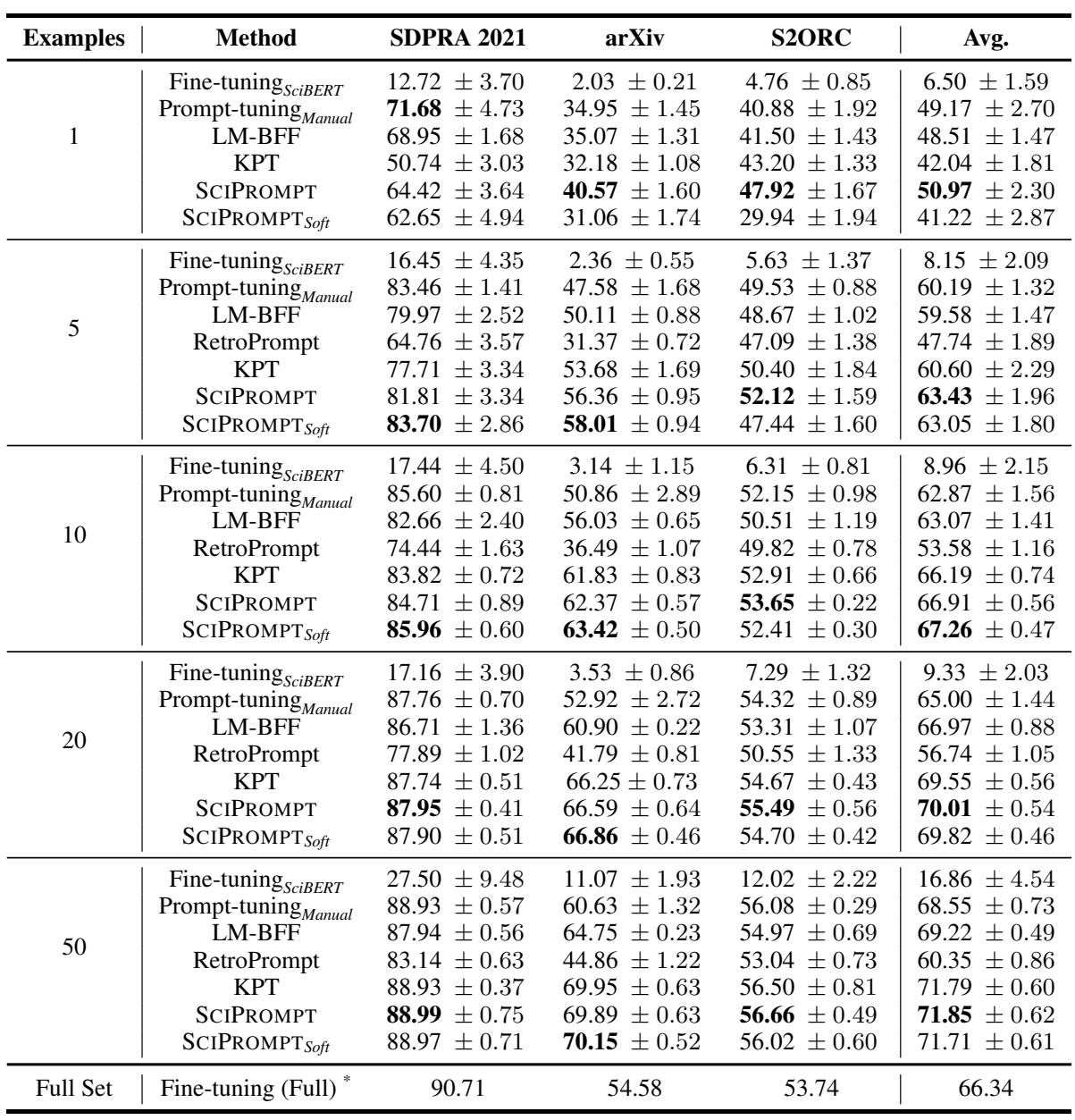
Key Takeaways from Table 1:
- Low Resource Dominance: In the 1-shot setting (where the model sees only ONE example per class), SCIPROMPT beats the standard KPT method by nearly 9% on average. This is a massive margin in machine learning.
- Stability: As the number of shots increases (5, 10, 20), SCIPROMPT maintains its lead.
- Soft vs. Hard: The “Soft” variant (SCIPROMPT-Soft) performs comparably to the main method, excelling in the SDPRA dataset but trailing slightly in others.
To visualize the stability of these methods, the authors analyzed the distribution of accuracy across different runs.
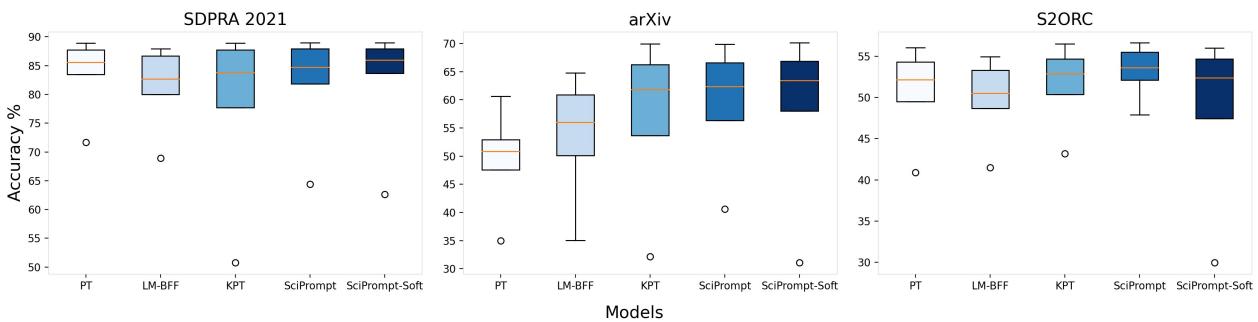
Figure 2 highlights that not only is SCIPROMPT more accurate on average, but it is also less volatile. Standard Prompt Tuning (PT) shows a wide variance (tall boxes), meaning it’s hit-or-miss depending on which random training examples you pick. SCIPROMPT is robust.
Zero-Shot Performance
What if we give the model zero training examples?
The researchers compared SCIPROMPT against massive Large Language Models (LLMs) like Llama 2 (70 Billion parameters), ChatGPT, and Llama 3. SCIPROMPT uses SciBERT, which is significantly smaller (millions of parameters, not billions).
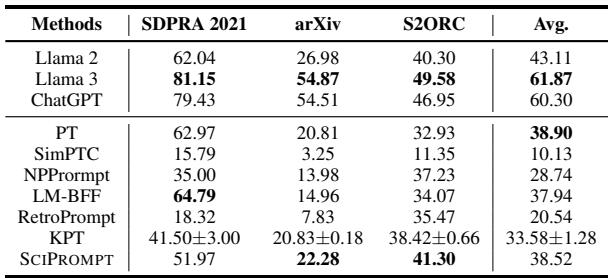
Amazingly, SCIPROMPT outperforms Llama 2 (70B) on the arXiv and S2ORC datasets in zero-shot settings. While Llama 3 eventually pulls ahead due to its sheer size and advanced training, the fact that a specialized, knowledge-augmented small model can punch this far above its weight class is impressive.
The Challenge of Emerging Topics
Science changes fast. New fields emerge that didn’t exist when a model was pre-trained. The authors created a dataset called Emerging NLP, focusing on topics like “Prompt Engineering” or “Large Language Models”—terms that SciBERT (trained years ago) wouldn’t naturally know.
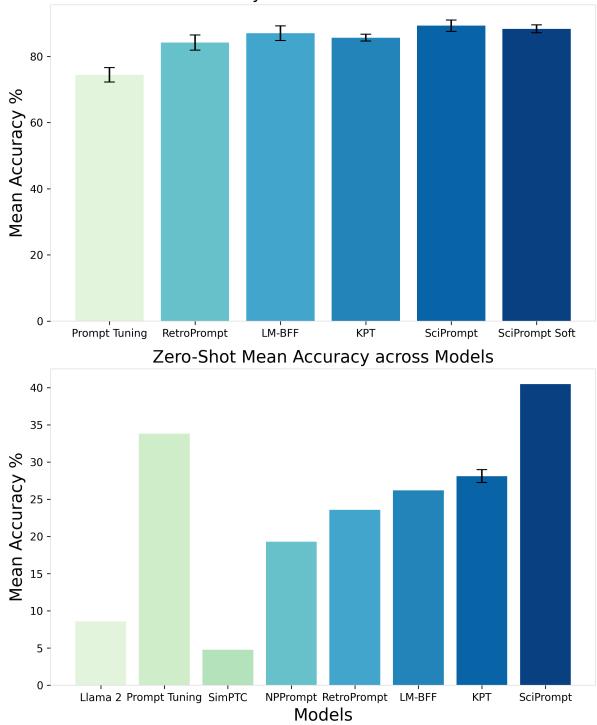
Figure 3 shows a dramatic victory. In the zero-shot setting for emerging topics, SCIPROMPT outperforms standard prompt tuning by over 6%. This proves that the Retrieval component works: the model pulls in updated knowledge from the external databases to “learn” what these new topics mean on the fly.
Efficiency
Finally, a note on computational cost. Running Llama 2 70B requires massive GPU clusters. SCIPROMPT is designed to be lightweight.
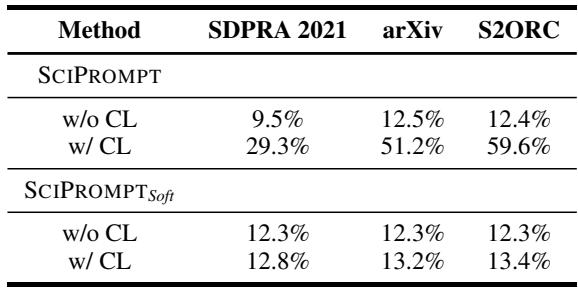
As shown in Table 4, the methods are GPU-efficient. SCIPROMPT-Soft, in particular, reduces memory usage significantly compared to the standard version because it optimizes vectors rather than managing a massive list of discrete label terms.
Why This Matters
The SCIPROMPT paper demonstrates a crucial concept in modern AI: Context is King.
We don’t always need bigger models (with their massive environmental and financial costs) to solve hard problems. Sometimes, we just need to provide the right context. By treating scientific classification not just as a pattern-matching task, but as a knowledge retrieval task, the researchers enabled a small model to understand complex, fine-grained, and emerging scientific fields.
This approach—combining specific external knowledge (verbalizers) with powerful pre-trained models—paves the way for automated systems that can keep up with the breakneck speed of scientific discovery. Whether it’s organizing preprint servers or helping researchers find relevant prior work, knowledge-augmented prompting offers a smarter, more efficient path forward.