](https://deep-paper.org/en/paper/2410.02089/images/cover.png)
Writing code is rarely a linear process. You write a function, run it, see an error message, stare at the screen, and then iterate. This loop—coding, executing, analyzing feedback, and refining—is the heartbeat of software development.
However, Large Language Models (LLMs) have historically struggled with this loop. While they are proficient at “one-shot” code generation (writing a solution in a single go), they are notoriously bad at fixing their own mistakes. When an LLM generates buggy code, simply pasting the error message back into the prompt often leads to a “death spiral” where the model doubles down on the error or introduces new bugs. In fact, prior research has shown that it is often more effective to just ask the model to generate a completely new solution from scratch (independent sampling) rather than asking it to fix the previous one.
This brings us to a new paper from Meta AI: “RLEF: Grounding Code LLMs in Execution Feedback with Reinforcement Learning.”
The researchers propose a method to teach models how to actually use compiler feedback and test results to improve their code. By training the model end-to-end using Reinforcement Learning (RL), they achieved state-of-the-art results on competitive programming benchmarks, drastically reducing the computational cost required to find a correct solution.
In this post, we will dissect the RLEF method, explore the architecture behind the training loop, and analyze why this approach marks a significant shift from prompt engineering to genuine model grounding.
The Problem: Hallucinating Solutions vs. Grounded Debugging
To understand why RLEF is necessary, we must first look at how “AI Agents” for coding are typically built today.
The Status Quo: Prompt Engineering and Scaffolding
Most current state-of-the-art coding systems (like AlphaCodium or MapCoder) rely on heavy “scaffolding.” This involves a complex, pre-programmed workflow where the LLM is prompted to:
- Generate a plan.
- Generate code.
- Generate tests.
- Run the code.
- If it fails, use a specific prompt template to ask for a fix.
While effective, these systems are fragile. They rely on the inherent capabilities of a frozen base model (like GPT-4). If the model hasn’t been explicitly trained to interpret a specific type of stack trace or logic error, no amount of clever prompting will make it a master debugger. Furthermore, these systems are expensive. They often require sampling dozens or hundreds of solutions to find one that works (a metric known as pass@k, where k is the sample budget).
The Goal: Efficient Self-Repair
The authors of RLEF posit that a decision-making agent needs two specific skills:
- Instruction Following: Deducing user intent (which standard LLMs are good at).
- Grounding in Feedback: Utilizing intermediate results (like error messages) to guide the next step.
The goal of this paper is to move away from complex manual scaffolding and instead fine-tune the model to be inherently good at the iterative debugging loop.
The RLEF Method
The core contribution of this paper is a framework called Reinforcement Learning with Execution Feedback (RLEF). Instead of just training the model to predict the next token in a correct code snippet (standard Supervised Fine-Tuning), they train the model to navigate a multi-turn conversation where it receives feedback from a compiler.
1. The Iterative Environment
The researchers treat code synthesis not as a translation task (text-to-code), but as a Markov Decision Process (MDP)—a sequence of decisions and states.
Here is how the environment works:
- Observation (\(o_0\)): The model receives a natural language problem description.
- Action (\(a_0\)): The model generates a code solution.
- Execution: The code is run against a set of Public Tests.
- Feedback: If the code fails, the error message (stderr, stack trace, or failed test case info) is formatted into text and fed back to the model as a new observation.
- Loop: The model generates a refined solution (\(a_1\)).
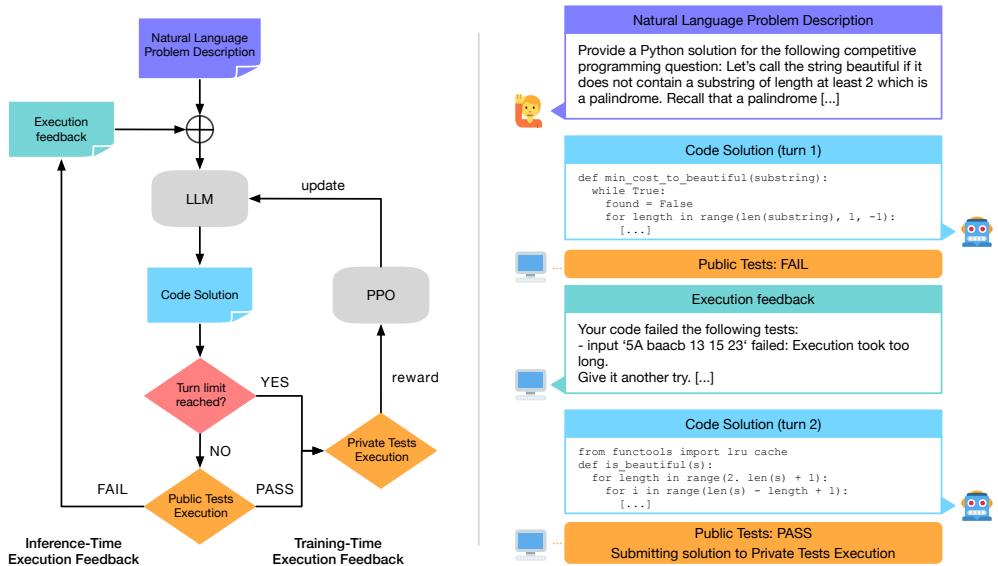
As shown in Figure 2 above, this process creates a dialog history. On the left, we see the flow: the model proposes code, the environment (sandbox) runs it, and feedback loops back. On the right, we see a concrete example. The model writes a solution that is too slow (Time Limit Exceeded). The feedback explicitly states this. The model then “realizes” it needs a more efficient approach (using a cache) and rewrites the code.
2. The Test Set Split: Public vs. Private
A critical detail in this methodology is the separation of test cases.
- Public Tests: These are visible to the agent. The feedback provided during the conversation comes only from these tests.
- Private Tests: These are held-out tests that the agent never sees feedback from during the episode.
Why is this important? If the model received feedback on all tests, it could learn to “cheat” by hard-coding edge cases to satisfy specific inputs without actually solving the general logic of the algorithm. By rewarding the model only if it passes the private tests at the end, the researchers ensure the model learns robust general solutions.
3. The Reinforcement Learning Setup (PPO)
The authors use Proximal Policy Optimization (PPO), a standard algorithm for RLHF (Reinforcement Learning from Human Feedback), but adapted here for Execution Feedback.
The training process involves two models:
- Policy Model (\(\pi\)): The LLM being trained to generate code.
- Value Model (\(V\)): A model that predicts how likely the current conversation state is to lead to a correct solution.
The Reward Function
The reward signal is the most critical component of any RL system. In RLEF, the reward is sparse—meaning the model mostly gets a signal only at the very end of the conversation.
The reward function \(R(s_t, a_t)\) is defined as follows:

Let’s break down this equation:
- Success (+1): The model gets a reward of +1 only if, at the end of the episode, the code passes all tests (both public and private).
- Failure (-1): It gets -1 if any test fails at the end of the episode.
- Invalid Code Penalty (-0.2): If the model generates gibberish that isn’t even valid Python code during intermediate steps, it gets a small slap on the wrist. This prevents the model from wasting turns.
- KL Penalty (\(\beta \dots\)): This standard term in RL training prevents the model from drifting too far away from its original training distribution (the “reference model” \(\rho\)). It ensures the model doesn’t start outputting weird text just to game the reward metric.
The “Turn-Level” Value Function
Standard PPO often trains the value function to predict the value of every single token. However, in coding, a specific token (like def or import) doesn’t have intrinsic value; the value comes from the completed program.
The researchers used a hybrid approach:
- Policy: Optimized at the token level (standard for LLMs).
- Value Function: Predicts the value of the whole turn based on the last token of the prompt.
- Advantage: The “advantage” (how much better an action was than expected) is calculated once per response and applied to all tokens in that response.
This effectively tells the model: “This entire block of code you just wrote led to a success, so make all the tokens that comprise it more likely.”
Experiments and Results
The team benchmarked their method on CodeContests, a challenging dataset of competitive programming problems (similar to LeetCode hard or Codeforces). These problems are significantly harder than standard benchmarks like HumanEval.
They used Llama 3.1 (8B and 70B parameters) as their base models.
State-of-the-Art Performance
The results were impressive. RLEF allowed the models to outperform previous state-of-the-art systems while using a fraction of the inference budget.
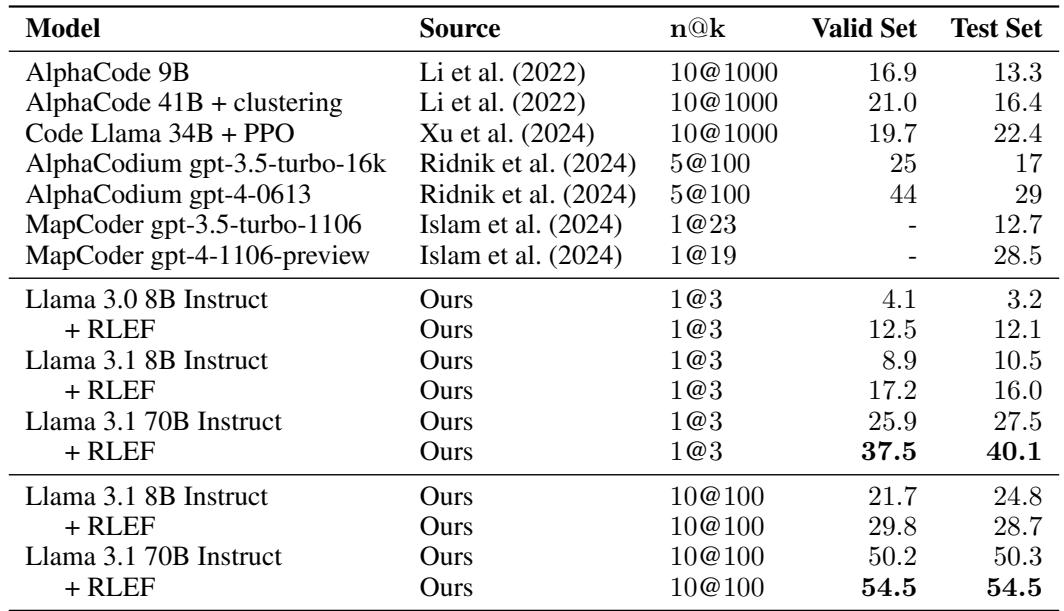
Looking at Table 1 (above), we can see several key comparisons:
- Sample Efficiency: The metric
1@3means “one correct solution found within 3 attempts.” The Llama 3.1 70B model with RLEF achieved a 37.5% solve rate on the validation set, beating the massive AlphaCode 2 estimates (using much fewer samples) and crushing AlphaCodium (which used GPT-4). - Massive Gains: The 8B model’s performance jumped from 4.1% (base instruct) to 12.5% (RLEF). The 70B model jumped from 25.9% to 37.5%.
- Beating GPT-4 Scaffolds: The RLEF 70B model (1@3) outperformed MapCoder using GPT-4-Turbo (1@19). This proves that a specialized, fine-tuned open-weight model can beat a massive proprietary model that relies on prompt engineering.
Efficiency and Scaling
One of the most compelling arguments for RLEF is inference efficiency. Many agentic frameworks require hundreds of calls to the LLM to solve a hard problem. RLEF is designed to work with a small budget (e.g., 3 turns).
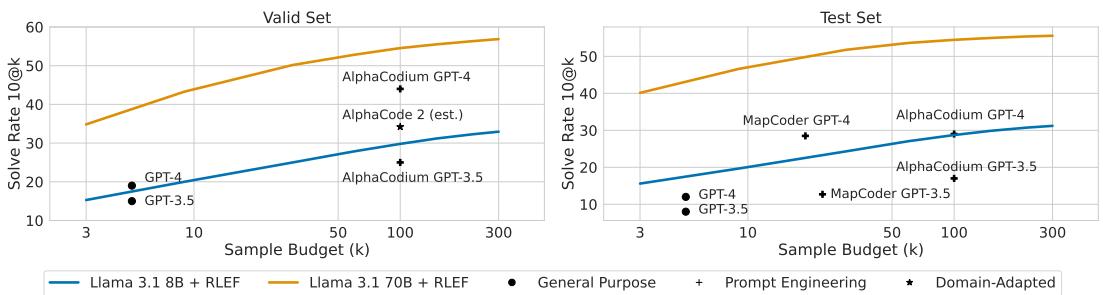
Figure 1 illustrates the solve rate against the sample budget (k).
- The Orange Line (70B + RLEF) sits well above the data points for GPT-4 and AlphaCodium (stars and circles).
- Even at low budgets (left side of the x-axis), RLEF maintains high performance. This implies the model isn’t just “guessing” more; it is guessing smarter.
Does the Model Actually “Debug”?
A skeptic might ask: Is the model actually using the feedback to repair code, or is it just sampling a diverse set of random solutions and getting lucky?
To test this, the authors analyzed the “edit distance” (how much the code changes) and the success rate of repairs.
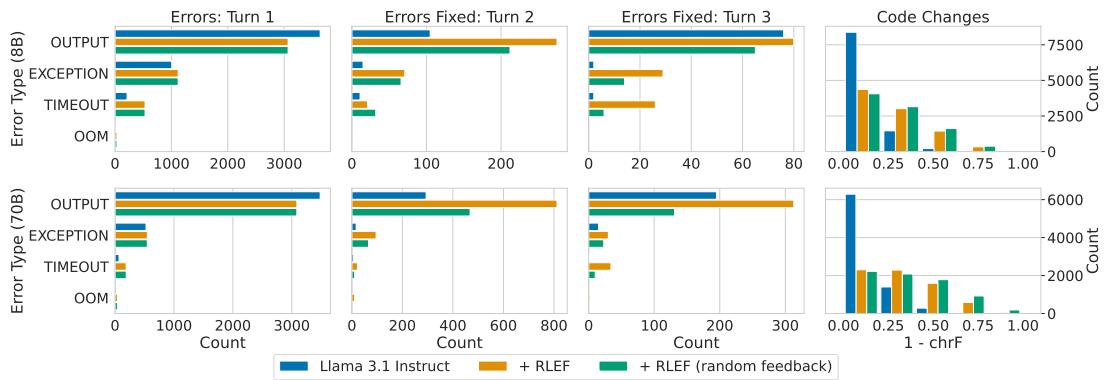
Figure 3 provides a fascinating look into the model’s behavior:
- Errors Decrease (Top Left): The number of errors (Output, Exception, Timeout) drops significantly in Turn 2 and Turn 3 for the RLEF model (Orange bars) compared to the base model (Blue bars).
- Code Changes (Top Right): The “chrF” graph measures similarity between consecutive code generations.
- The Blue bars (Base model) cluster at 1.0, meaning the base model often ignores feedback and outputs the exact same code again.
- The Orange bars (RLEF) show a distribution of changes. The model is actively rewriting sections of the code to address errors.
The “Random Feedback” Ablation
The ultimate proof of grounding came from an ablation study where the researchers provided Random Feedback—fake error messages from completely unrelated problems—to the model.
If the model was just ignoring feedback and guessing, random feedback shouldn’t hurt it much.
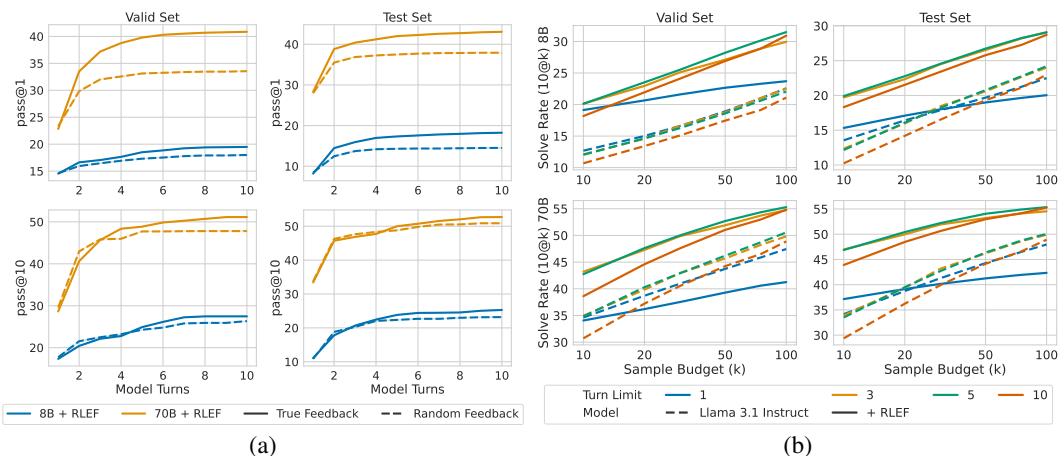
As shown in Figure 4(a):
- Solid Line (True Feedback): Performance increases as the model is allowed more turns (from 2 to 10). It converges toward a correct solution.
- Dotted Line (Random Feedback): Performance flatlines or drops. The model tries to “fix” bugs that don’t exist, breaking its own valid logic.
This confirms that RLEF produces models that pay close attention to the specific error messages they receive.
Conclusion and Implications
The RLEF paper demonstrates a pivotal shift in how we build coding agents. Rather than treating LLMs as static text generators that need to be coaxed into working via complex prompt chains, we can treat them as learnable agents.
By exposing the model to the execution environment during training—not just during inference—the model internalizes the dynamics of coding. It learns that a TimeoutError requires an algorithmic change (like adding a cache), while a SyntaxError requires a surface-level fix.
Key Takeaways:
- Training > Prompting: Fine-tuning with RL on execution feedback yields better results than complex prompt engineering with superior base models (GPT-4).
- Sample Efficiency: RLEF allows models to solve problems with far fewer generations, reducing the cost and latency of AI coding assistants.
- True Grounding: The models genuinely learn to utilize error messages, evidenced by their failure when provided with fake feedback.
For students and researchers, RLEF highlights the potential of moving beyond “Next Token Prediction” loss. When we optimize specifically for the outcome (passing tests) rather than the process (imitating human text), we unlock capabilities that mimic genuine reasoning and self-correction. As execution environments become more integrated into LLM training pipelines, we can expect AI agents to become not just writers of code, but competent maintainers and debuggers of it as well.