](https://deep-paper.org/en/paper/2410.02184/images/cover.png)
Introduction
In the rapidly evolving landscape of Artificial Intelligence, code generation has become one of the “killer apps.” Tools like GitHub Copilot and ChatGPT have transformed how developers write software, churning out functions, classes, and even entire applications in seconds. But this capability introduces a critical, often overlooked bottleneck: Evaluation.
How do we know if the code an AI writes is actually good?
Historically, we’ve relied on two main methods: running the code against unit tests (which requires writing those tests first) or comparing the text of the code to a “correct” reference solution (using metrics like BLEU). Both methods have severe limitations. Real-world tasks often lack test cases, and correct code can be written in a thousand different ways, making text comparison unreliable.
Enter CODEJUDGE.
In a recent paper, researchers introduced a new framework that fundamentally changes how we grade AI-generated code. Instead of relying on rigid test cases or surface-level text matching, CODEJUDGE leverages the reasoning capabilities of Large Language Models (LLMs) themselves. By forcing an evaluator model to engage in “slow thinking”—a step-by-step analysis mimicking a human code review—CODEJUDGE achieves state-of-the-art performance in assessing code correctness.
In this post, we will tear down the limitations of current evaluation metrics, explore the “slow thinking” architecture of CODEJUDGE, and look at the data proving why this might be the future of automated code review.
The Evaluation Bottleneck
To understand why CODEJUDGE is necessary, we first need to look at why existing methods are failing.
The Problem with Test Cases
The gold standard for checking code is pass@k—generating \(k\) solutions and seeing if any of them pass a suite of unit tests. While accurate, this is expensive and rigid. It requires a human to write comprehensive test cases for every single problem. In domains like web scraping, UI design, or object serialization, setting up the “test harness” (mocks, stubs, environment) is often harder than writing the actual code. If you don’t have test cases, you can’t use this metric.
The Problem with Text Matching
When test cases aren’t available, researchers often fall back on token-based metrics like BLEU or CodeBLEU. These metrics compare the AI-generated code to a “Ground Truth” reference code, calculating similarity based on overlapping words or n-grams.
The issue? Code is not natural language.
Consider a simple task: “Sort a list of words.”
- Solution A might use a
forloop and a bubble sort. - Solution B might use a built-in
.sort()method. - Solution C might use a functional map/reduce approach.
All three are semantically correct, but they look completely different textually. A token-based metric might look at Solution C, see that it shares very few words with Solution A (the reference), and grade it as “wrong.” Conversely, it might give a high score to code that looks like the reference but contains a critical bug (like an infinite loop).
The researchers highlighted this failure clearly. They compared various metrics against human judgment on different code snippets.
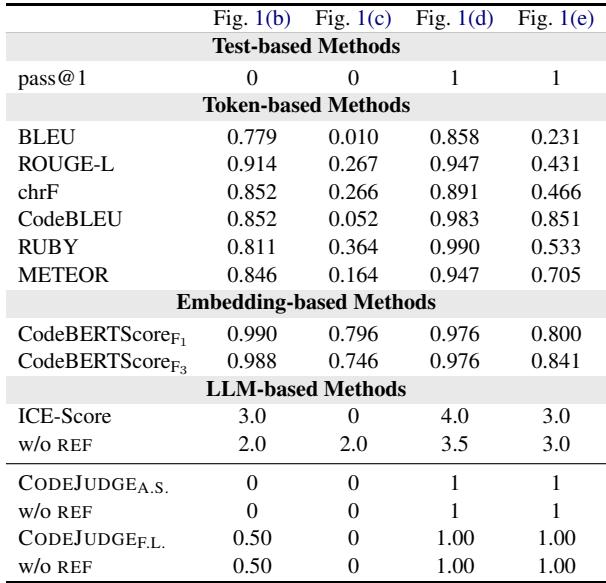
As shown in Table 1 above, look at the column for Fig. 1(e). This represents code that is “Correct code with a different implementation.”
- BLEU gives it a score of
0.231(very low). - CodeBLEU gives it
0.851. - CODEJUDGE (the proposed method) correctly identifies it as a
1(Correct).
Conversely, look at Fig. 1(b), which is “Partially correct code.” Traditional metrics give it very high scores (e.g., CodeBERTScore gives it 0.990), essentially failing to punish the error. CODEJUDGE correctly identifies it as flawed (0 or 0.50 depending on the mode).
The CODEJUDGE Solution: System 2 Thinking
The core insight of CODEJUDGE is that evaluating code requires reasoning, not just matching. It draws inspiration from Daniel Kahneman’s concept of “Thinking, Fast and Slow.”
- Fast Thinking (System 1): Intuitive, immediate. (e.g., “This code looks about right.”)
- Slow Thinking (System 2): Analytical, logical, step-by-step. (e.g., “Let’s trace the variable
xthrough this loop to see if it causes an index error.”)
Existing LLM-based evaluators often fall into the “Fast Thinking” trap. They are prompted to simply “Rate this code from 1 to 5,” which encourages hallucinations and shallow assessment. CODEJUDGE forces the LLM to use System 2 thinking through two distinct evaluation workflows.
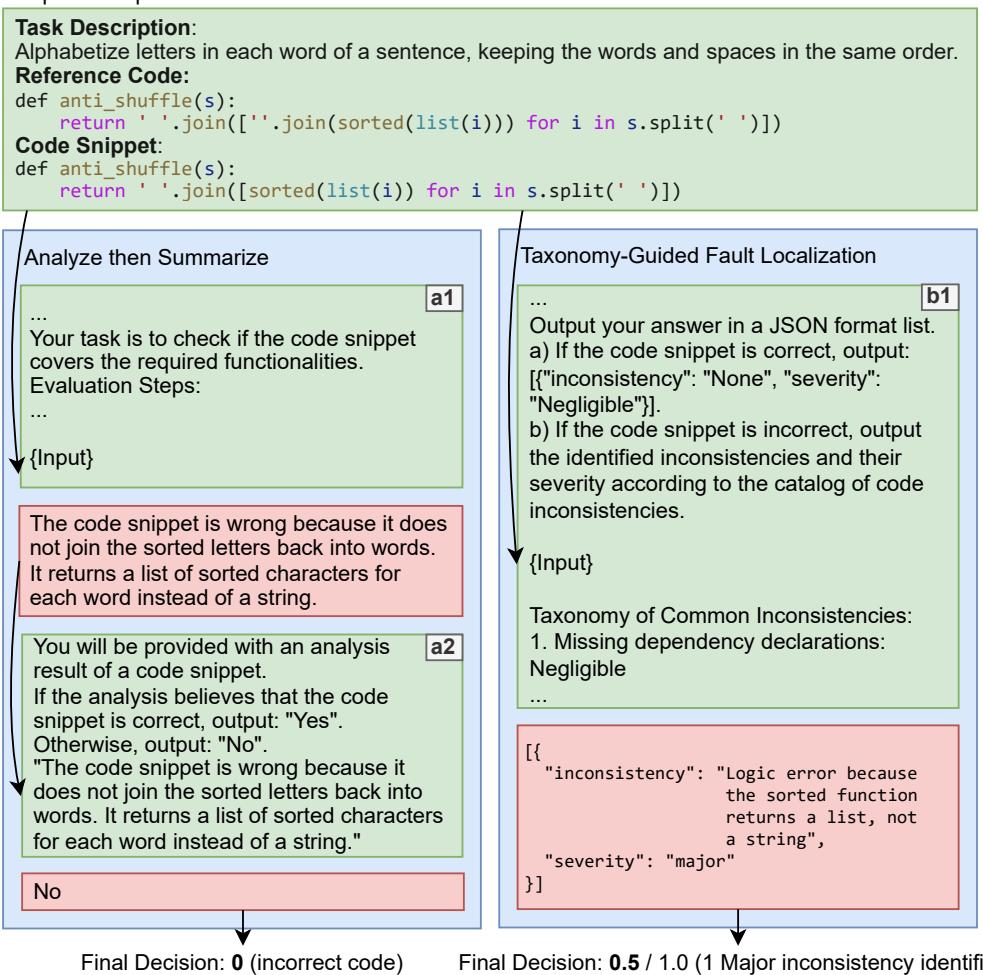
As illustrated in Figure 2, the framework splits the evaluation into structured steps. Let’s break down the two main modes of operation.
1. Analyze then Summarize (Binary Evaluation)
This mode is designed to answer a simple question: Is the code correct? (Yes/No).
Instead of asking for the answer immediately, CODEJUDGE decomposes the task:
- Analysis Subtask: The model is provided with the task description and the generated code (and optionally a reference solution). It is instructed to perform a step-by-step analysis. It must identify required functionalities and examine the logic line-by-line.
- Summarization Subtask: The model takes its own analysis from step 1 and summarizes it into a final binary decision.
This mirrors how a human senior engineer conducts a code review. They don’t just say “LGTM” (Looks Good To Me) immediately; they explain why it looks good or bad first, then make the decision. This intermediate step significantly reduces false positives.
2. Taxonomy-Guided Fault Localization (Partial Correctness)
Real-world coding isn’t always binary. Sometimes code is mostly right but misses an edge case. To handle this, CODEJUDGE uses a more granular approach called Taxonomy-Guided Fault Localization.
The researchers developed a taxonomy of common coding errors, categorized by severity.
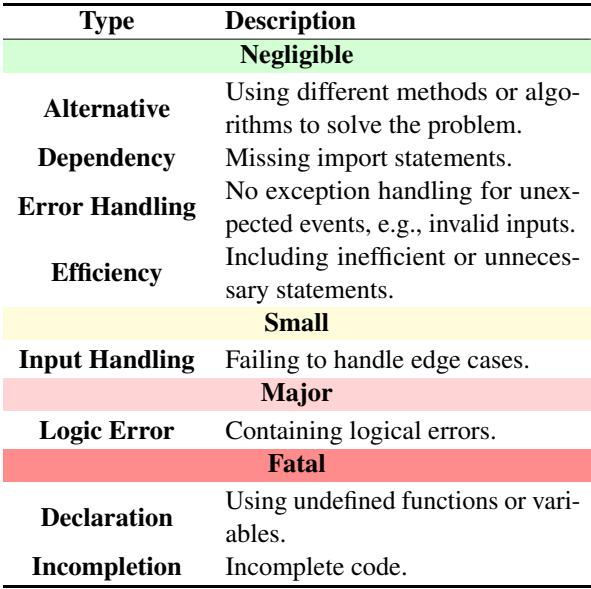
As seen in Table 2, errors are weighted:
- Negligible: Missing imports or minor stylistic issues. (These shouldn’t tank the score).
- Small: Failure to handle edge cases.
- Major: Logic errors that produce wrong results.
- Fatal: Syntax errors, undefined variables, or hallucinations that prevent the code from running.
In this mode, the LLM is instructed to identify specific inconsistencies from this list. The final score isn’t an arbitrary “4 out of 5 stars.” It is calculated mathematically based on the severity of the faults found.
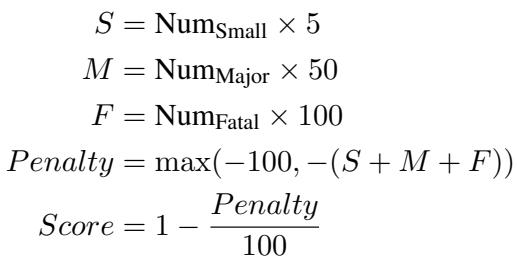
The scoring formula (shown above) starts with a perfect score and subtracts penalty points weighted by the error type. This ensures that a “Fatal” error (like calling a fake function) penalizes the score much more heavily than a “Small” error (like missing an input validation).
Experimental Results
The researchers evaluated CODEJUDGE against a battery of datasets (HumanEval-X, APPS, CoNaLa, BigCodeBench) and compared it to both traditional metrics and other LLM-based evaluators (like ICE-Score).
Correlation with Human Judgment
The primary metric for success here is correlation. If a human judge says “This code is good” and “This code is bad,” does the automated metric agree?
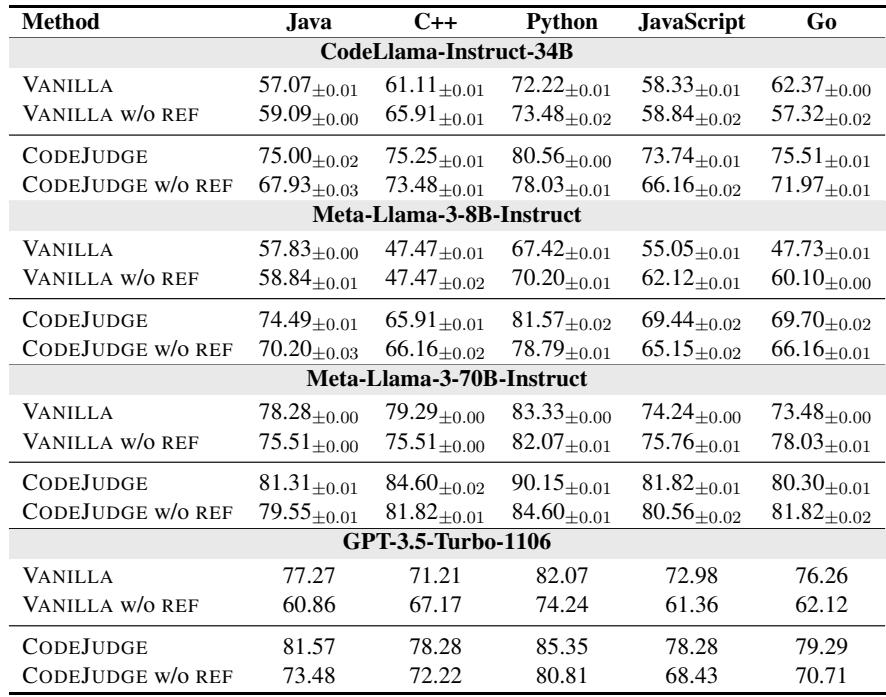
Table 12 provides a snapshot of accuracy on the HumanEval-X dataset.
- VANILLA (asking GPT-3.5 “Is this correct?”) achieves roughly 60-70% accuracy depending on the language.
- CODEJUDGE significantly boosts this, reaching 81.57% accuracy in Python and 81.31% in Java when using high-end models.
What is particularly impressive is the “w/o REF” (Without Reference) rows. CODEJUDGE achieves 73-80% accuracy even when it isn’t shown the correct answer. This confirms that the model is actually “reasoning” about the code logic rather than just comparing it to a cheat sheet.
Efficiency and Model Size
One might assume that you need the massive GPT-4 or Claude 3.5 Sonnet to perform this kind of complex reasoning. However, CODEJUDGE proves efficient even on open-source models.
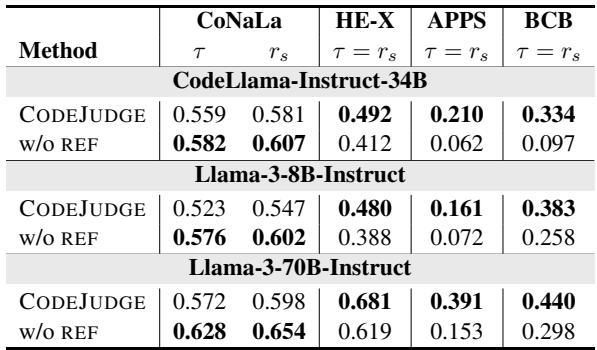
Table 6 reveals a fascinating finding. When using the smaller Llama-3-8B-Instruct model, CODEJUDGE achieves a Kendall’s Tau correlation of 0.523 on the CoNaLa dataset. This is competitive with, and often better than, other methods using the much larger GPT-3.5 Turbo.
This implies that the structure of the prompt (the “slow thinking” workflow) matters just as much as the raw intelligence of the model. By guiding a smaller model to think step-by-step, you can outperform a larger model that is making snap judgments.
Prompt Engineering vs. Framework Design
Is CODEJUDGE just fancy prompt engineering? The researchers compared their method against standard Chain-of-Thought (CoT) and Few-Shot prompting.
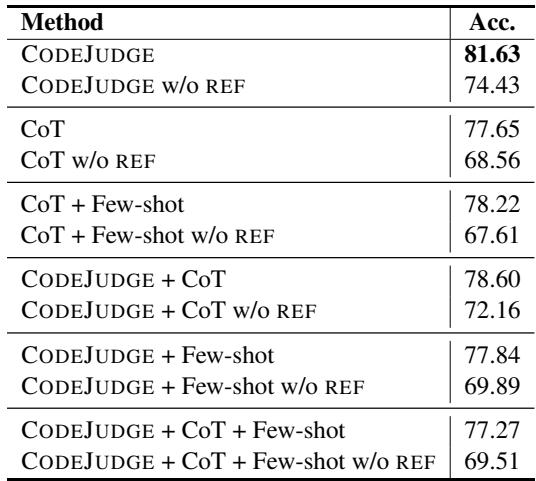
Table 7 shows that simply adding “Let’s think step by step” (CoT) or providing examples (Few-shot) does not yield the same results as the full CODEJUDGE framework.
- Standard CoT accuracy: 77.65%
- CODEJUDGE accuracy: 81.63%
The researchers noted that standard CoT often led the model to hallucinate a “fix” for the code and then grade the fixed version rather than the original version. CODEJUDGE’s strict separation of “Analysis” and “Summarization” prevents this drift.
Why This Matters
The implications of CODEJUDGE extend beyond just academic benchmarking.
1. Evaluating “Wild” Tasks: Currently, we can only reliably test AI coding agents on LeetCode-style problems where test cases exist. CODEJUDGE opens the door to evaluating agents on open-ended tasks—like “Write a script to analyze this CSV file” or “Create a React component for a login form”—where ground truth reference code might not exist.
2. Human-in-the-Loop Debugging: Because CODEJUDGE produces an analysis trace (the “Analysis” step) and a taxonomy of errors (the “Fault Localization” step), it doesn’t just give a score; it gives feedback. This could be integrated into IDEs to give developers an explanation of why their code (or the AI’s code) is likely wrong, pointing out specific logical flaws or missing edge cases.
3. Cost Reduction: The ability of CODEJUDGE to perform well with Llama-3-8B (a model small enough to run on consumer hardware) suggests that high-quality code evaluation doesn’t require expensive API calls to massive proprietary models.
Conclusion & Future Outlook
Evaluating generated code has long been the “elephant in the room” for AI programming. We have models that can write code faster than we can read it, but we’ve struggled to grade that work automatically.
CODEJUDGE demonstrates that the solution isn’t necessarily better test suites or fancier string-matching algorithms. The solution is metacognition—using the AI to critique itself. By forcing the model to slow down, analyze requirements, categorize errors, and then make a judgment, we can achieve evaluation systems that align closely with human expertise.
While limitations exist (the paper notes the model still struggles with extremely complex, competition-level logic in the APPS dataset), frameworks like CODEJUDGE are a necessary step toward autonomous software engineering agents that can not only write code but verify it, too.