](https://deep-paper.org/en/paper/2410.02521/images/cover.png)
Imagine you are listening to a conversation in Singapore. You might hear a sentence like: “I thought all trains 都是 via Jurong East 去到 Pasir Ris.”
To a monolingual speaker, this is chaos. To a bilingual speaker, it’s perfectly natural. This phenomenon is known as Code-Switching (CS)—the fluid alternation between two or more languages in a single conversation.
For humans, processing this is intuitive. For Artificial Intelligence, particularly Automatic Speech Recognition (ASR) systems, it is a nightmare. Most ASR models are trained to expect one language. When languages mix, the model struggles to decide which vocabulary or grammatical rules to apply.
Standard approaches try to solve this using Language Identification (LID), which essentially asks: “Which language is being spoken right now?” or “Which language is spoken more in this sentence?” But this approach misses the forest for the trees. It ignores the structural backbone of the sentence.
In the research paper “Methods for Automatic Matrix Language Determination of Code-Switched Speech,” researchers Olga Iakovenko and Thomas Hain propose a more sophisticated approach. Instead of just counting words, they apply a linguistic concept called the Matrix Language Frame (MLF) theory to teach machines how to identify the “dominant” grammatical framework of a mixed sentence.
In this deep dive, we will explore how they bridged the gap between theoretical linguistics and computational modeling to create a system that understands not just what is being said, but how it is structured.
The Linguistic Foundation: What is a Matrix Language?
To understand the solution, we first need to understand the problem through the lens of linguistics.
When people code-switch, they don’t just throw words together randomly. There are rules. The Matrix Language Frame (MLF) theory, introduced by Myers-Scotton in 1997, suggests that in any code-switched utterance, there is a hierarchy:
- The Matrix Language (ML): This is the dominant language. It provides the grammatical frame—the word order and the system morphemes (like tense markers, prepositions, and determiners).
- The Embedded Language (EL): These are the inserted elements from the other language, usually content words like nouns or verbs.
The Content vs. System Distinction
A crucial distinction in this theory is between content morphemes (words that carry meaning, like “university” or “run”) and system morphemes (words that provide structure, like “the,” “is,” or “ing”).
If a speaker says, “I’m okay with the danhuang” (egg yolk), the grammar is English. “The” is an English system morpheme. Therefore, English is the Matrix Language, and danhuang is an Embedded Language insertion. Determining this identity—the Matrix Language Identity (MLID)—is far more useful for speech processing than simply knowing that 20% of the sentence was Mandarin.
The Core Method: Automating ML Determination
The researchers developed three distinct principles to determine the Matrix Language automatically. Two are based on text (using linguistic rules), and one uses these textual principles to train an audio-based model.
Principle 1.1: The Singleton Principle (The Lone Wolf)
The first method is straightforward. It posits that if a sentence consists of a stream of words in Language A, with single, isolated words from Language B inserted, then Language A must be the Matrix Language. Language A is providing the context for these “singleton” insertions.
For example, in the phrase “Oh you post at your that blog”, the words “post” and “blog” are English singletons inserted into a Mandarin grammatical structure. Therefore, the Matrix Language is Mandarin.
While accurate, this principle has a limitation: it only applies when the code-switching happens as single-word insertions. It cannot handle complex blocks of mixed text.
Principle 1.2: The Token Order Principle (The Probability Game)
This is where the engineering gets clever. The second implementation, P1.2, relies on the idea that the order of words is dictated by the Matrix Language.
To determine this computationally, the researchers built a pipeline involving Machine Translation (MT) and Language Models (LMs).
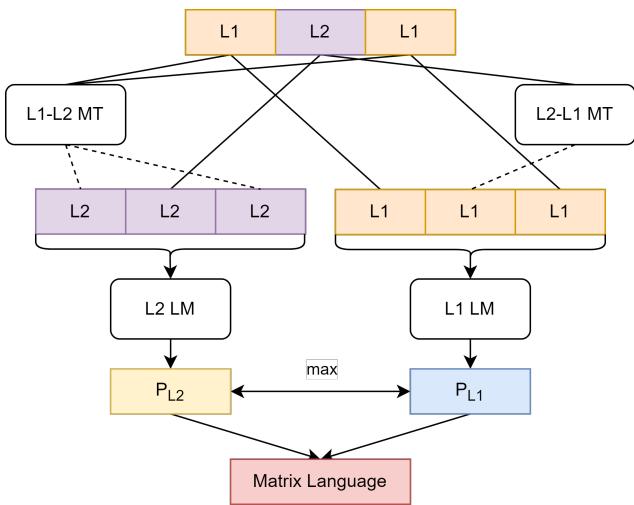
As shown in Figure 2, the process works like this:
- Take a code-switched sentence (let’s say a mix of L1 and L2).
- Translate the entire sentence into pure L1 (using a word-by-word translation to preserve the original word order).
- Translate the entire sentence into pure L2.
- Feed these translated versions into monolingual Language Models (LMs) for L1 and L2.
The Logic: A Language Model is trained to predict how likely a sequence of words is. If the original code-switched sentence followed the grammar (word order) of L1, then the L1 Language Model should see the translated sentence as “highly probable.” The L2 model, however, will look at the L2 translation (which still has L1 word order) and think it is gibberish.
The Mathematics of Grammar
To make this decision mathematically, the system compares the probabilities.
We want to see if the probability of the sentence structure belonging to Language 1 (\(L_1\)) is greater than Language 2 (\(L_2\)):

Since we are estimating this using translated versions of the sentence (\(\hat{\mathbf{y}}\)), we look at the ratio of the probabilities given by the two language models:
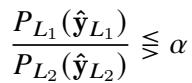
Here, \(\alpha\) is a scaling factor. Why do we need \(\alpha\)? Because two different language models (e.g., an English model and a Mandarin model) might be “confident” at different scales. One might output generally lower probabilities than the other just by design. The \(\alpha\) factor balances them out.
Taking the logarithm of this ratio gives us a workable inequality:

The system calculates \(\alpha\) by averaging the differences in log-probabilities over known monolingual datasets:

Finally, the decision function—the “judge”—decides the Matrix Language based on this threshold:

This method allows the computer to determine which language “owns” the word order of the sentence, even if the words themselves are mixed.
Calibrating the System
The researchers used Detection Error Tradeoff (DET) curves to tune this \(\alpha\) value.
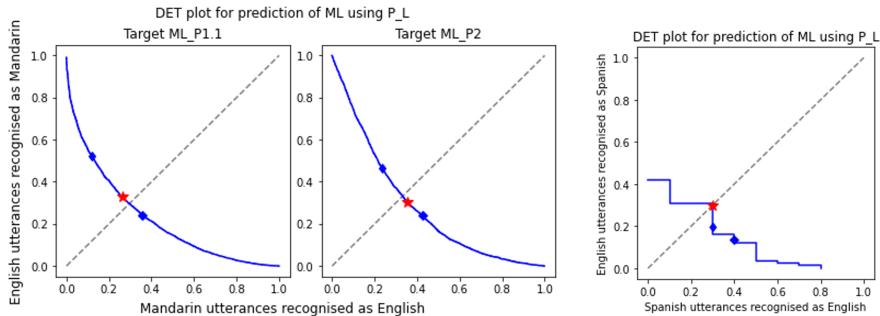
In Figure 1, we can see the performance trade-offs. The red star represents the ideal ground truth. The goal is to estimate an \(\alpha\) (the thick diamond) that brings the system’s performance as close to that red star as possible, balancing False Acceptances and False Rejections.
Principle 2: The System Word Principle (The Skeleton)
The third text-based method, P2, focuses on Part-of-Speech (POS) tags. It implements the linguistic rule that system morphemes come from the Matrix Language.
The system scans the sentence for “function words”:
- Determiners (the, a)
- Auxiliaries (is, have, do)
- Conjunctions (and, but, because)
If the sentence contains function words from English, but not from Mandarin, the system labels the Matrix Language as English. This is a robust method because function words act as the “skeleton” of the sentence.
Concrete Examples
How do these principles look in practice? The table below shows how different methods categorize real code-switched utterances.

Notice the second example: “but he quite zai right”.
- Baseline (counting tokens): Mostly English words \(\rightarrow\) English.
- P1.1 (Singleton): “zai” is a singleton insertion \(\rightarrow\) English.
- P2 (System Word): “but”, “he”, “right” are English function words \(\rightarrow\) English.
- Wait… The table actually lists P1.1 as determining Mandarin (zh) for the second row? Correction: Looking closely at the table image, for “but he quite zai right”, P1.1 says zh. Why? Because if “but”, “he”, “quite”, “right” are seen as insertions around “zai”, or if the structure implies a specific Mandarin syntax familiar to Singaporean speakers (“zai” meaning steady/capable), the logic shifts. However, typically “zai” is the EL here. This highlights the complexity: different principles can sometimes disagree, offering different perspectives on the “truth.”
From Text to Audio: The MLID System
The principles above work on text. But the ultimate goal is to process speech.
The researchers took the labels generated by these text-based principles (P1.1, P1.2, and P2) and used them to train an acoustic model. They used an ECAPA-TDNN architecture—a state-of-the-art model usually used for speaker recognition.
Instead of training the model to just identify the language (LID), they trained mappings (\(MLID_{P1.1}\), \(MLID_{P1.2}\), \(MLID_{P2}\)) to predict the Matrix Language directly from the audio waveform.
Experiments and Results
The team tested their systems on two major code-switching corpora:
- SEAME: A Mandarin-English corpus from Singapore and Malaysia.
- Miami: A Spanish-English corpus from the Bangor Miami corpus.
They compared their new Matrix Language Identity (MLID) predictors against a standard acoustic Language ID (LID) system.
Does Audio MLID Work?
The results were compelling. The audio models trained to predict Matrix Language correlated better with the linguistic structural truth than standard LID models did.
Take a look at the correlations in the Miami dataset:
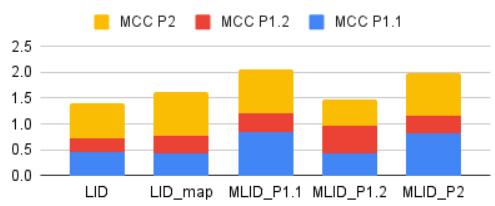
In Figure 4, the taller bars represent higher correlation with the textual principles. The columns labeled \(MLID\) generally show strong performance, often outperforming the standard \(LID\) and \(LID_{map}\) baselines. This proves that an audio model can learn to “hear” the grammatical structure (Matrix Language) rather than just counting which language has more acoustic presence.
The “English Bias” Discovery
One of the most profound findings of this paper wasn’t just about algorithm performance—it was a sociolinguistic insight revealed by the data.
In monolingual datasets, English usually dominates. However, when the researchers analyzed the distribution of the Matrix Language in code-switched conversations, they found a stark difference.
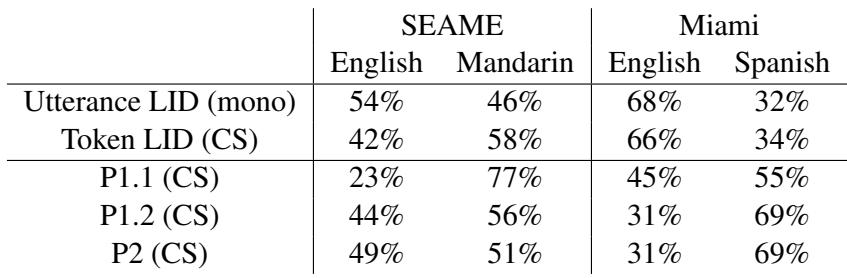
Table 11 reveals a fascinating trend:
- Utterance LID (Monolingual): In the Miami corpus, 68% of monolingual utterances are English.
- Matrix Language (P2 - CS): When code-switching happens, English is the Matrix Language only 31% of the time. Spanish becomes the dominant grammatical frame (69%).
Similarly, in the SEAME (Mandarin-English) corpus:
- Token LID: 58% of tokens are Mandarin.
- Matrix Language (P1.1): Mandarin provides the grammatical frame 77% of the time.
The implication: Even if speakers use a lot of English vocabulary (nouns, verbs), they prefer to stick to their native or local language (Mandarin or Spanish) for the grammatical structure of the sentence. Standard LID systems often miss this, classifying sentences as English simply because they contain English words, whereas the MLID system correctly identifies that the “operating system” of the sentence is actually Spanish or Mandarin.
Performance on Ground Truth
For a small subset of the Miami corpus, the researchers had human-annotated “Ground Truth” labels for the Matrix Language.
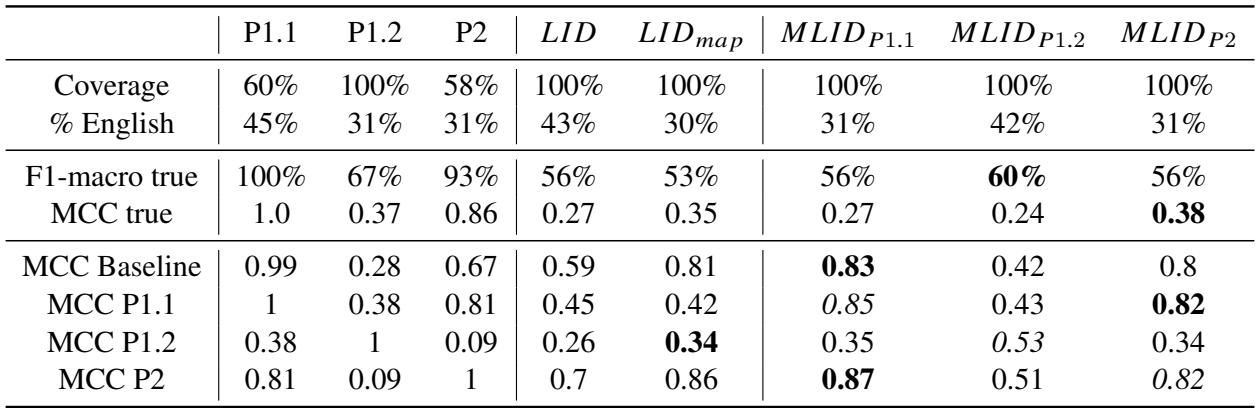
Looking at Table 8:
- The F1-macro score (a measure of accuracy) for the standard LID system was 56%.
- The MLID P1.2 system achieved 60%.
While 60% suggests there is still room for improvement, the MLID approach objectively outperforms the traditional method of simply identifying the languages present.
Conclusion: Why This Matters
This research represents a significant step forward in making machines understand human language as it is actually spoken. Code-switching is not an error or a “glitch”—it is a complex, structured linguistic behavior.
By applying the Matrix Language Frame theory, Iakovenko and Hain demonstrated that:
- We can automate the extraction of complex linguistic features (like Matrix Language) from text using translation and part-of-speech rules.
- We can train audio models to recognize these structural patterns directly from speech, outperforming traditional Language Identification methods.
- Context is King: Speakers may borrow English words extensively, but they tend to retain their native grammatical framework. Acknowledging this is key to building better speech recognition systems for bilingual communities.
As our world becomes increasingly interconnected and multilingual, technologies that respect and understand the “Matrix” of our speech will be essential for seamless communication.