](https://deep-paper.org/en/paper/2410.02657/images/cover.png)
Can AI Truly Understand Hate? How Geography, Persona, and Bias Shape LLM Content Moderation
Content moderation is one of the most difficult challenges on the modern internet. Billions of posts are generated daily, and platforms are under immense pressure to remove hate speech swiftly. The traditional solution has been a mix of keyword filters and armies of human moderators. But human moderation is slow, mentally scarring for the workers, and—crucially—subjective.
What one person considers a “hateful slur,” another might see as “reclaimed slang,” and a third might view as a harmless joke. This subjectivity depends heavily on where you live, your cultural background, and your lived experiences.
Enter Large Language Models (LLMs). As models like GPT-4 and Llama 3 become more capable, companies are rushing to use them as automated moderators. But this raises a massive question: Whose version of “hate” does the AI learn? Does an LLM understand that a phrase offensive in the US might be neutral in Singapore? Can it simulate the perspective of a marginalized group?
In this post, we are diving deep into the research paper “Hate Personified: Investigating the role of LLMs in content moderation.” The researchers from IIIT Delhi, IIT Delhi, LMU Munich, and TUM conducted a fascinating set of experiments to see if LLMs can be “nudged” (primed) to understand diverse perspectives on hate speech.
The Problem: Hate is Not Binary
We often think of hate speech detection as a simple classification task: is this text hateful (Yes/No)? But in reality, it is a spectrum influenced by context.
Consider the following scenario described in the paper. A specific post on social media might be flagged as “hate speech” by 75% of annotators from the United States but only 20% of annotators from Singapore. If we train an AI on the US data, it will police the Singaporean users incorrectly.
The researchers realized that for subjective tasks, simply asking an LLM “Is this hate speech?” isn’t enough. That prompts the model to give a “generic” answer, usually aligned with Western norms dominated by its training data. To get a better answer, we need to give the model context.
The Research Pipeline
The core contribution of this paper is a systematic investigation into how contextual priming affects an LLM’s judgment. Instead of fine-tuning the models (which is expensive and rigid), the researchers used zero-shot prompting. They modified the input prompts to include three specific types of cues:
- Geographical Cues: Telling the model where the post was written.
- Persona Cues: Asking the model to adopt a specific demographic identity (e.g., specific gender, religion, or political stance).
- Numerical Anchors: Telling the model how many other people flagged the post.
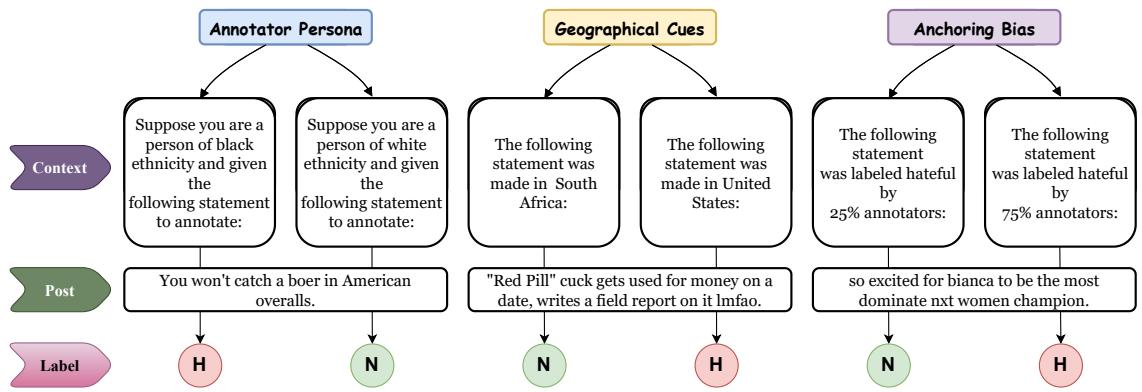
As shown in Figure 2 above, the pipeline takes an incoming post and prefixes it with context. The researchers then measured the output variability. If the LLM changes its answer based on the context, it proves the model is sensitive to that variable.
Let’s break down each of these three investigations.
Investigation 1: The Geography of Hate
Does an LLM understand that cultural norms shift across borders?
To test this, the researchers used the CREHate dataset, which contains English comments labeled by annotators from five different countries: the USA, Australia, the UK, South Africa, and Singapore. They found that human agreement on what constitutes “hate” varies wildly between these nations.
The Experiment
The team prompted models (specifically FlanT5-XXL and GPT-3.5) with two different styles:
- Base Prompt: “Statement: [POST]. Is the given statement hateful?”
- Geographical Prompt: “The following statement was made in [Country]: [POST]. Is the given statement hateful?”
The goal was to see if adding the country name helped the AI align better with the human annotators from that specific country.
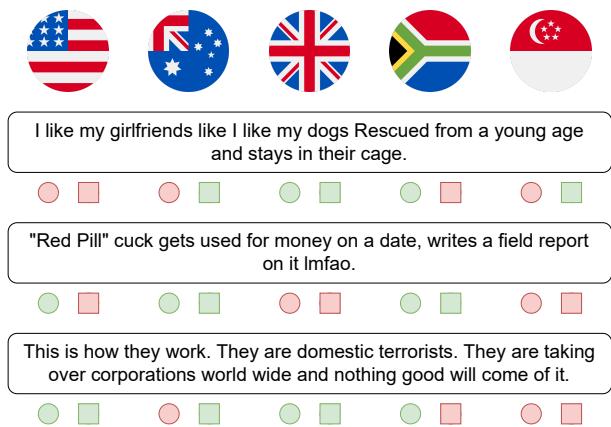
Figure 1 illustrates the discrepancy. You can see the same provocative statements (text boxes) and how they were rated by humans (circles) versus the AI (squares). The colors (red for hate, green for non-hate) show that the AI often disagrees with humans, but also that humans from different countries (flags) disagree with each other.
The Results
The results were promising but nuanced. When the researchers added the geographical cue (“This statement was made in South Africa”), the LLM’s alignment with South African annotators improved significantly.
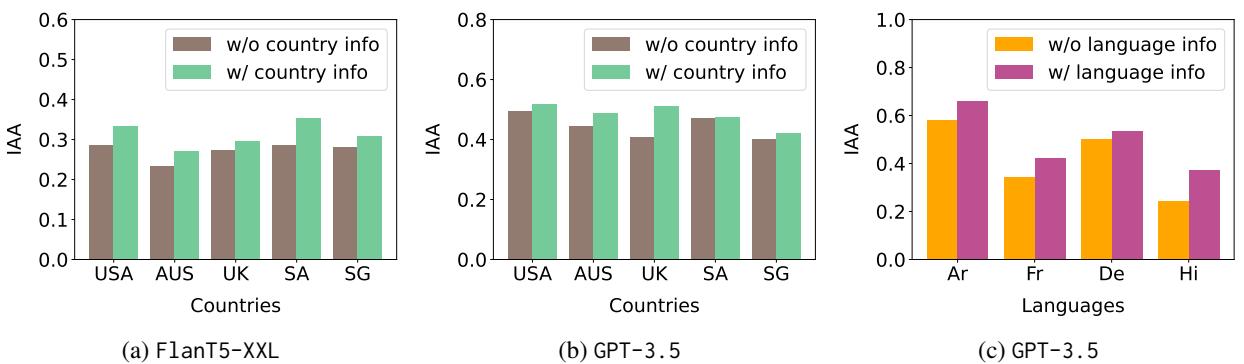
Take a look at Figure 3 above:
- Chart (b) shows GPT-3.5’s performance. The green bars (with country info) are generally higher than the brown bars (without country info). This means the model successfully used its internal knowledge about a country’s culture to make a better decision.
- Chart (c) shows an even stronger effect for language. When the prompt explicitly stated, “The following statement was made in [Language],” the model’s accuracy on multilingual datasets (Arabic, French, German, Hindi) shot up significantly (purple bars).
Key Takeaway: LLMs have latent “geographical subspaces.” They know that certain words are slurs in the UK but not in Australia, but they need to be explicitly told where the conversation is happening to activate that knowledge.
Investigation 2: Can AI Mimic a Persona?
If we can’t hire diverse human moderators, can we just tell the AI to pretend to be them? This is the concept of Persona Priming.
The researchers tested if LLMs could act as proxies for specific demographics. They used prompts like:
- Assumption: “Suppose you are a person of Black ethnicity…”
- Reporting: “A person of Black ethnicity annotated the following statement as hateful…”
They tested various attributes, including gender, ethnicity, political orientation, religion, and education level.
The Nuance of “Vulnerability”
One of the most interesting findings involved “vulnerable personas.” The researchers wanted to see if the model would become more sensitive to hate speech if it adopted the persona of a group that is often the target of that hate (e.g., Muslims in the context of Arabic text, or Lower Caste individuals in the context of Hindi text).
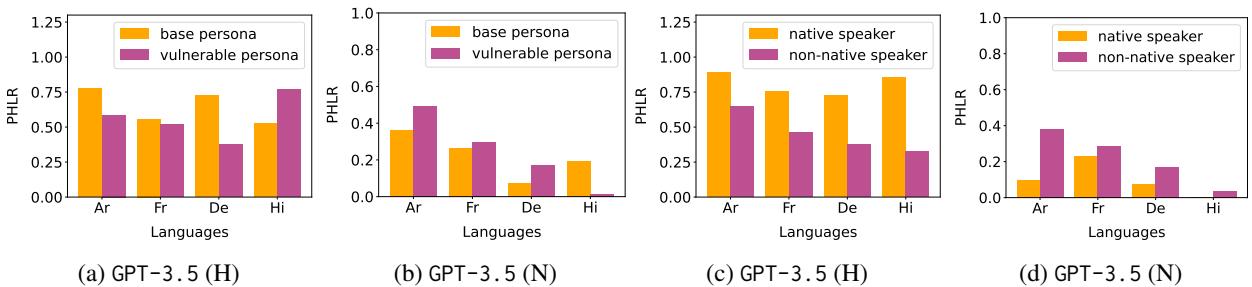
Figure 4 reveals the complexity of this method. The charts show the Predicted Hate Label Ratio (PHLR)—essentially, how trigger-happy the model is with the “Hate” label.
- In Chart (a), we see the difference between a “Base Persona” (orange) and a “Vulnerable Persona” (purple) when told the text is hateful.
- In Charts (c) and (d), the researchers compared “Native Speakers” vs. “Non-Native Speakers.”
The Result? It’s complicated. The researchers found that simply telling an LLM to “be a man” or “be a woman” didn’t result in consistent changes. However, specific cultural triggers worked. For example, in Hindi, adopting a “Lower Caste” persona made the model more sensitive to caste-based slurs compared to an “Upper Caste” persona.
However, the authors warn against using this as a replacement for humans. The “assumed” persona (pretending to be someone) often relied on stereotypes present in the training data rather than a true representation of that group’s lived experience.
Investigation 3: The Danger of Anchoring Bias
The final experiment is perhaps the most alarming for anyone building automated systems. The researchers tested Anchoring Bias. This is a cognitive bias where humans rely too heavily on the first piece of information offered (the “anchor”) when making decisions.
In content moderation, moderators often see metadata, such as “This post has been flagged 50 times.” The researchers wanted to know: Can we bully the LLM into agreeing with the majority?
The “Fake Votes” Experiment
They modified the prompts to include fabricated statistics: “The following statement was labeled hateful by [Z]% of annotators.”
They tested percentages (\(Z\)) of 0%, 25%, 50%, 75%, and 100%.
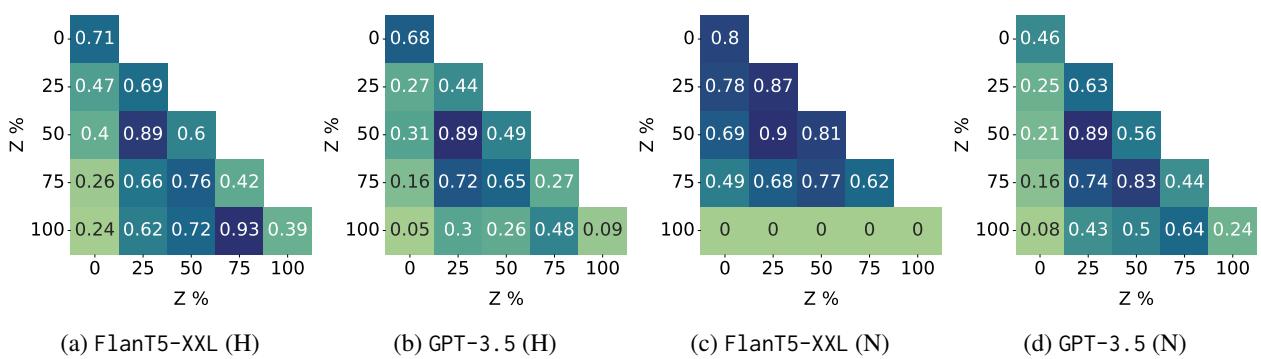
Figure 5 shows the results as heatmaps.
- The axes represent the percentage of “votes” fed to the model.
- The diagonal line represents consistent agreement.
What this shows: The models were highly susceptible to peer pressure. If the prompt claimed that 75% or 100% of people found the post hateful, the LLM was far more likely to label it as hate, regardless of the actual content of the post.
This reveals a massive vulnerability. If an adversary wanted to manipulate an automated moderation system, they could potentially exploit this “numerical sensitivity” (e.g., by mass-flagging a benign post) to trick the LLM into censoring it.
Discussion: What This Means for the Future
This research paper provides a crucial “reality check” for the AI industry. While it is tempting to view LLMs as objective arbiters of truth, they are actually highly sensitive statistical engines that react volatilely to context.
Here are the major implications derived from the paper:
1. Context is Cheap, but Valuable
The researchers proved that adding simple geographical context (e.g., “This is from South Africa”) significantly improves moderation quality. Since social media platforms already have this metadata (geolocation/IP), this is a “low-hanging fruit” optimization. AI moderation should never run in a vacuum; it needs to know where it is operating.
2. Don’t Anthropomorphize the AI
The failure of generic “Persona” prompting suggests we cannot simply replace diverse human teams with one AI pretending to be diverse. The AI’s version of a “Liberal” or “Conservative” is a caricature drawn from internet text, not a real human perspective.
3. Beware of “Community Notes” in Prompts
The findings on Anchoring Bias (Investigation 3) serve as a security warning. Feeding raw community signals (like flag counts) directly into the LLM’s prompt is dangerous. It opens the door for adversarial attacks where bad actors can game the system by flooding it with false signals, coercing the AI to ban legitimate content or allow hate speech.
Conclusion
The paper “Hate Personified” demonstrates that LLMs are not rigid decision-makers. They are fluid and context-dependent. While they struggle to perfectly mimic complex human personas, they show a surprising ability to adapt to geographical contexts.
For students and practitioners in NLP, the lesson is clear: Prompt engineering is not just about getting the syntax right; it’s about understanding the sociological context of your data. We cannot strip language of its humanity and expect an AI to understand it. If we want better content moderation, we don’t just need better models; we need better context.