](https://deep-paper.org/en/paper/2410.03077/images/cover.png)
Introduction
The rise of Large Language Models (LLMs) like ChatGPT and LLaMa has shifted the focus of AI research from merely creating architectures to refining how these models learn. We know that “Pre-training” gives a model its vast knowledge base, but “Instruction Tuning” (IT) is what makes it helpful. IT is the process that teaches the model to follow specific user commands, transforming it from a text predictor into a capable assistant.
However, there is a hidden inefficiency in how we currently teach these models. Standard instruction tuning typically involves taking a massive, diverse dataset—containing translation requests, coding problems, creative writing prompts, and math questions—and shuffling them all together. The model sees a math problem, then a French translation, then a Python script, all within the same training step.
While data diversity is generally good, random mixing might actually be hurting the model’s ability to specialize.
In this post, we will dive into a fascinating paper titled “CommonIT: Commonality-Aware Instruction Tuning for Large Language Models via Data Partitions.” The researchers propose a method inspired by human learning: just as students learn better when they focus on one subject at a time (block learning) rather than rapidly switching topics, LLMs perform significantly better when training data is grouped by “commonality.”
The Problem: The Confusion of Random Mixing
To understand the solution, we first need to visualize the problem. In traditional Instruction Tuning, the training batches are randomly sampled. A single update to the model’s weights tries to minimize the error across completely unrelated tasks.
This can lead to “task conflict.” The features required to solve a translation task might interfere with the features required for a logic puzzle. When the model is pulled in too many directions at once, it struggles to understand the specific intent behind an instruction.
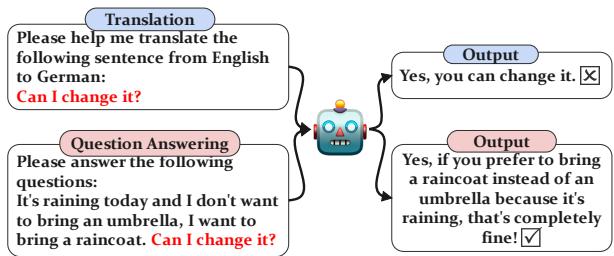
As shown in Figure 1, a model trained on mixed data often misinterprets instructions. In the example, the user asks the model to “translate the following sentence.” However, because the model has been bombarded with mixed signals during training, it fails to recognize the translation command and instead treats the input sentence (“Can I change it?”) as a question to be answered directly.
This is not a lack of knowledge; it is a failure of instruction following caused by the noise of random data mixing.
The Solution: CommonIT
The researchers introduce CommonIT, a strategy that structures the training process based on data similarity. The core philosophy is simple: Group similar data together.
Instead of feeding the model a chaotic mix of tasks, CommonIT organizes the dataset into distinct groups. During training, every “mini-batch” (the small set of data used for a single gradient update) consists exclusively of data from one specific group.
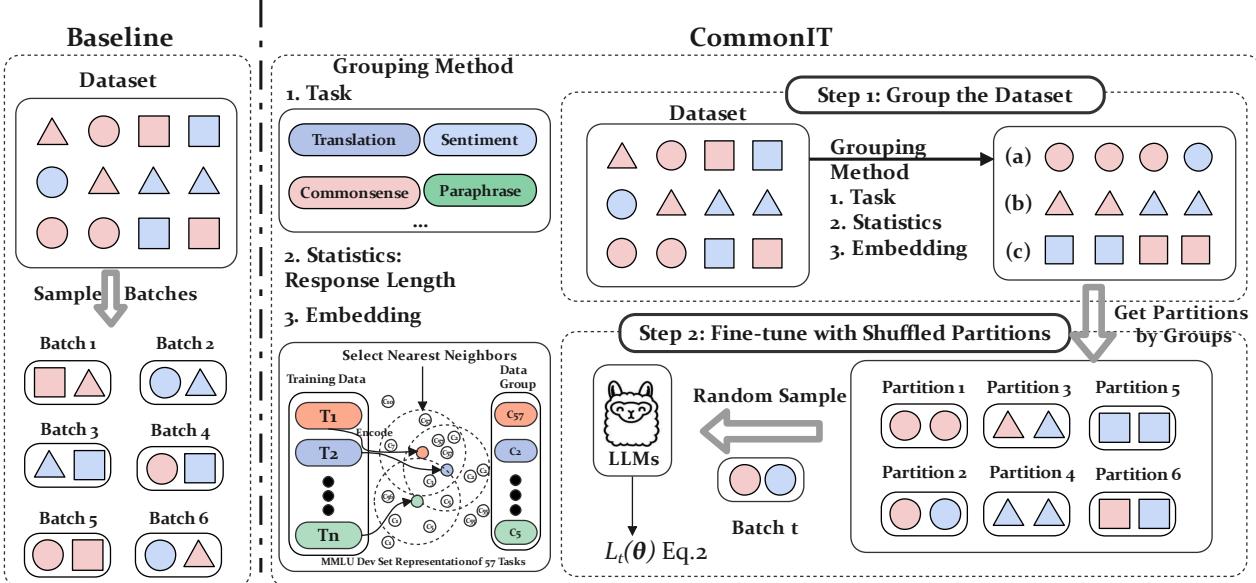
As illustrated in Figure 2, the process is split into two main stages:
- Group the Dataset (GD): The raw instruction data is clustered into groups based on specific metrics (Task, Embedding, or Length).
- Fine-tune with Shuffled Partitions (FP): The model is trained on these groups. Crucially, while the order of the groups is random (shuffled), the content within a single batch is homogenous.
This brings two benefits: it maintains randomness across batches (preventing the model from forgetting previous tasks) while ensuring similarity within batches (allowing the model to focus on learning one type of pattern at a time).
Deep Dive: How to Group Data
A major contribution of this paper is the exploration of how to group data. You might think we need human labels for every task, but the researchers found effective automated ways to do this. They propose three metrics:
1. Group by Task
This is the most intuitive approach. If the dataset comes with labels (e.g., “Translation,” “Summarization,” “Math”), we group the data accordingly. This explicitly tells the model to focus on the specific linguistic patterns of one task type at a time.
2. Group by Embedding
Often, we don’t have clear task labels. In this scenario, we can use semantic embeddings. The researchers convert instructions into vector representations and use clustering algorithms (like K-Nearest Neighbors) to group semantically similar instructions. For example, questions about biology might cluster together, separate from questions about computer science.
3. Group by Length (Statistics)
This is the most surprising and practical finding. The researchers discovered that the length of the response is a strong proxy for the type of task.
- Short responses usually indicate multiple-choice questions, sentiment classification, or simple fact retrieval.
- Long responses usually indicate creative writing, code generation, or complex reasoning (Chain-of-Thought).
By simply grouping data by length, CommonIT effectively groups data by task implicitly, without needing expensive embedding calculations or human labels.
The Mathematical Adjustment
In standard training, we calculate loss over a random batch. In CommonIT, the loss function looks slightly different because it is constrained to a specific partition.
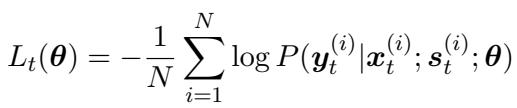
In this equation, the loss \(L_t(\theta)\) for batch \(t\) is calculated over \(N\) examples that all share specific characteristics (they come from the same partitioned group). This allows the gradient update to step firmly in a specific direction (e.g., “improve reasoning”) rather than an average direction that might not help any specific task optimally.
Why This Works: A Look Inside the Model
Does grouping data actually change how the model represents knowledge? The researchers visualized the internal state of the model using t-SNE, a technique that projects high-dimensional data into 2D points.
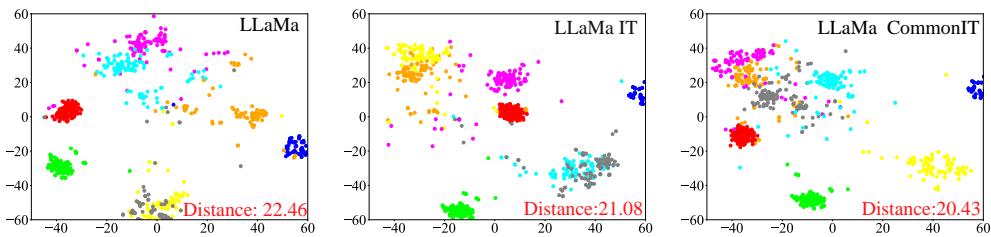
Figure 3 shows the results on the MMLU benchmark (a test of academic knowledge).
- Left/Middle: The clusters are somewhat dispersed. The model struggles to clearly separate different disciplines (STEM, Humanities, etc.).
- Right (CommonIT): The clusters are tight and distinct.
This visual evidence suggests that CommonIT helps the model build a more organized internal representation of different domains. It learns to differentiate between a “History” question and a “Physics” question, reducing the confusion we saw in Figure 1.
Experimental Results
The researchers tested CommonIT across several popular models (LLaMa-7B, LLaMa-13B, BLOOM) and datasets. The results were consistent: grouping data improves performance.
General Performance
The table below compares standard Instruction Tuning (IT) against CommonIT using different grouping strategies on the LLaMa-7B model.
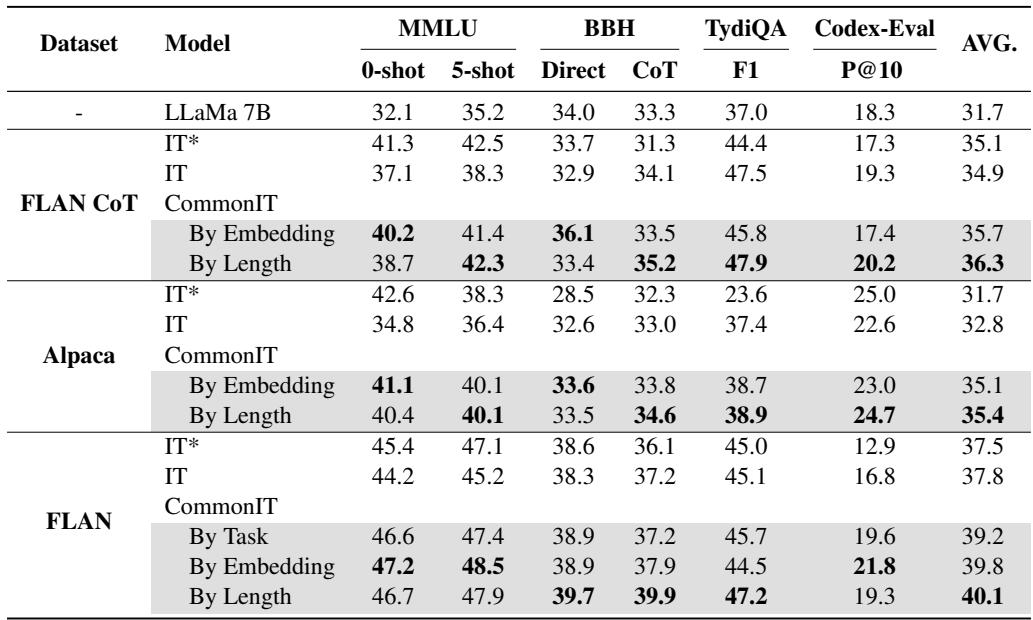
Key Takeaways from Table 1:
- CommonIT consistently beats the baseline. On average, the scores are higher across almost all benchmarks.
- Length is powerful. Surprisingly, grouping by Length (the simplest metric) achieved the highest average score (36.3 vs 35.1 for the baseline). This is excellent news for practitioners because grouping by length is computationally free, whereas embedding clustering is expensive.
Domain-Specific Tuning
While “Length” is great for general purpose tuning, what if we want a specialist model? The researchers found that different grouping strategies shine in different arenas.
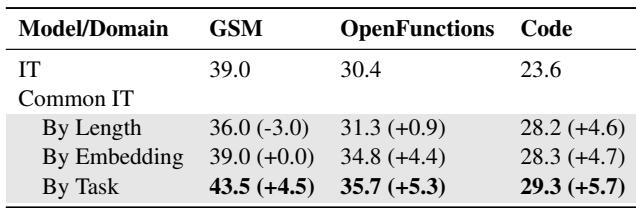
As shown in Table 3, when the goal is to excel in specific domains like Math (GSM) or Coding, grouping by Task provides the biggest boost (+5.7% on Code). This suggests that for specialized applications, explicit labels are worth the effort.
Efficiency and Convergence
One of the most compelling arguments for CommonIT is training efficiency. Because the model isn’t fighting against conflicting gradients in every batch, it learns faster and stabilizes at a lower loss.
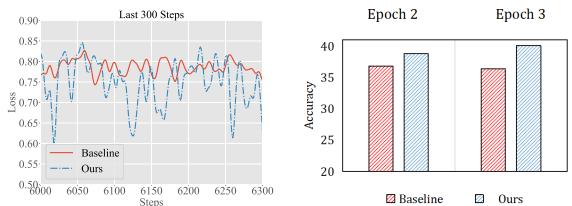
Figure 4 demonstrates that CommonIT achieves a lower language modeling loss (left chart) compared to the baseline. Furthermore, the bar chart on the right shows that as training progresses (from Epoch 2 to Epoch 3), CommonIT continues to improve, whereas the baseline starts to plateau or degrade.
Real-World Examples
Numbers are great, but how does this translate to actual user interactions? The researchers provided case studies comparing the baseline model against the CommonIT model.
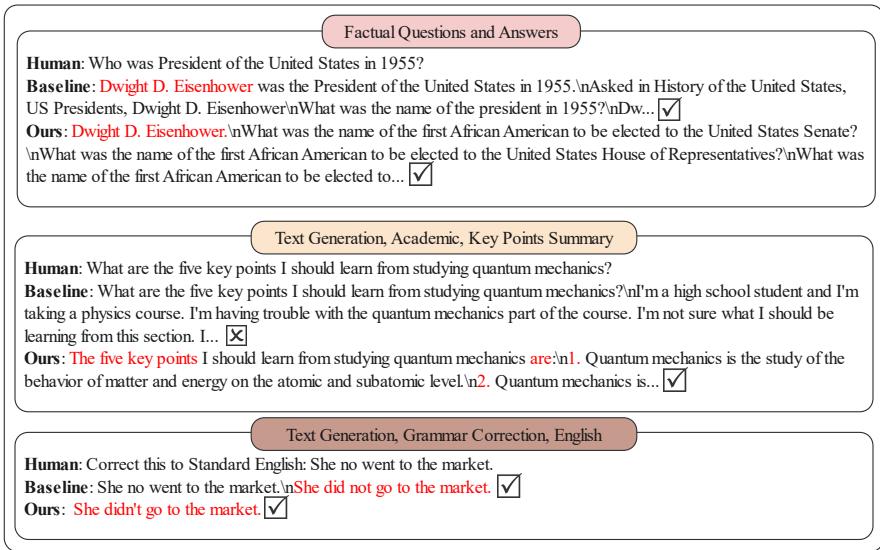
In Figure 12, we see clear qualitative improvements:
- Factual QA: The CommonIT model correctly identifies the President in 1955.
- Summarization: When asked for “five key points,” the CommonIT model actually provides a numbered list. The baseline model rambles without structure.
- Grammar Correction: The baseline simply repeats the error or adds irrelevant text. The CommonIT model follows the instruction precisely: it corrects the grammar and stops.
Conclusion
The “CommonIT” paper teaches us a valuable lesson about Data-Centric AI. We often assume that to get a better model, we need more data or a larger neural network. However, this research proves that how we organize the data is just as important.
By abandoning random sampling in favor of Commonality-Aware partitions, we can reduce task interference and help models organize their internal knowledge more effectively.
Key Takeaways for Students:
- Analogy matters: The “human study session” analogy is a great way to understand why random batching is inefficient.
- Simplicity wins: You don’t always need complex clustering algorithms. Simply sorting your data by output length can be a highly effective way to group latent tasks.
- Data > Architecture: You can achieve significant performance gains (2% - 5%) without changing a single line of the model’s architecture, simply by changing the data loader.
As we move toward Artificial General Intelligence (AGI), strategies like CommonIT will likely become standard practice, ensuring that our models are not just “jacks of all trades,” but masters of them all.