](https://deep-paper.org/en/paper/2410.03457/images/cover.png)
Introduction: The Art of Bad Arguments
If you have ever ventured into the comments section of a controversial news article, you have likely encountered them: arguments that sound convincing on the surface but crumble under the slightest scrutiny. A commenter might claim that implementing a small tax increase will inevitably lead to a totalitarian communist state (a Slippery Slope). Another might argue that because a specific politician is corrupt, all politicians must be criminals (a Hasty Generalization).
These are logical fallacies—reasoning errors that undermine the validity of an argument. They are rampant in online discourse, fueling misinformation and toxic polarization. For researchers in Natural Language Processing (NLP), detecting these fallacies automatically is a “holy grail” task. If an AI could flag a logical fallacy in real-time, it could help users identify flawed reasoning and perhaps raise the quality of online debate.
But there is a major bottleneck: data. To train a model to spot a fallacy, you need thousands of examples. In the real world, fallacies are often buried in long, messy paragraphs, making them incredibly expensive and difficult to label manually.
This brings us to a fascinating new research paper: CoCoLoFa. The researchers behind this project didn’t just scrape more comments; they engineered a new way to create data. By combining human creativity with the power of Large Language Models (LLMs), they built the largest dataset of logical fallacies to date. This post explores how they did it, why it works, and what it teaches us about the future of AI-assisted data generation.
The Problem: Finding Needles in Haystacks
Before we dive into the solution, we must understand why existing datasets fall short. Previous attempts to build fallacy datasets generally fell into two categories:
- High Quality, Low Reality: Datasets like LOGIC used quiz questions from educational materials. These are clean and clear but look nothing like a messy Reddit thread.
- High Reality, Low Context: Datasets scraped from Reddit are realistic but often lack the context of the original discussion, or they rely on user tags (like someone replying “/r/shills”) which are noisy and unreliable.
The biggest challenge is that finding a specific fallacy in the wild is like finding a needle in a haystack. You might read 100 comments and find zero clear examples of a “False Dilemma.” This makes hiring annotators to read and label existing text prohibitively expensive.
To solve this, the CoCoLoFa team flipped the script. Instead of asking humans to find fallacies, why not ask humans to write them?
The Method: Manufacturing Fallacies
The core contribution of this paper is a novel data collection pipeline that solves the scarcity problem. The researchers focused on 8 common fallacy types:
- Appeal to Authority
- Appeal to Majority
- Appeal to Nature
- Appeal to Tradition
- Appeal to Worse Problems
- False Dilemma
- Hasty Generalization
- Slippery Slope
They recruited 143 crowd workers and tasked them with writing comments in response to real news articles. However, writing a subtle, convincing logical fallacy is actually a sophisticated cognitive task. It’s hard to do on command.
To assist the workers, the researchers integrated an LLM (GPT-4) directly into the writing interface.
The LLM-Assisted Workflow
The process was designed to simulate a real comment section while ensuring high data quality. Here is how the workflow progressed for a worker:
- Read the News: The worker is presented with a real news article (crawled from Global Voices) covering a controversial topic like politics, gender rights, or freedom of speech.
- Sanity Check: To ensure the worker actually read the article, they must answer LLM-generated multiple-choice questions about the content.
- The Assignment: The worker is assigned a specific fallacy type (e.g., “Appeal to Tradition”) and a definition.
- Drafting & Refining: This is the critical step. The worker writes a draft. Then, they can click a button to get suggestions from GPT-4. The LLM analyzes the draft and the news article, then suggests how to make the fallacy more convincing or subtle.
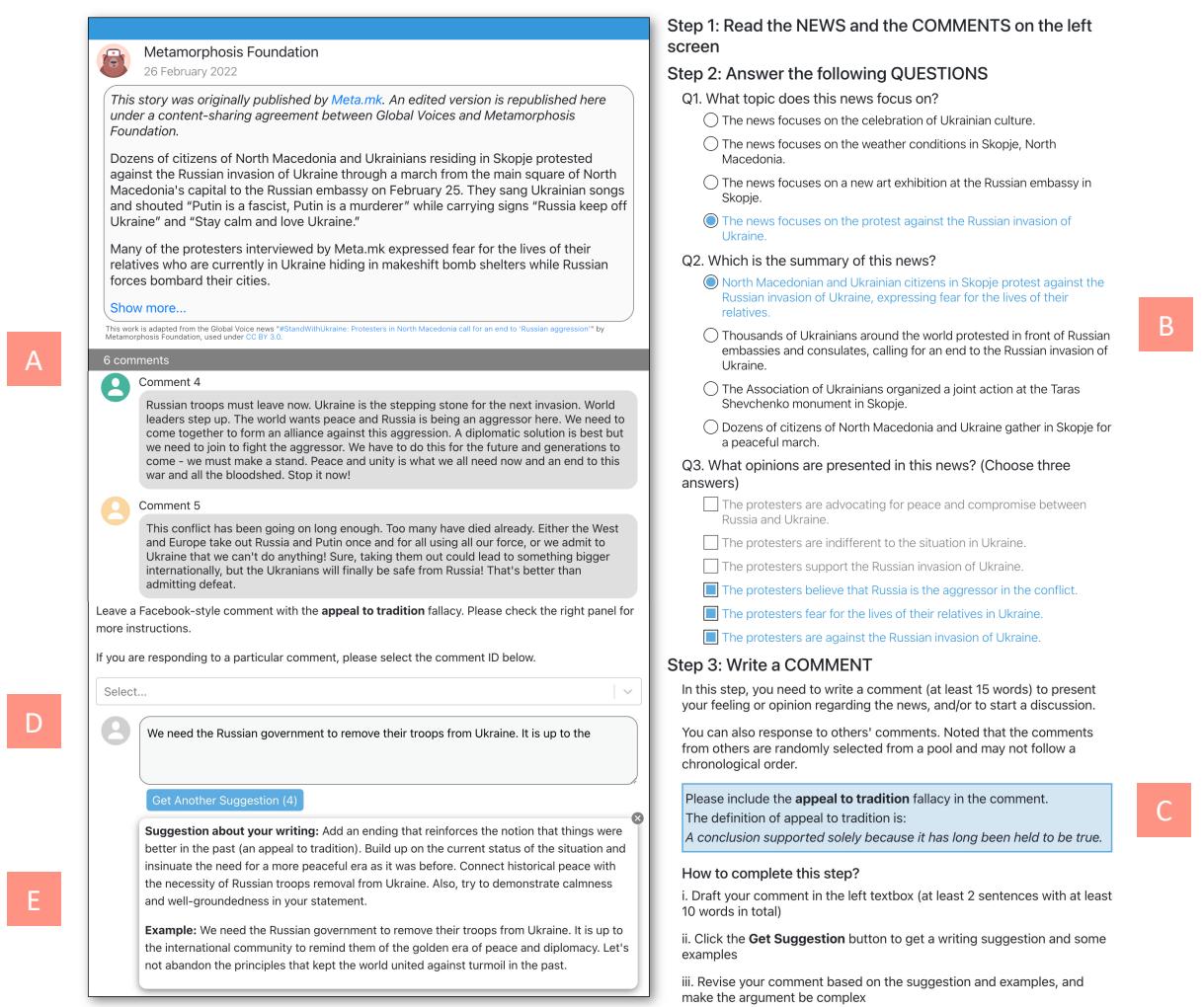
As shown in Figure 2 above, the interface is split. On the left (A), the worker sees the news and existing comments. On the right (C and E), they receive the specific instruction (“Write an Appeal to Tradition”) and the AI assistance.
This setup offers the best of both worlds. The human provides the intent, the opinion, and the connection to the specific news event. The AI acts as a writing coach, ensuring the logic (or lack thereof) fits the specific definition of the fallacy.
The Resulting Data
The result of this process is CoCoLoFa (Common Logical Fallacies), a massive dataset containing 7,706 comments across 648 news articles.
What makes this dataset unique is not just its size, but its structure. Because workers were responding to articles and even to each other, the dataset preserves the context of a threaded conversation.
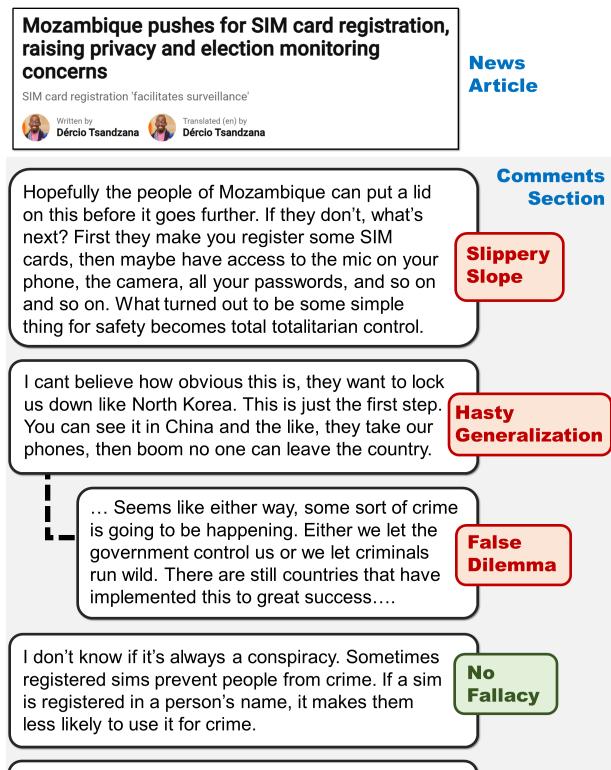
Figure 1 illustrates the output. Notice how natural the comments sound.
- Comment 1 (Slippery Slope): Argues that registering SIM cards is the first step toward total government control.
- Comment 3 (False Dilemma): Claims there are only two choices: accept the policy or let criminals run wild.
These look exactly like comments you would find on Facebook or a news site, yet they are precisely labeled because they were generated with a specific target in mind.
How Does it Compare?
When we stack CoCoLoFa against previous datasets, the difference in scale and complexity becomes clear.
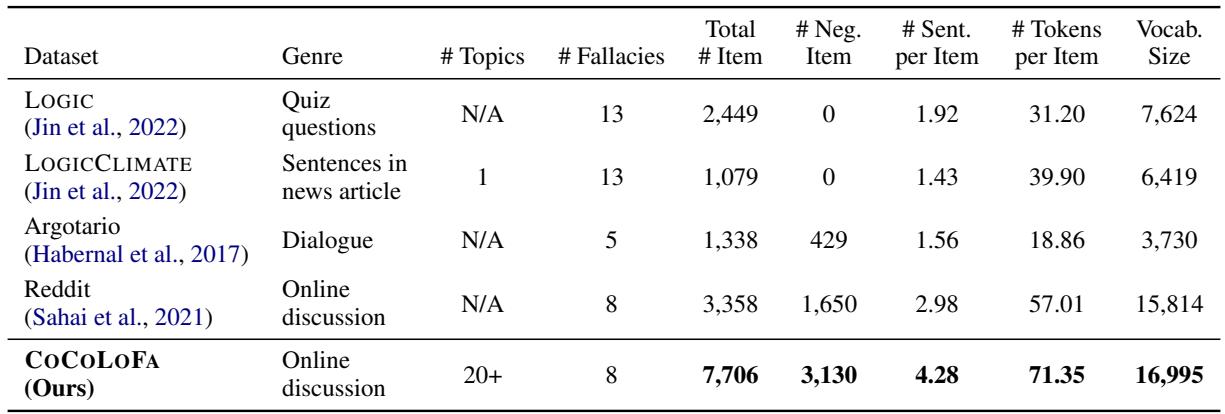
As seen in Table 1 (labeled Table 2 in the image deck), CoCoLoFa is significantly larger than previous curated datasets like LOGIC or Argotario. More importantly, look at the # Sentences per Item (4.28) and # Tokens per Item (71.35). CoCoLoFa comments are longer and more complex than the short, punchy examples found in quiz-based datasets. This complexity is vital for training models to detect fallacies in the real world, where people rarely speak in simple subject-verb-object sentences.
Experiments: Can Machines Learn Logic?
Creating the dataset is only half the battle. The researchers needed to prove that CoCoLoFa is actually useful for training AI models. They designed two primary tasks:
- Fallacy Detection: A binary task. Does this comment contain a fallacy (Yes/No)?
- Fallacy Classification: If a comment has a fallacy, which of the 8 types is it?
They fine-tuned BERT-based models (standard NLP workhorses) on CoCoLoFa and compared them to models trained on the Reddit dataset. They also tested state-of-the-art LLMs (GPT-4o and Llama3) using prompt engineering techniques like Chain-of-Thought (COT).
The Results
The results showed that high-quality training data matters immensely. Models trained on CoCoLoFa generally performed better and generalized well.
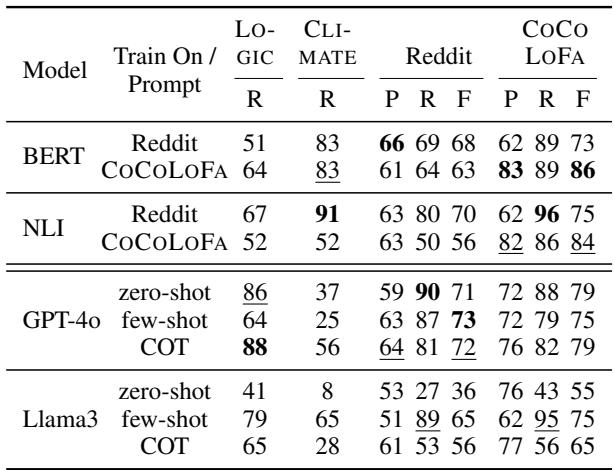
In the Fallacy Detection task (shown in Table 4), the BERT model trained on CoCoLoFa achieved an F1 score of 86, which is remarkably high for such a subjective task. It also outperformed the Reddit-trained model when tested on the Reddit dataset itself in some metrics, suggesting that the CoCoLoFa model learned a more robust understanding of what a fallacy looks like.
Interestingly, while GPT-4o (Zero-shot) is very strong, the fine-tuned smaller models (BERT) were competitive and often superior when trained on this specific high-quality data.
The “In the Wild” Test
The ultimate test for any NLP model is how it performs on completely unseen, real-world data that wasn’t part of the collection process. The researchers took a dataset of New York Times (NYT) comments and had experts annotate them for fallacies.
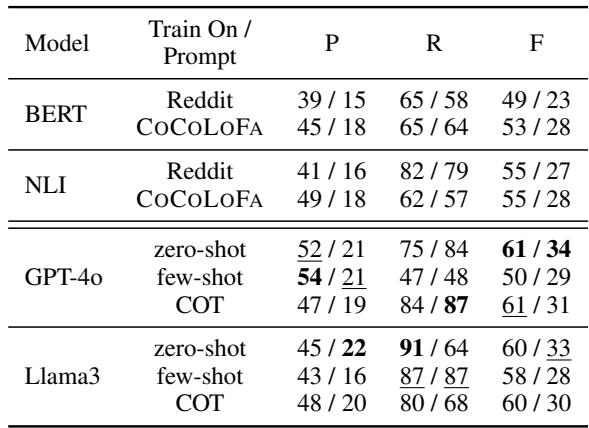
Table 6 reveals a hard truth about NLP: Generalization is difficult. When applied to the NYT comments, performance dropped across the board (F1 scores hovering around 50-60). However, the model trained on CoCoLoFa still consistently outperformed the model trained on Reddit.
This highlights that while CoCoLoFa is a massive step forward, detecting fallacies in the wild remains an unsolved problem. Real-world comments are messy, and the line between a “bad argument” and a “logical fallacy” is often blurry.
The Human Factor: The Challenge of Subjectivity
One of the most insightful parts of the paper is the analysis of human agreement. If two experts read the same comment, will they agree on the fallacy?
The answer is: Not always.
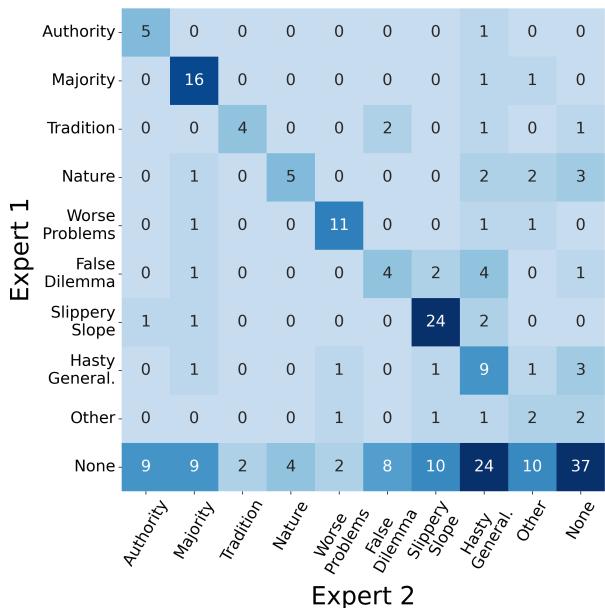
Figure 3 visualizes the agreement between two PhD-level experts. While they often agreed (the diagonal line), there were many cases where they disagreed.
- Ambiguity: Is a comment attacking a person a simple insult, or an Ad Hominem fallacy?
- Overlap: A comment might contain elements of both Slippery Slope and Appeal to Fear (Appeal to Worse Problems).
- Intent vs. Perception: The writer might have intended a valid comparison, but the reader perceives it as a False Analogy.
The researchers note that “Most of the disagreement happened when determining if a comment is fallacious or not.” This suggests that future datasets might need to embrace this ambiguity, perhaps by using multi-label annotation (allowing a comment to be both X and Y) rather than forcing a single category.
Conclusion
CoCoLoFa represents a shift in how we build datasets for difficult linguistic tasks. By treating data collection as a generation task rather than a search task, the researchers were able to create a massive, balanced, and high-quality resource for studying logical fallacies.
The integration of LLMs into the crowdsourcing pipeline is particularly clever. It lowers the barrier to entry for crowd workers, allowing non-experts to generate sophisticated linguistic examples.
Key Takeaways:
- Collaboration is Key: The best data came from humans guided by AI, not humans alone or AI alone.
- Context Matters: Unlike quiz questions, CoCoLoFa preserves the thread of conversation, which is essential for understanding arguments.
- The Problem isn’t Solved: While models trained on CoCoLoFa are better, the “in the wild” performance on NYT data shows we still have a long way to go before AI can reliably police logic on social media.
This paper provides a blueprint for future research. As we try to teach AI to understand nuance, sarcasm, and logic, we will likely see more of these “cyborg” datasets—where human creativity is amplified by machine capability to feed the next generation of models.