](https://deep-paper.org/en/paper/2410.03502/images/cover.png)
Beyond the Board Exam: Why Chinese Medical AI Needs Real-World Clinical Testing
We are living in an era where Artificial Intelligence is passing medical licensing exams with flying colors. Headlines frequently tout Large Language Models (LLMs) that can score passing grades on the USMLE or its Chinese equivalents. This has led to a surge of excitement—and hype—about the imminent arrival of “AI Doctors.”
However, anyone who has been to medical school (or treated a patient) knows a fundamental truth: Passing an exam is not the same as practicing medicine.
Textbook questions are clean, structured, and theoretical. Real clinical practice is messy. Patient histories are convoluted, symptoms are ambiguous, and decisions often involve complex reasoning chains involving multiple specialists. If we want AI to be truly useful in healthcare, we need to stop testing it on textbooks and start testing it on reality.
In this post, we are diving deep into CliMedBench, a groundbreaking research paper that attempts to bridge this gap. The researchers have constructed a massive, real-world benchmark based on actual hospital data to see how Chinese Medical LLMs hold up in the trenches of clinical practice. The results are surprising, revealing that specialized “medical” models often lag behind general-purpose giants, and that we have a long way to go before AI is ready for the ward.
The Problem: The “Textbook vs. Reality” Gap
Current benchmarks for evaluating Chinese medical LLMs, such as MedQA or CMExam, rely heavily on open educational resources. They use questions from medical qualification exams or textbooks. While useful for checking basic knowledge retention, these benchmarks suffer from two major flaws:
- Lack of Authenticity: They don’t reflect the complexity of Electronic Health Records (EHRs), where information is often unstructured and requires synthesizing data from various timelines (admission, treatment, discharge).
- Data Contamination: Because these benchmarks come from public internet sources, many LLMs have likely already “seen” the questions during their training phase, inflating their scores.
To solve this, the researchers introduced CliMedBench. It is a comprehensive benchmark comprising 33,735 questions derived largely from real-world medical reports of top-tier tertiary hospitals in China. It is designed to evaluate models not just on what they know, but on how they reason in a clinical setting.
The Architecture of CliMedBench
Creating a benchmark that mirrors real life requires a structured approach to chaos. The researchers developed a taxonomy to categorize clinical practice, ensuring no part of the medical process was left untested.
The “Who-What-How” Taxonomy
As illustrated in the figure below, the benchmark is structured around three axes:
- Who: The role the model must assume or interact with (e.g., Specialist Doctor, Radiographer, Pharmacist, Patient).
- What: The specific clinical scenario (e.g., In-hospital diagnosis, Drug consultation, Discharge summary).
- How: The dimension of capability being tested (e.g., Reasoning, Hallucination, Toxicity, QA ability).
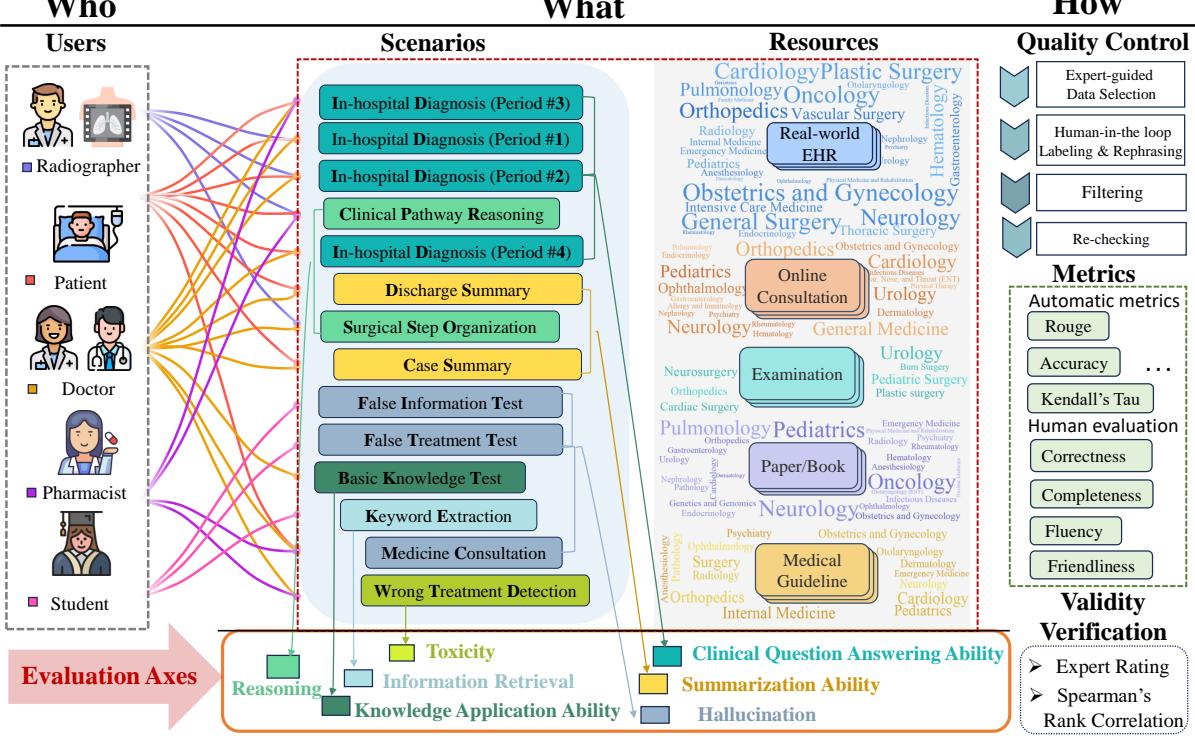
This structure results in 14 core clinical scenarios. For example, the “In-hospital Diagnosis” (ID) scenario is broken down into four distinct periods covering the patient’s entire journey:
- ID #1: Selection of examinations (What tests do we run?).
- ID #2: Diagnosis based on history and results (What does the patient have?).
- ID #3: Treatment strategy (Drugs or surgery?).
- ID #4: Discharge instructions (What should the patient do at home?).
This granularity ensures the model isn’t just answering a generic “What is disease X?” question, but is actively participating in the clinical workflow.
Construction: Humans and AI in the Loop
One of the most impressive aspects of CliMedBench is how the dataset was built. You cannot simply feed raw hospital records into a public dataset due to privacy concerns (PHI - Protected Health Information) and data noise.
The researchers employed a Human-LLM Collaboration Workflow.
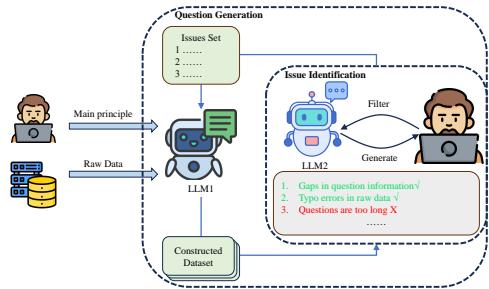
Here is how the pipeline works, as shown in the figure above:
- De-identification: First, all real EHRs are scrubbed of sensitive patient data by ethics committees.
- LLM1 (The Generator): A primary LLM processes the raw data to identify issues and generate potential Questions and Answers (QA pairs) based on specific medical principles.
- LLM2 (The Auditor): A secondary LLM acts as a critic. It checks the generated questions for logical gaps, typos, or ambiguity.
- Human Expert Review: Medical professionals step in to handle the flagged issues and refine the dataset.
This iterative process ensures the data is messy enough to be real, but clean enough to be a fair test. The final distribution of data spans 19 branches of medicine, including neurosurgery and gastroenterology.
Experimental Results: The General vs. Specialized Surprise
The researchers tested 11 representative LLMs. The lineup included:
- General-Domain LLMs: GPT-4, ChatGPT, Qwen (Alibaba), ERNIE-Bot (Baidu), ChatGLM3.
- Medical-Specific LLMs: HuatuoGPT, BenTsao, ChatMed, MedicalGPT.
The hypothesis might be that models specifically trained on medical texts (HuatuoGPT, etc.) would outperform general models like Qwen or GPT-4.
The results showed the exact opposite.
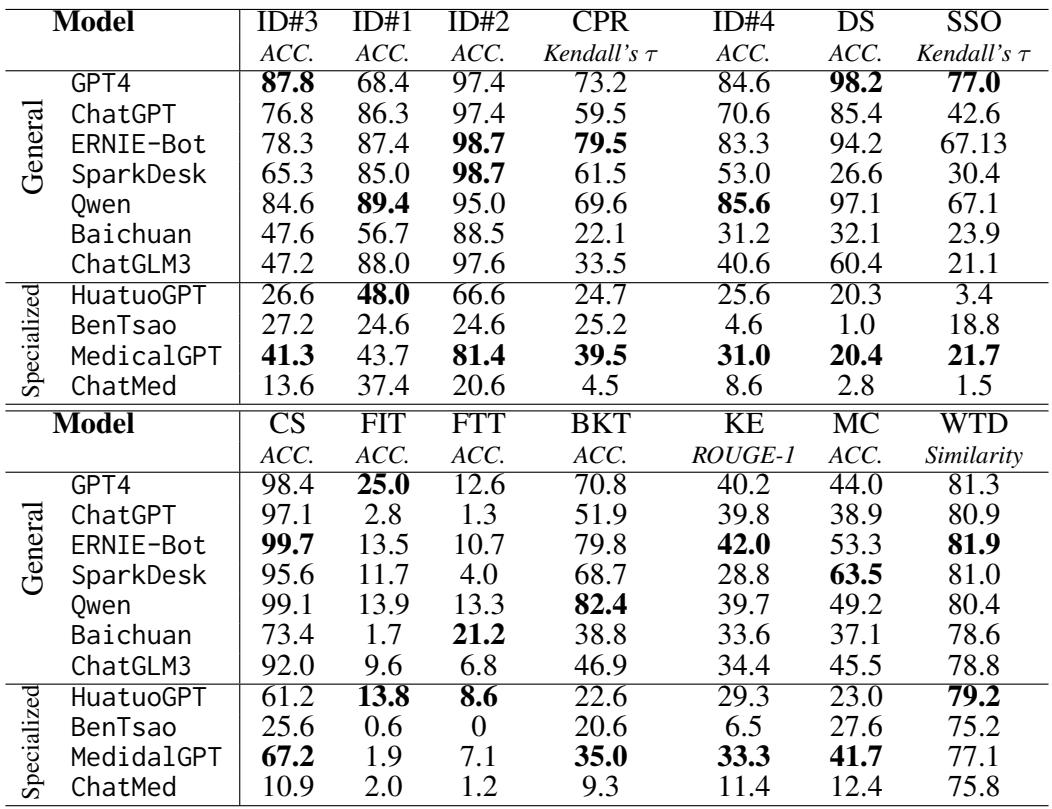
As seen in the table above, general-purpose models dominated the leaderboard:
- Top Performers: GPT-4, ERNIE-Bot, and Qwen consistently scored highest, with average scores hovering around 69.
- Underperformance of Specialists: Specialized Chinese medical LLMs struggled significantly. For example, ChatMed scored very low across almost all categories.
Why did the specialists fail?
The paper suggests that while specialized models have seen medical vocabulary, they lack the reasoning capabilities and language understanding of the massive general models. Clinical scenarios require connecting dots (logic) more than just retrieving facts (memorization).
Key Weaknesses Identified
The study highlighted several critical areas where current technology falls short:
1. Hallucinations and Factual Consistency The researchers included a “False Information Test” (FIT) designed to trigger hallucinations. When fed misleading inputs, model accuracy plummeted from ~47% (on basic knowledge) to ~8%. This shows that models are easily swayed by incorrect premises in a prompt—a dangerous flaw in a clinical setting.
2. The Context Window Problem Real medical records are long. They contain pages of lab results, history, and notes. The study found that as the input length increased, performance dropped for all models.
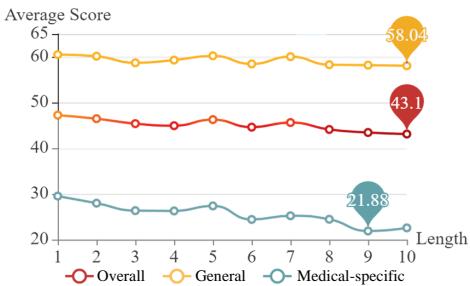
The graph above illustrates this decline. Notice the “Medical-specific” line (green/teal) specifically struggles, trending downward as complexity and length increase. This limited input capacity is a major barrier to practical deployment.
3. Multimodal Limitations Doctors don’t just read text; they look at scans. The researchers tested GPT-4V (the vision-enabled version of GPT-4) on ultrasound and MRI images.
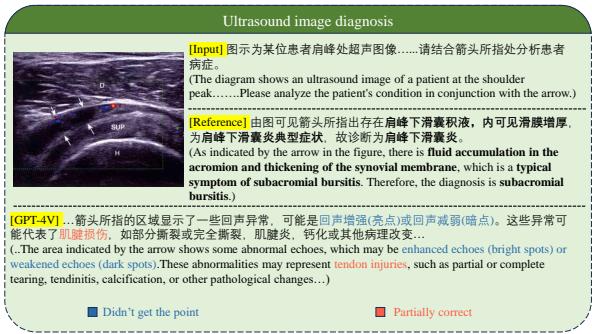
In the example above, GPT-4V correctly identifies the image as an ultrasound of a shoulder but fails to identify the specific pathology (subacromial bursitis) indicated by the arrow. It often responds with vague disclaimers. Currently, the “eyes” of Medical AI are not sharp enough for diagnosis.
A Novel Evaluation Method: Agent-Based CAT
One of the logistical problems with benchmarking LLMs is the cost. Running 33,000+ questions on GPT-4 is expensive and time-consuming. To solve this, the researchers adapted a technique from psychometrics called Computerized Adaptive Testing (CAT).
Think of CAT like the GRE or GMAT exams. If you answer a question correctly, the next one gets harder. If you answer incorrectly, it gets easier. This allows the test to pinpoint your exact ability level with far fewer questions.
The researchers proposed an Agent-based CAT system.
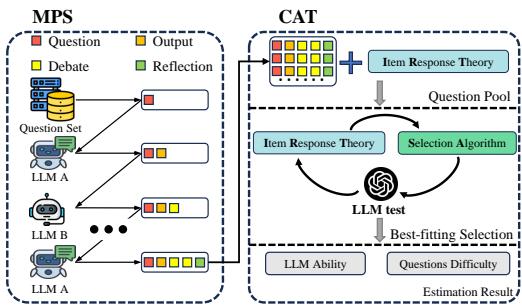
How it works:
- Multi-Agent Participant Synthesis (MPS): Because they didn’t have thousands of human test-takers to calibrate the difficulty of every question, they used LLMs to simulate students taking the test. This “synthetic data” helped establish the difficulty curves (Item Response Theory) for the questions.
- Adaptive Selection: The system selects the “best-fitting” question to ask next based on the model’s previous answers.
The Result: Using only 243 questions (less than 1% of the full dataset), the Agent-based CAT approach produced a ranking of models that was highly consistent with the full evaluation.
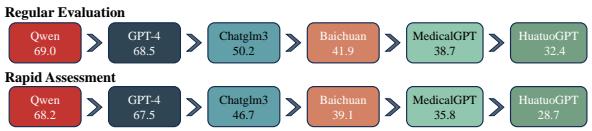
As shown above, the relative ranking of the models (Qwen > GPT-4 > ChatGLM > etc.) remains almost identical between the massive “Regular Evaluation” and the efficient “Rapid Assessment.” This is a significant contribution to the field, making model evaluation faster and cheaper.
Conclusion and Implications
CliMedBench serves as a reality check for the medical AI community. It demonstrates that high scores on exam-based benchmarks do not translate to clinical competence.
The key takeaways for students and researchers are:
- General Intelligence Wins (For Now): Strong reasoning capabilities found in large foundation models (like GPT-4 and Qwen) currently trump domain-specific training on smaller models.
- Data Matters: We need to move away from textbook data and embrace the messy, complex reality of de-identified EHRs to train and test robust models.
- Safety First: The high rates of hallucination and susceptibility to interference in these models indicate they are not yet ready to act as autonomous agents in healthcare.
By providing a rigorous, realistic testing ground, CliMedBench pushes the field toward developing AI that is not just “book smart,” but “street smart” enough for the hospital ward.