](https://deep-paper.org/en/paper/2410.03531/images/cover.png)
Opening the Black Box: How MARE Extracts Multi-Aspect Rationales from Text
Deep learning models, particularly those based on Transformers like BERT, have revolutionized text classification. They can read a movie review and tell you with high accuracy whether it’s positive or negative. But there is a persistent problem: these models are “black boxes.” They give us a prediction, but they rarely tell us why they made it.
In high-stakes domains like healthcare, law, or finance, “because the model said so” isn’t good enough. We need rationales—specific snippets of text that justify the model’s decision.
While researchers have developed methods for Unsupervised Rationale Extraction (finding these snippets without human labels), most existing approaches suffer from a significant limitation: they are uni-aspect. They can only look for one type of explanation at a time. If you want to know why a beer review is positive regarding its taste AND its aroma, you would typically need to train two completely separate models.
In this post, we are doing a deep dive into a research paper that proposes a sleek solution to this inefficiency. We will explore MARE (Multi-Aspect Rationale Extractor), a unified framework that predicts and explains multiple aspects of a text simultaneously. We will break down how it uses a novel attention mechanism to isolate different aspects and how it employs “hard deletion” to ensure the explanations are genuine.
The Problem: One Track Minds
To understand why MARE is necessary, let’s look at the data it deals with. Consider a review from the BeerAdvocate dataset. A single review often comments on multiple aspects of the beer: its appearance, its aroma, and its palate (taste/texture).
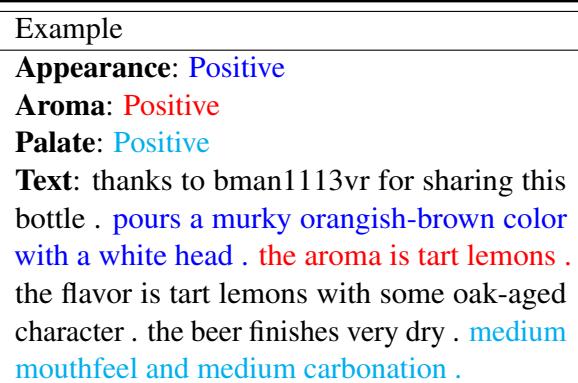
As you can see in Table 1 above, different parts of the sentence support different labels. The phrase “murky orangish-brown color” supports the Appearance rating, while “tart lemons” supports the Aroma rating.
The Uni-Aspect Limitation
Traditional unsupervised rationale extraction models follow the structure shown in Figure 1(a) below. If you have three aspects (Appearance, Aroma, Palate), you must train three independent models.
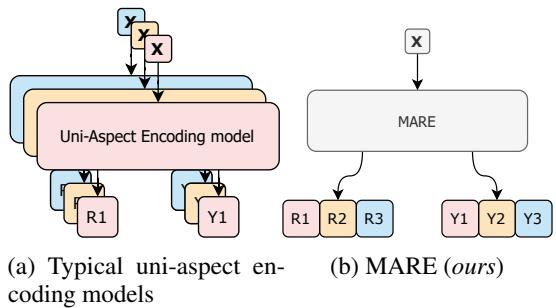
This approach has two major flaws:
- Inefficiency: It is computationally expensive and labor-intensive to train and maintain separate models for every aspect you care about.
- Loss of Correlation: Aspects are often internally correlated. A beer with a “chemically” smell (Aroma) is likely to have a bad taste (Palate). Independent models cannot share this knowledge; they operate in silos.
MARE (Figure 1b) changes this paradigm. It takes the input text once and outputs predictions and rationales for all aspects simultaneously. It achieves this by “collaborative encoding,” allowing the model to learn the internal correlations between different aspects.
The Architecture of MARE
How does MARE manage to process multiple aspects at once without getting them confused? The secret lies in how it structures the input and how it modifies the Transformer’s attention mechanism.
1. Multi-Aspect Input Strategy
Standard BERT models take an input starting with a [CLS] token (used for classification). MARE modifies this by prepending multiple special tokens, one for each aspect.
If we have \(k\) aspects (e.g., Appearance, Aroma, Palate), the input sequence looks like this:
[Aspect_1] [Aspect_2] ... [Aspect_k] [Word_1] [Word_2] ... [Word_n]
Each special token acts as an aggregator for information specific to its aspect.
2. Multi-Aspect Multi-Head Attention (MAMHA)
The core innovation of this paper is the MAMHA block. In a standard Transformer, the self-attention mechanism allows every token to attend to every other token. However, for rationale extraction, we want to filter out irrelevant words before the final prediction.
MAMHA splits the attention process into two parallel tracks:
- The Multi-Aspect Controller (MAC): This track decides which words are important for which aspect. It generates a “mask” (a filter).
- The Multi-Head Attention (MHA): This is the standard Transformer attention, but it uses the mask generated by the MAC to block out irrelevant information.
Let’s look at the overall architecture:
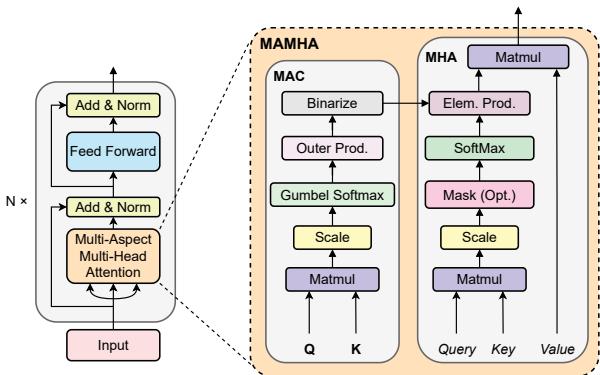
As shown in Figure 3, the MAMHA block replaces the standard attention block in the Transformer layers.
The Multi-Aspect Controller (MAC)
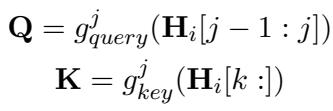
The MAC’s job is to figure out the rationale mask. For every word in the sentence, and for every aspect, it needs to make a binary decision: keep the word (1) or delete it (0).
To do this, it first calculates a similarity score between the special aspect tokens and the regular text tokens.
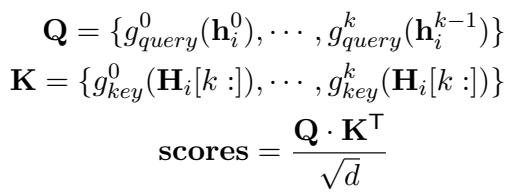
Here, \(g_{query}\) and \(g_{key}\) are mapping functions (neural network layers). The model calculates the dot product between the aspect token (Query) and the text tokens (Key) to get a score.
However, we need a hard binary decision (keep/drop), but standard thresholding isn’t differentiable (you can’t train it with backpropagation). To solve this, the authors use the Gumbel-Softmax trick. This allows the model to sample from a categorical distribution in a way that allows gradients to flow backward during training.

The result, \(\mathbf{m}\), is a matrix of 0s and 1s, where \(m[i,j]=1\) means the \(j\)-th word is a rationale for the \(i\)-th aspect.
Visualizing the Controller
To visualize what the MAC is doing, look at Figure 4.
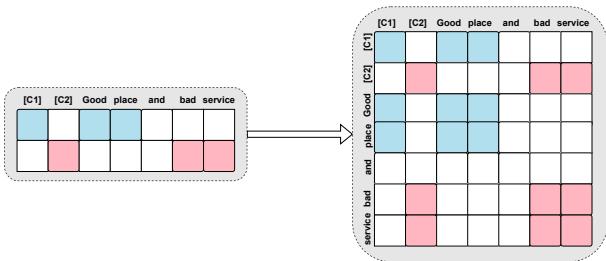
On the left, we see the decisions for two aspects: [C1] (Location) and [C2] (Service).
- For Location (
[C1]), it selects “Good place”. - For Service (
[C2]), it selects “bad service”.
On the right, notice the grid. This represents the attention mask. The model ensures that the [C1] token can only “see” “Good place,” and [C2] can only “see” “bad service.” Crucially, the words “Good place” can see each other, but they cannot see “bad service.”
The “Hard Deletion” Mechanism
One of the most technical but important contributions of this paper is how it handles deletion.
In previous works (like a method called Attention Mask Deletion or AMD), researchers would simply set the attention score of deleted words to zero. This sounds correct, but in Transformers, it leads to a problem called “Information Leakage.”
The Leakage Problem
In a Transformer, the [CLS] token (or in this case, the Aspect tokens) usually attends to all other tokens. Even if you mask out “Word A” so “Word B” can’t see it, “Word B” might still be able to infer information about “Word A” indirectly through the [CLS] token if the masking isn’t done perfectly across all layers.
The authors illustrate this difference in Figure 2.
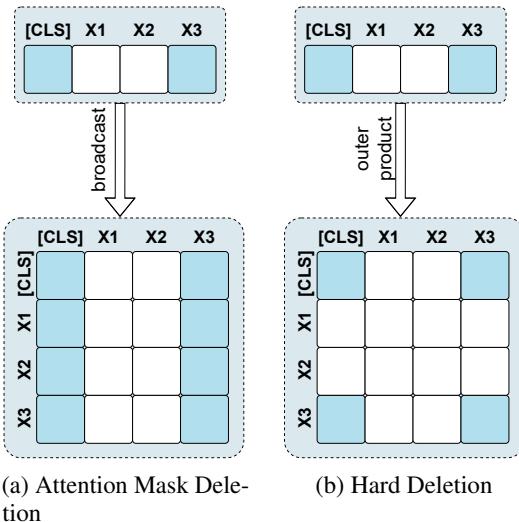
In Figure 2(a) (the old way), the broadcast operation allows some information to remain in the background representation. In Figure 2(b) (MARE’s way), they use an Outer Product operation. This ensures that if a token is deleted, its row and column in the attention matrix are completely zeroed out. It effectively ceases to exist for that calculation.
The Math of Hard Deletion
To achieve this rigorous deletion, the model calculates the outer product of the mask vector \(\mathbf{m}\).
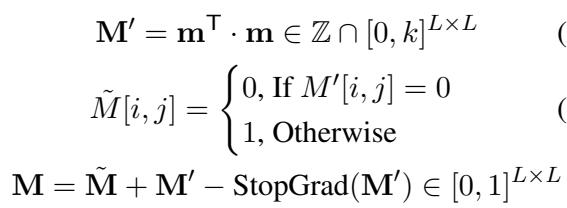
This creates a matrix \(\mathbf{M}\) where a value is non-zero only if both the row token and the column token are selected rationales.
Finally, this mask is applied to the attention scores:

By multiplying the attention matrix \(\mathbf{A}\) by the mask \(\mathbf{M}\), the model forces the attention scores between unrelated or deleted tokens to be exactly zero.
Implementation in Code
For the students who prefer code to math, the authors provided a snippet showing exactly how this “Hard Deletion” is implemented in PyTorch.
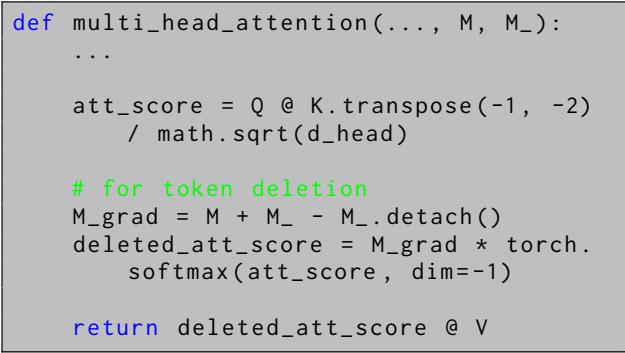
Notice M_grad = M + M_ - M_.detach(). This is a classic “Straight-Through Estimator” trick. It allows the binary mask M_ (which has no gradient) to be used in the forward pass, while passing the gradients through M (the soft probability) during the backward pass.
Training Strategy: Multi-Task Learning
Even though MARE can predict all aspects at once, we often lack training data where every single aspect is labeled for every single sentence. For example, a hotel review might only be tagged with “Cleanliness: 5 stars” but have no tag for “Location.”
To handle this, MARE uses Multi-Task Training.
The model trains on aspects in a round-robin fashion. If the current batch of data is about Aspect \(j\), the model only activates the Query/Key generators for that specific aspect.
This saves massive amounts of memory. As shown in the ablation study later, multi-task training used 17.9% less memory and was 25.2% faster than trying to train all aspects simultaneously, while achieving slightly better results because it prevents early-stage confusion.
The Loss Function
The model is trained to minimize a combination of three things:
- Cross Entropy (\(L_{CE}\)): Did it predict the sentiment correctly?
- Sparsity (\(L_{sparse}\)): Did it select as few words as possible? (We want concise rationales, not the whole text).
- Continuity (\(L_{cont}\)): Are the selected words next to each other? (We prefer phrases like “great service” over scattered words like “great … … … service”).
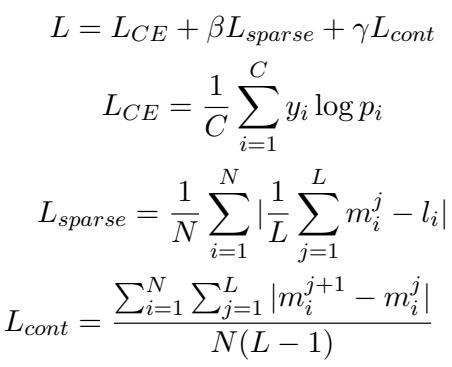
The parameters \(\beta\) and \(\gamma\) control how much the model cares about brevity and continuity versus accuracy.
Experiments and Results
The researchers tested MARE on two benchmark datasets: BeerAdvocate and Hotel Review.
BeerAdvocate Results
The BeerAdvocate dataset is difficult because the ratings are often highly correlated (a great beer usually gets high scores everywhere). The authors used a “decorrelated” version of the dataset to really test the model’s ability to find specific rationales.
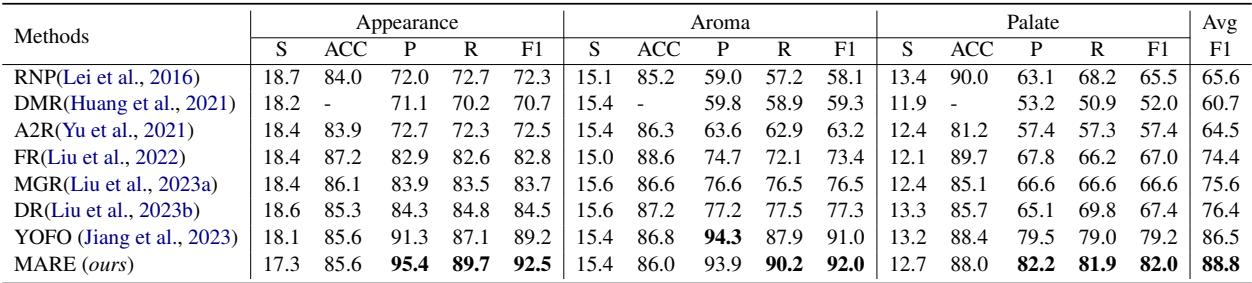
Table 2 shows the performance on the “High-Sparse” setting (meaning the model is forced to pick very few words).
Key Takeaways from Table 2:
- F1 Score: This is the most important metric here, measuring the overlap between the model’s selected rationale and the human-annotated rationale.
- Dominance: MARE (bottom row) achieves an average F1 of 88.8%, beating the previous state-of-the-art (YOFO) which scored 86.5%.
- Consistency: It outperforms other models across all three aspects (Appearance, Aroma, Palate).
Hotel Review Results
The Hotel Review dataset poses a different challenge: the test set has annotations for three aspects (Location, Service, Cleanliness), but the training data is usually single-label.
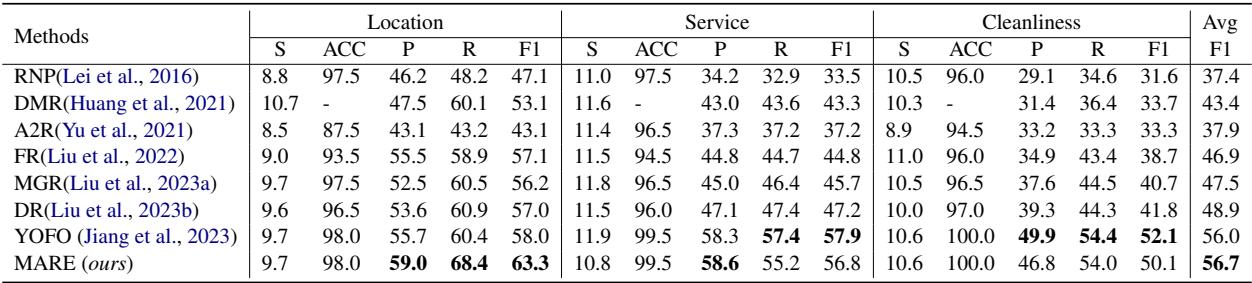
As seen in Table 5, MARE performs exceptionally well on “Location” (63.3 F1 vs 58.0 for YOFO). It is slightly lower on Service and Cleanliness but achieves the highest average F1 score overall (56.7).
Seeing is Believing: Case Studies
Numbers are great, but does it actually work on real text? Table 6 illustrates MARE in action.
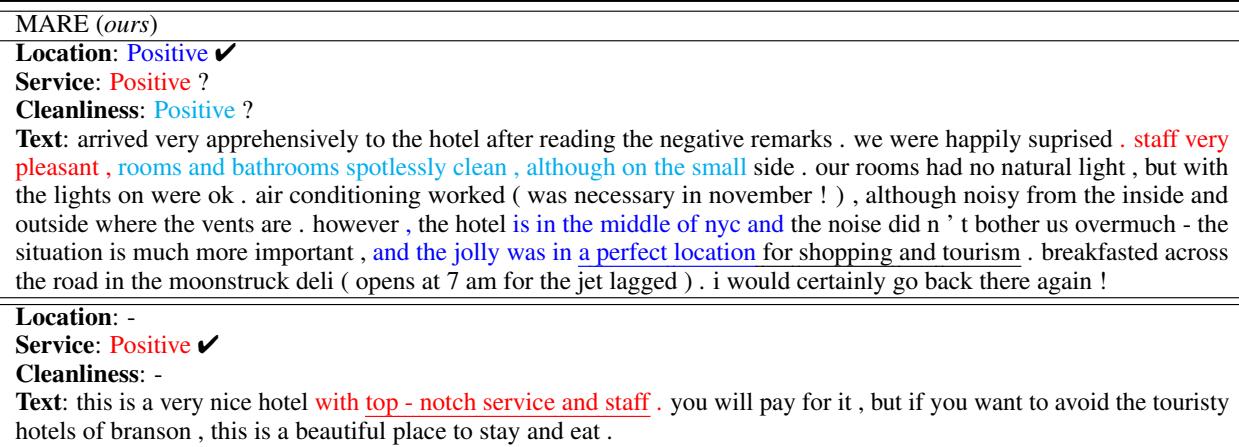
In the first example, the review discusses multiple things. Even though the example might only be labeled for “Location,” MARE successfully identifies:
- Service rationale: “Staff very pleasant”
- Cleanliness rationale: “rooms and bathrooms spotlessly clean”
- Location rationale: “perfect location for shopping and tourism”
This confirms that MARE successfully disentangles the different aspects woven into a single paragraph.
Ablation Studies: Did the New Components Work?
The authors performed “ablation studies”—removing parts of the model to see if they were actually necessary.
1. Does Hard Deletion Matter?
They compared their “Hard Deletion” (using outer products) against “Attention Mask Deletion” (AMD).
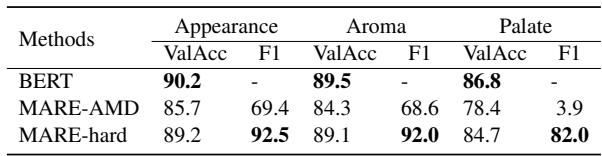
Table 8 shows a massive difference. MARE-AMD (the soft masking version) collapses, with F1 scores dropping to 69.4 and even 3.9 for Palate. MARE-hard stays in the 90s. This proves that the standard masking technique allows for too much information leakage in this specific architecture, and Hard Deletion is essential.
2. Multi-Task vs. Collaborative Training
Is it better to train all aspects at once (Collaborative) or one by one (Multi-Task)?

Table 7 reveals that Multi-Task training (one aspect at a time) is not only lighter on memory (19GB vs 24GB) and faster (25 min vs 34 min), but it also yields slightly higher F1 scores. This suggests that forcing the model to learn everything at once from step zero might overwhelm it, while cycling through tasks creates a more robust encoder.
Conclusion
The Multi-Aspect Rationale Extractor (MARE) represents a significant step forward in making AI interpretable. By moving away from the “one model, one aspect” limitation, it offers a more efficient and rigorous way to extract explanations from text.
Its success relies on two clever engineering decisions:
- Hard Deletion via Outer Products: Ensuring that when a model ignores a word, it really ignores it, preventing information leakage.
- Multi-Aspect Controller: A mechanism that dynamically sorts words into different aspect “buckets” within a single pass.
For students and practitioners, MARE demonstrates that we don’t always need bigger models to get better results—sometimes we just need a smarter architecture that better models the structure of our data.