](https://deep-paper.org/en/paper/2410.03545/images/cover.png)
Introduction
In the world of Natural Language Processing (NLP) and Computational Social Science (CSS), we are often obsessed with the “State of the Art.” We chase higher F1 scores and accuracy percentages, celebrating every fractional increase on the leaderboard. But what if those high scores are an illusion? What if our models aren’t actually learning to understand language, but are simply memorizing repeated data points hidden within our training sets?
This is the core question tackled in the paper “Enhancing Data Quality through Simple De-duplication: Navigating Responsible Computational Social Science Research.” The researchers—Yida Mu, Mali Jin, Xingyi Song, and Nikolaos Aletras—conducted a forensic audit of 20 popular datasets used to train models on tasks like hate speech detection, misinformation analysis, and stance detection.
Their findings reveal a pervasive issue: social media datasets are riddled with duplicate and near-duplicate content. This “noise” creates a distorted view of model performance, leading to data leakage and inconsistent labeling.
In this post, we will break down their investigation, explain the mechanics of how data duplication hurts machine learning models, and look at the proposed protocols to fix it. If you are a student or researcher working with social media text, this analysis is critical for ensuring your results are statistically valid.
The Context: Social Media Data is Messy
Research in CSS relies heavily on user-generated content from platforms like Twitter (now X) and Weibo. This data is invaluable for analyzing sociolinguistic phenomena, but it comes with unique characteristics that traditional datasets (like edited news corpora) do not have.
Social media content is highly repetitive.
- Viral Phenomena: During major events (like the COVID-19 pandemic or elections), users often copy-paste text, retweet widely, or use identical hashtags and slogans.
- Bots: Automated accounts amplify specific messages, flooding the network with identical or slightly modified posts.
- Near-Duplicates: A post might be “original” but only differ from another by a single emoji, a URL, or a user mention tag.
When researchers scrape this data to build datasets, they often inherit this repetition. While data cleaning is a standard step in data science pipelines, this paper suggests that the community has been underestimating the severity of duplication.
The Investigation: Auditing 20 Datasets
To understand the scale of the problem, the authors selected 20 representative datasets across four major CSS domains:
- Offensive Language Detection: Identifying hate speech and harassment.
- Misinformation Detection: Spotting fake news and rumors.
- Speech Act & Sentiment Analysis: Detecting sarcasm, complaints, and emotions.
- Stance Detection: Determining a user’s attitude toward a target (e.g., vaccines).
They analyzed these datasets to see how many unique posts existed versus how many were duplicates. They looked at two types of duplication:
- Exact Duplicates: The text is identical after basic preprocessing (replacing URLs and user mentions with placeholders).
- Near-Duplicates: The text is slightly different but semantically the same. They used Levenshtein distance (a string metric for measuring the difference between two sequences) to identify these.
The results of this audit were significant.

As shown in Table 2, the majority of the datasets (18 out of 20) contained duplicate samples. Look closely at the column “Self-claimed Deduplication.” Very few dataset creators (marked with a checkmark) explicitly stated they deduplicated their data.
Consequently, when the authors applied their own cleaning process—replacing special tokens and checking for uniqueness—the size of the datasets often shrank. For example, in the WASEEM dataset (a famous hate speech corpus), the number of distinct posts drops significantly when near-duplicates are removed. This indicates that a large portion of what the model “learns” from is actually repetitive noise.
The Core Problems: Why Duplication Matters
You might ask: “Why is duplication bad? Doesn’t more data help the model learn?”
In deep learning, duplication is dangerous because it violates the assumption that our training and testing data are independent. The authors identify three critical consequences of this data quality issue.
1. Label Inconsistency
When you have duplicate tweets in a dataset, there is a risk that human annotators labeled the same text differently. This confuses the model. If the input is \(X\), and the training data says the label is Neutral in row 500 but Against in row 1000, the model cannot learn a reliable decision boundary.
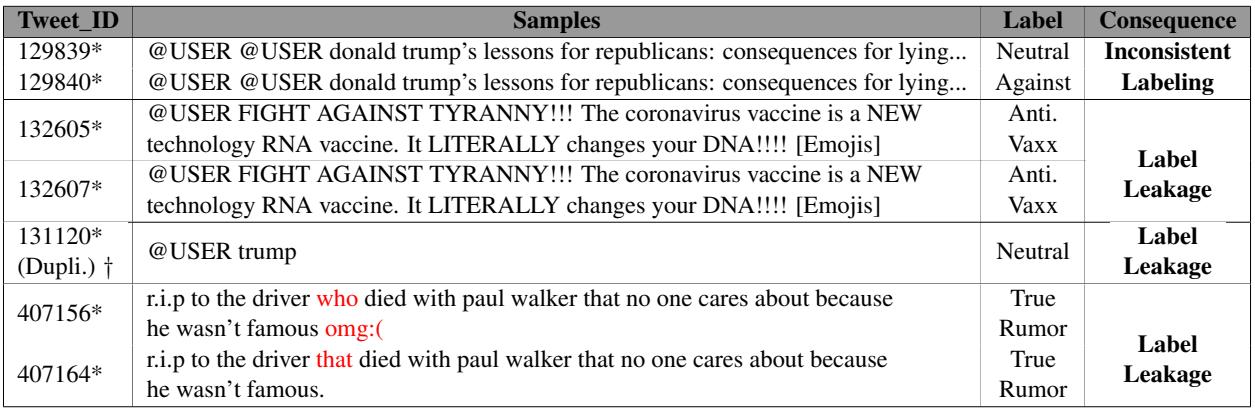
Table 1 provides a striking example of this. Look at the first two rows (Tweet_ID 129839 and 129840). The text is identical: “donald trump’s lessons for republicans: consequences for lying…” Yet, one entry is labeled Neutral and the other Against.
Further down, we see instances of Label Leakage. Duplicate tweets (Tweet_ID 132605 and 132607) regarding vaccines appear twice. If one of these ends up in the training set and the other in the test set, the model isn’t predicting—it’s recalling.
2. Data Leakage and Performance Inflation
This leads to the second major issue: Data Leakage.
Standard machine learning practice involves splitting data into a Training Set (80%) and a Test Set (20%). The Test Set must remain unseen. However, if your dataset contains duplicates, and you split it randomly, you will likely end up with the same tweet in both sets.
During testing, the model sees a tweet it has already memorized during training. It outputs the correct label not because it understands the semantics, but because it has “seen” the answer key. This artificially inflates the performance metrics (Accuracy and F1 Score), making the model look better than it actually is.
3. Model Ranking Instability
This issue affects the entire field’s progress. Researchers compare their models against baselines. If Model A scores 85% and Model B scores 86%, Model B is declared the “State of the Art” (SoTA). However, if that 1% difference is due to how well Model B memorized duplicates, the comparison is invalid. The authors hypothesize that cleaning the data might change which models are actually considered superior.
Experiments & Results
To test their hypotheses, the researchers trained standard BERT-style models (like BERTweet) on the datasets in three configurations:
- Original: As downloaded, with duplicates.
- w/o Duplicates: Exact duplicates removed from the training set if they appear in the test set.
- w/o Near-Duplicates: Similar tweets removed using Levenshtein distance.
The Performance Drop
The most immediate result was a drop in predictive performance across the board. When you remove the “cheat sheet” (the duplicates), the test becomes harder.
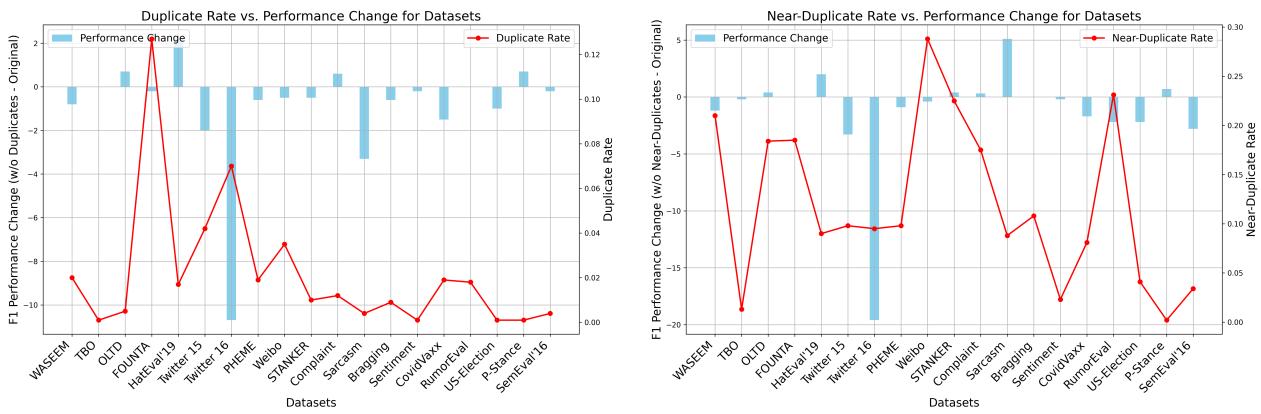
Figure 1 visualizes this impact.
- Left Chart (Exact Duplicates): The blue bars represent the change in F1 score. Notice that almost all bars go downward (negative values). The dataset Twitter ‘16 shows a massive drop in performance.
- Right Chart (Near-Duplicates): The trend continues. As you remove near-duplicates (which requires a more aggressive cleaning strategy), the performance drops further.
This confirms that current performance claims in CSS literature are likely overestimated. The models are not as robust as we thought.
LLMs vs. Fine-Tuned Models
With the rise of Large Language Models (LLMs), one might wonder if zero-shot learning (using models like GPT-4) avoids this problem since they aren’t fine-tuned on the specific noisy training set.
The authors compared GPT-4o and LLaMA-3 (zero-shot) against BERTweet (fine-tuned).

Table 4 highlights an interesting dynamic.
- Even after cleaning (w/o Near-dupl), the fine-tuned BERTweet generally outperforms the zero-shot LLMs on tasks like Complaint Detection and Sarcasm.
- This suggests that we cannot simply abandon supervised learning for LLMs to solve data quality issues. We still need fine-tuned models, which means we still need to fix the datasets.
Ranking Instability
Perhaps the most concerning finding for researchers is that data duplication scrambles the leaderboard. The authors saved 5 different checkpoints of their models during training (epochs 6 through 10) and ranked them by F1 score.
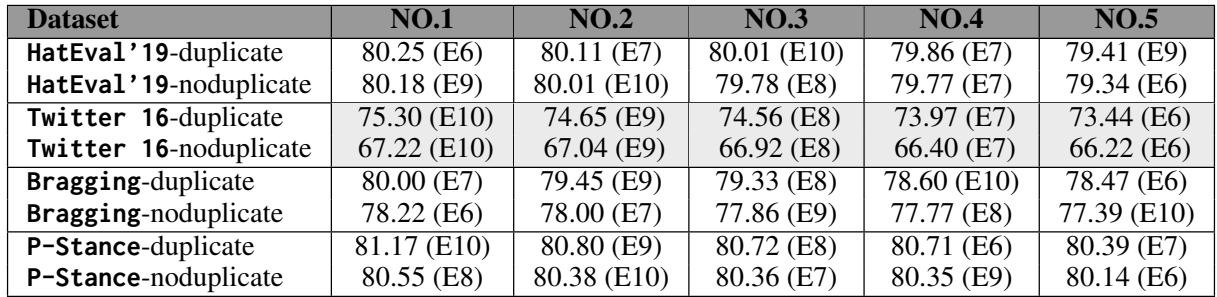
Table 5 shows the chaos.
- In HatEval'19, the best model was from Epoch 6 when duplicates were present. After cleaning, the best model was from Epoch 9.
- In Twitter 16, the rankings shifted significantly.
This implies that hyperparameter tuning and model selection performed on “dirty” data might lead researchers to choose the wrong model configurations. A model that looks stable on a duplicate-heavy dataset might just be the one that overfitted the fastest.
Error Analysis
Finally, the authors performed an error analysis to see exactly what the models were predicting wrong.
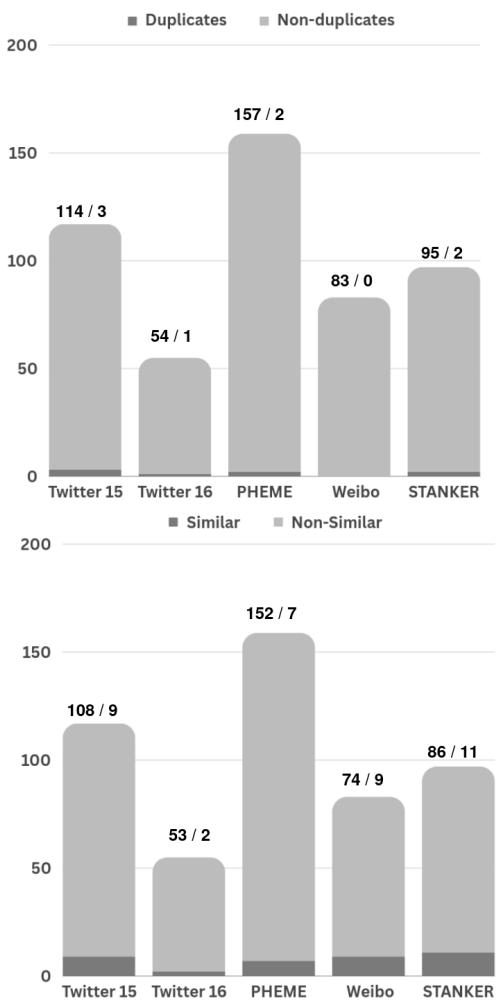
Figure 2 offers a nuance to the story. The bars represent the ratio of duplicates found in the wrong predictions.
- The dark gray sections (duplicates) are very small compared to the light gray sections.
- This means that models rarely get the duplicates wrong.
If a sample is duplicated between train and test, the model almost always predicts it correctly. The errors (light gray) are concentrated in the non-duplicated, unique samples. This proves that the duplicates are providing “free points” to the accuracy score, masking the model’s struggle with unique, unseen data.
Implications and Recommendations
The paper concludes that while the CSS community has focused heavily on complex model architectures, it has neglected the fundamental quality of the data. The authors propose several changes to research protocols.
1. Pre-Annotation Cleaning
The best time to handle duplicates is before human annotation. By running de-duplication scripts (using Levenshtein distance) on the raw data, researchers can:
- Save money (fewer tweets to pay annotators to label).
- Prevent label inconsistency (a single tweet won’t be sent to two different annotators who might disagree).
2. Standardized Checklists
Conferences like ACL and ICWSM already use “Ethics and Reproducibility Checklists.” The authors argue for a “minor revision” to these forms. Authors should be explicitly asked:
- Did you perform data deduplication?
- How did you handle near-duplicates?
3. Reporting Multiple Baselines
When releasing a new dataset, developers should provide both the “raw” version and the “deduplicated” version. Benchmarks should report performance on the cleaned version to prevent future researchers from chasing inflated scores.
Conclusion
Data is the fuel for our computational engines. If the fuel is contaminated, the engine’s performance metrics become meaningless. This research by Mu et al. serves as a wake-up call for undergraduate and master’s students entering the field: Don’t trust the dataset blindly.
High accuracy on a social media dataset might just mean the model is good at memorizing viral retweets. By applying simple de-duplication strategies—specifically checking for exact matches and near-neighbor text similarity—we can strip away the noise. The resulting scores might be lower, but they will be honest. And in science, an honest 70% accuracy is infinitely more valuable than a fake 90%.