](https://deep-paper.org/en/paper/2410.03594/images/cover.png)
Imagine you are a doctor reading a patient’s forum post on Reddit. The patient writes, “I haven’t taken my 12mg dose since Thursday… struggling with the shakes.”
As a human, you immediately understand several things:
- The Event: The patient is tapering off medication or withdrawing.
- Implicit Information: Even though they didn’t explicitly say “I stopped taking my meds,” the context implies a “Stop” event.
- Scattered Information: The dosage (12mg) and the timing (since Thursday) are separated from the symptoms (shakes), yet they all belong to the same medical event.
For years, Natural Language Processing (NLP) models have treated Event Extraction (EE) like a student with a highlighter. They look for specific, continuous spans of text to identify “Who,” “What,” and “When.” But as the example above shows, real-world communication—especially online discourse—is rarely that tidy.
In this post, we are deep-diving into a research paper that challenges the traditional “highlighting” paradigm. The paper, “Explicit, Implicit, and Scattered: Revisiting Event Extraction to Capture Complex Arguments,” introduces a new dataset and a new way of thinking: treating event extraction not as a search-and-highlight task, but as a text generation problem.
The Problem with Traditional Event Extraction
To understand the innovation here, we first need to understand the status quo. Event Extraction typically involves two sub-tasks:
- Event Detection (ED): Identifying that an event happened (e.g., classifying a sentence as a “Medical Procedure”).
- Event Argument Extraction (EAE): Finding the details (arguments) associated with that event (e.g., Patient Name, Doctor Name, Date).
Historically, EAE has been formulated as a span extraction problem. The model is trained to find a contiguous start and end index in the sentence that answers a question.
This works beautifully for formal text like news articles: “On Monday [Time], Apple [Company] announced a new iPhone [Product].”
However, this method crumbles when faced with informal social media text. Why? Because humans often speak in subtext. We imply things. We scatter details across multiple sentences. A model looking for a single, continuous phrase will miss the forest for the trees.
Introducing the Three Argument Types
The researchers behind this paper argue that to truly model complex events, we must categorize arguments into three distinct types.
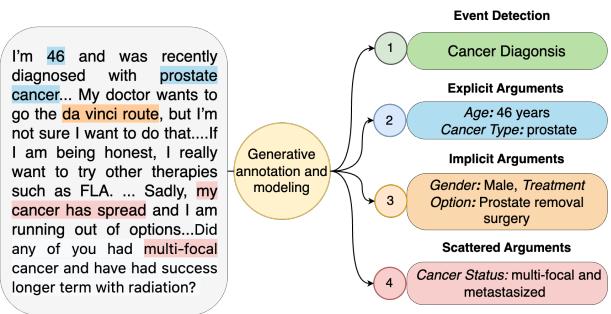
As illustrated in Figure 1 above, utilizing a real-world Reddit post about a prostate cancer diagnosis, we can see the breakdown:
- Explicit Arguments: These are the easy ones. They are contiguous spans of text directly mentioned in the document. In the figure, “46” (Age) and “prostate” (Cancer Type) are explicitly stated.
- Implicit Arguments: These are details not directly mentioned but inferred through context. In Figure 1, the text mentions the “da vinci route.” A human (or a smart model) knows this implies the Treatment Option is “Prostate removal surgery,” even though those exact words never appear.
- Scattered Arguments: These arguments are composed of multiple pieces of information dispersed throughout the text. The patient mentions “multi-focal” in one sentence and implies “spread” in another. Together, they form the Cancer Status: “multi-focal and metastasized.”
Traditional extractive models fail miserably at #2 and #3. If the words aren’t there, or if they aren’t next to each other, a span-based model returns nothing.
DiscourseEE: A New Dataset for Health Advice
To tackle this, the researchers curated a novel dataset called DiscourseEE. They focused on a domain where understanding nuance is critical: online health discourse regarding Opioid Use Disorder (OUD).
Analyzing how people discuss treatment, relapse, and tapering on social media can provide massive insights for public health. However, this data is incredibly messy.
The Event Ontology
The researchers defined a hierarchy of events to structure this unstructured chaos.
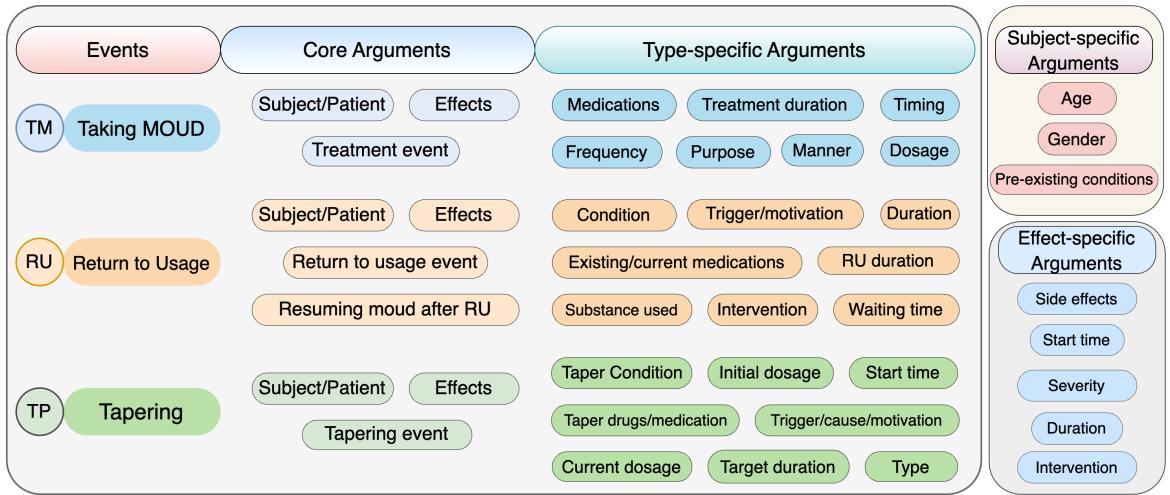
As shown in Figure 3, the ontology covers three main event types:
- Taking MOUD: Discussions about medication regimens (dosage, frequency).
- Return to Usage: Discussions about relapse or using substances during recovery.
- Tapering: Discussions about reducing dosage or quitting.
For each event, the model must extract four layers of arguments:
- Core Arguments: The high-level summary (Who is the patient? What is the event?).
- Type-Specific: Nitty-gritty details (What was the trigger? What is the goal dosage?).
- Subject-Specific: Demographics (Age, Gender).
- Effect-Specific: Outcomes (Side effects, severity).
Annotation: A Human-LLM Collaboration
Creating a dataset with this level of complexity is difficult. You can’t just ask crowd-workers to “highlight the text” because, as we established, the text might not be there explicitly.
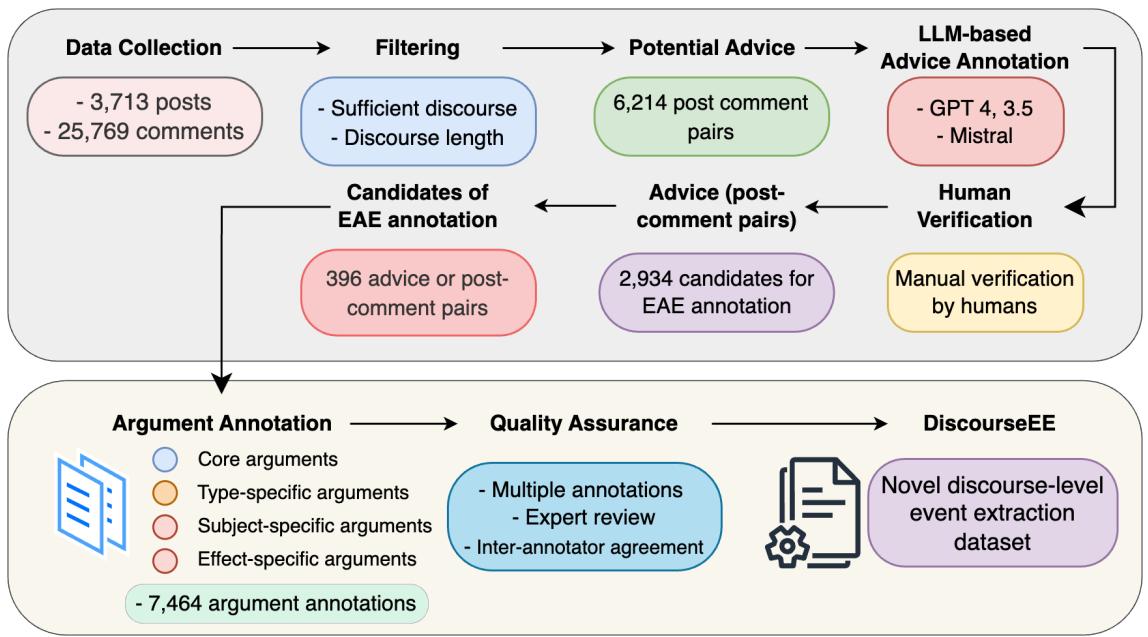
The team developed a sophisticated pipeline (Figure 5) involving:
- Filtering: Selecting threads from Reddit with sufficient depth.
- Advice Identification: Using GPT-4 to identify comments that actually offer advice/answers, rather than just chit-chat.
- Human Annotation: Expert annotators were trained to write out the arguments (generative annotation) rather than just selecting text spans.
The resulting dataset, DiscourseEE, contains over 7,400 argument annotations. Crucially, 51.2% of these arguments are implicit, and 17.4% are scattered. This confirms that traditional models would fail on nearly 70% of the data.
The Paradigm Shift: Extraction via Generation
Since the answers aren’t always explicitly in the text, the researchers reformulated the task. Instead of asking the model, “Where in the text is the answer?”, they ask: “Read this text and generate a natural language answer.”
This moves Event Extraction into the realm of Text Generation.
The Architecture
The researchers benchmarked several models, but the methodology for the generative approach is distinct. They utilized Large Language Models (LLMs) like Llama-3, Mistral, and GPT-4, as well as instruction-tuned models like FLAN-T5.
They employed a Question-Answering (QA) format. For example:
- Input: The Reddit post + A question (e.g., “What are the tapering steps?”).
- Output: The model generates a text string (e.g., “Goal dosage is 0mg”).
Crucially, in the “tapering” example, the text might never say “0mg.” It might say “I want to be clean.” The model generates “0mg” based on its understanding of the word “clean” in this context. A span-based model would return null.
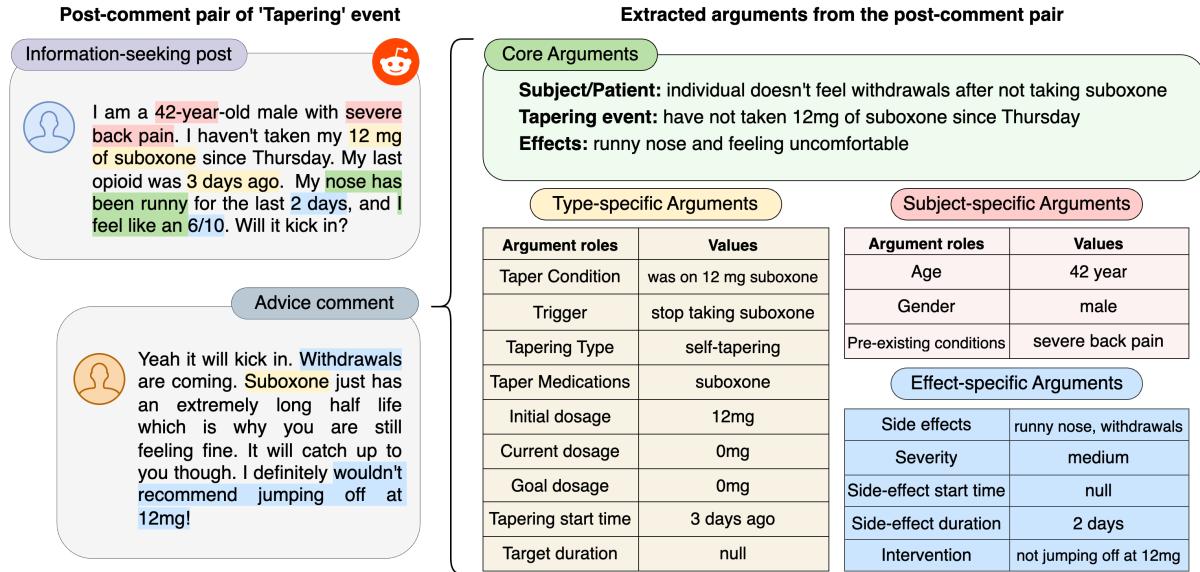
Figure 2 provides a concrete look at what the model is trying to produce. Notice the Core Arguments section. The model synthesizes the “Tapering Event” into a coherent summary: “haven’t taken 12mg of suboxone since Thursday.” This synthesis requires understanding the whole document, not just matching keywords.
Experiments and Results
So, how did the models perform? The researchers compared:
- Extractive-QA (Baseline): A BERT-based model that looks for spans.
- Generative-QA: FLAN-T5 (Base and Large) fine-tuned to generate answers.
- LLMs: Zero-shot prompting of Llama-3, Mistral, Gemma, and GPT-4.
The Metric Dilemma: Exact vs. Relaxed Match
Evaluating generative models is tricky.
- Ground Truth: “Runny nose”
- Model Prediction: “Nasal discharge”
If you use Exact Match (EM), the model gets a score of 0. But semantic, it’s correct. To solve this, the researchers used a Relaxed Match (RM) metric based on semantic similarity (using BERT embeddings). If the similarity score is above 0.75, it counts as a match.
The Leaderboard
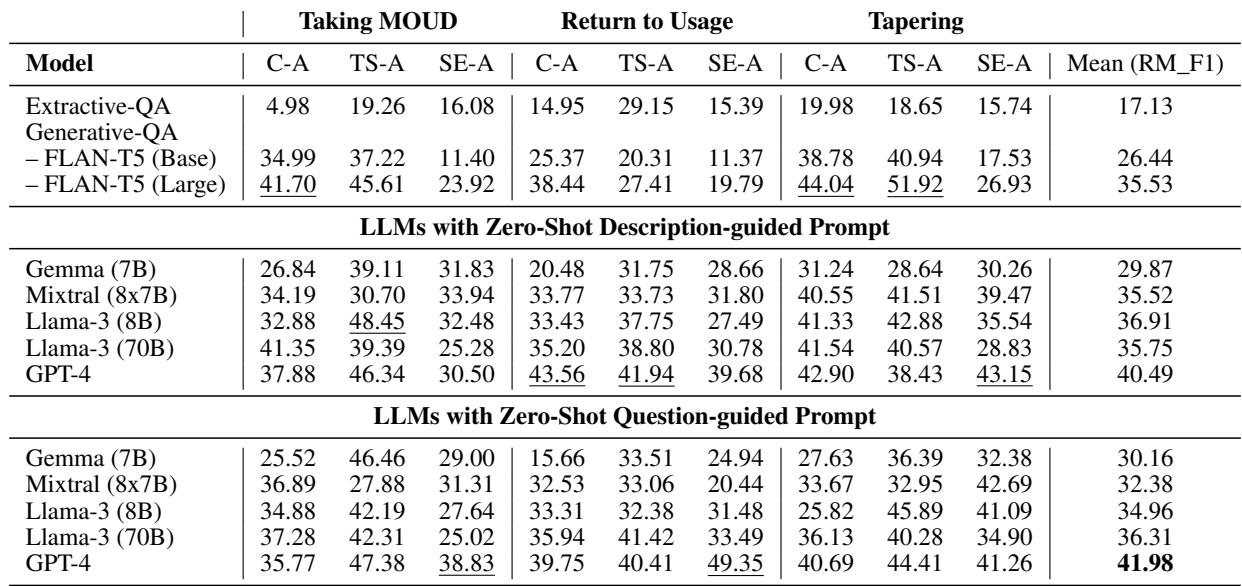
Table 3 reveals the landscape of current capabilities:
- GPT-4 Reigns Supreme: With a Relaxed Match F1 score of 41.98, GPT-4 (using question-guided prompts) outperformed all other models.
- Extractive Models Fail: The Extractive-QA baseline scored a measly 17.13. This empirically proves that traditional span-extraction is insufficient for complex discourse.
- Size Isn’t Everything (Sort of): The fine-tuned FLAN-T5 Large (780M parameters) scored 35.53, beating out the much larger zero-shot Mixtral (8x7B) and coming close to Llama-3. This highlights the value of instruction tuning on domain-specific data.
The Challenge of Implicit Arguments
While GPT-4 performed “best,” a 42% F1 score is hardly solved. The breakdown shows where the difficulty lies.
While not visually presented here, the data in the paper (Table 5) showed that Extractive models captured only 9.4% of implicit arguments. Generative models improved this significantly, with GPT-4 capturing roughly 36%. This is a massive leap, but it also means the state-of-the-art AI still misses the majority of subtext in complex human discussions.
Implications and Future Directions
This paper marks a pivotal moment for Event Extraction. It forces us to acknowledge that “extracting” information often requires “generating” understanding.
Key Takeaways for Students:
- Real World Data is Scattered: If you are building NLP tools for social media, you cannot rely on sentences being grammatically perfect or information being contiguous.
- Generative > Extractive: For complex tasks, we are moving away from classification/tagging and toward generation. This allows for capturing implicit knowledge.
- Evaluation is Hard: As we move to generative models, we need better metrics than “Exact Match.” Semantic evaluation is the new standard.
The DiscourseEE dataset opens the door for new research into how machines can understand the unsaid parts of our conversations. Whether it’s detecting misinformation, understanding mental health crises, or simply summarizing advice, the ability to read between the lines (implicit) and connect the dots (scattered) is the next frontier in NLP.