](https://deep-paper.org/en/paper/2410.03798/images/cover.png)
Large Language Models (LLMs) like GPT-4 and Llama have revolutionized how we interact with text. They can reason, summarize, and translate with ease. However, when we try to extend these capabilities to the auditory world—creating Large Speech-text Models (LSMs)—we hit a stumbling block.
Ideally, we want an LSM to process speech just as fluently as it processes text. You should be able to speak a sentence and ask the model to translate it, extract keywords, or analyze the sentiment, directly from the audio. But current training methods face a significant resource hurdle. Unified pre-training requires massive computational power, and while fine-tuning on speech datasets seems efficient, it often results in models that simply transcribe what they hear, ignoring the user’s actual instructions.
In this deep dive, we are exploring a fascinating paper titled “Self-Powered LLM Modality Expansion for Large Speech-Text Models”. The researchers identify a critical phenomenon they call Speech Anchor Bias—a tendency for models to over-rely on speech input at the expense of text instructions. More importantly, they propose a clever, resource-efficient solution: a Self-Powered LSM that generates its own training data to learn how to listen properly.
The Quest for the Unified Speech-Text Model
To understand the innovation of this paper, we first need to look at how researchers typically build these multimodal models. The standard architecture involves taking a pre-trained speech encoder (like OpenAI’s Whisper) and stitching it to a pre-trained LLM (like Vicuna) using a connecting module (like a Q-Former).
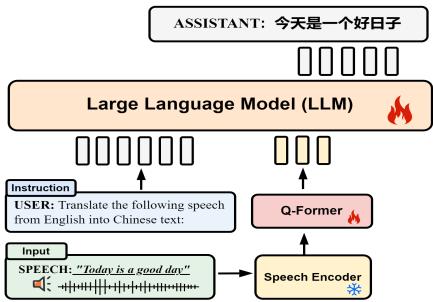
As shown in Figure 1, the pipeline works as follows:
- Input: The model receives raw speech (waveform) and a text instruction (e.g., “Translate the following speech…”).
- Encoder: The speech encoder processes the audio into feature representations.
- Connector (Q-Former): This module compresses the speech features into a format the LLM can digest.
- LLM: The Large Language Model takes the processed speech features and the text instruction to generate a text response.
The standard way to train this beast is “Instruction Tuning.” You feed the model pairs of speech and text targets. The mathematical objective is to minimize the difference between the model’s prediction and the target text, conditioned on the speech and the instruction.
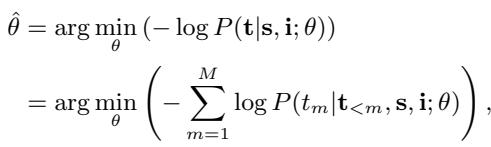
Here, \(\theta\) represents the model parameters, \(t\) is the target text, \(s\) is the speech, and \(i\) is the instruction.
The Problem: Speech Anchor Bias
It sounds straightforward, but there is a catch. The most abundant source of speech data is Automatic Speech Recognition (ASR) data—pairs of audio and their exact transcriptions. When researchers train LSMs primarily on this data, the model learns a bad habit. It assumes that its job is always to transcribe the audio, regardless of what the text instruction actually asks it to do.
The researchers termed this phenomenon Speech Anchor Bias.
To illustrate, imagine you play an audio clip of someone saying “Today is a good day” and ask the model to “Translate to Chinese.” A biased model will ignore the instruction and simply output “Today is a good day.” It has anchored itself to the speech input and disregarded the textual prompt.
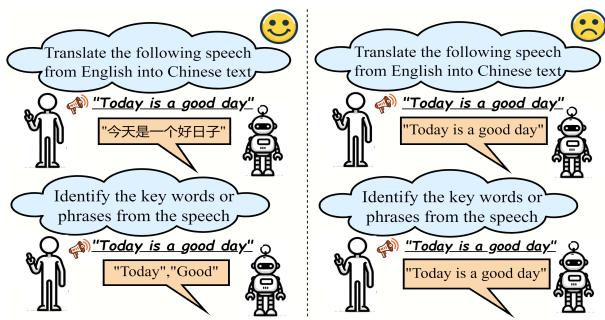
Figure 2 provides a stark contrast. The “Instruction-Following LSM” (left) correctly translates or extracts keywords. The “Vanilla IT” (Instruction Tuned) model (right) blindly repeats the content, failing the specific task requested by the user.
Diagnosing the Bias with Attention Analysis
The researchers didn’t just observe this failure; they diagnosed it mathematically by analyzing the model’s attention mechanisms. In Transformer models, attention weights determine how much focus the model places on different parts of the input when generating an output.
They defined a metric to measure the “information flow” from two sources: the Instruction and the Speech.

By calculating the proportion of attention dedicated to instructions versus speech across the distinct layers of the model, they discovered a distinct pattern.
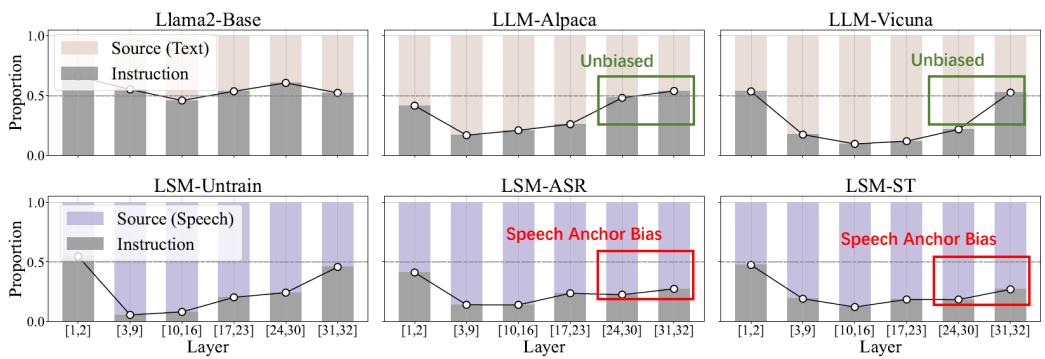
Figure 3 reveals the internal mechanics of the bias:
- Top Row (Standard LLMs): In text-only LLMs (like Llama-2 or Vicuna), the model pays attention to the source text in the middle layers but shifts its focus heavily toward the instruction in the deep layers (the final processing steps). This allows the model to refine its output based on what the user wants.
- Bottom Row (LSMs): In LSMs trained on standard ASR data (labeled LSM-ASR), the instruction proportion (the grey line) drops significantly in the deeper layers. The model is “listening” to the audio so intently that it “forgets” the instruction by the time it generates the output.
The Solution: Self-Powered Modality Expansion
So, how do we fix this? We need the model to learn that instructions matter. We need training data where the same speech input leads to different outputs depending on the instruction.
We could manually annotate thousands of hours of speech with translations, sentiment labels, and summaries, but that is prohibitively expensive. Instead, the authors propose a Self-Powered approach. They use the LLM’s own intelligence to generate this data.
Step 1: Self-Powered Data Generation
The process is ingenious in its simplicity. We already have the ground-truth transcript text from standard ASR datasets. We can feed this transcript into the LLM (which is already smart) and ask it to perform various tasks—summarize it, translate it, analyze the sentiment, etc.
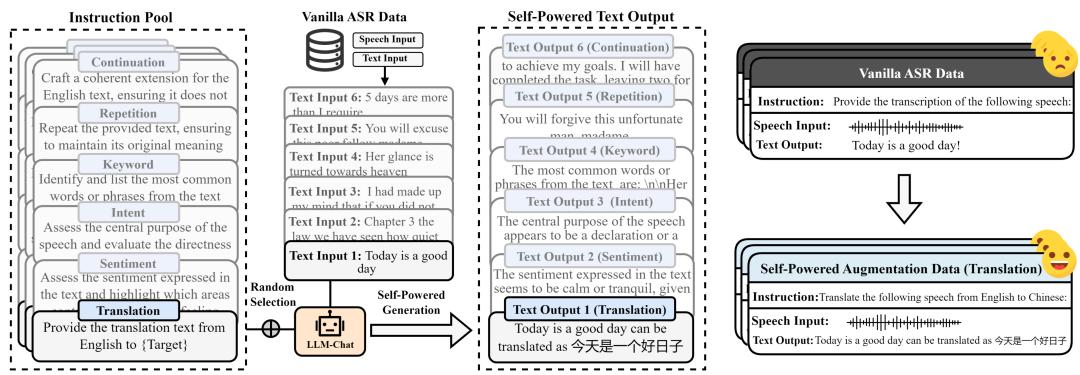
As illustrated in Figure 4, the pipeline works like this:
- Take a standard ASR pair: Audio + Transcript (“Today is a good day”).
- Pick a random task from an “Instruction Pool” (e.g., Translation).
- Feed the transcript and the instruction into the LLM text-only backbone.
- The LLM generates the target output (e.g., “今天是一个好日子”).
- New Training Sample: We now have a new multimodal training pair: Audio + Instruction (Translate) -> Target (Chinese text).
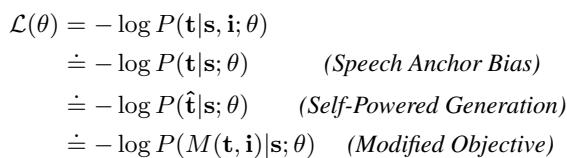
This generates the “Self-Powered” target text \(\hat{t}\):

Step 2: Training with Augmented Data
Now, the LSM is trained using this augmented dataset. The speech encoder is frozen (to maintain the quality of auditory features), and only the Q-Former and the LLM are fine-tuned.

By mixing these diverse tasks into the training loop, the model can no longer simply repeat the audio. To minimize loss, it must pay attention to the instruction variable \(i\), because the speech \(s\) remains constant while the target output changes based on \(i\).
The mathematical justification for this approach is that it shifts the probability distribution. Instead of the model learning \(P(t|s)\) (predict text given speech), it is forced to learn \(P(t|s, i)\) (predict text given speech and instruction).
Experimental Setup
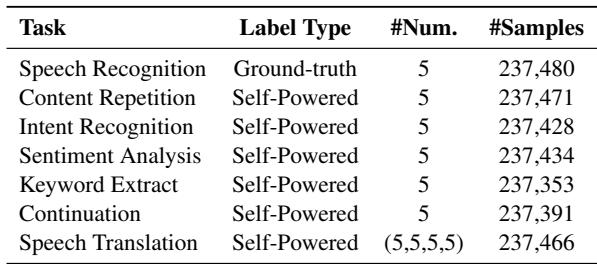
The researchers validated this method using 4,500 hours of training data from datasets like LibriSpeech and Common Voice. They created an instruction pool covering six task types: Speech Recognition, Content Repetition, Intent Recognition, Sentiment Analysis, Keyword Extraction, and Speech Translation.
The models were evaluated across a wide suite of benchmarks, including ASR (LibriSpeech), Speech Translation (CoVoST, MuST-C), and Spoken Language Understanding (MELD for emotion, FSC for intent).
Results: Breaking the Anchor
The results confirmed the hypothesis: the Self-Powered LSM significantly outperforms the vanilla instruction-tuned models and competes with other state-of-the-art methods that rely on ground-truth data.
Key Findings:
- Massive Improvement over Vanilla IT: The model trained on standard data failed almost completely on tasks like translation and keyword extraction (scores near 0.0). The Self-Powered LSM achieved high performance across the board.
- Generalization: Even though the model generated its own training targets (pseudo-labels), it generalized well to standard test sets. For example, in Speech Translation (ST), it performed admirably even though it never saw “ground truth” human-verified translation audio pairs during training—only the ones it generated itself.
- Scaling Laws Apply: Using a larger speech encoder (Whisper-large vs. Whisper-small) consistently improved performance, suggesting the method scales well with model size.
Investigating the “Fix”
The researchers returned to their attention analysis to verify why the performance improved.
Layer-wise Behavior: Recall the “red boxes” in Figure 3, where the vanilla model stopped paying attention to instructions in deep layers. Look at the behavior of the Self-Powered LSM in Figure 5:
![Figure 5: Layer-wise behavior in Self-Powered LSM. Note the uptick in instruction attention (grey line) in the deep layers [31,32].](/en/paper/2410.03798/images/014.jpg#center)
The trend line has changed. In the final layers (31-32), the proportion of attention on instructions rises significantly (from roughly 0.2 to 0.4). This indicates the model has learned to consult the instruction before generating the final token, effectively mitigating the Speech Anchor Bias.
Modality Alignment (t-SNE): The team also visualized how the model represents speech and text in its high-dimensional space. In a perfect LSM, the representation of a spoken sentence and its written text transcript should be very close to each other.
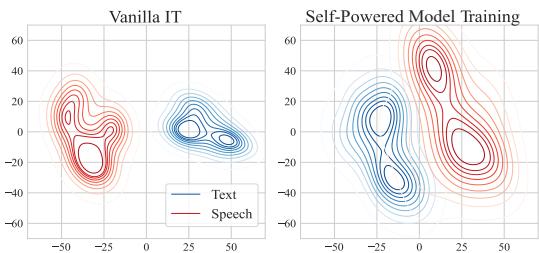
In Figure 6, the “Vanilla IT” plot (left) shows distinct clusters where speech (red) and text (blue) are somewhat separated. In the “Self-Powered” plot (right), the distributions are complex and deeply intertwined. This “mixing” suggests a much tighter fusion of modalities—the model “understands” speech and text as equivalent concepts.
Does it break the LLM?
A common fear when fine-tuning LLMs on new modalities is “catastrophic forgetting”—that the model will get better at hearing but become stupider at reasoning.
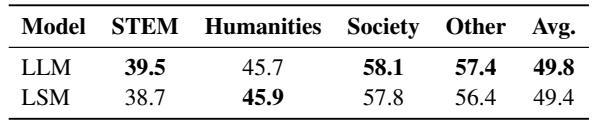
Table 6 compares the Self-Powered LSM against its backbone LLM (Vicuna) on the MMLU benchmark (a massive test of multitasking accuracy). The scores are nearly identical (49.4 vs. 49.8). This confirms that expanding the model’s speech capabilities via this method does not degrade its core intelligence.
Discussion: End-to-End vs. Cascade
Finally, is it worth building a single giant model (End-to-End) when we could just chain separate models together (Cascade: ASR model -> Text LLM)?
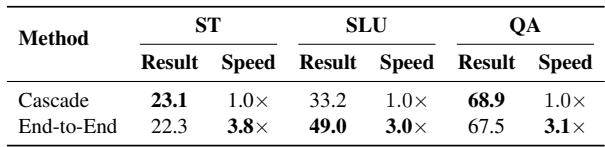
The researchers compared their method against a cascade of Whisper + Vicuna (Table 7). While the cascade approach is slightly more accurate on some tasks, the End-to-End Self-Powered LSM is roughly 3x faster during inference. This speed advantage makes end-to-end models highly attractive for real-time applications, and the performance gap is closing.
Conclusion
The “Self-Powered LLM Modality Expansion” paper offers a significant step forward in multimodal AI. It highlights a subtle but critical flaw in how we train large speech models—Speech Anchor Bias—and provides a practical solution that doesn’t require millions of dollars in new data annotation.
By using the LLM’s own text-generation capabilities to augment its speech training data, we can build models that truly “listen” to instructions rather than just acting as glorified stenographers. As LLMs continue to evolve, self-supervised and self-powered techniques like this will likely become the standard for efficiently teaching models to perceive the world around them.