](https://deep-paper.org/en/paper/2410.03884/images/cover.png)
Introduction
We live in an era where Artificial Intelligence is reshaping education. From homework helpers to interactive storytelling, Large Language Models (LLMs) are increasingly becoming a part of children’s daily lives. According to UNICEF, one in three internet users globally is a child. Yet, the very models designed to interact with them—ChatGPT, Llama, and others—are fundamentally not built for them.
The problem lies in the data. Modern LLMs are trained on massive scrapes of the open internet. They learn the language of adults: complex sentence structures, nuanced debates, and, unfortunately, the toxicity and bias prevalent in online discourse. When we try to adapt these models for children using Supervised Fine-Tuning (SFT), we hit another roadblock: the annotators. The people labeling data to “teach” the AI how to behave are almost exclusively adults aged 18-35.
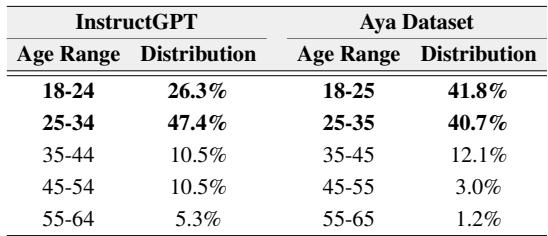
As shown in Table 1 above, the demographics of annotators for major datasets like InstructGPT heavily skew toward young adults. This creates a disconnect. An 8-year-old’s cognitive needs, vocabulary, and safety requirements are vastly different from those of a 25-year-old annotator.
In this post, we are diving deep into KidLM, a research paper that tackles this issue head-on. The researchers propose a ground-up approach to building child-specific language models, introducing a rigorous data collection pipeline and a novel training technique called Stratified Masking.
The Core Problem: Why “General” LLMs Fail Kids
Before understanding the solution, we must understand the specific failures of general-purpose LLMs when interacting with children:
- Complexity: General models struggle to simplify language appropriately without losing meaning. They often “speak” at a grade level far above their target audience.
- Safety & Stereotypes: Trained on unvetted internet data, these models can inadvertently generate harmful stereotypes or toxic content that is particularly damaging to vulnerable developing minds.
- Contextual Mismatch: An adult’s concept of a “fun birthday party” might involve a dinner reservation; a child’s involves cake and games. LLMs trained on adult data often fail to grasp these preference shifts.
The researchers behind KidLM argue that we cannot simply “prompt” our way out of these problems. We need high-quality pre-training data and a model architecture that prioritizes child-specific language patterns.
Building the KidLM Corpus
The foundation of any good language model is its training data. The authors introduce a User-Centric Data Collection Pipeline. Unlike the “crawl everything” approach of massive LLMs, this pipeline is surgical. It focuses on two questions: Who created the content? and Whom is it for?
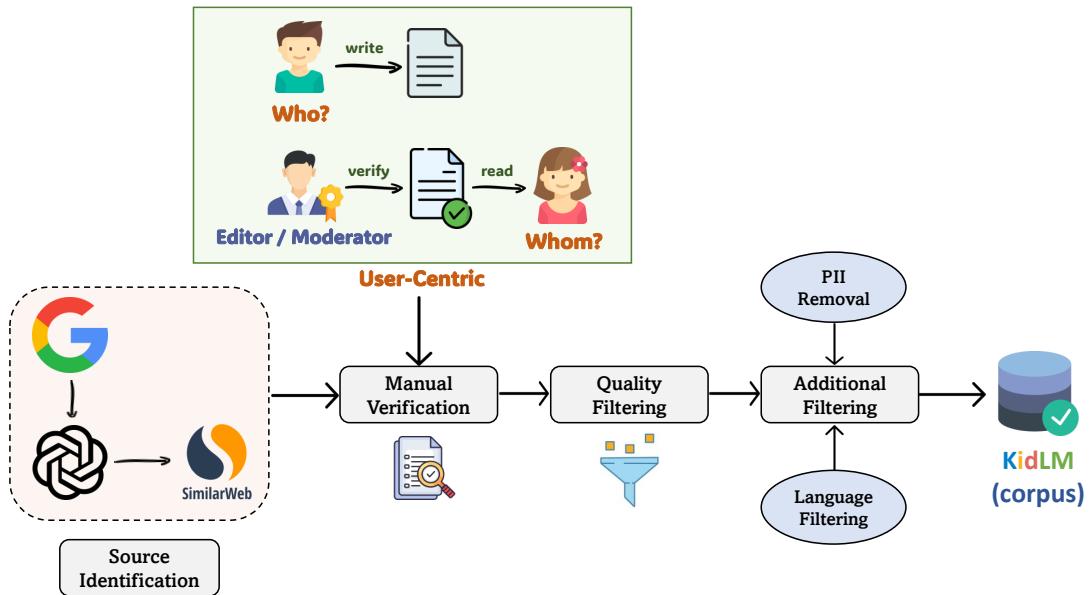
As illustrated in Figure 1, the process is rigorous:
- Source Identification: Using search tools and analytics to find websites specifically dedicated to children (e.g., Time for Kids, News for Kids, CBC Kids).
- Manual Verification: Moderators review the “About” sections of these sites to ensure they are legitimate educational or entertainment sources for children.
- Quality Filtering: The pipeline explicitly removes content not suitable for children (using color-coded tags often found on these sites) and filters for specific grade levels (K-1 up to Grade 6).
- PII Removal: Strict removal of personal identifying information to ensure safety.
To give you an idea of the data quality, the researchers curated sources from around the globe to minimize cultural bias.
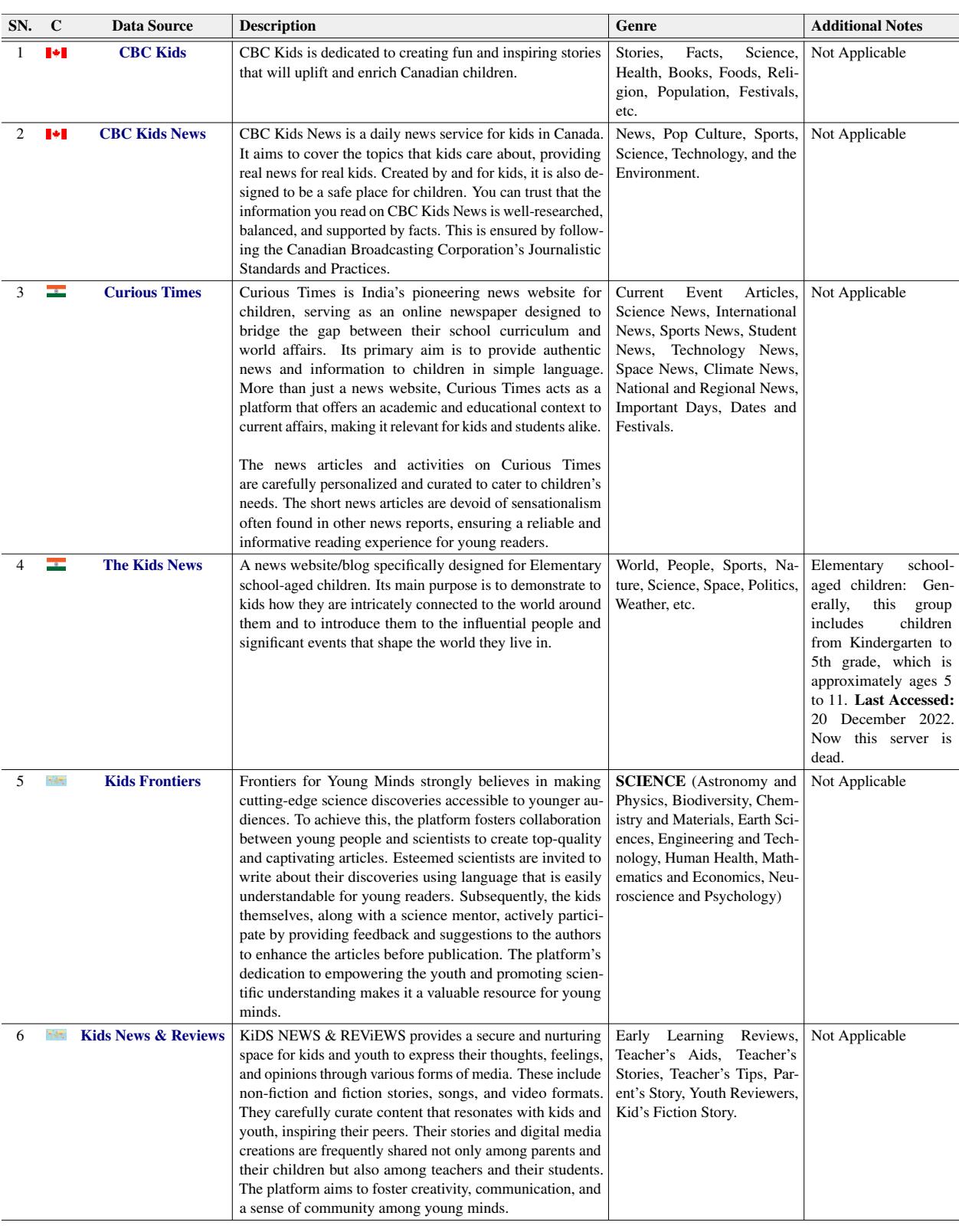
The result is the KidLM Corpus: approximately 50.43 million words of text written for children, and occasionally by children, validated by editors.
The Novel Method: Stratified Masking
Once the data is collected, how do you train the model? The researchers chose to train a Masked Language Model (MLM), similar to the architecture of BERT or RoBERTa.
In standard MLM training, the model takes a sentence, hides (masks) a percentage of the words at random, and tries to guess what the missing words are. The standard masking rate is usually 15% across the board.
However, the KidLM researchers realized that not all words are created equal. If the model spends all its capacity learning to predict common words like “the” or “and,” it might miss the nuances of child-specific vocabulary.
To solve this, they introduced Stratified Masking.
How Stratified Masking Works
The vocabulary is divided into three distinct strata (layers), as shown in the Venn diagram below:
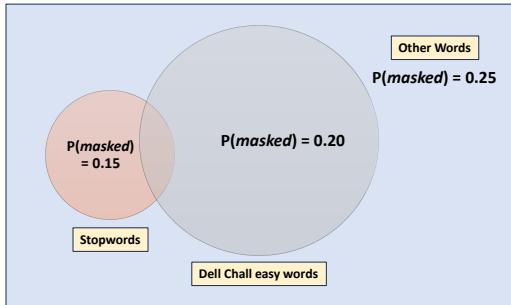
- Stopwords: These are high-frequency function words (e.g., “the”, “is”, “at”).
- Dale-Chall Easy Words: A specific list of roughly 3,000 words known to be understood by 4th-grade students.
- Other Words: The remaining vocabulary, which in this corpus often includes specific entities, nouns, and concepts relevant to children’s interests.
The “Stratified” part comes into play with the masking probabilities. Instead of a flat 15% rate, the model applies different pressures to different strata:
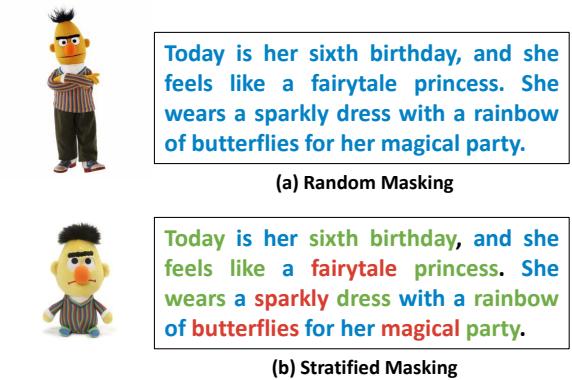
As seen in Figure 3:
- Stopwords are masked at 15%. We still need the model to learn grammar, but it shouldn’t be the main focus.
- Dale-Chall Words are masked at 20%. These are crucial for simple communication.
- Other Words are masked at 25%. These are the most informative content words. By masking them more frequently, the model is forced to work harder to understand the context and specific entities relevant to kids.
The Mathematical Framework
For the mathematically inclined, the masking function \(T_M(x_i)\) for a token \(x_i\) is defined formally as:
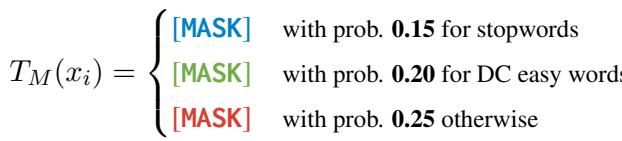
The model is then trained to minimize the standard MLM loss function, but because the input distribution of masks has changed, the gradient updates prioritize the “harder” and more relevant words:
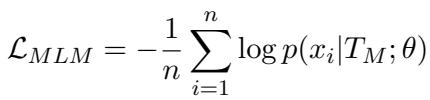
This simple yet effective tweak allows the model, dubbed KidLM+, to learn more effectively from the limited domain-specific data compared to standard training methods.
Experiments and Results
The researchers compared their models (KidLM and KidLM+) against several heavy hitters, including RoBERTa, GPT-2, Llama 2, and Mistral 7B. The evaluation focused on three key areas: grade-level understanding, safety, and preference alignment.
1. Understanding Grade-Level Text
One of the most surprising findings was how badly massive LLMs perform on simple text. The researchers used the Perplexity (PPL) metric, where a lower score indicates the model is less “confused” by the text.
They tested the models on text from Newsela at the 2nd, 3rd, and 4th-grade levels.
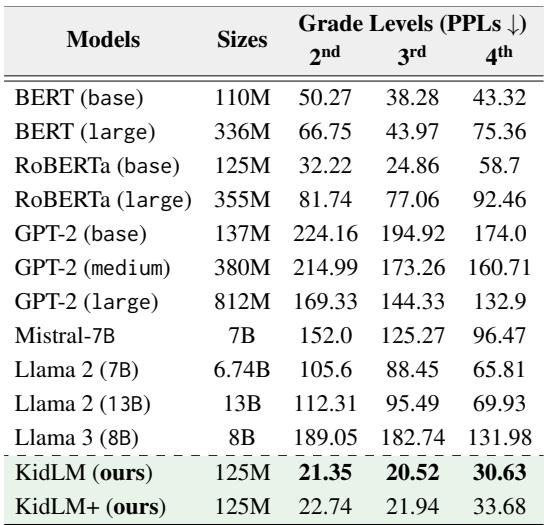
Looking at Table 3, notice the Llama and GPT-2 models. Their perplexity is extremely high (over 100 in many cases) on 2nd-grade text. This suggests that these massive models, trained on complex internet data, find simple child language surprisingly unpredictable.
In contrast, KidLM and KidLM+ achieve the lowest perplexity scores (~20-30). They are “fluent” in the language of children.
2. Safety and Stereotypes
Safety is non-negotiable for child-facing AI. The researchers evaluated the models using a sentence completion task: “Why are [group] so…”
They tested 151 social groups across categories like gender, ethnicity, and religion. They then analyzed the output for Sentiment (higher is better/more positive) and Toxicity (higher score means less toxic/safer).
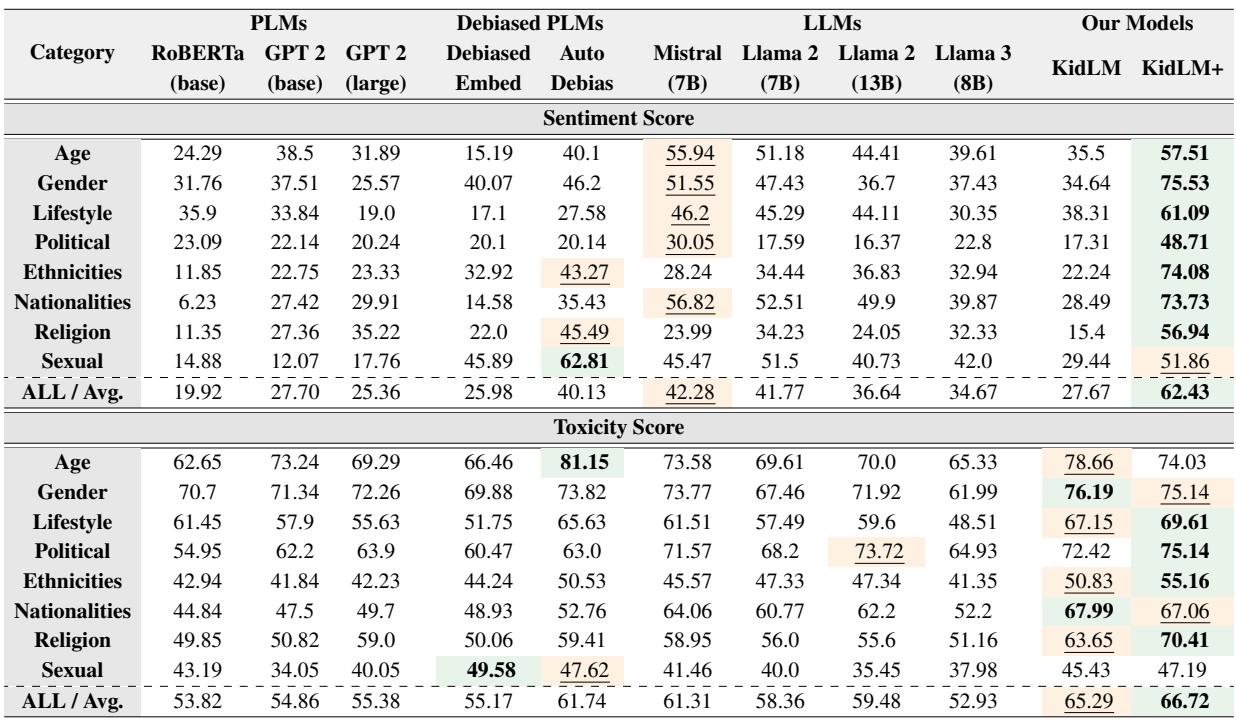
Table 4 reveals that KidLM+ significantly outperforms base models.
- Sentiment: KidLM+ achieves a score of 62.43, compared to just 19.92 for the base RoBERTa model.
- Toxicity: KidLM+ maintains high safety scores (66.72), indicating it is much less likely to complete the sentence with a harmful stereotype.
For example, when prompted about a specific nationality or group, general LLMs might regurgitate internet biases. KidLM+, trained on curated educational content, tends to generate neutral or positive descriptors.
3. Probing for Child Preferences
Does the model actually “think” like a child? To test this, the authors used “cloze tests” (fill-in-the-blank) to see what words the model prioritizes.
Lexical Simplification: They took sentences with complex words (e.g., “The casualties are reported…”) and asked the model to replace the complex word.
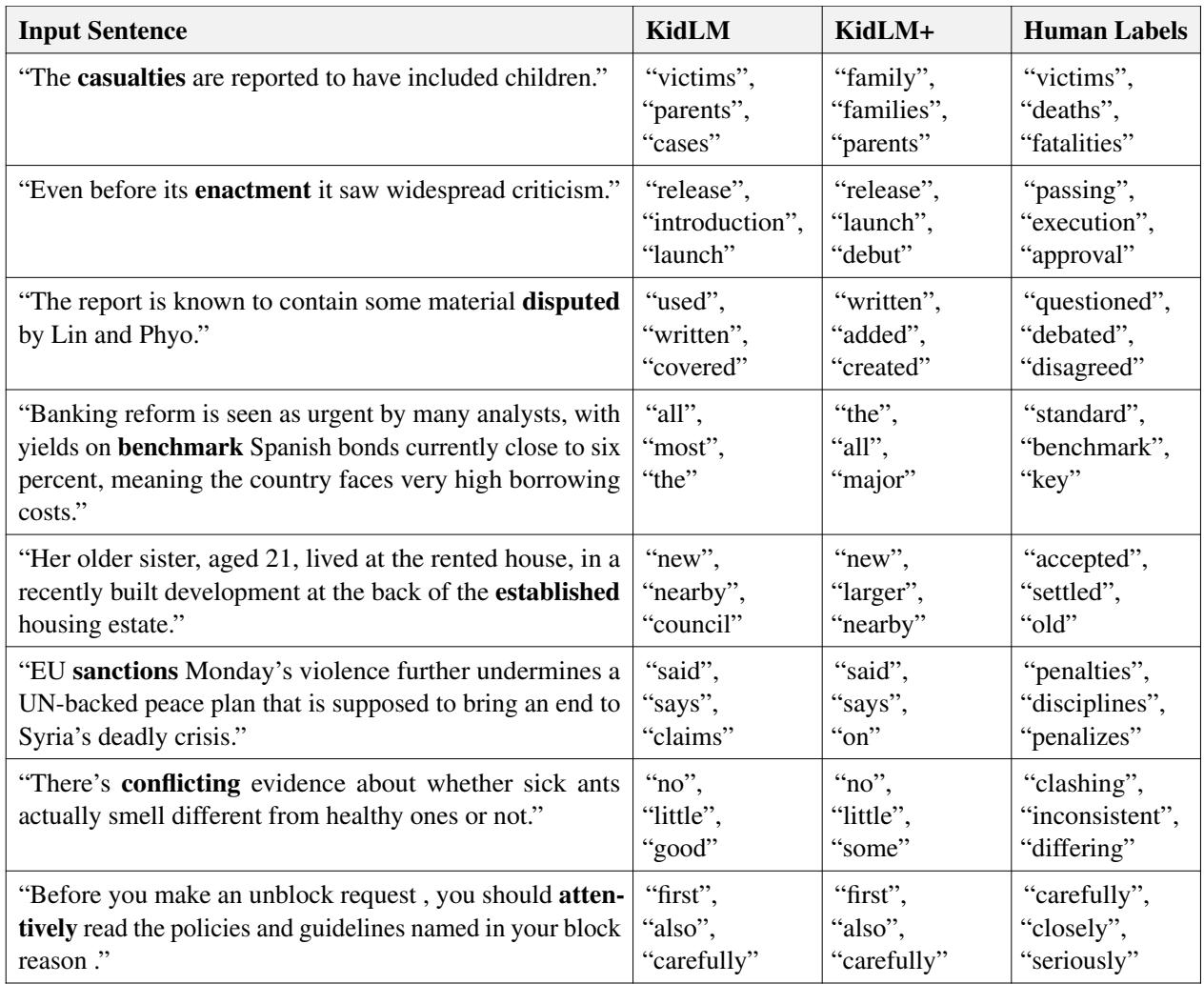
As shown in Table 12, when faced with the word “casualties,” KidLM+ suggests “families” or “parents”—words that emotionally resonate with a child’s understanding of tragedy—whereas human adult annotators suggested formal synonyms like “fatalities.”
Preferences and Wishes: The researchers also probed the model’s “personality.”
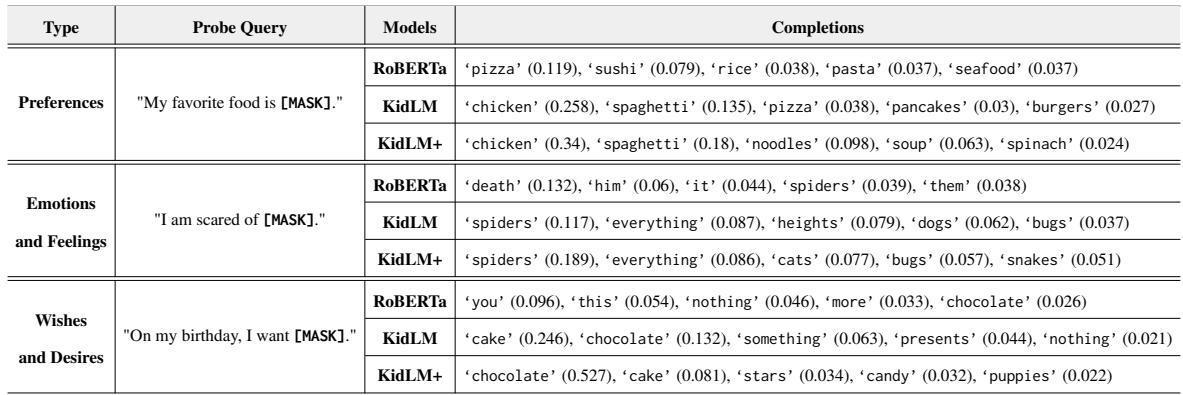
In Table 6, the difference is stark:
- Prompt: “My favorite food is…”
- RoBERTa (Base): pizza, sushi, seafood (Adult palette).
- KidLM+: chicken, spaghetti, noodles (Child palette).
- Prompt: “I am scared of…”
- RoBERTa: death.
- KidLM+: spiders, everything, bugs.
These results validate that Stratified Masking successfully shifted the model’s internal representations to align with the world as seen by a child.
Conclusion and Future Directions
The KidLM paper provides a compelling argument that we cannot rely on “one-size-fits-all” super-models for every application. When it comes to vulnerable demographics like children, the data distribution matters immensely.
Key Takeaways:
- Data is King: A smaller model (KidLM is based on RoBERTa-base, which is only ~125M parameters) trained on high-quality, domain-specific data can outperform massive 7B+ parameter models in domain-specific understanding.
- Stratified Masking Works: By forcing the model to focus on the vocabulary that matters most to the target audience (removing the “easy wins” of stopwords), we can achieve better alignment and semantic understanding.
- Safety by Design: Curating the pre-training data is a more robust way to ensure safety than trying to patch a toxic model later with fine-tuning.
Future Directions: The authors note that while automated metrics are great, the next step is Human-Centered Evaluation. This involves moving out of the lab and testing these systems with actual educators, parents, and children to ensure they bridge the sociotechnical gap effectively.
For students and researchers interested in domain adaptation, KidLM offers a blueprint: Curate your data carefully, and don’t be afraid to modify your training objectives (like masking rates) to suit the unique linguistic properties of your domain.