](https://deep-paper.org/en/paper/2410.03909/images/cover.png)
Introduction: The Problem with “Random”
Imagine you are a robot arm tasked with reaching into a crowded box to pick up a specific object without touching the sides. To figure out how to move, you need a plan. In the world of robotics, one of the most popular ways to find this plan is to play a game of “connect the dots.” You scatter thousands of random points across the possibilities of your movement, check which ones are safe, and connect them to form a roadmap.
This method, known as Sampling-based Motion Planning, powers everything from autonomous vehicles to surgical robots. But there is a hidden flaw in the foundation of this approach: Randomness is actually quite inefficient.
When you throw random points into a space, they don’t spread out perfectly. They clump together in some spots and leave large, empty gaps in others. In simple 2D spaces, this is annoying. In the high-dimensional mathematics where robots “live” (often 6, 10, or more dimensions), these gaps become massive voids that can cause the robot to fail to find a path, even if one exists.
In a fascinating new paper titled “Improving Efficiency of Sampling-based Motion Planning via Message-Passing Monte Carlo,” researchers from MIT and the Max Planck Institute propose a solution that replaces luck with learning. They introduce Message-Passing Monte Carlo (MPMC), a technique that uses Graph Neural Networks (GNNs) to generate point sets that are mathematically “more uniform” than random chance.
In this deep dive, we will explore how this method works, the complex math behind measuring “uniformity,” and why this might be the future of how robots navigate our world.
Background: Configuration Spaces and Roadmaps
To understand the contribution of this paper, we first need to understand the playground: the Configuration Space (C-Space).
If a robot has 6 joints, its C-Space is 6-dimensional. Every single point in this 6D space represents a unique pose of the robot. Some points are “free” (the robot is safe), and some are “collisions” (the robot hits a wall). The goal of motion planning is to find a continuous line of “free” points from a start pose to a goal pose.
The Probabilistic Roadmap (PRM)
Calculating the geometry of high-dimensional obstacles is impossibly slow. So, we cheat. We use the Probabilistic Roadmap (PRM) algorithm:
- Sample: Pick \(N\) points randomly from the C-Space.
- Check: Discard points that result in a collision.
- Connect: Link remaining points to their nearest neighbors if the straight line between them is safe.
- Query: Search this graph (the roadmap) for a path from start to goal.
The efficiency of a PRM depends entirely on step 1. If your samples fall into the “clumps,” you waste computation checking redundant points. If you miss the “gaps,” you might miss the only narrow corridor that leads to the solution.
For decades, researchers have used “Low-Discrepancy Sequences” (like Halton or Sobol sequences) instead of pure random numbers to try and spread points out evenly. However, these mathematical sequences often break down when the number of dimensions gets high (\(d > 10\)). This is where the authors’ new method steps in.
The Core Method: Message-Passing Monte Carlo
The researchers propose generating sample points using a deep learning framework called Message-Passing Monte Carlo (MPMC).
Instead of using a fixed mathematical formula to place points (like Halton sequences) or rolling dice (Uniform sampling), MPMC treats the placement of points as an optimization problem. It asks: How can we move a set of points around so that they cover the space as evenly as possible?
The Architecture
The engine behind this is a Graph Neural Network (GNN). As illustrated in Figure 1, the process works like a refinement loop:
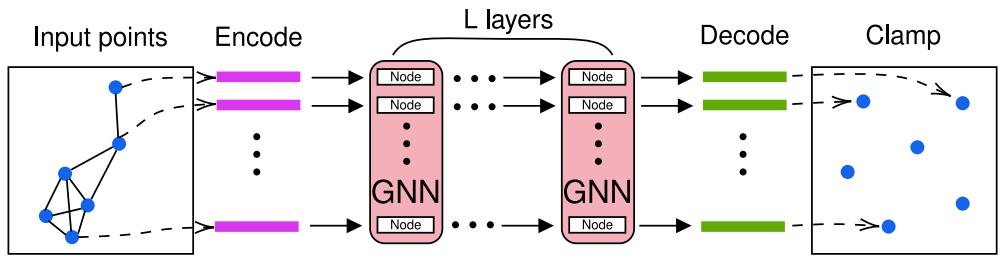 Figure 1: The MPMC Architecture. Random noise enters, and structured, low-discrepancy points exit.
- Input: The system starts with a set of random points.
- Graph Construction: The points are treated as nodes in a graph, connected to their nearest neighbors.
- Message Passing (GNN): This is the “brain” of the operation. The network allows points to “talk” to their neighbors. You can think of this as points pushing and pulling against each other. If two points are too close (a clump), the network learns to push them apart. If there is a gap, it pulls points in to fill it.
- Decoding & Clamping: The final positions are decoded and “clamped” to ensure they stay within the valid boundaries of the space (the unit hypercube \([0, 1]^d\)).
The Math of “Perfect” Spacing: Discrepancy
How does the neural network know if the points are spread out well? It needs a loss function—a score to minimize. This score is called Discrepancy.
Discrepancy measures how much a set of points deviates from a perfectly uniform distribution. The paper focuses on the \(\mathcal{L}_p\)-discrepancy, defined mathematically as:

In simple English:
- Take any box inside your space starting from the origin \([0,0...]\) to some point \(\mathbf{x}\).
- Calculate the volume of that box.
- Count the percentage of your points that fall inside that box.
- In a perfect world, if a box takes up 20% of the space, it should contain exactly 20% of the points.
- The difference between the actual count and the expected volume is the error. We sum up this error for every possible box.
Solving the High-Dimensional Crisis
Calculating the equation above is computationally expensive. For standard cases (\(p=2\)), there is a formula called Warnock’s formula that solves it in \(O(N^2d)\) time.
However, the authors note a critical issue: standard discrepancy measures struggle in high dimensions. When dimensions get high, almost all the volume of a hypercube is pushed to the edges (a phenomenon known as the Curse of Dimensionality). A standard discrepancy metric might fail to distinguish between random noise and a truly uniform set.
To fix this, the authors utilize the Hickernell \(\mathcal{L}_2\)-discrepancy. This is a more robust metric that accounts for projections. It ensures that the points look uniform not just in the full 10D space, but also if you look at their 2D or 3D “shadows” (projections).
The paper leverages a closed-form solution for this metric that is differentiable, meaning the neural network can use it for backpropagation training:

By minimizing this specific equation, the GNN learns to arrange points that satisfy the “uniformity” requirement even in difficult, high-dimensional spaces.
Visualizing the Difference
Does it actually work? Let’s look at the points. In Figure 6 below, we see 2D comparisons of different sampling methods.
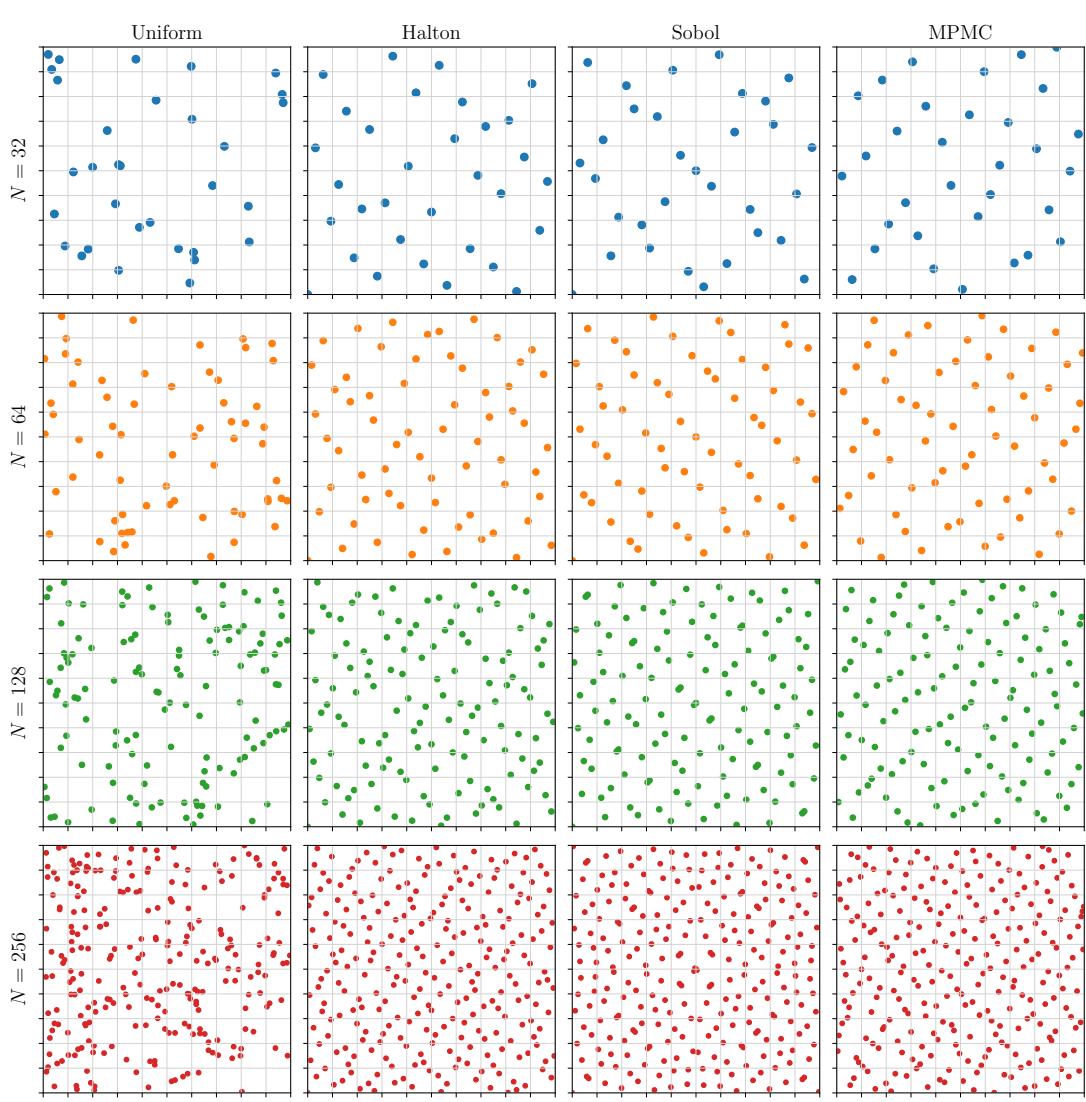 Figure 6: Visual comparison of point sets. Note the “clumping” in the Uniform column (blue/orange) versus the even spread in the MPMC column (red/green).
- Uniform (Left): Notice the empty white spaces and the clusters where dots overlap.
- Halton/Sobol (Middle): Better, structured, but still some distinct patterns.
- MPMC (Right): The points cover the square almost like a mesh. They are not a rigid grid, but they avoid overlapping and minimize gaps effectively.
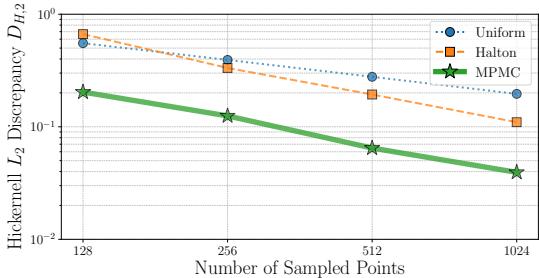
We can also quantify this improvement. Figure 2 shows the discrepancy score (lower is better) as the number of points increases in a 10-dimensional space. MPMC (green line) consistently achieves lower discrepancy than both random (blue) and Halton (orange) methods.
Connecting Discrepancy to Robot Planning
Why do we care about low discrepancy? Because of Dispersion.
While discrepancy is about volume ratios, dispersion is about the size of the largest empty ball you can fit in the space without touching a point. For a robot, an empty ball represents a blind spot where a narrow corridor might be hiding.
The dispersion \(\mathcal{D}_p\) is defined as:

The paper highlights a theoretical link: Low discrepancy implies low dispersion.

This theoretical bound allows the authors to derive a connection to the Probabilistic Roadmap radius. In PRM, you have to decide how far to look to connect a point to its neighbors (the radius \(r_N\)). If you look too far, it’s slow. If you don’t look far enough, the graph is disconnected.
Using MPMC points, which guarantee better coverage, we can define a connection radius \(r_N\) that is theoretically sufficient to find a path if one exists:

This provides a “deterministic sampling guarantee.” By minimizing the training loss (discrepancy), the MPMC model is mathematically reducing the chance that the motion planner will fail to find a path.
Experiments and Results
The authors tested their method (MPMC) against Uniform sampling and standard low-discrepancy sequences (Halton and Sobol). They modified the PRM algorithm to use these pre-calculated point sets (“ps-PRM”).
They utilized a variety of benchmarks, ranging from simple 2D mazes to complex robotic arms.
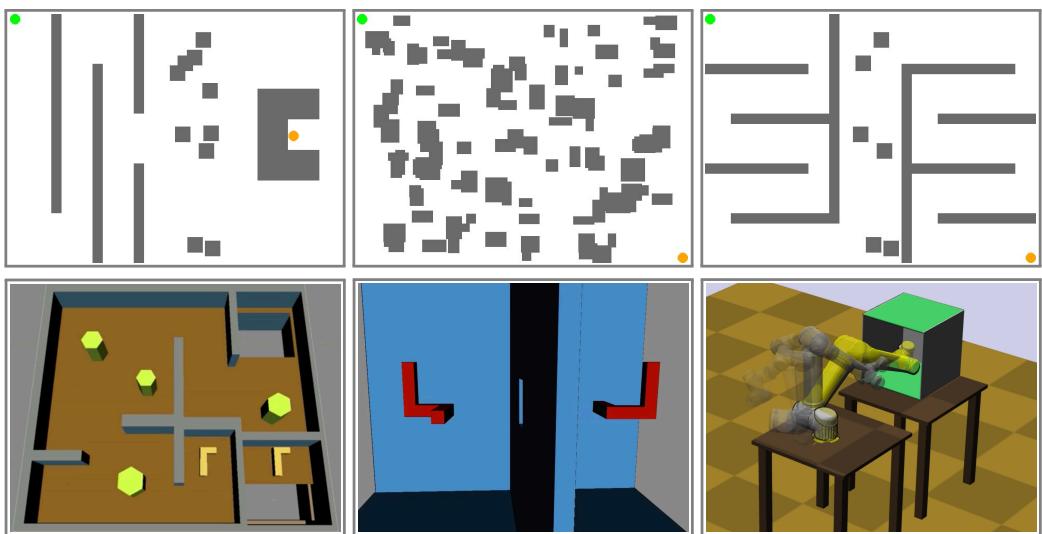 Figure 3: The test environments. Top: 2D Mazes. Bottom: 3D puzzles and the UR5 robot arm.
1. The 2D Maze
In simple mazes, “random” sampling often gets stuck because it fails to put points inside narrow hallways. Figure 5 shows the success rate of finding a path.
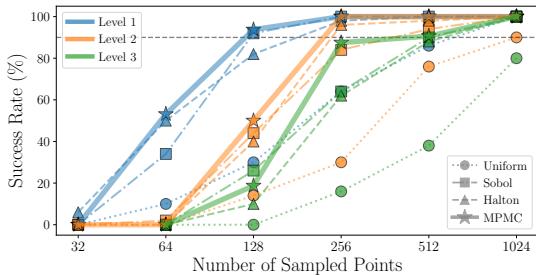
MPMC (the stars) consistently reaches high success rates with fewer points. For example, in Level 3 (the hardest maze), MPMC approaches 90% success with just 256 points, while Uniform sampling fails to reach that reliability even with 1024 points.
2. High-Dimensional Benchmarks (The Real Challenge)
The true test for MPMC is in high dimensions, where traditional Halton/Sobol sequences usually fail.
The authors ran benchmarks on:
- SE(3) Puzzles: Moving a rigid object through a twisty corridor.
- Hypercubes: Artificial narrow corridors in 10 dimensions.
- Kinematic Chain: A multi-link robot arm in 10 dimensions.
- UR5 Robot Arm: A realistic 6-DOF robotic manipulator task.
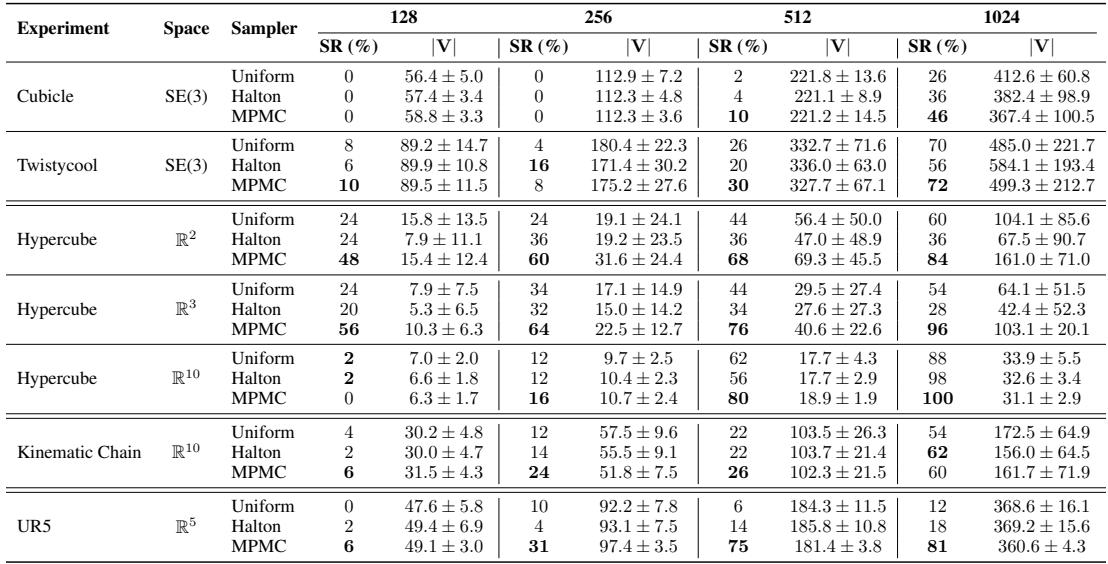
The results are summarized in Table 1 below.
Key Takeaways from the Data:
- 10D Hypercube: With 512 samples, MPMC solved 80% of the problems. Halton solved 56%. Uniform solved 62%.
- 10D Kinematic Chain: With 256 samples, MPMC achieved 24% success, double that of Uniform (12%).
- UR5 Robot: In this practical scenario, MPMC achieved a 75% success rate with 512 points, compared to a measly 6% for Uniform sampling.
3. Real World Deployment
The team didn’t just stay in simulation. They deployed the MPMC sampler on a physical UR5 robot. The task was to reach into a box sideways—a constrained movement that requires precise planning.

The robot successfully executed the plans, validating that the mathematical improvements in sampling translate to real-world hardware.
Conclusion and Future Outlook
This paper presents a compelling argument: We should stop rolling dice for robot motion planning.
By treating the sampling process as a learning problem, MPMC uses the power of Graph Neural Networks to create point sets that are mathematically superior to random chance. These points cover space more efficiently, reducing the “blind spots” that cause planners to fail.
Why does this matter?
- Efficiency: Robots can find paths using fewer sample points, which means less computation and faster reaction times.
- Reliability: In tight, complex environments (like the 10D kinematic chain), MPMC makes the difference between finding a solution and getting stuck.
- Theory-to-Practice: The method bridges deep learning (GNNs), number theory (Discrepancy), and robotics (PRMs) into a unified framework.
Limitations: The main drawback is that the GNN must be retrained for a specific number of points (\(N\)) and dimensions (\(d\)). You cannot simply ask a model trained for 100 points to generate 1000. However, the authors suggest future work could focus on “inductive” graph learning to generalize across different set sizes.
As robots face increasingly complex environments—from folding laundry to navigating debris fields—the quality of their “roadmap” becomes critical. MPMC proves that a little bit of structured learning goes a long way in navigating the chaos of the real world.