](https://deep-paper.org/en/paper/2410.04027/images/cover.png)
Have you ever typed a message in a hurry, hit send, and then realized your phone’s autocorrect turned a heartfelt compliment into complete nonsense? In English, spelling errors are usually about letter arrangements. In Chinese, however, the problem is far more complex due to the nature of the language. Because Chinese input methods rely heavily on Pinyin (phonetic typing), a simple slip of the finger or a similar-sounding syllable can result in a completely different character with a radically different meaning.
This is the challenge of Chinese Spelling Correction (CSC).
For years, researchers have built complex, supervised models to fix these errors. With the rise of Large Language Models (LLMs) like GPT-4 and Llama, you might assume we just ask the AI to “fix the spelling” and call it a day. But surprisingly, general-purpose LLMs often struggle with this task when using standard prompting techniques. They might hallucinate, rewrite the sentence entirely, or miss subtle phonetic errors.
In this post, we are diving deep into a fascinating paper titled “A Simple yet Effective Training-free Prompt-free Approach to Chinese Spelling Correction Based on Large Language Models.” The researchers propose a method that doesn’t require fine-tuning a model or crafting complex prompts. Instead, they go back to the mathematical roots of probability to combine the creative power of an LLM with a strict “Distortion Model.”
Let’s explore how they turned a standard LLM into a state-of-the-art spell checker using nothing but probability theory and clever decoding.
The Problem: When Pinyin Goes Wrong
To understand the solution, we first need to understand the error. Most Chinese text is input via keyboards using Pinyin. If you want to type “machine” (jī), you might accidentally select a character that sounds exactly the same but means “chicken” (jī). Or, you might type a character that looks similar visually.
Traditional Deep Learning models (like BERT) are fine-tuned specifically on massive datasets of these errors to learn how to fix them.
When researchers started applying LLMs to this field, they tried two main strategies:
- Prompt-based: Treating the LLM like a chatbot. User: “Please fix the spelling in this sentence…”
- The Issue: LLMs often struggle to understand the original intent of a misspelled sentence and may “over-fix” or ignore errors.
- Supervised Fine-Tuning (SFT): Retraining the LLM on error data.
- The Issue: This is computationally expensive and makes the model “forget” its general abilities, narrowing it down to just a spell checker.
The authors of this paper asked: Can we use an off-the-shelf LLM as a pure language model—without prompts or training—and still achieve state-of-the-art results?
The Core Intuition: A Bayesian Approach
The researchers propose a Training-free, Prompt-free framework. The core philosophy is to treat Spelling Correction as a probability problem.
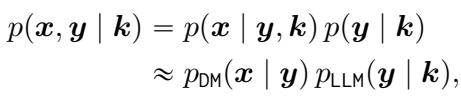
Given a potentially erroneous input sentence (\(x\)), we want to find the most likely correct sentence (\(y\)). Mathematically, we want to maximize the score of the pair \((x, y)\).
Using Bayes’ theorem, we can break this probability down into two distinct parts:
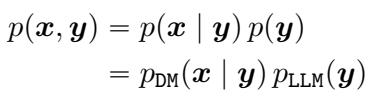
This equation is the heartbeat of the entire paper. Let’s break it down:
- \(p_{LLM}(y)\): This is the Language Model. It asks: “Is the output sentence \(y\) a fluent, logical Chinese sentence?” This is what LLMs are famous for—predicting the next token to create coherent text.
- \(p_{DM}(x|y)\): This is the Distortion Model. It asks: “If the correct character was \(y\), how likely is it that the user accidentally typed \(x\)?” This measures the similarity (phonetic or visual) between the input and the correction.
By multiplying these two probabilities, the system balances fluency (the sentence makes sense) with faithfulness (the sentence is close to what the user typed).
Visualizing the Architecture
The beauty of this approach is that the LLM never actually sees the input sentence \(x\) as a prompt. It is simply trying to generate a sentence from scratch. However, its generation is “guided” or constrained by the Distortion Model to ensure it aligns with the input characters.
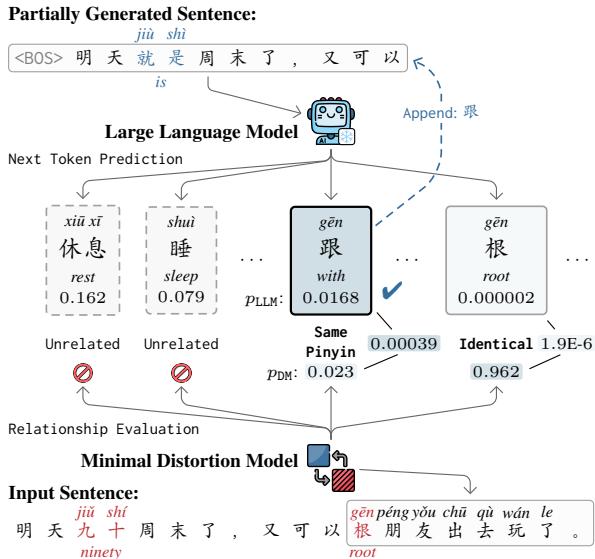
As shown in Figure 1 above, the process works step-by-step:
- The LLM predicts the next possible tokens (e.g., “rest”, “sleep”, “with”).
- The Distortion Model checks the input sentence (“jiu shi”) and compares it to the LLM’s predictions.
- Even though “rest” might make sense grammatically, “with” (gen) is selected because it is phonetically similar to the incorrect input “root” (gen), while also fitting the context.
Component 1: The Minimal Distortion Model
How does the system know if a character is a likely typo? The authors designed a “Minimal Distortion Model.” Instead of training a neural network to detect typos, they used statistical rules based on how people actually make mistakes.
They categorize the relationship between an input character (\(c_1\)) and a potential correction (\(c_2\)) into five types:
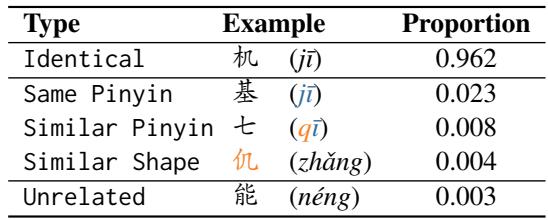
The probability of a correction is determined by the frequency of these error types in real-world data:
- Identical: The user typed the right character. (Highest probability, ~96%).
- Same Pinyin: The user typed a homophone (sounds exactly the same).
- Similar Pinyin: The user mistyped a sound (e.g., l vs n).
- Similar Shape: The user picked a look-alike character.
- Unrelated: The characters have nothing in common. (Lowest probability).
The mathematical formulation for the Distortion Model is a summation of the log probabilities of these character-level relationships:

By using a pre-calculated table (like Table 1), the distortion model is incredibly fast and requires no GPU training. It simply acts as a “gatekeeper” for the LLM’s imagination.
Component 2: The LLM as a Generator
The second half of the equation is the Large Language Model. The researchers use the LLM in its most traditional form: Next-Token Prediction.

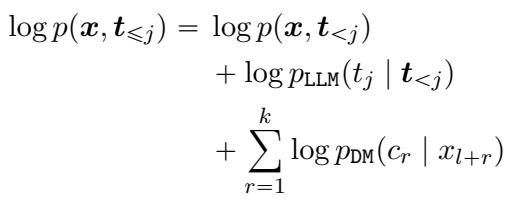
The LLM generates the sentence token by token. However, modern LLMs don’t just generate single characters; they generate “tokens” which can be words or phrases. A single token \(t_j\) might contain multiple Chinese characters.
When the LLM suggests a token, the system calculates a total score by combining the LLM’s confidence (is this good grammar?) with the Distortion Model’s score (does this sound like what the user typed?).
The combined scoring equation looks like this:
Optimization: Making the Decoding Better
If we just used the raw equation above, the system would fail. Why? Because LLMs and Beam Search (the algorithm used to explore possible sentences) have specific biases that don’t align well with spelling correction. The authors introduced two clever “Rewards” to fix this.
1. The Length Reward
LLMs are trained to be efficient. They prefer generating multi-character tokens (chunks of words) because that captures common phrases. However, standard decoding algorithms often favor single-character tokens because the math of accumulating probabilities can penalize longer paths.
If the search beam fills up with single characters, the model loses the semantic richness of the LLM.
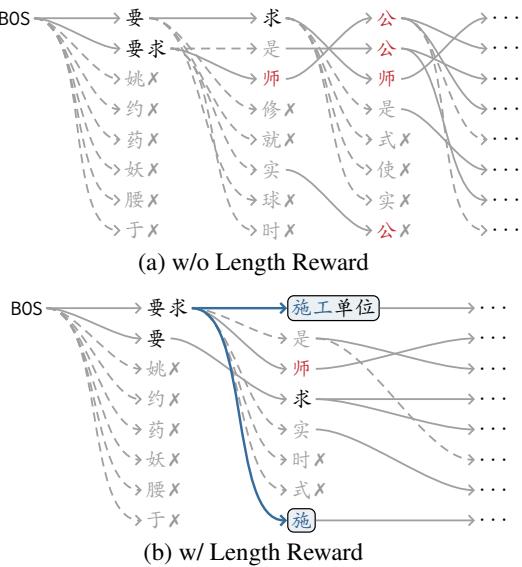
Look at Figure 2 above.
- (a) Without Length Reward: The model explores many single characters like “Master” (Shi), “Is” (Shi), etc. It gets stuck and misses the correct phrase.
- (b) With Length Reward: The model prioritizes the multi-character token “Construction Unit” (Shi Gong Dan Wei).
To implement this, they added a term to the scoring function that boosts the score based on the length of the token:
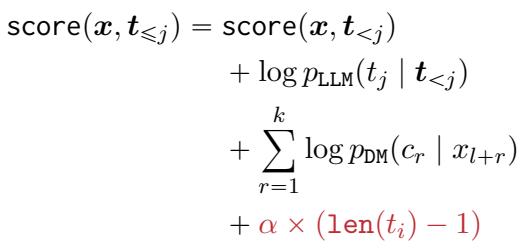
Here, \(\alpha\) is a hyperparameter. This simple addition forces the search algorithm to respect the LLM’s preference for complete words and phrases.
2. The Faithfulness Reward
There is a danger in using powerful LLMs: Over-correction.
If you type the name of a small, obscure city, the LLM might “correct” it to a famous city because the famous city has a much higher probability in its training data.
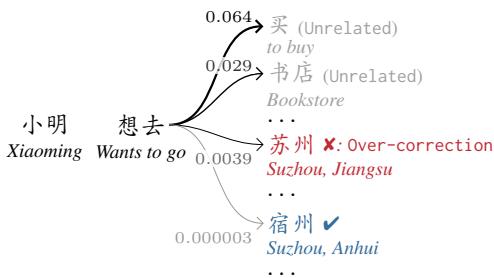
In Figure 3, the input is “Xiaoming wants to go to Suzhou (Anhui province).” The LLM sees “Xiaoming wants to go to…” and immediately thinks “He probably means Suzhou (Jiangsu province),” assigning it a much higher probability (0.0039) compared to the original input (\(3 \times 10^{-6}\)).
To stop the LLM from hallucinating corrections, the authors introduced the Faithfulness Reward.
The logic is: If the LLM is uncertain about what comes next (high entropy), we should trust the Distortion Model (the user’s original input) more.
They modify the score dynamically based on the entropy (uncertainty) of the LLM:
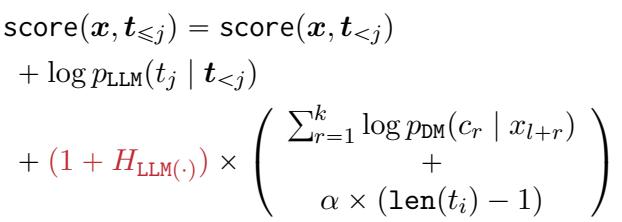
When the LLM is confused or uncertain, the weight of the Distortion Model increases, effectively saying, “I don’t know what fits here, so let’s stick to exactly what the user typed.”
Experimental Results
So, does this math-heavy approach actually work? The researchers tested it against:
- Domain-Specific SOTAs: Models trained specifically for this task (like BERT fine-tuned on spell check data).
- Prompt-based LLMs: GPT-3.5 and GPT-4 asked to “fix spelling.”
- General SOTAs: Large models trained on synthetic error data.
They used five public datasets covering everything from medical texts to social media posts.
Main Performance Table
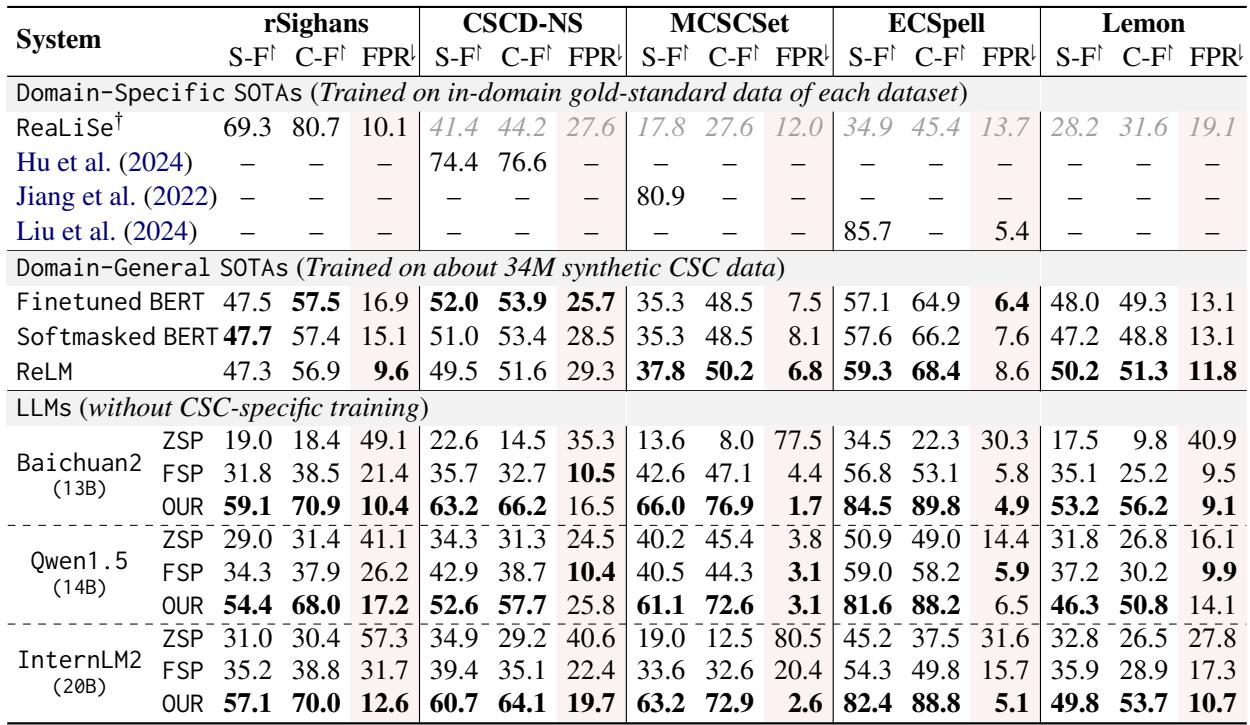
The results in Table 2 are striking:
- Beating Prompts: The “OUR” method (their approach) significantly outperforms Zero-Shot Prompting (ZSP) and Few-Shot Prompting (FSP) across almost every dataset and model (Baichuan, Qwen, InternLM).
- Closing the Gap: While domain-specific models (trained on the exact test data type) are still superior, this approach allows general LLMs to compete with and sometimes beat models trained on millions of synthetic examples.
- Generalization: On the “MCSCSet” (Medical) and “ECSpell” datasets, their approach performs exceptionally well, proving it handles jargon better than generic models.
Ablation Studies: Do the Rewards Matter?
You might wonder if the Length Reward and Faithfulness Reward are actually necessary. The authors ran ablation studies (removing parts of the model to see what breaks).
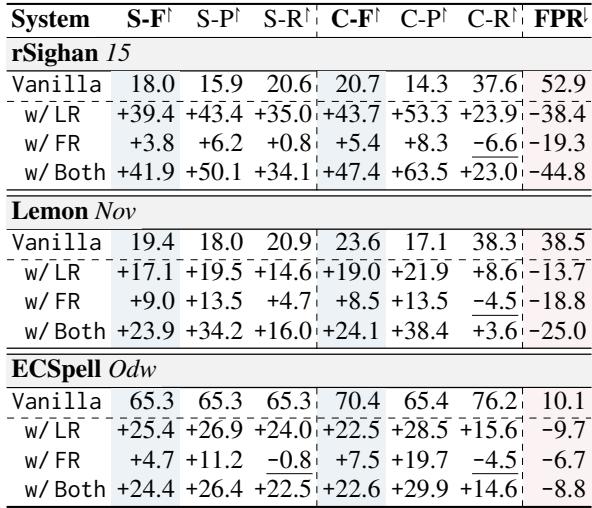
As Table 6 shows:
- Vanilla (Just the equation): Performs poorly.
- w/ LR (Length Reward): Massive jump in performance. This confirms that helping the LLM output whole words is critical.
- w/ FR (Faithfulness Reward): Improves precision (fewer false corrections).
- Both: The combination yields the best F1 scores.
Why This Matters
This paper represents a shift in how we think about using LLMs. Instead of treating them as black-box chatbots that we have to “prompt engineer” into submission, we can treat them as probability distributions.
By combining the LLM’s raw understanding of language with a simple, rule-based model of how humans make typos, we get the best of both worlds:
- Fluency: The output reads like natural Chinese.
- Accuracy: The system respects the sound and shape of the input.
- Efficiency: No training data or fine-tuning required.
Future Implications: Adding Knowledge
One final cool feature the authors discussed is the ability to inject knowledge. Because the LLM is just predicting tokens based on context, you can improve spell checking by simply adding a prefix.
For example, if you are correcting a medical transcript, you can prepend the text “Patient Question:”. The LLM adjusts its probabilities to favor medical terms, instantly becoming a better medical spell checker without any code changes.
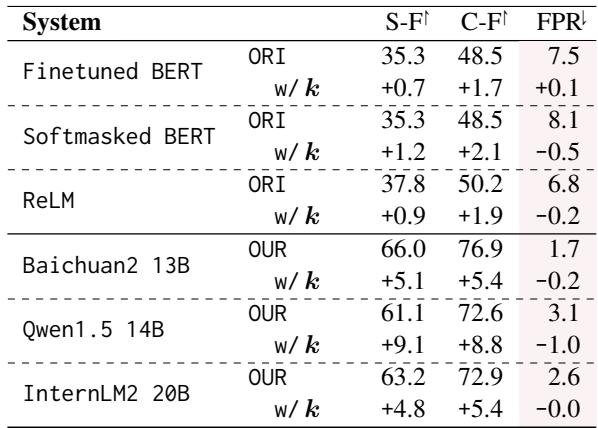
Table 8 shows that adding a simple prefix like “Patient Question:” boosted the F1 score by nearly 10 points on the Qwen model!
Conclusion
This paper demonstrates that we don’t always need more data or bigger prompts to solve NLP problems. Sometimes, we just need to look at the mathematical structure of the task. By decoupling the “language” part (LLM) from the “error” part (Distortion Model), the researchers created a flexible, powerful spell checker that works out of the box.
For students and engineers, this is a great lesson: LLMs are not just chat interfaces; they are probability engines. Using them as such can unlock solutions that prompting alone can never achieve.