](https://deep-paper.org/en/paper/2410.04103/images/cover.png)
In the fast-moving world of Artificial Intelligence, a Large Language Model (LLM) is often only as good as its most recent data. We all know the frustration of asking a chatbot about a recent event, only to be told, “My knowledge cutoff is…”
To keep models relevant, engineers must perform version updates. As new data continuously emerges, models need to ingest it. However, this creates a massive logistical and financial headache. Do you retrain the whole model from scratch every time (insanely expensive)? Or do you just train on the new data (computationally cheap, but often degrades performance)?
In a fascinating paper titled “A Learning Rate Path Switching Training Paradigm for Version Updates of Large Language Models,” researchers from Xiamen University and vivo AI Lab propose a third option. They have developed a training paradigm that balances the high performance of retraining with the efficiency of continual learning.
In this post, we will dissect why traditional update methods fail and explore this new “Path Switching” paradigm that might just become the industry standard for keeping LLMs up to date.
The Dilemma: Freshness vs. Cost
Before diving into the solution, we need to understand the two prevailing methods for updating LLMs and why neither is perfect.
1. Pre-Training From Scratch (PTFS)
This is the brute-force approach. When version 2 of a model is needed, you take the old data, mix it with the new data, and train the model from the very beginning (random initialization).
- Pros: It produces the best possible performance. The model learns correlations between old and new concepts perfectly.
- Cons: The cost is astronomical. As you add more versions, the dataset grows, and the training time grows quadratically. It is not sustainable for frequent updates.
2. Continual Pre-Training (CPT)
This is the economical approach. You take the checkpoint of Version 1 and train it only on the newly added data to create Version 2.
- Pros: Very cheap. You only pay to process the new tokens.
- Cons: Performance suffers. As you update version after version, the model tends to experience “catastrophic forgetting” or simply fails to integrate the new knowledge as effectively as PTFS.
The researchers visualized this trade-off effectively. In the chart below, you can see various methods plotted by Effectiveness (Average PPL, lower is better) vs. Efficiency (Relative Cost, lower is better).
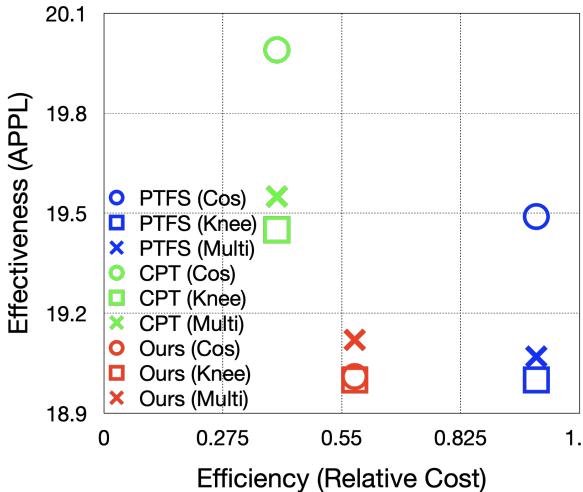
As you can see in Figure 2, PTFS (top left cluster) has great performance (low PPL) but high cost (1.0). Standard CPT (middle right) has low cost but poor performance. The goal of this research is to hit that “sweet spot” in the bottom left—low cost and high performance.
Why Does Continual Pre-Training Fail?
To fix CPT, the researchers first had to understand why it performs worse than retraining. They broke the training process down into two stages:
- Stage 1: The state of the model before the update (the initialization checkpoint).
- Stage 2: The actual training process on the new data.
The culprit, it turns out, is the Learning Rate (LR). The learning rate controls how much the model changes its weights in response to error.
The Paradox of the Learning Rate
Through a series of experiments, the authors discovered a conflicting requirement regarding the learning rate.
Finding 1: High LR is needed for Initialization (Stage 1) If you want a model to be a good starting point for future updates, it needs to be trained with a high learning rate. A high LR keeps the model “plastic” and adaptable. If the LR decays too much in the previous version, the model “crystallizes,” making it hard to teach it new tricks later.
The graph below shows this trend. As the first stage of training is extended (decaying the LR further), the performance of the subsequent update actually gets worse (the lines move up).
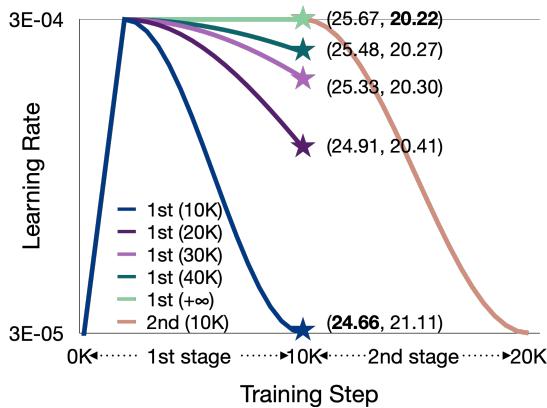
Finding 2: Full LR Decay is needed for Performance (Stage 2) However, for the current version to perform well, you must decay the learning rate to near zero by the end of training. This “settles” the model into a local minimum, minimizing perplexity (error).

The Conflict: Here lies the problem with standard Continual Pre-Training.
- To make Version 2 good, you must decay the learning rate to zero.
- But if Version 2 ends with a zero learning rate, it becomes a terrible starting point for Version 3.
Standard CPT gets stuck in a loop of diminishing returns because it cannot satisfy both conditions simultaneously.
The Solution: Learning Rate Path Switching
The researchers propose a paradigm that satisfies both needs by splitting the training into two distinct paths: a Main Path and Branching Paths.
How It Works
Imagine the training process not as a single line, but as a tree.
The Main Path (The “High Energy” Path): On this path, the model is trained continuously on data, but the learning rate is kept high. It never fully decays. This keeps the model in a highly adaptable state. This path is not used for deployment; it is used solely to generate optimal initialization checkpoints for future versions.
The Branching Paths (The “Settling” Paths): When it is time to release a new version (e.g., Version 2), the researchers “fork” the model off the Main Path. On this branch, they perform a short training run where the learning rate decays rapidly from high to low. This “cools down” the model, crystallizing the knowledge and optimizing performance for deployment.
Let’s look at the learning rate schedules visually to understand the difference.
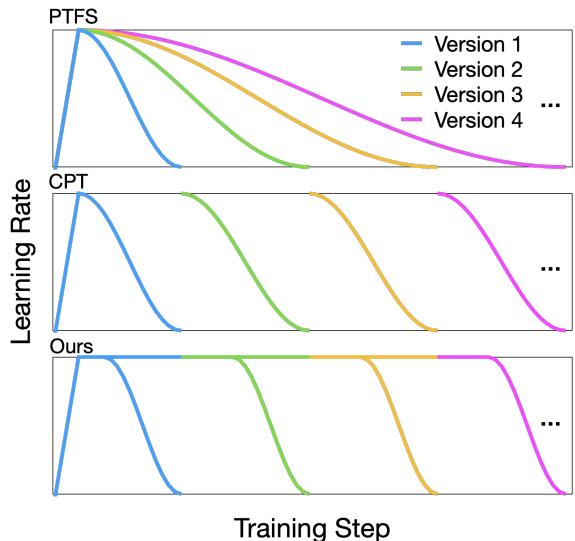
In Figure 1, look at the bottom graph (“Ours”):
- The Main Path (the horizontal-ish line) stays at a high learning rate.
- The Branching Paths (the vertical drops) represent the specific training done to finalize Version 2, Version 3, and Version 4.
This strategy allows the Main Path to remain “plastic” (solving Finding 1), while the Branching Paths allow the specific versions to achieve optimal convergence (solving Finding 2).
The Math Behind the Savings
You might wonder: “If we are training a main path AND branching paths, isn’t that more expensive?”
It is slightly more expensive than basic CPT, but drastically cheaper than PTFS. The researchers quantified this using time complexity equations.

As shown in the equations above:
- PTFS (Top): The cost grows quadratically (\(N^2\)) because you re-process old data every time.
- CPT (Middle): The cost is linear (\(T \times N\)).
- Ours (Bottom): The cost is also linear, roughly \((1 + \alpha)T \times N\).
Here, \(\alpha\) represents the extra steps taken on the branching path. In their experiments, \(\alpha\) was set to 0.6. This means their method costs about 1.6x the cost of CPT, but PTFS can cost 10x or 20x more as versions pile up.
Experimental Results
So, does this theory hold up in practice? The researchers tested this on LLaMA-1.2B, updating it through four versions.
Perplexity and Cost
The table below summarizes the key findings.
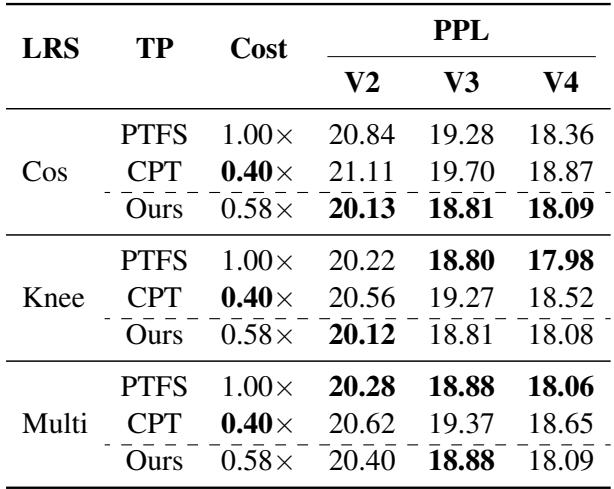
In Table 3, compare the PTFS and Ours rows:
- Cost: PTFS has a cost of
1.00x. The proposed paradigm has a cost of0.58x. That is nearly a 42% reduction in compute resources. - PPL (Perplexity): The perplexity scores (V2, V3, V4) are almost identical. in some cases, the Path Switching method (Ours) even scores slightly better (lower) than training from scratch.
Compare this to CPT, which is cheaper (0.40x) but suffers from significantly worse perplexity (higher numbers) in later versions (V3, V4).
Downstream Tasks
Perplexity is a proxy metric. What about actual tasks? The researchers evaluated the models on benchmarks like GSM8K (math), MMLU (knowledge), and C-Eval.
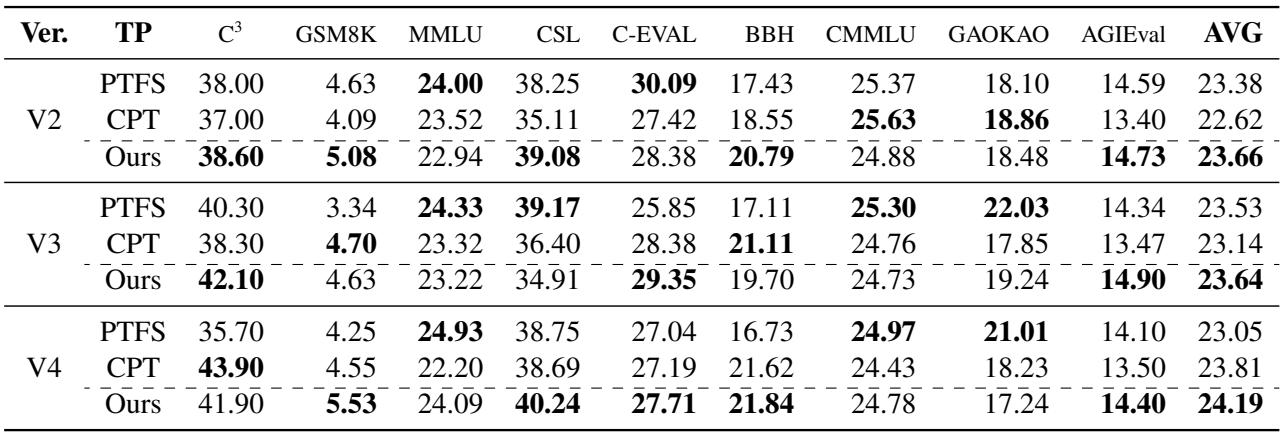
Table 4 confirms the findings. The average score (“AVG” column) for the proposed method (23.66, 23.64, 24.19) is consistently higher than standard CPT and competes toe-to-toe with PTFS.
Generalization
A common concern with new training tricks is whether they only work for specific setups. The authors rigorously tested the generalization of their paradigm.
Different Architectures: They applied the method to Qwen, a completely different model architecture than LLaMA.
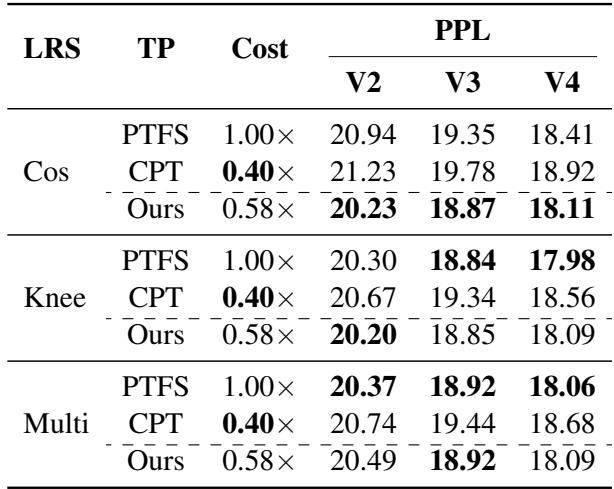
As Table 5 shows, the pattern repeats. The “Ours” method achieves PTFS-level performance at roughly half the cost.
Data Scaling: They also verified that the method holds up regardless of the size of the dataset updates (ranging from 21B to 168B tokens).
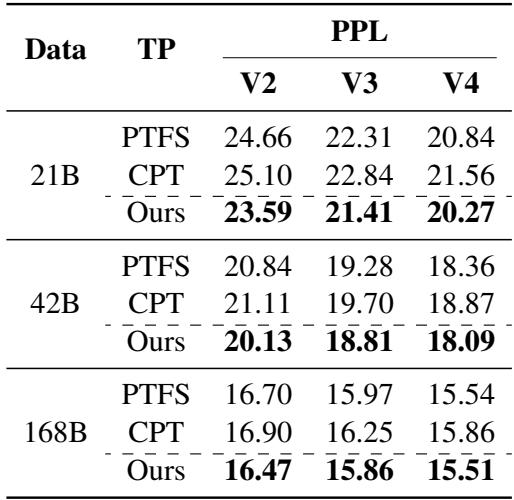
Table 7 demonstrates that whether the dataset is small or large, the Path Switching paradigm consistently outperforms standard CPT.
Conclusion
The “Learning Rate Path Switching” paradigm offers a clever engineering solution to the fundamental conflict of version updates. By acknowledging that a model needs to be in two different states—adaptable for the future and optimized for the present—the researchers designed a split-path training process that achieves the best of both worlds.
For students and researchers in the field, this paper highlights a critical lesson: Hyperparameters like learning rate are not just numbers to be tuned; they define the dynamics of how a model stores and updates information.
As LLMs continue to grow in size, retraining from scratch will become economically impossible. Techniques like Path Switching will likely become the standard operating procedure for keeping our AI assistants knowledgeable without burning through the world’s energy reserves.
Key Takeaways
- PTFS is too expensive; CPT degrades quality.
- Models need High LR for future adaptability but Low LR for current performance.
- Path Switching maintains a “Main Path” (High LR) for the pipeline and “Branching Paths” (Decaying LR) for releases.
- This method achieves comparable performance to retraining at nearly half the cost.