](https://deep-paper.org/en/paper/2410.04484/images/cover.png)
Introduction
Reading is one of the most fundamental skills required to navigate modern society, yet assessing how well someone understands what they read remains a complex challenge. Traditionally, the only practical way to measure reading comprehension is through standardized testing—giving someone a passage and asking them questions afterwards.
While effective, this approach has significant limitations. It is “offline,” meaning we only get the results after the reading process is finished. It doesn’t tell us where the reader got confused, when their attention drifted, or how they processed the information in real-time. It is essentially a “black box” approach: text goes in, an answer comes out, and we miss everything that happened in between.
But what if we could open that box? What if we could decode comprehension as it happens?
This is the central question addressed in the paper “Fine-Grained Prediction of Reading Comprehension from Eye Movements.” The researchers investigate whether it is possible to predict if a single participant will answer a single question correctly based solely on their eye movements while reading a paragraph.
This blog post will walk you through their methodology, the novel machine learning architectures they developed to fuse text and gaze data, and the surprising results of their extensive experiments.
Background: The Eye-Mind Link
The scientific basis for this research lies in the “Eye-Mind Hypothesis” (Just & Carpenter, 1980), which suggests a tight temporal link between where we look and what we are cognitively processing. When you encounter a difficult word, your gaze lingers. When a sentence is syntactically complex, your eyes might regress (jump backward) to re-read previous words. These microscopic movements—fixations and saccades—leave a trace of your cognitive effort.
The Limitations of Prior Research
While the idea of using eye tracking to predict comprehension isn’t new, previous attempts have faced several bottlenecks:
- Small Data: Most datasets were tiny, with few participants and very few questions, making it hard to train modern, data-hungry machine learning models.
- Coarse Granularity: Past studies often tried to predict an aggregated score (e.g., a general “high vs. low” comprehension level) rather than specific answers to specific questions.
- Reading Regimes: Most studies focused only on “ordinary reading” (reading for general understanding) and ignored “information seeking” (hunting for a specific answer), which is a common real-world behavior.
The OneStop Dataset
To overcome these limitations, the authors utilize the OneStop Eye Movements dataset. This is the largest eyetracking corpus for reading comprehension to date. It involves 360 participants reading articles from The Guardian and answering 486 multiple-choice questions.
Crucially, the data distinguishes between two reading modes:
- Gathering (Ordinary Reading): Participants read the text first, then see the question.
- Hunting (Information Seeking): Participants see the question first, then read the text to find the answer.
The dataset uses the STARC annotation framework to categorize answers, ensuring that “incorrect” answers aren’t just random, but reflect specific types of misunderstanding.

As shown in Table 1 above, the dataset tracks not just correct answers (A), but also answers that show partial comprehension or plausible misunderstandings (B, C, D). This granularity allows for a much more nuanced analysis of prediction.
The Challenge: Single-Item Prediction
The core task defined by the authors is Fine-Grained Prediction. They define a “trial” as a specific participant reading a specific paragraph and answering a specific question.
The goal is to build a classifier \(h\) that takes the trial data (the text item \(W\) and the eye movements \(S\)) and predicts the outcome.
The first variation of this task is a Binary Classification:
 Here, the model predicts 1 for a correct answer and 0 for an incorrect one. This formulation is agnostic to the test format—it doesn’t care if it’s multiple choice or open-ended, just whether the reader understood.
The second variation takes advantage of the multiple-choice format:
 Here, the model attempts to predict exactly which option (\(a_1, a_2, a_3, a_4\)) the participant will choose.
Core Method: Multimodal Transformers
To tackle this challenge, the authors needed a way to combine two very different types of data: Natural Language (Text) and Physiological Signals (Eye Movements). They leveraged the power of Transformer models (specifically RoBERTa), which are the backbone of modern NLP, and developed three distinct architectures to integrate gaze data.
1. Feature Extraction
Before feeding eye movements into a neural network, the raw signal must be processed. An eye tracker records gaze coordinates at 1000 Hz (1000 times per second).
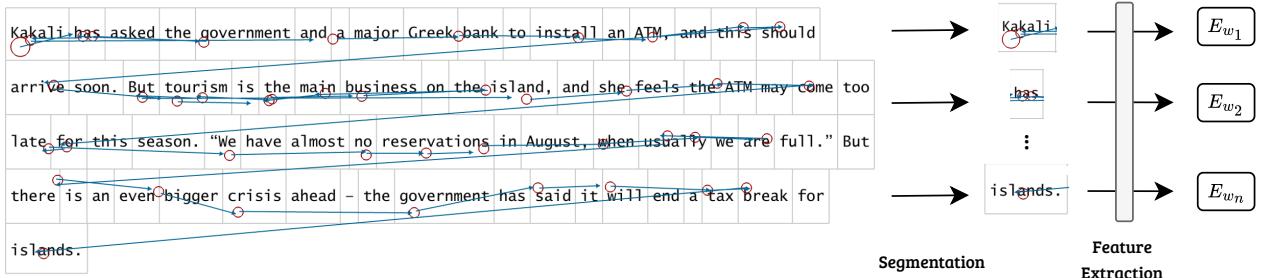
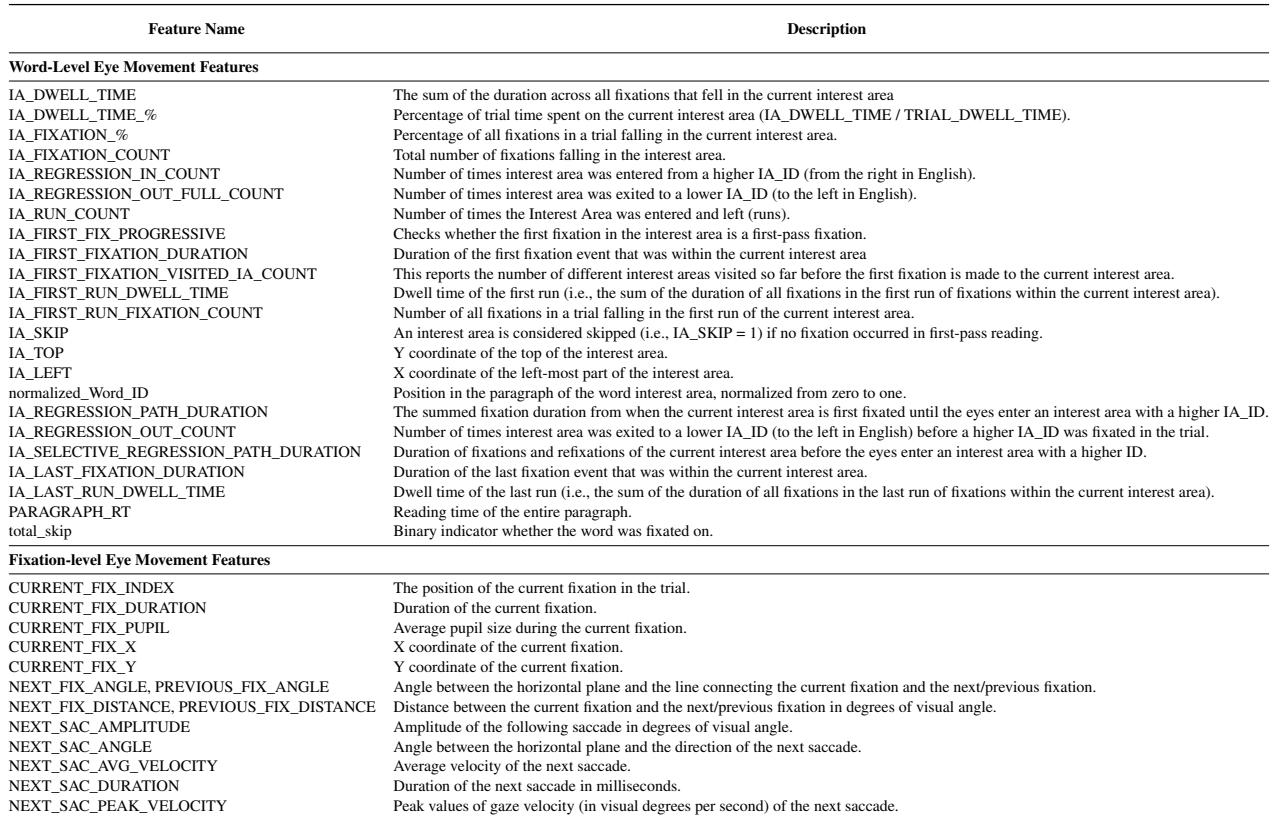
As illustrated in Figure 1, the raw trajectory (left) is converted into word-level features (right). For every word in the paragraph, the researchers extract specific metrics. They also calculate linguistic properties of the words (like length and frequency) because we know these affect reading time regardless of comprehension.
The specific features extracted are quite detailed, covering dwell times, regression counts, and pupil size:
2. The Model Architectures
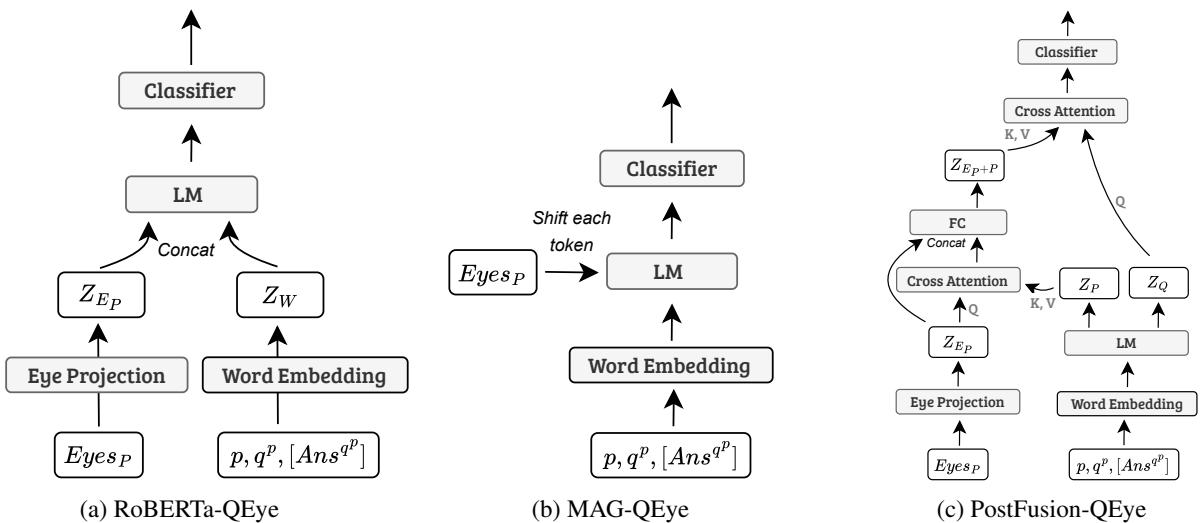
The authors propose three strategies for fusing this gaze data with the text.
A. RoBERTa-QEye (Early Fusion)
This is the most direct approach (Figure 2a). The model concatenates the eye movement features directly with the word embeddings.
For every word \(w_i\), the model generates a combined representation \(Z_{E_{w_i}}\). This involves projecting the eye movement features (\(E_{w_i}\)) into the same dimensional space as the word embeddings using a fully connected layer (\(FC\)), and adding a learned “eye embedding” tag (\(Emb_{eye}\)):

This creates a sequence that looks like: [Text Embedding Sequence] [Separator] [Eye Feature Sequence]. The Transformer then processes this long sequence, allowing it to “attend” to both the semantic meaning of the words and the physiological reaction to them simultaneously.
B. MAG-QEye (Mid-level Fusion)
Adapted from the “Multimodal Adaptation Gate” (MAG) used in sentiment analysis, this model (Figure 2b) is more subtle. Instead of appending eye features as new tokens, it uses them to shift the representation of the text tokens inside the Transformer layers.
The idea is to emphasize or de-emphasize words based on how they were read. If a user fixated heavily on a specific word, the MAG gate shifts that word’s vector representation significantly.
Mathematically, the hidden representation of a word at a specific layer (\(Z\)) is modified by an eye-movement vector (\(H\)):
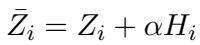
The magnitude of this shift is controlled by a gating mechanism that considers both the text and the eye features. This allows the model to dynamically decide how much the eye movements should influence the meaning of the text.
C. PostFusion-QEye (Late Fusion)
In this architecture (Figure 2c), the text and eye movements are processed by separate encoders initially.
- The text goes through a standard Language Model.
- The eye movements go through Convolutional Neural Networks (CNNs).
- The two streams are merged using Cross-Attention.
The eye movements act as a “query” to extract relevant information from the text “keys” and “values.” This creates a unified “reading space” representation. Finally, the question itself is used to query this combined reading representation, focusing the model’s attention on the parts of the reading experience most relevant to the question asked.
Experimental Setup
To rigorously test these models, the authors devised a strict evaluation protocol. One of the biggest pitfalls in machine learning is “data leakage”—training the model on data that is too similar to the test data.
To avoid this, they utilized three different splitting regimes:
- New Participant: The model is tested on a person it has never seen before (but it has seen the text paragraph before).
- New Item: The model is tested on a text paragraph it has never seen before (but it has seen the participant before).
- New Item & Participant: The hardest setting. The model knows neither the person nor the text.
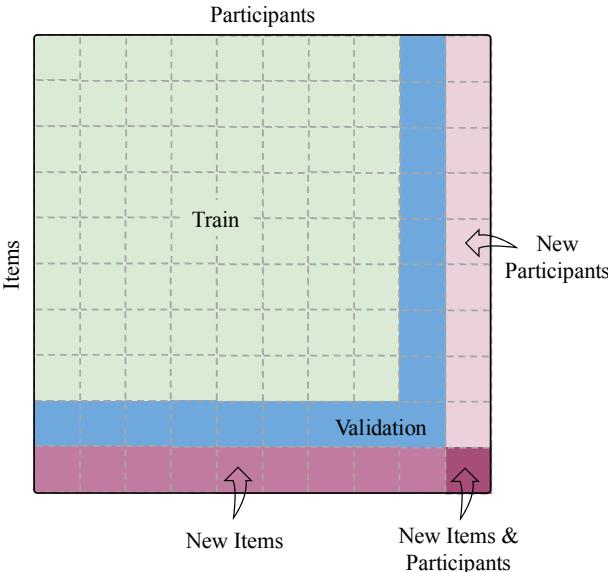
Figure 3 illustrates this complex split. This ensures that if the model performs well, it’s not just memorizing that “Participant #5 always guesses B” or “Paragraph #12 is really hard.”
The Baselines
The authors compared their new Transformer models against several baselines:
- Majority Class: Simply guessing the most common outcome.
- Logistic Regression & CNN: Simpler models used in prior studies.
- Text-only RoBERTa: This is a critical baseline. It uses only the text (paragraph + question) to predict correctness. Why is this important? Because some questions are objectively harder than others. A text-only model captures the inherent difficulty of the item. Any improvement above this baseline represents the true value added by the eye movements.
Results and Discussion
So, can eye movements predict comprehension? The answer is… yes, but it’s complicated.
Binary Classification Results (Correct vs. Incorrect)
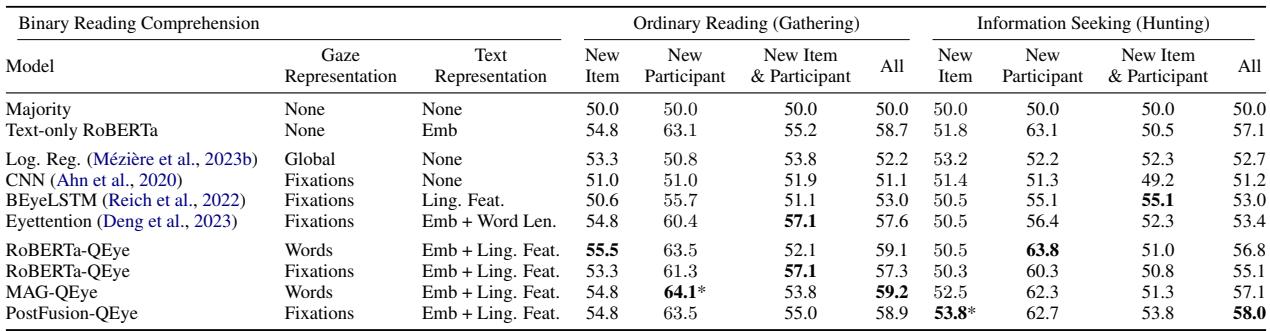
Table 2 (below) presents the results for predicting whether an answer will be correct. The metric used is Balanced Accuracy (50% is random chance).
Key Takeaways:
- The Task is Hard: The best accuracies hover around 59-60%. This is better than chance (50%), but it shows that reading comprehension is a noisy process that isn’t easily decoded just from gaze.
- Text Difficulty Matters: The Text-only RoBERTa baseline performs surprisingly well (around 57-58%). This suggests that a large chunk of predictability comes simply from knowing that “this is a hard question,” regardless of how the person moved their eyes.
- Eye Movements Add Value: The proposed models (RoBERTa-QEye, MAG-QEye, PostFusion-QEye) consistently outperform the text-only baseline, particularly in the “Ordinary Reading” (Gathering) regime. This proves that eye movements do contain unique signals about comprehension that aren’t found in the text alone.
- Generalization is Tricky: Models perform better on “New Participants” than on “New Items.” It is easier for the model to adapt to a new person’s reading style on a familiar text than to understand reading behavior on a completely new text.
Multiple-Choice Results
When predicting the specific answer choice (A, B, C, or D), the chance level is 25%.
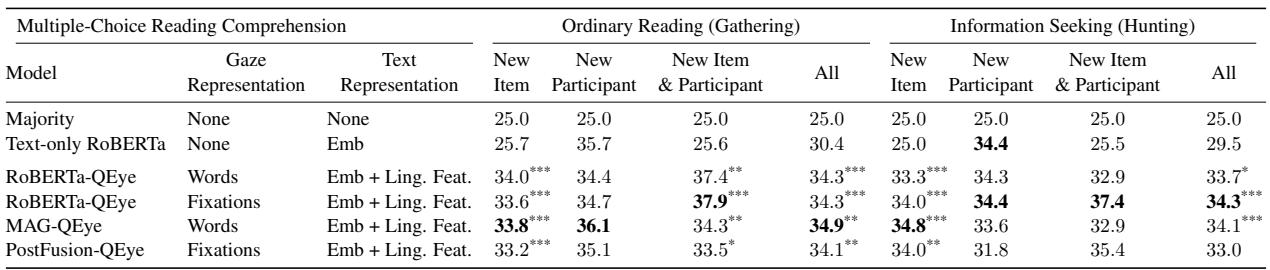
As shown in the table above, the models again outperform the text-only baseline. Interestingly, the RoBERTa-QEye (Fixations) model performs best here. The improvement is statistically significant, meaning the eye movements are helping the model differentiate between the correct answer and specific distractors.
Conclusion & Implications
This research represents a significant step forward in the intersection of psycholinguistics and artificial intelligence. By applying large-scale Transformers to fine-grained eye-tracking data, the authors demonstrated that it is possible to predict single-item comprehension with above-chance accuracy.
However, the modest gains over text-only baselines serve as a reality check. We are not yet at the stage where an AI can perfectly “read your mind” through your eyes. Several factors might explain this:
- Signal Noise: Eye movements are influenced by fatigue, distractions, and motor noise, not just comprehension.
- Modeling Limits: Even sophisticated Transformers might not yet capture the complex temporal dynamics of cognitive processing.
- Data Imbalance: In real-world data, people get most answers right. Predicting the rare instances of confusion is inherently difficult.
Why does this matter? Despite the challenges, this work lays the infrastructure for future “online” educational tools. Imagine an e-reader that detects when you’ve zoned out or misunderstood a complex paragraph and prompts you to re-read it, or an automated testing system that doesn’t require answering questions at all. While we aren’t there yet, this paper provides the architectural blueprints—and the rigorous evaluation standards—needed to get there.
The study highlights that while the eyes may be the window to the soul, decoding what they see requires not just powerful models, but a deep understanding of the text they are reading.