](https://deep-paper.org/en/paper/2410.05206/images/cover.png)
Artificial Intelligence has a representation problem. By now, many of us are familiar with the headlines about facial recognition systems failing on darker skin tones or language models perpetuating gender stereotypes. However, as we push the boundaries of AI into new modalities, such as sign language recognition, we encounter a new frontier of bias—one that is complex, multi-dimensional, and often invisible to the naked eye.
For Deaf and Hard-of-Hearing (DHH) communities, AI-powered tools like digital dictionaries and automated recognition systems are not just novelties; they are vital instruments for accessibility. But what happens if these tools work significantly better for men than for women? What if they fail when the lighting isn’t perfect, or if the user has a darker skin tone?
In a recent study, researchers from Northeastern University and Microsoft Research undertook a comprehensive audit of the ASL Citizen dataset—a massive, crowd-sourced collection of American Sign Language (ASL) videos. Their goal was not just to find the cracks in the system but to repair them.
In this deep dive, we will explore how they dissected the “black box” of Sign Language Recognition (ISLR), identified hidden sources of bias, and engineered a clever mathematical fix to make these systems more equitable.
The Context: Why Sign Language AI is Hard
Before we look at the bias, we need to understand the data. Natural Language Processing (NLP) for spoken languages (like English) has billions of text documents to learn from. Sign languages, however, are “under-resourced.” We don’t have the internet’s worth of text; we have video.
The ASL Citizen dataset was a major leap forward. It is the first crowd-sourced dataset for isolated sign recognition, containing over 83,000 videos of 2,731 unique signs. Because it is crowd-sourced, it captures the real world: different webcams, different living rooms, different lighting, and different people.
While this diversity is good for robustness, it introduces noise. And in the world of AI, noise often correlates with bias. The researchers set out to answer two main questions:
- Which factors (demographic, linguistic, or video-quality) actually hurt model performance?
- Can we fix it without sacrificing overall accuracy?
Part 1: The Audit – Who is in the Data?
To understand model performance, we first have to look at the humans behind the data. The researchers released detailed demographic information about the participants in the ASL Citizen dataset, allowing for a granular analysis.
Demographics and Distribution
The dataset includes a mix of participants, but it isn’t perfectly balanced. As shown below, the participants are skewed toward younger adults (20s and 30s) and those with high proficiency in ASL (levels 6 and 7).
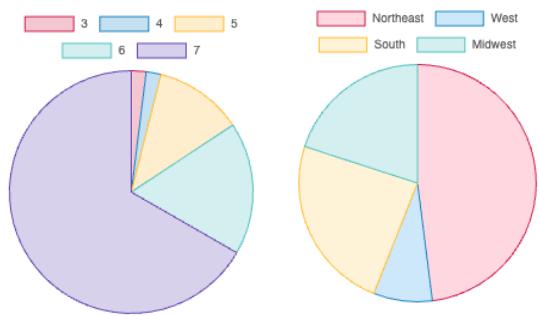
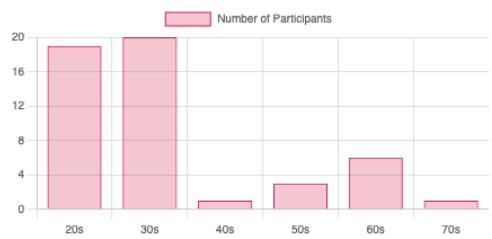
This skew matters. If a model is trained primarily on people in their 20s, how will it perform for a 70-year-old signer whose motor control or signing speed might differ?
The Skin Tone Disparity
One of the most critical checks in any computer vision task is skin tone analysis. The researchers used a skin-tone classifier on the video frames. The distribution of data showed a higher volume of lighter skin tones.
When they tested two different types of AI models—I3D (which looks at the raw video pixels) and ST-GCN (which looks at “skeleton” pose landmarks)—they found a troubling trend.
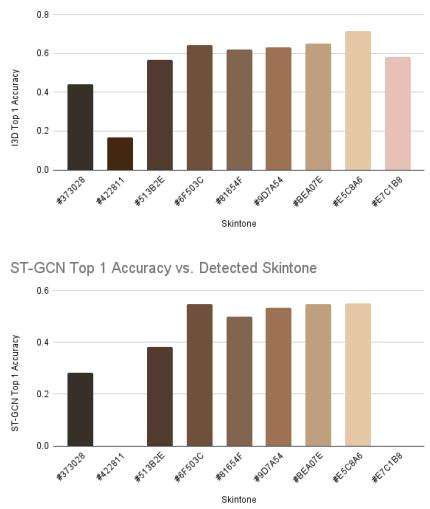
As the charts illustrate, despite some variation, accuracy generally trends higher for lighter skin tones. The ST-GCN model (bottom chart), which relies on detecting the joints of the hands and body, performed notably worse on darker skin tones. This suggests that the underlying computer vision tools used to extract poses might struggle with contrast in darker-skinned subjects, cascading into a failure of the sign recognition model itself.
Part 2: Invisible Biases – Video Quality and Linguistics
Bias isn’t always about who you are; sometimes it’s about the technology you possess. The researchers moved beyond demographics to look at “video-level” features. This is where the analysis gets fascinating.
The Impact of Image Quality (BRISQUE)
Not everyone has a 4K webcam. The researchers used a metric called BRISQUE (Blind/Referenceless Image Spatial Quality Evaluator) to score the quality of the video frames. A lower BRISQUE score means high quality; a high score means the image is distorted or low quality.
They found a strong correlation: Better cameras lead to better AI recognition.
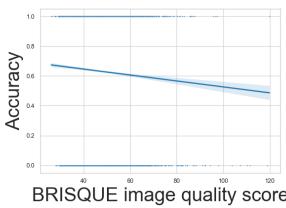
This chart reveals a socio-economic bias. If users with lower-end hardware (generating high BRISQUE scores) receive worse recognition results, the technology becomes less accessible to lower-income communities.
The “Speed” of Signing
Another hidden factor is how a signer moves. The researchers used the Frechet distance to measure the “speed” or deviation of movement in a video compared to a reference “seed signer” (a professional model).
Think of Frechet distance using the “dog-walking” analogy: Imagine a person walking a dog on a leash. The Frechet distance is the length of the shortest leash required for the two to walk their separate paths. In this context, it measures how much a participant’s hand movement deviates from the “standard” or average movement for that sign.
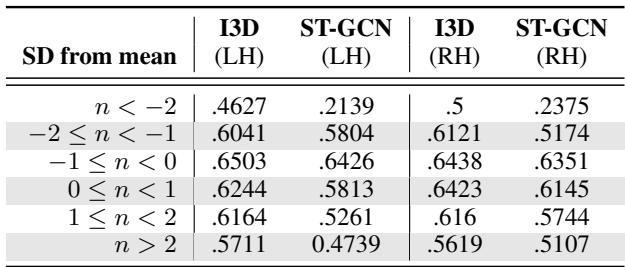
The data in Table 2 (above) shows that “outliers”—people who sign much faster or slower than the average (high standard deviations)—suffer from significantly lower accuracy.
The Gender Gap and Video Length
Perhaps the most surprising finding was a stark gender gap. The baseline models performed over 10 percentage points better for male participants than female participants.
Why? It wasn’t just biology. The researchers analyzed video lengths and found a behavioral difference.
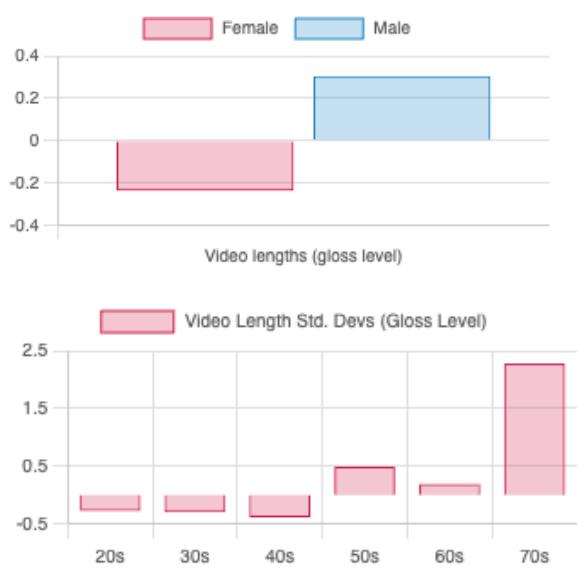
On average, female participants recorded significantly shorter videos (negative deviation) compared to men. Older participants (60s and 70s) recorded longer videos, often pausing before or after the sign. Since the models struggle with “outlier” video lengths (very short or very long), these behavioral differences contributed to the performance gap.
Part 3: Fixing the Bias with Weighted Resampling
The researchers had identified the villains:
- Video Quality: Low-quality video kills performance.
- Video Length: Outliers (too short/long) confuse the model.
- Demographic Imbalance: Training data isn’t representative.
Standard approaches, like training on only one gender, failed to produce good results. Instead, the team turned to Weighted Resampling.
The Hypothesis
If the model struggles with “difficult” videos (low quality or outlier lengths), we shouldn’t hide them. We should force the model to look at them more often during training. By increasing the probability that the model sees a low-quality video, the model is forced to learn robust features that work even when the image is grainy.
Strategy A: Resampling by Video Length
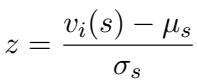
The team tried resampling videos based on how “normal” their length was. They used the Z-score (standard deviation) of the video length:
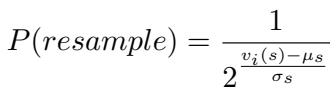
They calculated a probability for resampling where videos closer to the mean were prioritized to stabilize training:
This helped, but it wasn’t the magic bullet.
Strategy B: Resampling by Quality (The Winner)
The most effective strategy involved the BRISQUE score. They flipped the script: they configured the training loop to resample lower-quality videos at a higher rate.
The probability of a video being selected for a training batch was calculated using the inverse of its quality, ensuring that high-BRISQUE (low quality) videos appeared more frequently:
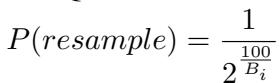
Here, \(B_i\) is the BRISQUE score. As the score goes up (quality gets worse), the probability of resampling increases.
The Results: Closing the Gap
The results of this “stress-training” were remarkable. By forcing the model to grapple with lower-quality video inputs, the researchers didn’t just improve the model’s ability to handle bad webcams—they accidentally fixed the gender gap.
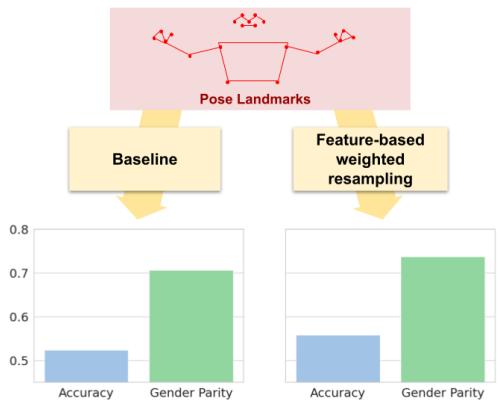
As shown in Figure 1 above:
- Left (Baseline): The accuracy is lower, and the “Gender Parity” (the ratio of female-to-male performance) is around 0.7.
- Right (Weighted Resampling): The accuracy jumps up, and the Gender Parity climbs significantly higher.
It turns out that “video quality” was a latent variable masking other biases. By making the model robust to visual noise, the researchers created a system that was more generalized and fair across different demographics.
Linguistic Factors
The study also confirmed that linguistic complexity plays a role. Signs that are phonologically complex or have “crowded neighborhoods” (look similar to many other signs) are harder to recognize.

The charts above show that as complexity increases (moving right on the x-axis), accuracy dips. However, the resampling technique helped mitigate these inherent linguistic difficulties as well.
Conclusion and Key Takeaways
This research highlights a crucial lesson for AI developers: Bias is not always about the label.
In the case of ASL Citizen, the bias wasn’t just “Male vs. Female.” It was entangled with video duration, camera quality, and signing speed. Men tended to have longer videos; lower-income users might have grainier webcams. These technical features served as proxies for demographic bias.
By systematically auditing the dataset and applying a feature-based weighted resampling strategy—specifically targeting low-quality videos—the researchers achieved a “win-win”:
- Higher Overall Accuracy: The model became better at recognizing signs generally.
- Higher Fairness: The performance gap between men and women shrank.
This work serves as a blueprint for future sign language research. It proves that we don’t always need to collect millions of new data points to fix bias; sometimes, we just need to change how the model looks at the data we already have. By releasing the demographic data for ASL Citizen, the authors have opened the door for the community to continue building more equitable, accessible technology for everyone.