](https://deep-paper.org/en/paper/2410.05581/images/cover.png)
In the traditional world of machine learning, there is a golden rule that almost always holds true: if you want a model to perform better on a specific topic, you train it on data from that topic. If you want a neural network to recognize cats, you show it more cats. If you want a language model to understand biology, you train it on biology papers.
But in the era of Large Language Models (LLMs), this intuitive logic is beginning to fracture.
A fascinating research paper titled “Adaptation Odyssey in LLMs” explores a counter-intuitive phenomenon: taking a massive, pre-trained model and training it further on a specific domain can sometimes worsen its performance on that very same domain. This creates a paradox for engineers and researchers. We assume that “adaptation” (fine-tuning or continued pretraining) always specializes the model, but the results suggest otherwise.
In this post, we will break down why this happens, how domain similarity plays a crucial role, and why a simple “newline” character might be ruining your perplexity scores.
The Breakdown of the “Train-Test” Paradigm
To understand why this research matters, we have to look at how deep learning has evolved.
In the past, we had a clear dichotomy:
- Training Set: The data the model sees.
- Test Set: The data the model has never seen, used to evaluate it.
We assumed these came from a fixed distribution. Later, Domain Adaptation became popular, where we acknowledged that the training data (e.g., generic web text) might differ from our target application (e.g., medical records). The solution was always to train the model further on the target domain.
However, LLMs like GPT, LLaMA, and OLMo have changed the game. They are trained on internet-scale corpora (trillions of tokens) that are often undocumented or proprietary. Because they have seen so much, it is difficult to know if a “new” dataset is actually new. If you try to adapt a model to Wikipedia articles, and the model has already memorized Wikipedia during its initial training, standard generalization theories stop applying.
The researchers behind this paper asked a critical question: Is it still relevant to study additional pretraining when we don’t know exactly what the model has already seen?
The Core Method: Investigating Adaptation
The researchers set up an experiment to test the effectiveness of additional pretraining. They wanted to see if taking a base model and training it for one more epoch on a specific domain would lower its perplexity (a measure of how confused the model is; lower is better).
The Setup
- Models: They used a variety of open models, including the GPT-2 family (Small, Large, XLarge), OLMo-1B, and LLaMA-7B.
- Dataset (M2D2): They used the Massively Multi-Domain Dataset, specifically selecting 20 domains. Crucially, these domains were split into two types:
- Wikipedia (Wiki): General knowledge topics (e.g., “Society,” “History”).
- S2ORC: Specialized scientific papers (e.g., “High Energy Physics,” “Mathematics”).
- The Test: They compared the Zero-Shot Perplexity (how the model performs out of the box) with the Adaptation Perplexity (how it performs after training on that domain).
Measuring Similarity
Here is the most innovative part of their methodology. To understand why performance changes, they needed to measure how similar the new domain was to the model’s original training data.
Since they used open-data models, they could sample the original training sets (like OpenWebText for GPT-2 or Dolma for OLMo). They calculated the “distance” between the original training data and the new adaptation domain using two mathematical metrics:
- Maximum Mean Discrepancy (MMD)
- Fréchet Distance (FD)
Think of these metrics as “similarity scores.” A low score means the new data is very similar to what the model has already seen. A high score means the new data is distinct and unfamiliar.
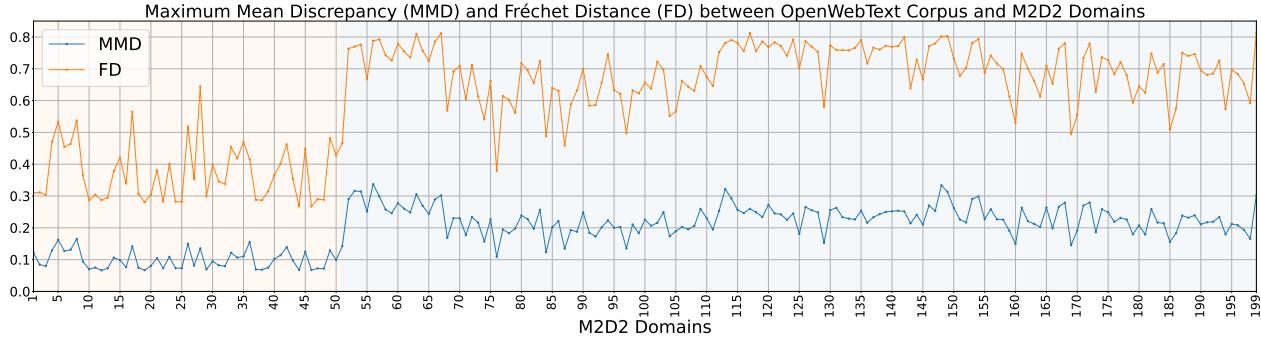
As shown in Figure 2, there is a clear distinction. The Wiki domains (blue area) have much lower distance scores, meaning they are very similar to the original pretraining data. The S2ORC domains (orange area) are scientifically dense and distinct, resulting in higher distance scores.
Experiments & Results: The Adaptation Paradox
The researchers trained the models on these domains and measured the change in perplexity. Mathematically, they looked at:
\[ \Delta P = \text{Zero-Shot Perplexity} - \text{Adaptation Perplexity} \]- If \(\Delta P\) is positive, adaptation helped (perplexity went down).
- If \(\Delta P\) is negative, adaptation hurt (perplexity went up).
The results were striking.
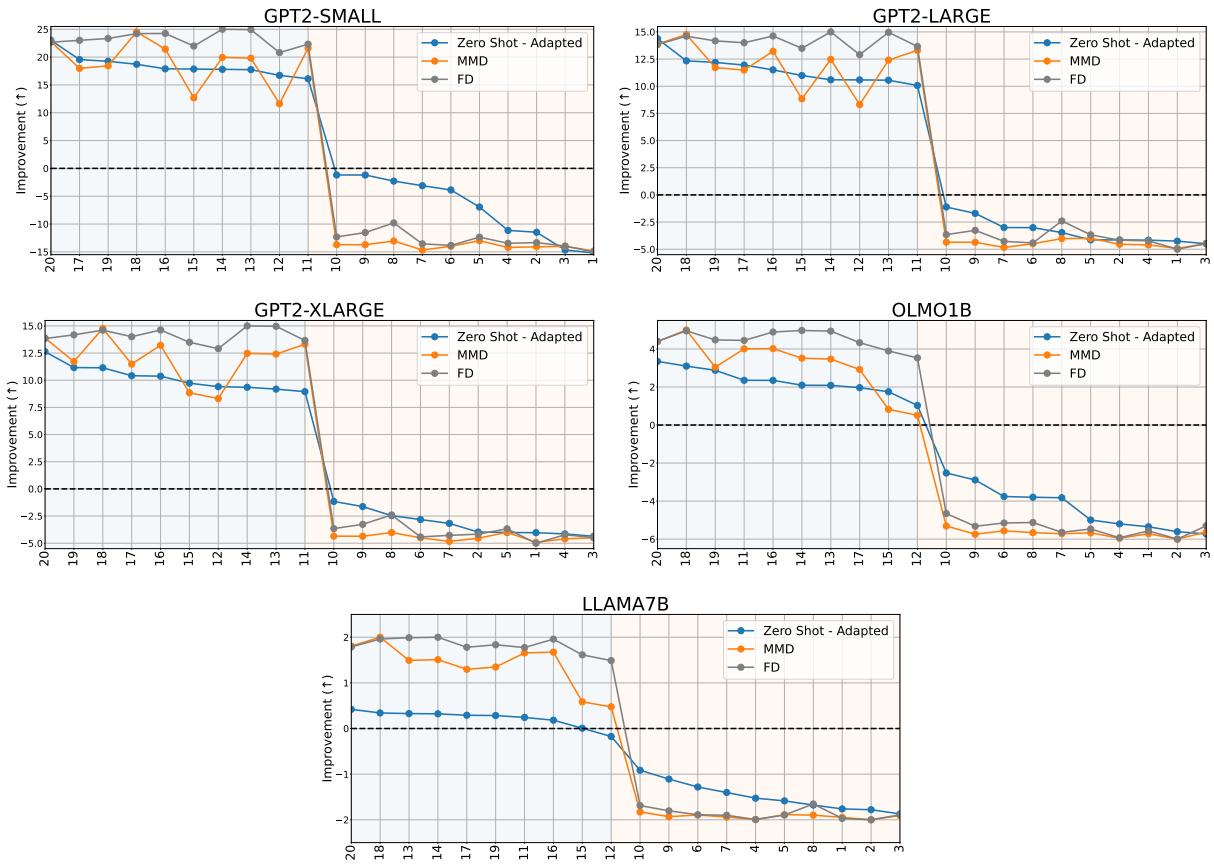
Figure 1 tells the story of the “Adaptation Odyssey.” Look at the Zero Shot - Adapted line (the blue line with dots).
- The S2ORC Effect (Blue Shaded Region): For scientific domains like Physics or Math, the value is consistently positive. The models were unfamiliar with this dense technical jargon, so training on it helped significantly.
- The Wiki Effect (Orange Shaded Region): For general Wikipedia domains, the line often drops below zero. This means that after training on the specific domain, the model actually got worse at predicting text from that domain.
This confirms the hypothesis: Adaptation improves performance on unfamiliar data (S2ORC) but can degrade performance on data that is too similar to the original training corpus (Wiki).
Why Does Training Degrade Performance?
To understand this degradation, the authors looked at the training curves. Usually, we expect both training loss and validation loss to go down over time.
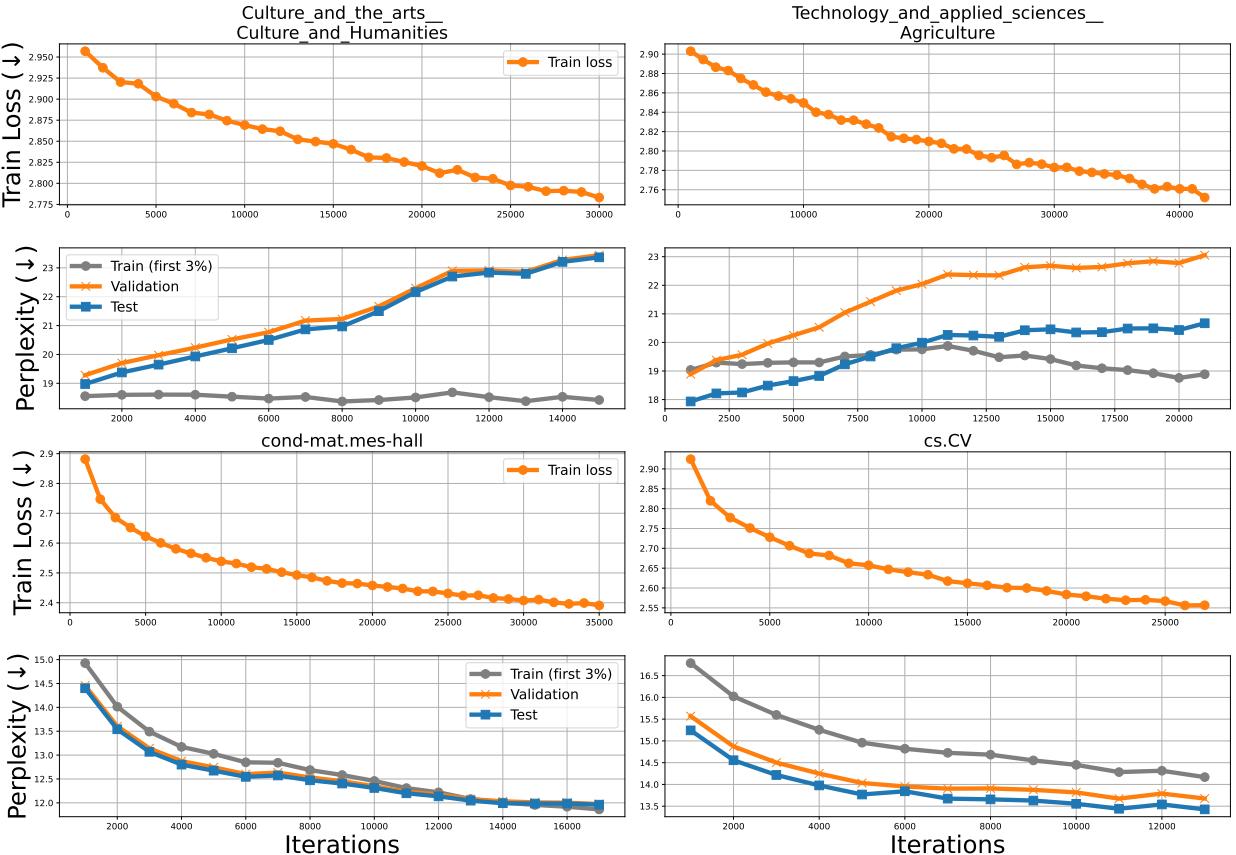
In Figure 3, look at the “Perplexity” charts on the bottom row. For the domain cs.CV (Computer Vision, a scientific domain), the test perplexity drops, which is good. But for Culture and Humanities (a Wiki domain), the validation and test perplexity increase as training proceeds.
The model is essentially “overthinking.” It has already learned the general structure of this data during its massive pretraining. When forced to train on it again specifically, it may be overfitting to noise or specific artifacts of the new dataset rather than learning generalizable concepts.
The “Newline” Culprit: Token-Level Analysis
The researchers dug even deeper. They asked: Is the model getting worse at everything, or just specific things?
They analyzed the perplexity change for every unique token in the vocabulary. The discovery was surprising. The degradation wasn’t spread evenly; it was concentrated on a handful of “uninformative” tokens.
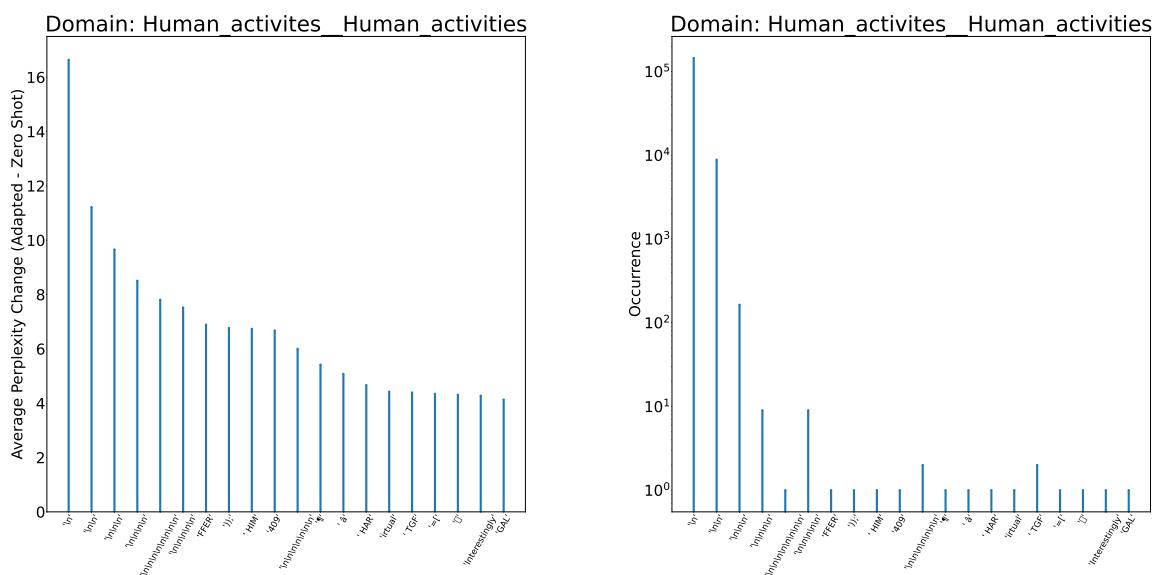
Figure 4 reveals the offender. The tokens with the massive spikes in perplexity degradation are predominantly structural tokens like \n (newline) and \n\n (double newline).
Because the specific formatting of the adaptation dataset might differ slightly from the massive internet corpus the model was originally trained on, the model becomes “surprised” by where the line breaks are. Since these tokens appear very frequently (as shown in the right panel of Figure 4), they drag down the average perplexity score for the entire dataset.
This implies that the model might not be losing its knowledge of “Culture” or “History,” but simply struggling to predict the specific formatting of the new dataset.
Discussion and Implications
This paper serves as a crucial reality check for the current practice of LLM development. It challenges the “more is always better” mentality regarding data.
Here are the key takeaways for students and practitioners:
- Know Your Data Similarity: Before you spend computational resources fine-tuning or adapting a model, check how similar your data is to the model’s pretraining corpus. If it’s too similar (like general Wikipedia text), you might be wasting time or actively harming the model.
- The “Uncanny Valley” of Pretraining: Adaptation works best when the new domain is “out-of-distribution” (like dense physics papers for a general web model). It fails when the domain is “in-distribution.”
- Perplexity is Deceptive: An increase in perplexity doesn’t always mean the model has become “stupid.” As the token-level analysis showed, the model might just be confused by formatting (newlines). Relying solely on average perplexity can lead to false conclusions.
- Model Size Matters: The paper notes (visible in Figure 1) that as model capacity increases (moving from GPT-2 Small to XLarge), the gap between zero-shot and adaptation narrows. Larger models are more robust and “harder to move” via simple adaptation.
Conclusion
The “Adaptation Odyssey” teaches us that machine learning is no longer just about feeding data into a black box. As models grow larger and their training data encompasses nearly the entire internet, the lines between “new” and “old” data blur.
Successful adaptation requires a strategic approach: analyzing the distributional distance of your data and looking beyond aggregate metrics like perplexity to understand what the model is actually learning—or forgetting. Sometimes, the best move is to rely on the foundation model’s existing capabilities rather than trying to force it to learn what it already knows.