](https://deep-paper.org/en/paper/2410.05698/images/cover.png)
Decoding the French Flow: A Data-Efficient Approach to Pronunciation Learning
If you have ever tried to learn French, you have likely encountered a specific frustration. You learn a word, you memorize how to pronounce it, and then you hear a native speaker say it in a sentence, and it sounds completely different.
This is not just a problem for language learners; it is a massive headache for Text-to-Speech (TTS) systems. While modern TTS systems are incredibly advanced, achieving natural-sounding speech in French requires mastering complex phonological rules where words blend into one another.
Usually, solving this requires massive datasets of spoken sentences labeled by experts—a resource that is expensive and hard to come by. But what if we could solve this problem without needing thousands of hours of annotated data?
In this post, we are diving deep into a paper titled “A Two-Step Approach for Data-Efficient French Pronunciation Learning.” The researchers propose a clever “divide and conquer” strategy that separates word pronunciation from sentence flow, achieving impressive results with a surprisingly small amount of data.
The Problem: When Words Collide
To understand why this research is significant, we first need to understand the linguistic quirks of the French language. In many languages, you can get away with pronouncing words in isolation and stringing them together. In French, however, the boundaries between words are fluid.
This fluidity is primarily driven by two phenomena: Linking (Enchaînement) and Liaison.
1. Linking (Enchaînement)
Linking occurs when a word ends with a pronounced consonant and the next word begins with a vowel. The consonant “moves” to become the start of the next syllable.
Consider the phrase une amie (a friend):
- une is pronounced
[yn] - amie is pronounced
[a.mi] - Together, they are not
[yn] [a.mi]. Thensound shifts, creating[y.na.mi].
2. Liaison
Liaison is even trickier. This happens when a word ends with a silent consonant that suddenly becomes pronounced because the next word starts with a vowel.
Take the word mes (my):
- Before a consonant (e.g., mes frères), the
sis silent:[me]. - Before a vowel (e.g., mes amis), the
sturns into azsound:[me.za.mi].
The Data Bottleneck
For a computer to learn these rules, it usually needs Post-Lexical Rules (PLR). Historically, engineers wrote these rules by hand—an exhausting task requiring deep linguistic expertise. Alternatively, modern Deep Learning models can learn these rules from data, but they need sentence-level phonetic transcriptions.
Creating a dataset where thousands of full sentences are transcribed into phonetic symbols (like International Phonetic Alphabet or X-SAMPA) is incredibly tedious and expensive. This paper asks: Can we build a system that handles these complex transitions using mostly cheap, single-word data and only a tiny amount of expensive sentence data?
The Solution: A Two-Step Architecture
The researchers propose splitting the task into two distinct stages. Instead of trying to train one giant model to go from text to perfect sentence pronunciation, they use two specialized models:
- Grapheme-to-Phoneme (G2P) Model: Converts individual words into their standard pronunciation.
- Post-Lexical Phonetization (PLP) Model: A “corrector” that looks at the sequence of words and fixes the boundaries to account for Liaison and Linking.
Let’s look at the architecture used to achieve this.
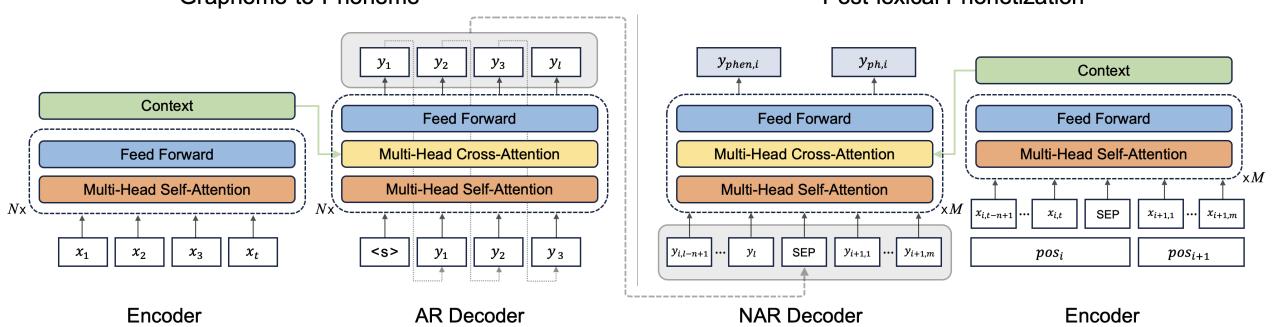
As shown in Figure 1, the architecture is a pipeline. On the left, we have the standard G2P process. On the right, we have the novel Post-Lexical Phonetization module.
Step 1: The G2P Model (The Foundation)
The first step uses an Autoregressive Transformer (ART). This is a standard architecture in NLP. It takes a sequence of letters (graphemes) and predicts the corresponding sounds (phonemes).
- Input: Individual words (e.g., “mes”, “amis”).
- Training Data: A dictionary of isolated words and their pronunciations. This data is easy to find or scrape from the web.
- Output: The dictionary pronunciation of the words (e.g.,
[me],[a.mi]).
If we stopped here, the TTS system would sound robotic and disjointed because it ignores the interactions between words.
Step 2: The Post-Lexical Phonetization Model (The Refiner)
This is the core innovation. The researchers use a Non-Autoregressive Transformer (NART) for this step. Unlike the first model, which generates sounds one by one, this model is “shallow” and fast. It doesn’t need to learn how to pronounce “encyclopedia”; it only needs to learn how to fix the edges of words.
The PLP model takes three inputs:
- Graphemes: The letters of the current word and the next word.
- Phonemes: The sounds predicted by Step 1.
- POS Tags: Part-of-Speech tags (noun, verb, adjective, etc.).
Why POS Tags? French Liaison is not just about sounds; it’s about grammar. For example, Liaison is mandatory between a determiner and a noun (mes amis), but forbidden in other grammatical contexts. By feeding the model Part-of-Speech tags (generated by a separate pre-trained tool), the model gains the grammatical context necessary to decide if a silent letter should be pronounced.
The PLP model focuses specifically on the boundary: the last few characters of the first word and the first few characters of the second word. It acts as a specialized surgeon, stitching the words together.
The Mathematics of Refinement
To train the Post-Lexical model effectively, the researchers had to design a specific loss function. This is because phonological phenomena are actually rare. In a sentence of 10 words, there might only be one or two spots where Liaison or Linking happens. If the model simply guessed “do nothing,” it would be right 90% of the time but useless for the task.
To solve this, they use a two-part loss function.
1. Detecting the Phenomenon
First, the model must predict if a change happens. This is a binary classification problem (Change vs. No Change). Because “No Change” is much more common, they use Weighted Binary Cross-Entropy (WBCE):
\[ \mathcal { L } _ { p h e n } = \mathrm { W B C E } \left( \hat { y } _ { p h e n } , y _ { p h e n } \right) \]This equation ensures that the model is penalized heavily if it misses a rare Liaison event, forcing it to pay attention to those specific moments.
2. Predicting the Sound
If the model decides a change is happening, it then needs to predict the correct phoneme. For this, they use standard Cross-Entropy (CE) loss, but they multiply it by the ground truth of the phenomenon occurrence (\(y_{phen}\)):
\[ \mathcal { L } _ { p h } = y _ { p h e n } \cdot \mathrm { C E } \left( \hat { y } _ { p h } , y _ { p h } \right) \]Here, \(y_{phen}\) acts like a switch.
\[ y _ { p h e n , i } = { \left\{ \begin{array} { l l } { 1 , } & { { \mathrm { i f ~ } } { \mathrm { p o s t - l e x i c a l ~ p h e n o m e n o n } } } \\ { 0 , } & { { \mathrm { o t h e r w i s e } } } \end{array} \right. } \]If there is no phenomenon (\(y_{phen} = 0\)), the loss for phoneme prediction becomes zero. This tells the model: “Don’t worry about predicting the sound unless a phenomenon is actually occurring.”
Total Loss
The final loss function combines these two objectives, allowing the model to simultaneously learn where to act and how to act.
\[ \mathcal { L } _ { p l p } = \mathcal { L } _ { p h } + \mathcal { L } _ { p h e n } \]The Experiments: Doing More with Less
The team curated a dataset to test their hypothesis. As mentioned, the goal was to use very little sentence-level data.
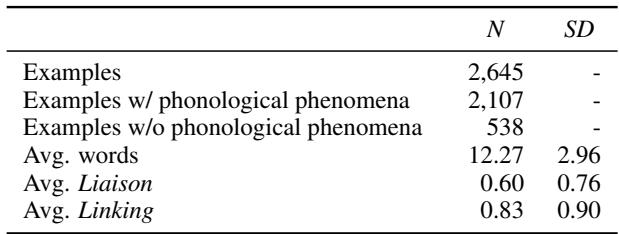
As shown in Table 1, their sentence-level dataset contains only 2,645 examples. In the world of Deep Learning, where datasets often number in the millions, this is tiny. This small size simulates a “resource-constrained” environment, which is common for languages that aren’t English or Chinese.
Comparison with Baselines
They compared their Two-Step approach against standard baselines:
- Word-level training: Training a model only on the dictionary.
- Sentence-level training: Training a model only on the 2,645 sentences.
- Combined: Training on both.
The results highlight the difficulty of the task.
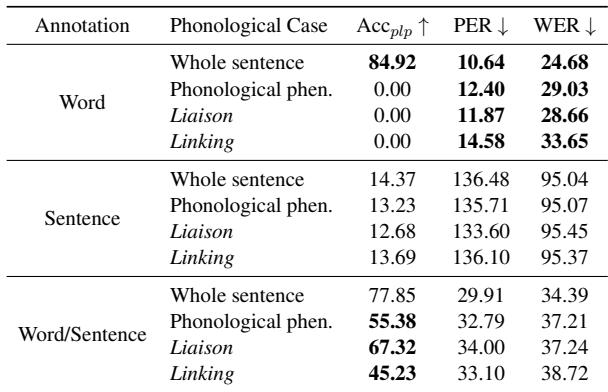
Table 2 reveals the failure points of traditional methods:
- Word-level models (top section) achieved 0.00% accuracy on Liaison and Linking. This is expected; the model literally never saw words interacting.
- Sentence-level models (middle section) failed because the dataset (2.6k sentences) was too small to learn the general rules of French pronunciation from scratch. The error rates (PER/WER) were massive.
- Combined models (bottom section) did better, but still struggled with Liaison (Acc_plp around 67%).
The Success of the Two-Step Method
Now, let’s look at how the proposed Two-Step method performed.

Table 3 shows the performance of the proposed method using varying amounts of data (25%, 50%, 75%, and Full).
The results are striking. Using the Full dataset (which is still only ~2.6k sentences), the model achieved:
- 95.52% accuracy on the whole sentence.
- 83.86% accuracy specifically on phonological phenomena.
- 89.21% accuracy on Linking.
Even more impressively, look at the 75% of Full column. With fewer than 2,000 sentences, the model achieved nearly 92% accuracy on Linking. This confirms the researchers’ hypothesis: You do not need massive sentence datasets if you decouple the basic pronunciation task from the context-dependent linking task.
The G2P model handles the heavy lifting of memorizing vocabulary (using cheap data), leaving the PLP model to focus solely on the intricate “stitching” of words (using the expensive data).
Conclusion and Implications
This research offers a promising blueprint for Data-Efficient Learning. By breaking a complex problem—French pronunciation—into sub-tasks, the authors managed to achieve high performance without the massive costs usually associated with speech synthesis data.
The takeaways for students and practitioners are clear:
- Decomposition: If a task is complex, try to break it down. One model doesn’t have to do everything.
- Targeted Data: Use cheap data (dictionaries) for general tasks and save expensive data (annotated sentences) for the specific nuances that require context.
- Specialized Architectures: A shallow, non-autoregressive model was perfect for the second step because it was a “refining” task, not a “generation” task.
This approach could be a game-changer not just for French, but for other languages with complex sandhi or liaison rules, making high-quality Text-to-Speech accessible even for low-resource languages.