](https://deep-paper.org/en/paper/2410.06519/images/cover.png)
Introduction
In the current landscape of Large Language Models (LLMs), there is an ongoing “arms race” for context window size. We have moved quickly from 4,000 tokens to 128,000, and even up to a million tokens. The assumption is simple: if the model can “see” the entire book, codebase, or legal archive at once, it should understand it perfectly.
However, reality paints a different picture. Simply expanding the context window does not guarantee robustness. Researchers have observed phenomena like “Lost in the Middle,” where models excel at retrieving information from the beginning or end of a prompt but fail to recall details buried in the center. Furthermore, processing massive contexts is computationally expensive and often introduces noise that degrades reasoning capabilities.
So, how do we process extensive documents efficiently without relying on massive, unwieldy context windows?
This brings us to SEGMENT+, a novel framework proposed by researchers from Fudan University and Ant Group. Instead of forcing a model to ingest a novel in one gulp, SEGMENT+ introduces a structured method to break down, analyze, and synthesize information using short-context models. It mimics a meticulous human reader: taking notes, quoting evidence, and filtering out the noise before drawing a final conclusion.
In this post, we will deconstruct how SEGMENT+ works, why its “Evidence vs. Reasoning” approach is a game-changer for information flow, and look at the experimental results that show it outperforming significantly larger models.
The Challenge of Long Text
Before diving into the solution, we must understand the limitations of current approaches to long-text processing.
The Limitations of RAG and Long-Context Models
Traditionally, there are two ways to handle texts longer than a model’s limit:
- Retrieval-Augmented Generation (RAG): You index the document and use a search algorithm to find relevant chunks based on a user’s query.
- The Problem: RAG is excellent for finding a specific fact, but it struggles with “global” questions that require synthesizing information from multiple parts of a text. If the retrieval step misses a chunk, the model never sees it.
- Long-Context Extension: You train the model to handle larger inputs (e.g., via position interpolation).
- The Problem: Attention mechanisms in Transformers scale quadratically in terms of compute for vanilla implementations. More critically, as the context grows, the “signal-to-noise” ratio drops. The model becomes easily distracted by irrelevant details.
The Agent Approach
A third approach involves using LLM agents to manage memory, reading a document sequentially and deciding what to remember. While promising, previous attempts like MemGPT often rely on the model’s inherent ability to plan and make spontaneous decisions. This frequently results in uncontrolled reasoning processes where the model gets stuck, forgets instructions, or produces inconsistent formatting.
The researchers behind SEGMENT+ argue that we don’t need infinite context or complex autonomous agents. We need structured information flow control.
The SEGMENT+ Methodology
The core philosophy of SEGMENT+ is that long-text processing should be a two-stage process: Gathering and Reasoning.
The framework is designed to process input segments in parallel, extract structured “notes,” filter out the garbage, and then merge the remaining high-quality information to answer the question.
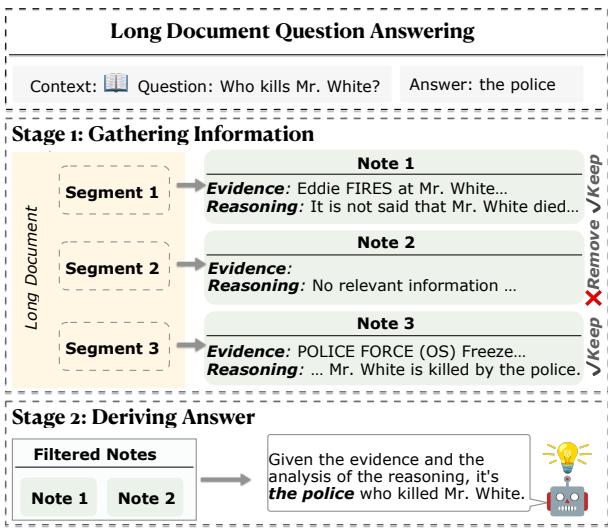
As shown in the figure above, the process resembles a detective organizing a case file. The system scans different segments (Stage 1), creates notes, decides which notes are relevant (Keep vs. Remove), and then moves to a synthesis phase (Stage 2) to derive the answer.
Let’s break this down into the specific architecture.
1. Structured Information Gathering
The most innovative aspect of SEGMENT+ is how it treats the data it reads. It does not simply summarize text. For every segment of the document, the model is asked to produce a structured output containing two specific components: Evidence and Reasoning.
- Evidence: This requires the model to extract original sentences from the text that directly relate to the question. This addresses “short-dependency” questions—facts that are explicitly stated. By forcing the model to quote the text, the framework ensures precision and reduces hallucinations.
- Reasoning: This asks the model to compress the context into high-level semantic information. It captures entities, events, and implications. This addresses “long-dependency” questions, where the answer isn’t written explicitly but must be inferred.
This structure is formalized as a JSON object:

By separating these two streams, the model can maintain exact details (Evidence) while simultaneously building a compressed understanding of the narrative (Reasoning).
2. The Filter Module (Noise Reduction)
In a long document, not every paragraph is relevant to a specific question. If you ask, “Who killed Mr. White?” chapters describing the weather or a different character’s backstory are noise.
If you feed this noise to a standard LLM, it might get confused or try to hallucinate a connection. SEGMENT+ introduces a Filter Module.
After the notes are generated for all segments, a verification step labels each note as Keep or Remove.
- If a segment produces a note saying “No relevant information found,” it is discarded.
- If a segment produces low-confidence reasoning without evidence, it is scrutinized.
This ensures that only information-dense content moves forward to the next stage.
3. Batch Merging and Answering
Once the relevant notes are collected, they might still be too large to fit into the final context window. SEGMENT+ handles this through a Batch Merging process.
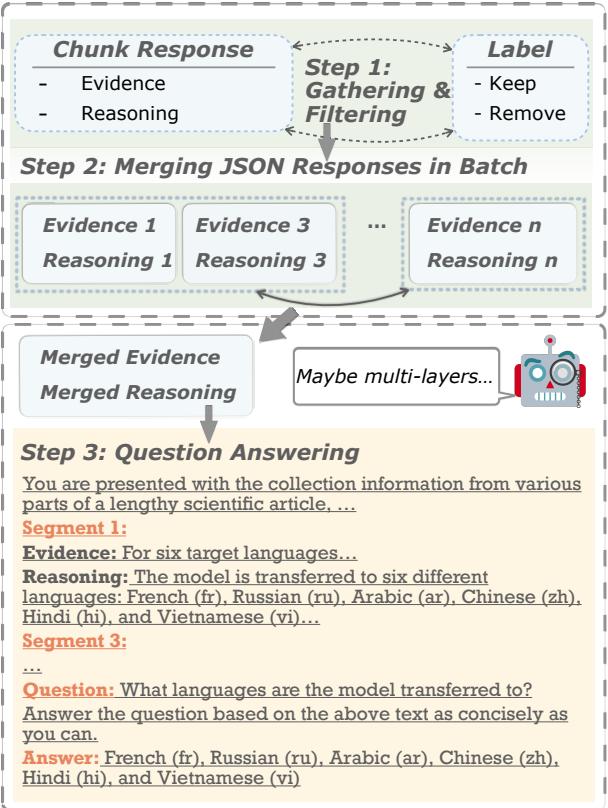
As illustrated in Figure 2, the process flows as follows:
- Input Segmentation: The long text is split into chunks.
- Parallel Processing: Each chunk is processed to generate the Evidence/Reasoning JSON.
- Filtering: Irrelevant notes are removed.
- Merging: The remaining notes are grouped into batches. The model concatenates the “Evidence” (to keep exact facts) and synthesizes the “Reasoning” (to compress the narrative further).
- Iteration: This merging step repeats until the total information fits within the target context window.
- Final QA: The compressed, high-density context is fed to the model to generate the final answer.
This “divide and conquer” strategy allows a short-context model (like a standard 4k or 8k Llama model) to process a document of arbitrary length effectively.
Experimental Results
The researchers put SEGMENT+ to the test against formidable baselines, including GPT-4 (128k context), standard RAG (Retriever-Augmented Generation), and agent-based approaches like MemGPT and Pearl.
The evaluation covered two primary domains: Long Document Question Answering and the Needle-in-a-Haystack test.
Long Document Question Answering
The benchmarks used included datasets from Scrolls (e.g., Qasper, NarrativeQA) and Longbench (e.g., HotpotQA, Musique). These datasets test everything from finding specific facts in scientific papers to understanding complex storylines in movie scripts.
The results were statistically significant:
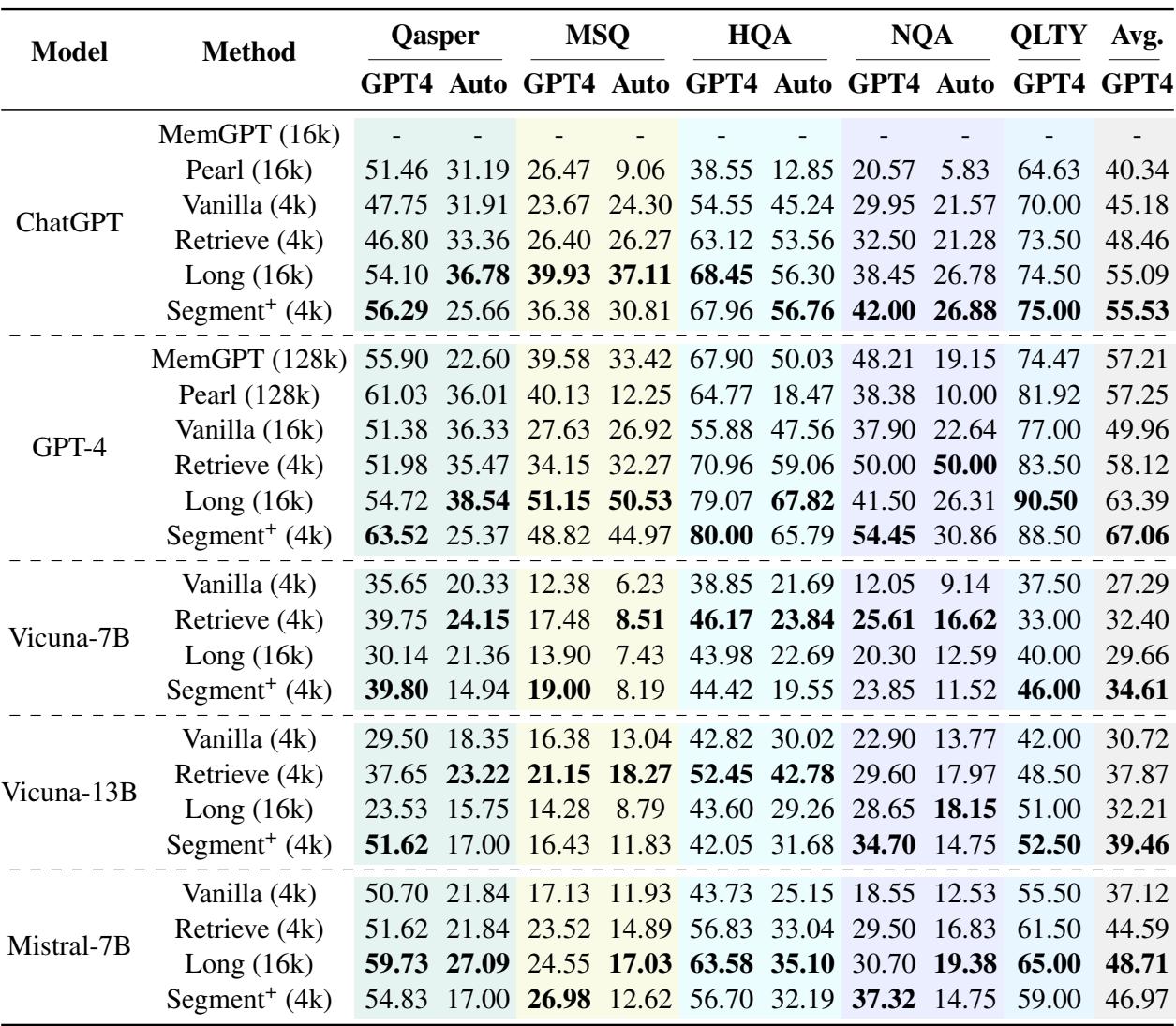
Key takeaways from the results:
- Beating the Giants: SEGMENT+ (using a 4k context limit) consistently outperformed “Vanilla” long-context models that had access to 16k or even 128k tokens.
- Empowering Smaller Models: When applied to smaller open-source models like Vicuna-7B or Mistral-7B, SEGMENT+ allowed them to achieve performance levels comparable to much larger proprietary models.
- Agent Stability: Compared to MemGPT, which often failed to return valid responses or got stuck in loops, SEGMENT+ showed high stability and robustness.
Needle-in-a-Haystack (Babilong)
The “Needle-in-a-Haystack” test involves hiding a specific fact (the needle) inside a massive amount of irrelevant text (the haystack) and asking the model to retrieve it. To make it harder, the researchers used the Babilong benchmark, which requires the model to not just find the fact but reason about it.
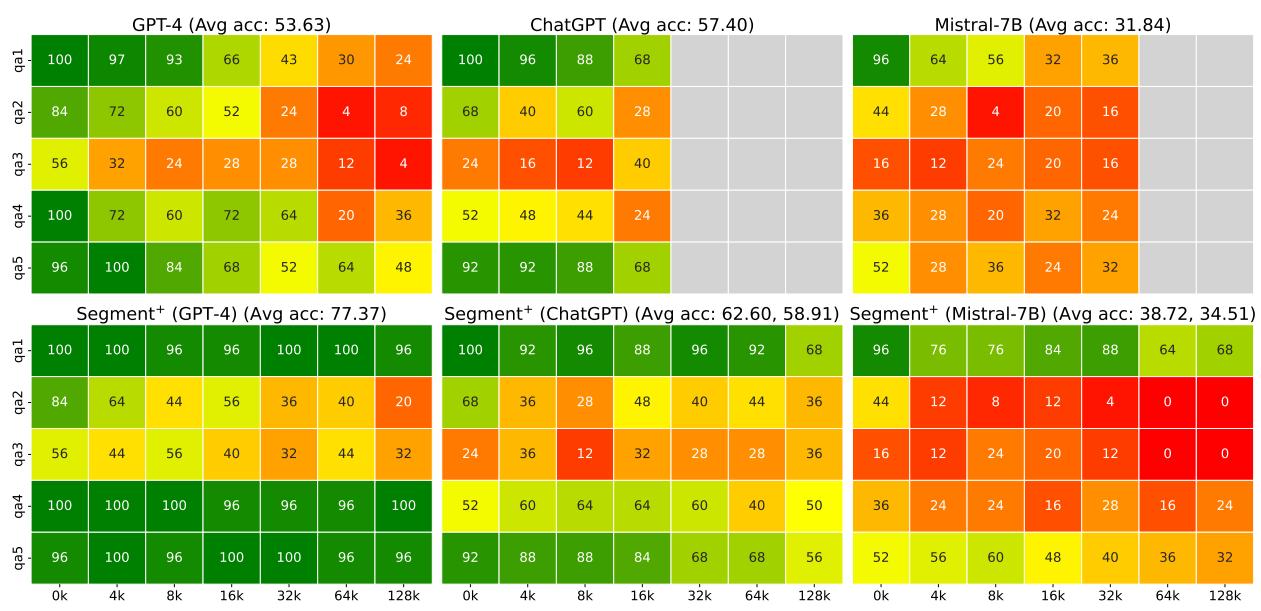
The heatmap above tells a compelling story.
- The X-Axis represents the length of the document (up to 128k tokens).
- The Y-Axis represents the complexity of the question (qa1 to qa5).
- Green indicates high accuracy; Red indicates failure.
Standard models (top row) degrade rapidly as the text length increases (moving right) or the complexity increases (moving down). SEGMENT+ (bottom rows), however, stays green. Even at 128k tokens, SEGMENT+ maintains near-perfect retrieval and reasoning capabilities. Remarkably, ChatGPT with SEGMENT+ outperformed vanilla GPT-4 by over 5% on average.
Why Does It Work? (Ablation Studies)
Is the success due to the filtering? Or is it the structured “Evidence/Reasoning” format? The researchers conducted ablation studies to find out.
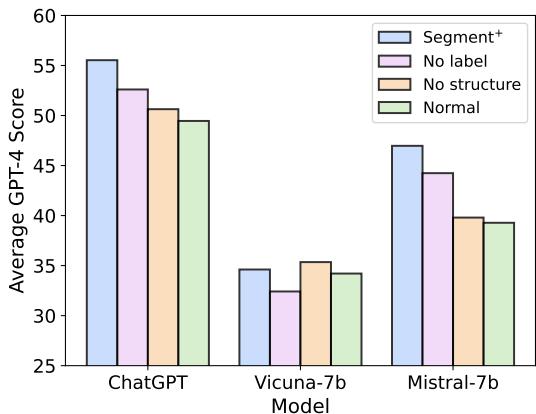
The bar chart above compares the full SEGMENT+ method against versions where the labeling (filtering) was removed, and versions where the structured JSON prompt was removed.
- No Label: Without filtering, performance drops because noisy segments contaminate the final context.
- No Structure: Without the strict Evidence/Reasoning split, performance drops because the model struggles to balance specific details with general summaries.
Both components are essential. The structure ensures the right kind of information is captured, and the filter ensures only relevant information is kept.
Segment Size Analysis
Finally, does the size of the chunks matter? The researchers tested segment sizes ranging from 1,000 to 3,000 tokens.
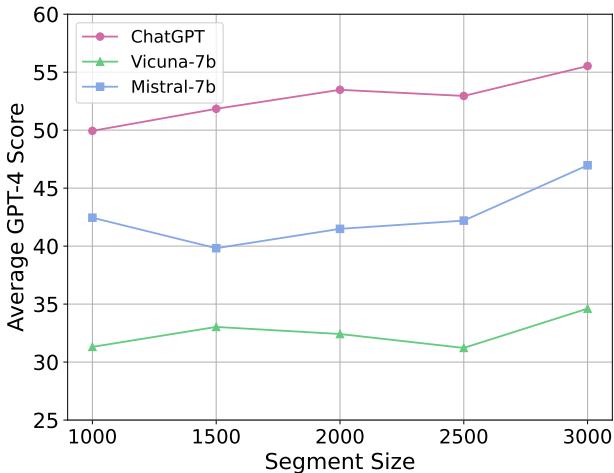
The results show that performance is relatively stable, peaking around 3,000 tokens. Larger segments allow the model to capture more local context without fragmentation, while still being small enough to process efficiently.
Conclusion and Implications
The SEGMENT+ paper provides a crucial insight for the future of AI development: Architecture and data flow can matter more than raw model size.
By acknowledging the limitations of current LLMs—specifically their inability to maintain attention over massive contexts—the researchers built a framework that works with the model’s strengths rather than against its weaknesses.
The implications are significant:
- Cost Efficiency: We can perform complex long-document analysis using cheaper, faster, short-context models.
- Interpretability: Because the system generates intermediate “notes,” humans can inspect exactly what evidence the model extracted and how it reasoned about it before seeing the final answer.
- Scalability: This approach theoretically scales to infinite lengths, as the “batch and merge” process can continue indefinitely, whereas a context window always hits a hard limit.
SEGMENT+ demonstrates that to read a library, you don’t need a bigger brain; you just need a better note-taking system.