](https://deep-paper.org/en/paper/2410.06524/images/cover.png)
The narrative of Artificial Intelligence in recent years has been dominated by a single, loud proclamation: supremacy. We hear that Large Language Models (LLMs) like GPT-4 are passing bar exams, acing medical boards, and crushing SATs. The implication is that AI has not only caught up to human intelligence but has begun to lap it.
But is this actually true? Or are we mistaking memorization for reasoning?
While an AI might defeat a human on a standardized test, does it solve the problem in the same way a human does? To answer this, we need to look beyond simple accuracy scores. We need to understand the latent skills required to answer questions and measure how humans and AIs differ in possessing them.
In a fascinating paper titled “Do great minds think alike? Investigating Human-AI Complementarity in Question Answering with CAIMIRA,” researchers from the University of Maryland and Microsoft Research propose a new framework to dissect these differences. They move beyond treating “intelligence” as a single score and instead map it into distinct dimensions—revealing that while AI is becoming a superhuman encyclopedia, it still lags behind humans in the art of intuitive connection.
The Problem with Current Benchmarks
The Natural Language Processing (NLP) community has historically focused on emulation—trying to get models to match human performance. Recently, however, the conversation has shifted to whether models have surpassed the “human ceiling.”
The issue is that standard benchmarks (like multiple-choice tests) are often flawed. They can be prone to data contamination (where the model has seen the test questions during training) or rely heavily on rote memorization.
To truly compare Human and AI cognition, the researchers turned to a more rigorous domain: Quizbowl.
Why Quizbowl?
Quizbowl is not your average trivia night. It is a competitive format where questions are “pyramidal.” They start with obscure, difficult clues and progressively become easier, ending with a “giveaway.”
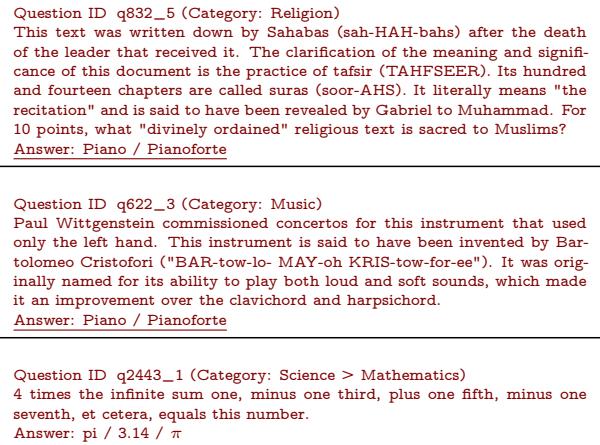
As shown in Figure 11 above, a single question contains multiple sentences. A player (or AI) can buzz in at any point. This structure allows us to measure not just if an agent knows the answer, but how deep their knowledge is. An agent that answers after the first clue possesses a fundamentally different level of skill than one that waits for the final sentence.
Enter IRT: Psychometrics for AI
To analyze the data from these games, the researchers utilized Item Response Theory (IRT). Originally developed for psychometrics (the science of educational testing), IRT is a statistical framework used to design standardized tests like the GRE or GMAT.
In a standard test, we usually just count the number of correct answers. IRT is different. It models the probability of a specific student (or AI) answering a specific question correctly based on two factors:
- Skill (\(s_i\)): The ability level of the agent.
- Difficulty (\(d_j\)): The inherent hardness of the question.
The basic probability is modeled using a sigmoid function:

If an agent’s skill is significantly higher than the question’s difficulty (\(s_i > d_j\)), the probability of a correct answer approaches 1. If the skill is lower, it approaches 0.
However, standard IRT is one-dimensional. It assumes “intelligence” is a single scalar value. But we know this isn’t true; a history buff might fail a physics question, and a math whiz might stumble on literature. To address this, the researchers extended the model to Multidimensional IRT (MIRT), where skill and difficulty are vectors:

Here, \(\boldsymbol{\alpha}_j\) represents the “discriminability” of a question—how well it differentiates between high and low-skill agents on specific dimensions.
CAIMIRA: The Neural Evolution of IRT
While MIRT is powerful, it has limitations. It treats questions as isolated ID numbers, ignoring the actual text of the question. This means it cannot predict how difficult a new question will be until many people have answered it (the “cold start” problem).
The researchers introduced CAIMIRA (Content-Aware, Identifiable, and Multidimensional Item Response Analysis). CAIMIRA is a neural framework that reads the text of the question to predict its difficulty and the skills required to answer it.
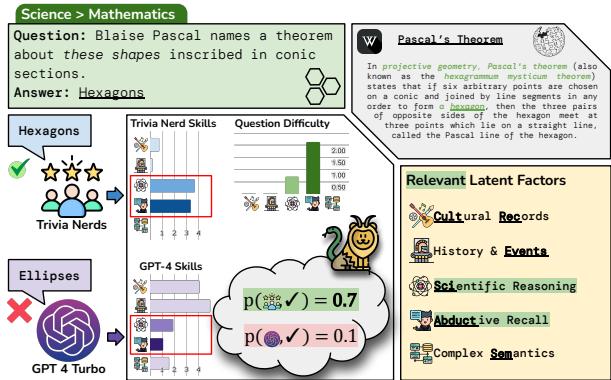
Figure 1 illustrates the core concept. To estimate if an agent (like GPT-4) will answer a question about Pascal’s Theorem correctly, the model analyzes the match between the agent’s skills and the question’s difficulty across specific latent factors (like “Scientific Reasoning”).
The Architecture
CAIMIRA introduces three key innovations to the standard mathematical model:
- Content-Awareness: It uses a pre-trained language model (SBERT) to embed the question text. This allows it to generalize to unseen questions.
- Relevance (\(\mathbf{r}_j\)): Instead of just difficulty, CAIMIRA calculates a “relevance” vector. This tells us which latent skills matter for a specific question. For a chemistry question, the “Science” dimension should have high relevance, while “Literature” should be near zero.
- Identifiability: By zero-centering the difficulty parameters, the model solves mathematical ambiguities that plagued previous MIRT models.
The probability of an agent \(i\) answering question \(j\) correctly in CAIMIRA is defined as:

This equation essentially says: Calculate the difference between skill and difficulty (\(\mathbf{s}_i - \mathbf{d}_j\)), weight that difference by how relevant the dimension is to the question (\(\mathbf{r}_j\)), and pass the result through a sigmoid function.
How the Model Learns
The workflow is visually summarized below. The model takes the question text, passes it through BERT to get an embedding (\(\mathbf{E}^q_j\)), and then learns linear transformations to produce the relevance and difficulty vectors.
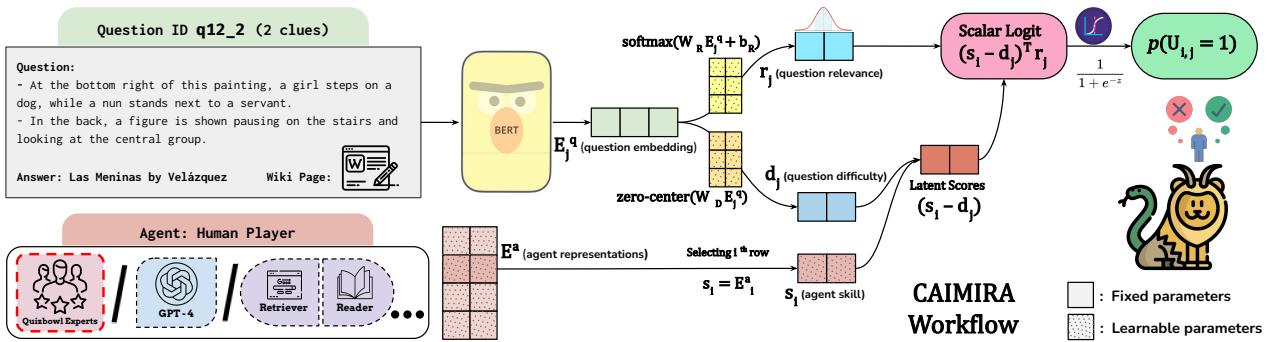
The transformations from the BERT embeddings are learned parameters:
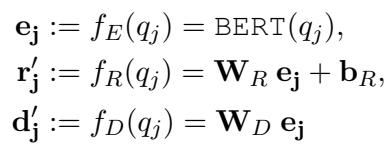
The raw outputs are then normalized. Relevance uses a softmax function (so the relevance weights sum to 1), and difficulty is zero-centered:

This architecture allows CAIMIRA to look at a brand new question and say, “This looks like a difficult History question,” automatically assigning high difficulty and high relevance to the history dimension.
The Experiment: Humans vs. The Machines
The researchers collected a massive dataset:
- Questions: Over 3,000 incremental Quizbowl questions.
- Human Agents: 155 distinct players from the “Protobowl” platform, grouped into synthetic agents to ensure statistical robustness.
- AI Agents: Roughly 70 different systems, including:
- Retrievers: Systems like BM25 and Contriever that search Wikipedia.
- LLMs: GPT-4, Llama-3, Claude, Gemini, etc.
- RAG (Retrieval-Augmented Generation): LLMs equipped with search tools.
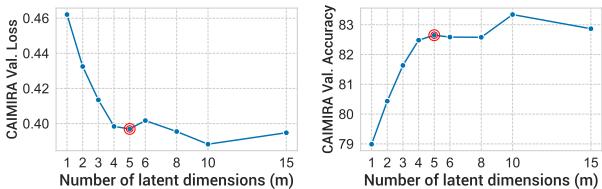
They trained a 5-dimensional CAIMIRA model on the response data. Why 5 dimensions? An ablation study (Figure 4) showed that model performance plateaued after \(m=5\).
Results: The 5 Dimensions of QA Intelligence
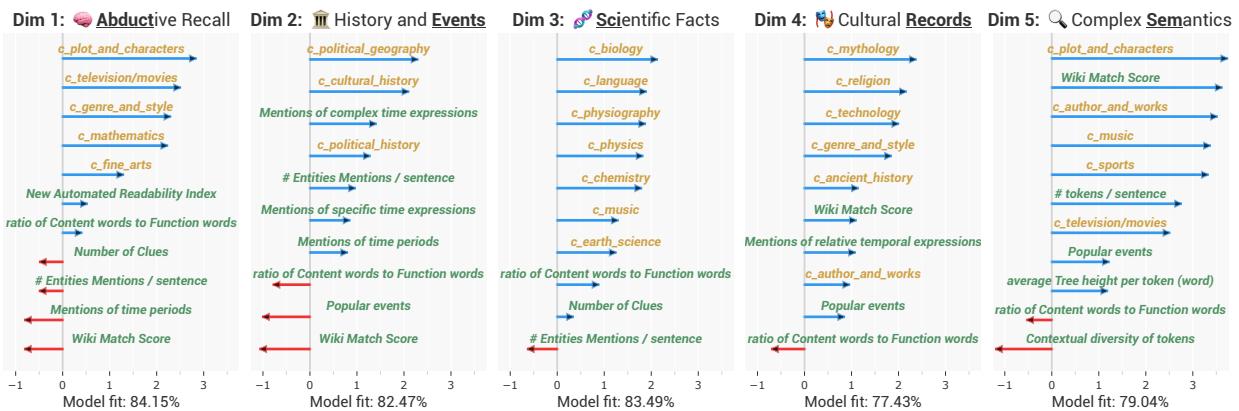
The most striking output of CAIMIRA is the discovery of five distinct “latent dimensions.” These aren’t just random clusters; they align with interpretable cognitive skills. By analyzing the linguistic features of questions in each dimension, the researchers named them:
- Abductive Recall: Questions that require bridging vague clues and making intuitive leaps (e.g., “This character did X…”).
- History and Events: Questions about wars, political figures, and timelines.
- Scientific Facts: Domain-specific conceptual knowledge (Biology, Physics).
- Cultural Records: “Who did what” knowledge about authors, artists, and celebrities.
- Complex Semantics: Questions with complicated sentence structures and obscure keywords.
The Human-AI Split
When we map the skills of Humans vs. AI agents across these dimensions, a clear pattern of complementarity emerges.
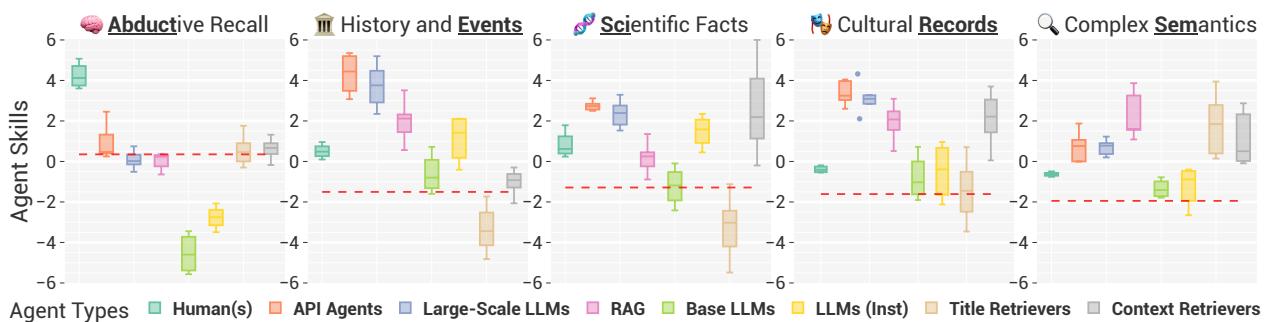
Take a close look at the box plots in Figure 6.
1. The Human Edge: Abductive Recall
Look at the first column, “Abduce.” Humans (the teal box) score significantly higher than almost all AI models.
- Why? These questions often narrate events or describe characters without using proper nouns. They require “thinking sideways”—connecting abstract clues to specific entities.
- Example: A question describing a fictional character’s actions without naming the book.
- Finding: Humans excel at this intuitive gap-filling. Even GPT-4 struggles to match the best humans here.
2. The Machine Edge: History & Science
Now look at “Events” and “Science.” Here, the large-scale LLMs (blue box) and even some base models perform exceptionally well, often surpassing humans.
- Why? These questions rely on “parametric memory”—the sheer volume of facts stored in the model’s weights. If a question asks for a specific date or chemical compound, the AI functions as a perfect encyclopedia.
- Finding: When the information gap is well-defined and fact-based, massive scale wins.
3. The Retrieval Paradox
The “Complex Semantics” dimension reveals something interesting about Retrievers (like a search engine). These questions have high “Wiki-Match scores,” meaning the answer is explicitly in a Wikipedia document. However, the questions are phrased with complex syntax.
- Finding: Retrievers can find the document, but generative models often fail to extract the answer because they get tripped up by the sentence structure. This turns a retrieval task into a difficult reading comprehension task.
Heatmap of Performance
We can see this disparity even more clearly in the accuracy heatmap below.
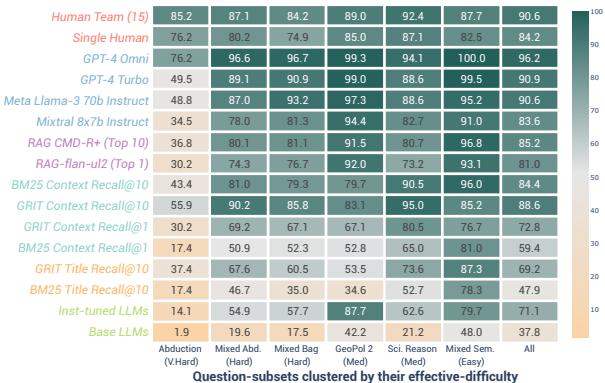
- Abduction (V. Hard): Look at the top-left cells. Human teams achieve high accuracy (76.2%). Most base LLMs are abysmal here (single digits). Even powerful models struggle compared to their performance in other categories.
- GeoPol / Science: Move to the right, and you see the LLMs turning deep green (high accuracy), effectively solving the category.
Conclusion: Do Great Minds Think Alike?
The answer is no. Humans and AIs think differently.
The CAIMIRA framework reveals that despite the hype, AI is not simply “smarter” than humans across the board. It possesses a different kind of intelligence.
- AI is an encyclopedic giant, dominating in tasks that require the retrieval of specific, concrete facts about history, science, and records.
- Humans are master weavers, excelling in Abductive Recall—the ability to take vague, indirect narrative clues and weave them into a coherent answer.
This finding is crucial for the future of AI development. Rather than simply trying to make models larger, researchers should focus on complementarity. The ideal system of the future might be a collaborative one: an AI that acts as a perfect memory bank, guided by a human’s superior ability to navigate ambiguity and nuance.
By using sophisticated measurement tools like CAIMIRA, we can stop asking “Who is better?” and start asking “How can we work best together?”