](https://deep-paper.org/en/paper/2410.06581/images/cover.png)
If you have ever tried to search for a specific legal precedent, you know it is not as simple as Googling a recipe. Legal Case Retrieval (LCR) is a high-stakes, complex task where a judge or lawyer inputs a fact description to find historically relevant cases.
The goal is judicial fairness: similar cases should receive similar judgments. To achieve this, legal professionals need tools that can dig through millions of documents to find the right precedent. However, training Artificial Intelligence to do this is notoriously difficult.
The primary obstacle is data. Unlike general web searches, where users generate billions of clicks (labels) daily, legal data requires highly skilled—and expensive—lawyers to annotate relevant cases. Consequently, existing datasets are tiny, often containing fewer than a hundred queries. Furthermore, most existing research focuses on “symmetric” retrieval (matching a long document to another long document), whereas real-world users typically type short, concise queries.
In this post, we will dive into a recent paper, “Enhancing Legal Case Retrieval via Scaling High-quality Synthetic Query-Candidate Pairs,” which proposes a clever solution to these problems. The researchers introduce LEAD, a method to automatically generate massive, high-quality legal datasets using Large Language Models (LLMs) and knowledge-driven augmentation.
The Challenge: Asymmetry and Scarcity
To understand the innovation of this paper, we must first understand the specific constraints of Legal Case Retrieval.
1. The Asymmetric Problem
In academic settings, researchers often test models by feeding them a full case judgment and asking them to find a similar full case judgment. This is symmetric retrieval.
However, in the real world, a judge doesn’t type a 50-page document into a search bar. They type a summary of the facts—perhaps a few sentences describing a crime. They expect the system to return full, detailed case documents. This is asymmetric retrieval. As shown in the image below, the query is short and focuses on key facts (blue), while the candidate cases are long and detailed.
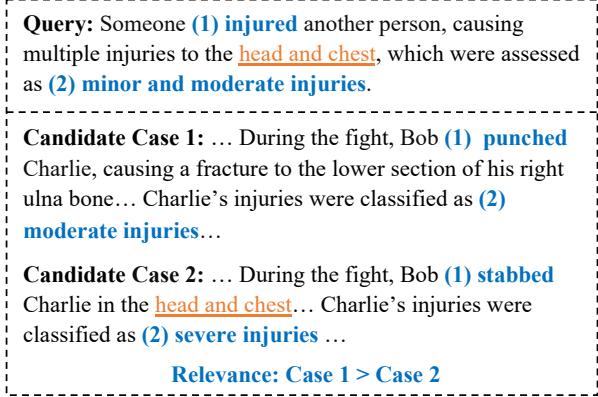
The model must be smart enough to recognize that “minor and moderate injuries” in the query matches the legal severity of the injuries in Candidate Case 1, even if the exact wording differs.
2. The Data Bottleneck
Deep learning models are “data-hungry.” They need thousands, if not millions, of examples to learn effective representations. Open-domain retrieval models are trained on massive datasets like MS MARCO. In contrast, legal datasets like LeCaRD contain only about 100 queries. This scarcity prevents legal AI from reaching the performance levels seen in other fields.
The Solution: The LEAD Dataset Construction
The researchers propose an automated framework to construct the LEAD dataset. Their goal was to create a dataset that is:
- Large-scale: Hundreds of times larger than existing benchmarks.
- Asymmetric: Mimicking real-world short queries.
- High-quality: incorporating legal logic, not just keyword matching.
They achieved this through a multi-step pipeline involving LLMs and a strategy they call “Knowledge-Driven Augmentation.”
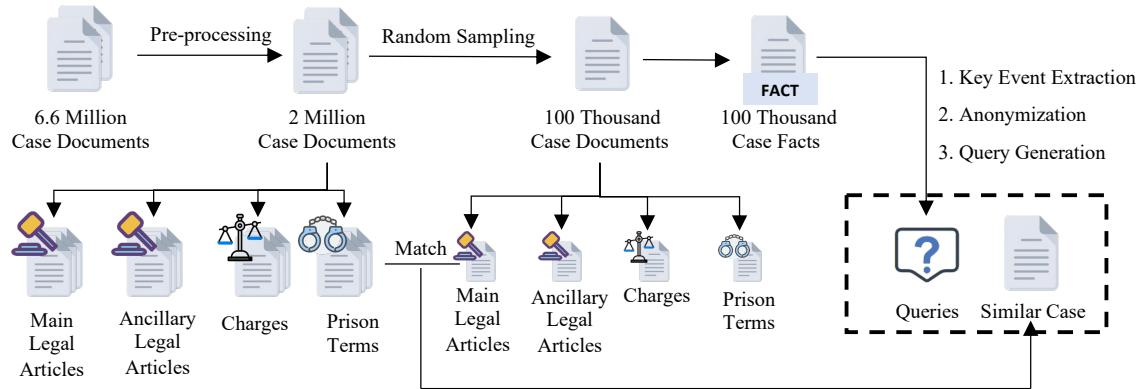
Let’s break down the process illustrated in the flowchart above.
Step 1: Data Collection and Pre-processing
The process begins with raw data—6.6 million criminal case documents collected from China Judgment Online.
- Filtering: They removed administrative rulings and cases with very short fact descriptions, narrowing the pool to 2 million cases.
- Extraction: Using regular expressions, they extracted structured data from these unstructured texts, identifying Charges (the crime), Legal Articles (the specific laws cited), and Prison Terms (the punishment).
- Sampling: From this pool, they randomly sampled 100,000 cases to serve as the source for generating queries.
Step 2: Automated Query Generation
To solve the asymmetry problem, the researchers needed to turn long case documents into short, search-like queries. They employed a Generative Large Language Model (LLM) to act as a summarizer.
For each sampled case, the LLM performed two critical tasks:
- Key Event Extraction: The model compressed the complex case facts into a brief description, retaining only the essential legal events.
- Anonymization: Real cases are full of specific names (e.g., “John Doe”) and locations. If a model learns to match “John Doe” in a query to “John Doe” in a document, it is cheating—it isn’t learning legal reasoning. The researchers used the LLM and Part-of-Speech tagging to replace specific entities with generic or random equivalents.
The result is a clean, short query that represents the core facts of a case without giving away the answer through keyword matching.
Step 3: Knowledge-Driven Data Augmentation
This is perhaps the most innovative part of the method.
If the researchers simply paired the Generated Query with the Original Case it came from, they would have a decent dataset. However, in law, two different cases can be “relevant” if they share similar legal elements, even if the specific story is different.
To teach the model this nuance, the researchers implemented Knowledge-Driven Augmentation:
- They took a generated query (derived from Case A).
- Instead of just using Case A as the target, they searched the entire database for a Case B that was legally identical to Case A.
- “Legally identical” meant matching:
- Charges: Same crime category.
- Legal Articles: Same laws applied.
- Prison Terms: Similar sentencing.
They then paired the query from Case A with Case B. This forces the retrieval model to look beyond surface-level text and understand the underlying legal principles. If the model can map the facts of Case A to the judgment of Case B, it has truly learned legal relevance.
Experimental Setup and Results
The researchers trained dense passage retrieval models (Dual-Encoders) using the LEAD dataset. They compared their approach against a wide range of baselines, including:
- Traditional Models: BM25 (keyword matching).
- Pre-trained Models: SAILER (a state-of-the-art legal retrieval model).
- General Models: BGE-M3 and models fine-tuned on general web search data (T2Ranking).
They tested these models on two benchmarks: LeCaRD and CAIL2022-LCR. Because these benchmarks traditionally use long queries, the researchers generated short-query versions of them to properly test the asymmetric capability.
Main Performance
The results were overwhelming. The model trained on LEAD achieved State-of-the-Art (SOTA) results across almost all metrics.
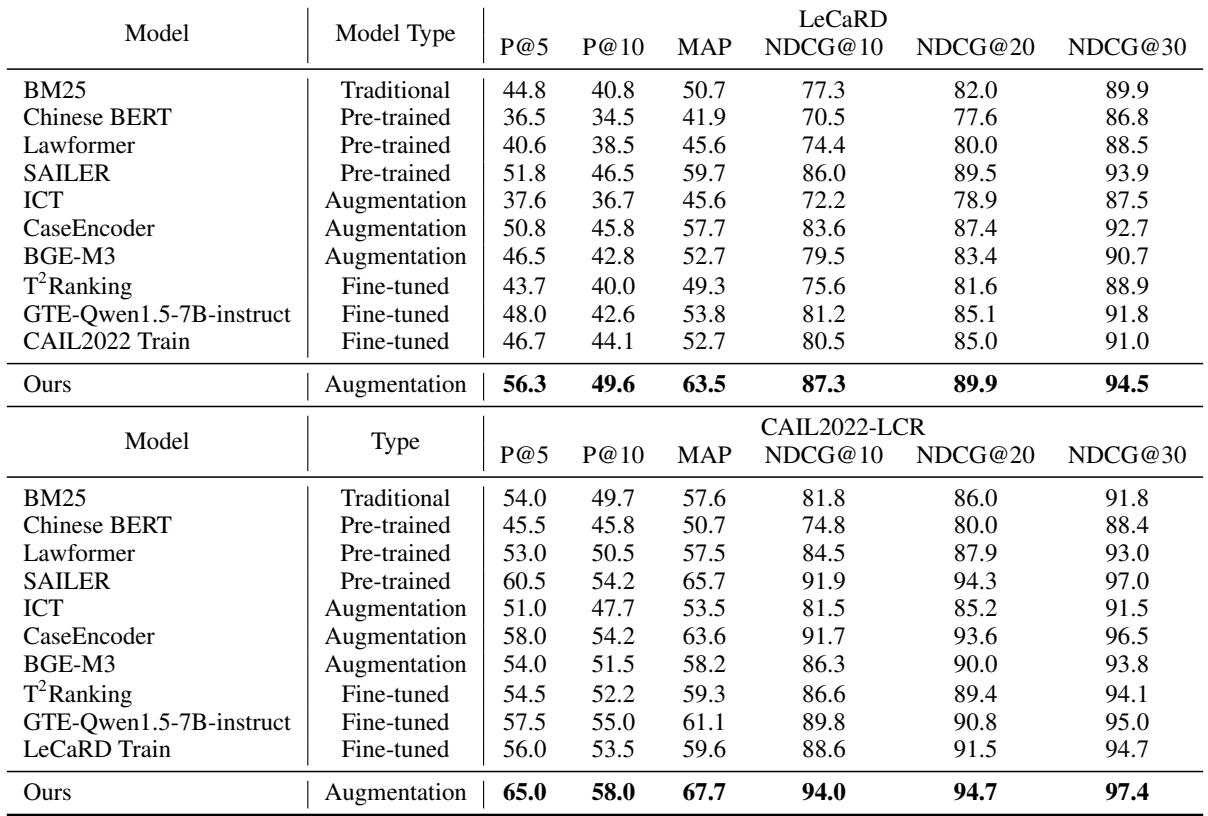
Key Takeaways from the Results:
- LEAD Dominates: The “Ours” row consistently shows the highest scores in Precision (P@5) and Normalized Discounted Cumulative Gain (NDCG).
- Scale Matters: The massive size of LEAD (100k+ pairs) allows the model to outperform SAILER, which was pre-trained but lacked this specific fine-tuning data.
- General vs. Legal: Models trained on general data (like T2Ranking) were often beaten by simple BM25. This proves that legal retrieval is a distinct domain; you cannot simply apply a generic search engine and expect it to understand jurisprudence.
The Impact of Augmentation
Was the complex “Knowledge-Driven Augmentation” actually necessary? The researchers conducted an ablation study to find out. They varied the proportion of augmented positive examples (pairing queries with legally similar different cases) versus original positive examples (pairing queries with their source cases).
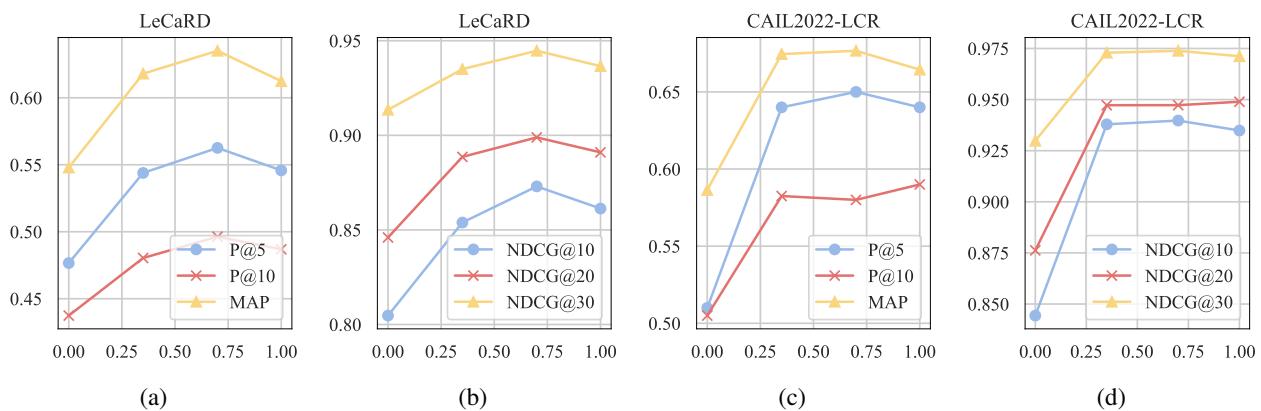
The charts above reveal an interesting trend. The performance peaks when the dataset consists of roughly 70% augmented pairs.
- 0% Augmentation (Pure Source): Performance is lower. The model likely overfits to the specific wording of the source case.
- 100% Augmentation: Performance drops again. The model loses the strong semantic connection provided by the original case text.
- The Sweet Spot (70%): By mixing both, the model learns strong semantic matching and abstract legal reasoning.
Handling False Negatives
Training dense retrievers involves “negative sampling”—showing the model a relevant case and a non-relevant case and asking it to pick the winner. Usually, other cases in the same training batch serve as negatives (In-Batch Negatives).
However, in a dataset of 100,000 crimes, two random cases in a batch might actually be about the same crime (e.g., two theft cases). If the model is told that the second theft case is a “negative” for the first theft query, it gets confused.
The researchers used False Negative Masking. During training, if a negative sample had the same charge as the query, the model ignored it.
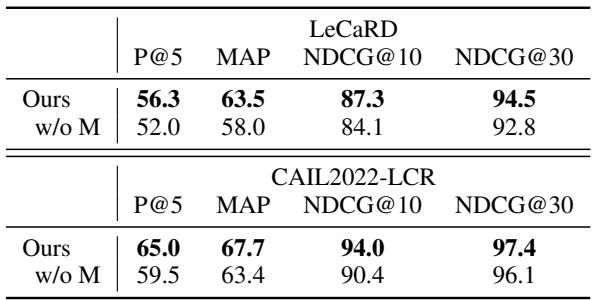
As shown in the table above (labeled “w/o M”), removing this masking strategy significantly hurt performance. This confirms that treating legally similar cases as negatives confuses the training process.
Broadening the Scope: Civil Cases
While the paper focused on criminal law, the method is highly versatile. To prove this, the researchers applied the same pipeline to Civil Cases (e.g., private lending disputes). They generated 77,000 civil query-candidate pairs.

Even in the civil domain, the model trained on synthesized data (“Ours”) outperformed standard baselines like BM25 and BERT. This suggests that the LEAD framework is not just a one-off trick for criminal law but a generalized solution for the legal domain.
Conclusion
The “data hunger” of modern AI has long been a barrier for specialized fields like law, where expert annotation is scarce and expensive. This research demonstrates that we can bypass this bottleneck by intelligently synthesizing data.
By combining the summarization capabilities of LLMs with structured legal knowledge (charges, articles, sentencing), the researchers created LEAD, the largest legal case retrieval dataset to date. Their work highlights three critical lessons for the future of Legal AI:
- Asymmetry is Key: Training data must look like real-world usage (short queries, long documents).
- Synthesis Works: High-quality synthetic data can outperform limited human-annotated data.
- Knowledge Augmentation: Teaching models “why” a case is relevant (via shared legal attributes) is more effective than teaching them simply “what” words match.
This approach paves the way for more accessible, accurate, and efficient legal search tools, potentially reducing the workload for judges and improving consistency in the justice system.