](https://deep-paper.org/en/paper/2410.06741/images/cover.png)
In the rapidly evolving landscape of Large Language Models (LLMs), we have moved past the initial awe of “it can speak” to the logistical nightmare of “how do we use this in production?”
Imagine you are an engineer at a tech giant. You need your LLM to perform code completion in Python, translate Java to C++, and generate unit tests. The traditional approach is to fine-tune a separate model for each task. But deploying five different 13-billion parameter models is incredibly resource-heavy and inefficient.
The solution seems obvious: Multi-Task Learning (MTL). Train one single model to do it all. It saves disk space, reduces inference complexity, and theoretically, the tasks should help each other (learning Python logic helps with Java logic).
However, MTL has a dirty secret: it is notoriously difficult to train. Tasks don’t learn at the same speed. While the model is still struggling to learn Japanese, it might have already mastered English and started overfitting, getting worse with every subsequent step.
This is the problem addressed by a fascinating new paper titled “CoBa: Convergence Balancer for Multitask Finetuning of Large Language Models.” The researchers introduce a lightweight, dynamic method to keep all tasks learning in harmony, ensuring they reach the finish line together without breaking the computational bank.
The Problem: The Hare, the Tortoise, and the GPU
To understand why CoBa is necessary, we first need to look at why standard Multi-Task Learning fails.
The standard optimization objective in MTL usually looks like this:
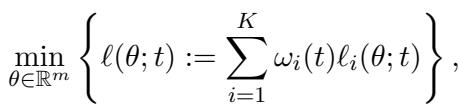
Here, the total loss is a weighted sum of the losses for each individual task (\(K\)). The simplest approach, often called “Uniform,” sets all weights (\(\omega_i\)) equally (\(1/K\)).
The issue is that different tasks have different difficulty levels and convergence rates.
- The Hare: An easy task (e.g., simple text classification) drops its loss quickly. If you keep training it while waiting for harder tasks, it starts to overfit—memorizing the training data rather than generalizing.
- The Tortoise: A complex task (e.g., reasoning) takes a long time to learn. If the “Hare” dominates the gradients, the model might ignore the “Tortoise” entirely.
The Computational Bottleneck
Previous researchers have tried to solve this using methods like GradNorm or FAMO. These methods look at the gradients (the direction of learning) to balance the tasks.
While effective for smaller neural networks, these methods are catastrophic for LLMs. Calculating and manipulating gradients for every task in a 70B parameter model is computationally expensive. As shown in the table below, methods like GradNorm add significant complexity (represented by terms involving model weights \(|\theta_s|\) or number of tasks \(K\)).

Notice that CoBa (the last row) maintains a complexity very similar to the standard Uniform approach, avoiding the heavy computational penalties of gradient-based methods.
Enter CoBa: The Convergence Balancer
The core insight of CoBa is simple but profound: Don’t look at the training gradients; look at the validation loss trends.
CoBa balances the training process by dynamically adjusting task weights based on how well the model is performing on a held-out validation set. It aims to satisfy two criteria:
- Relative Balance: If Task A is learning faster than Task B, lower Task A’s weight and increase Task B’s weight. Slow down the leader, speed up the straggler.
- Divergence Prevention: If Task A starts getting worse (validation loss goes up), immediately clamp down on its weight to prevent overfitting.
The Anatomy of CoBa
To implement this, the authors designed a system that relies on three main components: The Convergence Slope, the Relative Convergence Score (RCS), and the Absolute Convergence Score (ACS).
Let’s visualize the entire process using a concrete example provided in the paper.

In Figure 1 (above), we see the training dynamics of three tasks: A (Green), B (Blue), and C (Red).
- Graph (a) shows the loss ratios. Notice Task B drops very fast initially.
- Graph (f) shows the weights CoBa assigns. Task B (Blue) gets a high weight initially, but then drops off.
Let’s break down how the algorithm makes these decisions.
1. The Convergence Slope (\(\alpha\))
First, CoBa calculates how fast the validation loss is changing. It takes a window of recent validation losses and fits a simple linear line to them.

This slope (\(\alpha\)) tells us the speed. A large negative slope means the model is learning that task quickly. A slope near zero means learning has stalled. A positive slope means the model is diverging (getting worse).
2. Relative Convergence Score (RCS)
This metric addresses the first criterion: balancing speeds. It compares the slope of one task against all others.

- Logic: If a task has a “gentler” slope (learning slowly) compared to others, it gets a higher score. If it has a “steep” slope (learning fast), it gets a lower score.
- In Figure 1(c): You can see Task C (Red) has a higher RCS than Task A (Green) in the middle of training because it is converging more slowly.
3. Absolute Convergence Score (ACS)
RCS isn’t enough. Imagine Task A is diverging (getting worse), but Task B is diverging even faster. RCS might mistakenly tell us to focus on Task A. We need an absolute measure to say “Stop training this task, it’s getting worse!”
ACS looks at the task’s own history to detect overfitting.

- Logic: This formula penalizes tasks where the slope turns positive (divergence).
- In Figure 1(d): Look at Task B (Blue). It converges super fast, but then hits a floor. The ACS drops rapidly, effectively telling the model, “We are done with Task B, stop wasting energy on it.”
4. The Divergence Factor (DF)
Finally, how do we combine these two scores? CoBa introduces a “Divergence Factor” that acts as a mixer.

The DF is calculated based on the general trend of the training.
- Early in training: Most tasks are improving. DF is close to 1, meaning the model listens mostly to RCS (balancing speeds).
- Late in training: Tasks start to plateau or diverge. DF drops toward 0, meaning the model listens mostly to ACS (preventing overfitting).
This dynamic switching is the “secret sauce” that allows CoBa to be aggressive early on and cautious later.
Experimental Results
The researchers put CoBa to the test against several baselines, including Single-Task Learning (STL), Uniform MTL, and adapted versions of GradNorm and FAMO.
1. Code Completion (Python, Java, C++, etc.)
Using the Phi-1.5 (1.3B) model, they tested performance on code generation tasks.
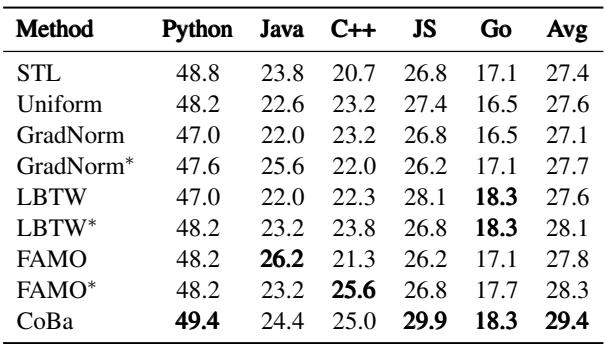
As seen in Table 2, CoBa achieves an average score of 29.4, significantly outperforming the Uniform baseline (27.6) and even Single-Task Learning (27.4). This confirms that CoBa doesn’t just “manage” the tasks; it actually enables positive transfer, where learning one language helps improves performance in others.
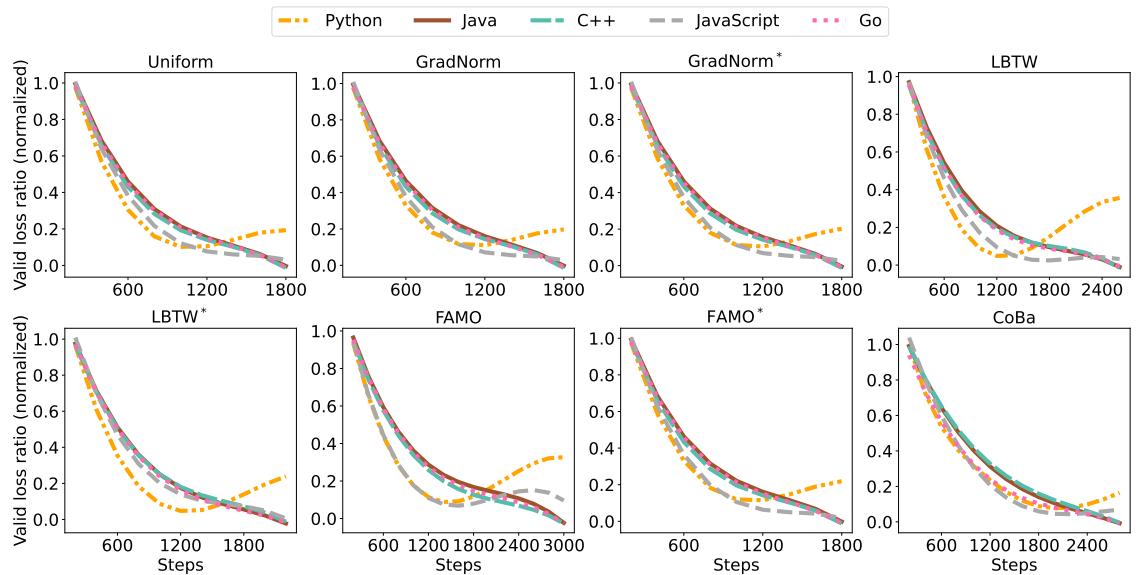
We can see the stability of CoBa visually in the loss curves below. Notice how CoBa (bottom right) keeps the validation loss for all languages tightly clustered and descending, whereas other methods result in scattered, uneven performance.
2. Multilingual Question Answering (XTREME-UP)
The method was also tested on human languages, specifically low-resource languages (like Telugu and Bengali) mixed with high-resource ones (English, Arabic).
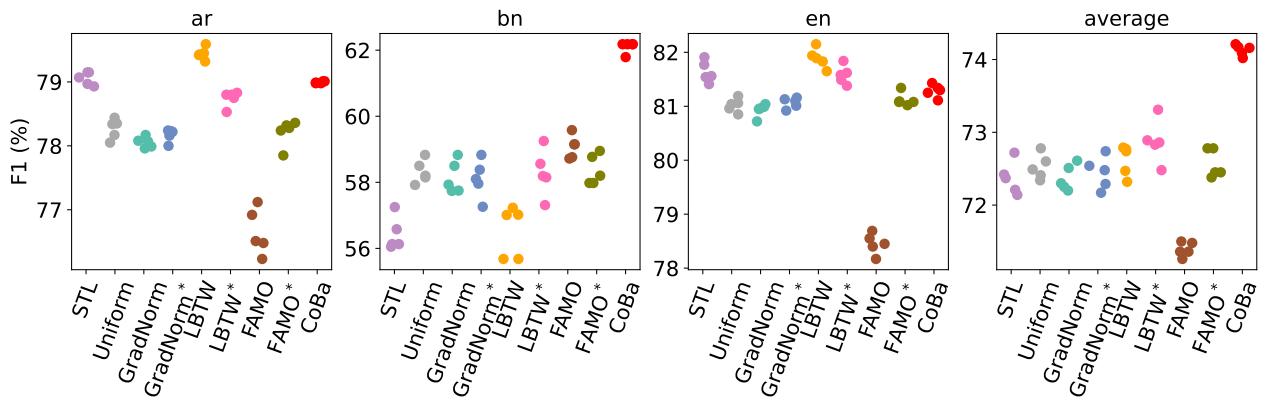
Figure 2 shows the F1 scores. CoBa (the orange/brown dots) consistently sits at the top of the performance charts across different languages. Crucially, it boosts low-resource languages significantly without hurting the high-resource ones—the holy grail of multilingual modeling.
3. Efficiency
Perhaps the most important metric for engineers is time. Does this complex balancing act slow down training?
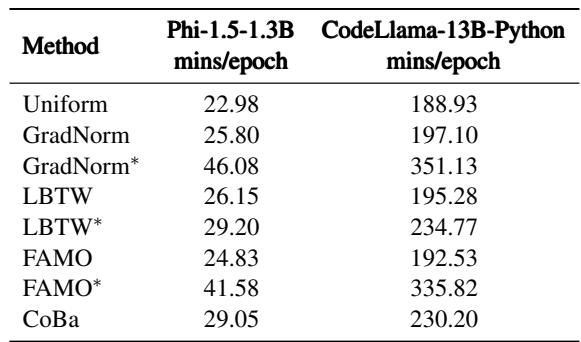
According to Table 4, CoBa is remarkably efficient.
- Uniform: 22.98 mins/epoch
- CoBa: 29.05 mins/epoch
- GradNorm*: 46.08 mins/epoch
CoBa adds a minor overhead compared to doing nothing (Uniform), but is nearly twice as fast as gradient-based balancing methods like GradNorm*.
Conclusion
Training Large Language Models is a resource-intensive endeavor. As we move toward general-purpose agents that can code, write, and reason, Multi-Task Learning will become the standard.
CoBa offers a compelling solution to the “alignment problem” of MTL. By ignoring expensive gradients and focusing on the actual goal—validation convergence—it offers a robust, efficient, and mathematically sound way to train models. It ensures that the “Hares” don’t overfit and the “Tortoises” get the attention they need.
For students and practitioners, CoBa serves as a great reminder: sometimes the most effective signals for training aren’t found in the complex backpropagation of gradients, but in the simple trend lines of your validation loss.
Key Takeaways
- MTL Efficiency: Multi-Task Learning saves deployment resources but suffers from uneven task convergence.
- Gradient-Free: CoBa avoids expensive gradient calculations, making it suitable for LLMs.
- Dynamic Weighting: It uses Validation Loss Slopes to balance fast and slow tasks (RCS) and prevent overfitting (ACS).
- Performance: It outperforms single-tasking and complex MTL baselines while being computationally cheap.