](https://deep-paper.org/en/paper/2410.07461/images/cover.png)
Introduction
In the current era of Artificial Intelligence, Large Language Models (LLMs) like Llama 2 and GPT-4 have transformed how we interact with technology. However, their capabilities come at a steep cost: hardware resources. A 7-billion parameter model can require upwards of 10GB of memory just to load, making it inaccessible for most consumer edge devices or mobile phones.
To solve this, researchers turn to network pruning—a compression technique that removes “unimportant” weights from a model to reduce its size and speed up inference. Modern pruning algorithms are surprisingly effective, capable of removing 50% or more of a model’s parameters with minimal loss in intelligence.
But how does an algorithm decide which weights are unimportant? It uses a small sample of text, known as calibration data, to test the network and calculate “pruning scores.” For years, the industry standard has been to blindly use the C4 dataset (Colossal Clean Crawled Corpus) for this purpose. It is the default setting in almost every major pruning library.
But is C4 actually the best choice?
In the paper “Is C4 Dataset Optimal for Pruning?”, researchers from the University of Washington, University of Surrey, and others challenge this status quo. They conducted a comprehensive investigation into how different types of data—from pre-training corpora to math problems and even random strings—affect the quality of a pruned model. Their results are surprising and suggest that we might have been doing LLM pruning sub-optimally all along.
Background: The Mechanics of Pruning
Before diving into the experiments, we need to understand the role calibration data plays in pruning.
The Pruning Process
In the context of LLMs, we typically use “post-training pruning.” This means we take a fully trained model and remove weights without needing to retrain it from scratch (which would be prohibitively expensive).
Two of the most popular state-of-the-art methods for this are Wanda (Pruning by Weights and activations) and SparseGPT.
As shown in the table below, both methods rely on input data (\(\mathbf{X}\)) to make decisions.
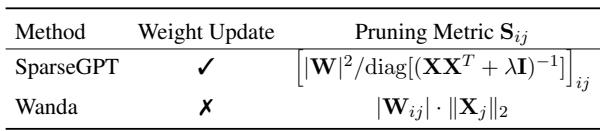
- Wanda calculates importance by multiplying the magnitude of the weight (\(\mathbf{W}\)) by the norm of the input activation (\(\mathbf{X}\)). If a weight is large but rarely activates on input data, it might still be pruned.
- SparseGPT uses a more complex second-order approximation involving the Hessian (represented by the \(\mathbf{X}\mathbf{X}^T\) term) to update weights as they are pruned to compensate for the loss.
In both cases, \(\mathbf{X}\) is the key. The input data determines which neurons fire. If you change the input data (the calibration data), you change the activations, which changes the pruning scores, which ultimately changes which parts of the brain are lobotomized.
The Status Quo
Until now, the community largely assumed that because models are often pre-trained on the C4 dataset, using a random slice of C4 for calibration was the safest bet to preserve the model’s original distribution. This paper tests that assumption.
The Study Design: Searching for the Best Data
The researchers designed a large-scale evaluation using the Llama 2-Chat 7B model. They pruned the model using various calibration datasets and then tested how smart the pruned model remained across a battery of nine different tasks, including arithmetic reasoning, common sense logic, and natural language inference.
They categorized calibration data into four distinct buckets:
- Pre-training Data: Large web-scrape datasets (C4, Pile, OSCAR, RedPajama).
- Downstream Data: Specific task data (e.g., GSM8K for math, e-SNLI for logic).
- Prompted Data: Changing the format of the text (Zero-shot vs. Few-shot).
- Nonsense Data: Random strings to test if semantic meaning actually matters.
The Role of Formatting
One of the unique contributions of this paper is the investigation of data format. LLMs are sensitive to prompts—we know they perform better when you give them examples (In-Context Learning). The authors hypothesized that using “smarter” data formats during calibration might yield a “smarter” sparse model.
They tested three specific formats:
- Zero-Shot: Just a question.
- In-Context Learning (ICL): A sequence of Question-Answer pairs.
- Chain-of-Thought (CoT): Question-Answer pairs where the answer includes step-by-step reasoning.
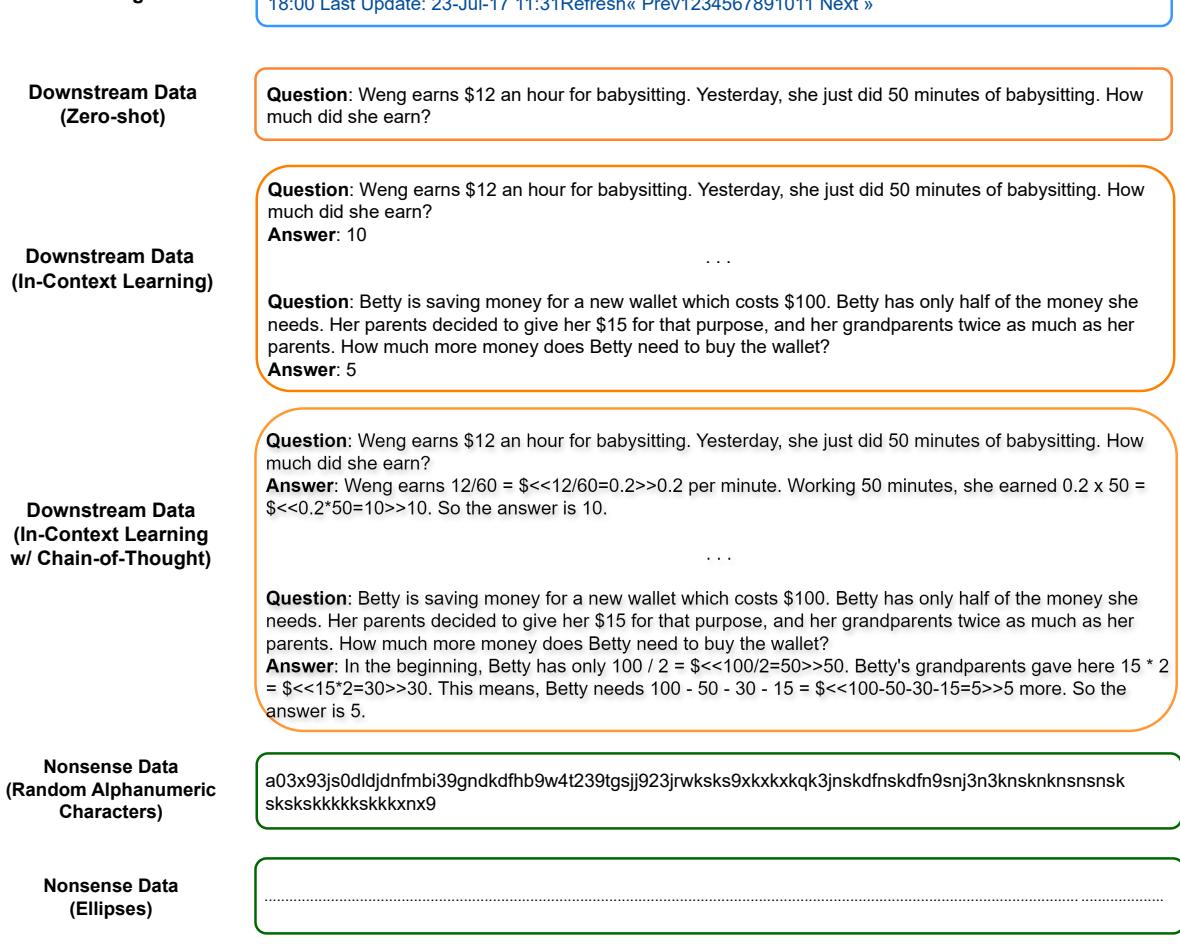
As Figure 1 illustrates, the density and quality of information increase as we move from raw web text to structured Chain-of-Thought reasoning.
Key Findings
The results of this study overturn several assumptions held by the model compression community. Let’s break down the major discoveries.
1. C4 is Not the King
The first major finding is that C4 is consistently outperformed by other pre-training datasets.
When the researchers pruned Llama 2 using different pre-training datasets and tested the resulting models, The Pile emerged as a superior choice. The Pile is a diverse dataset curated from academic papers, GitHub, medical data, and web text, whereas C4 is a cleaned version of Common Crawl (web pages).
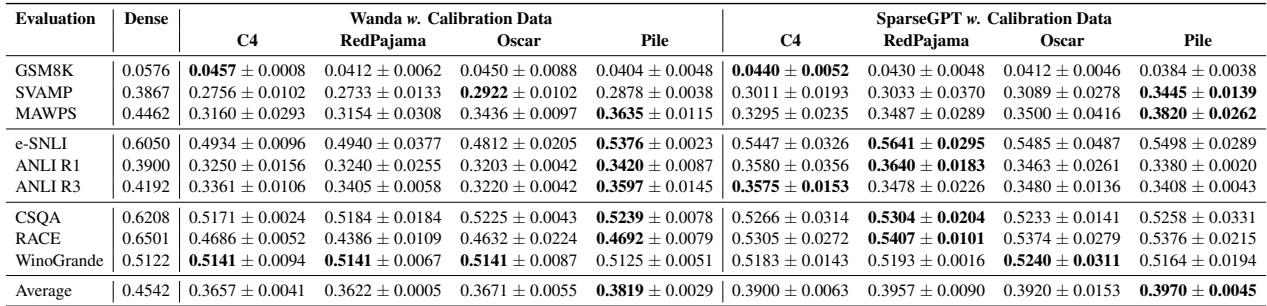
Looking at Table 2, we see the average accuracy across 9 tasks.
- Wanda Pruning: The Pile achieves an average accuracy of 38.19%, compared to C4’s 36.57%.
- SparseGPT: The trend holds, with The Pile achieving 39.70% vs C4’s 39.00%.
While a 1-2% gap might seem small, in the world of compressed models, this is significant. It implies that simply switching the calibration file from c4.train to pile.train grants a free performance boost.
This gap widens significantly when the pruning becomes more aggressive. When the model is pruned to 70% sparsity (removing 70% of weights), C4 begins to collapse much faster than The Pile.
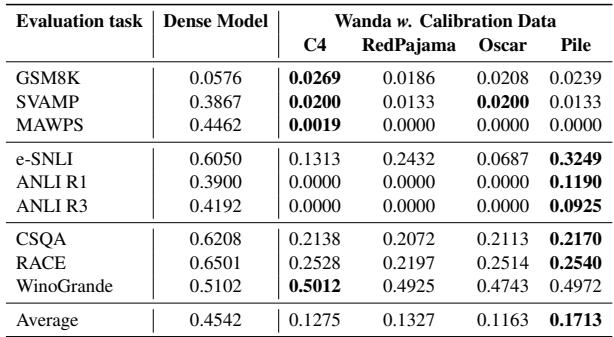
As shown in Table 3, at 70% sparsity, the model calibrated on C4 drops to an average accuracy of 12.75%, effectively becoming useless. However, the model calibrated on The Pile retains an average accuracy of 17.13%, with massive leads in specific tasks like e-SNLI.
2. Formatting Matters: The Power of In-Context Learning
The researchers found that how you present the data is just as important as what data you present.
They compared calibration data formatted as simple questions (Zero-shot) against data formatted as lists of examples (In-Context Learning or ICL).
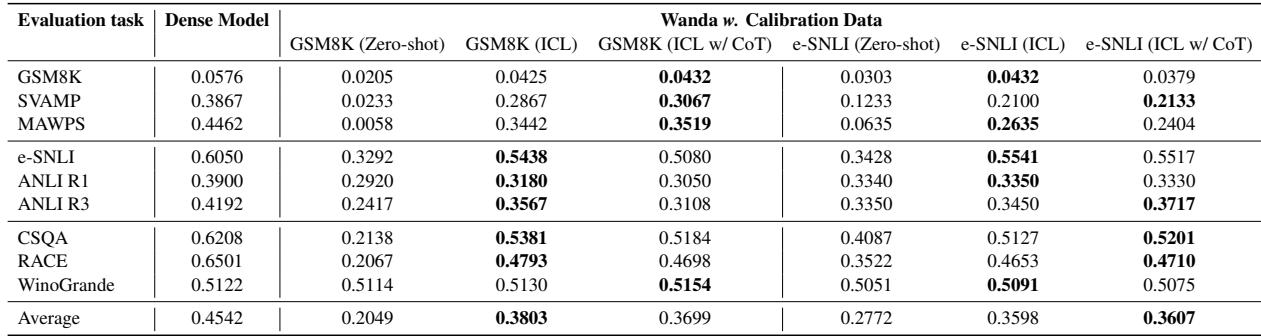
Table 4 reveals a stark difference. Using the GSM8K dataset (math problems):
- Zero-shot calibration resulted in an average model accuracy of 20.49%.
- ICL (giving Q&A examples) jumped to 38.03%.
This suggests that when the calibration data mimics the structure of high-quality reasoning (Q&A pairs), the pruning algorithm is better able to identify and preserve the weights responsible for that reasoning.
Interestingly, adding Chain-of-Thought (CoT)—where the answer explains why—was beneficial specifically for arithmetic tasks but didn’t always outperform standard ICL for general tasks. This indicates that while reasoning steps help preserve math logic, they might introduce biases that are less helpful for general language tasks.
3. The “Winning Dataset” Surprise
Perhaps the most counter-intuitive finding is the performance of specific downstream datasets. One might assume that to get a good general-purpose model, you must use a general-purpose dataset (like The Pile).
However, the researchers found that SVAMP, a dataset of grade-school math word problems, was an incredibly potent calibration source.
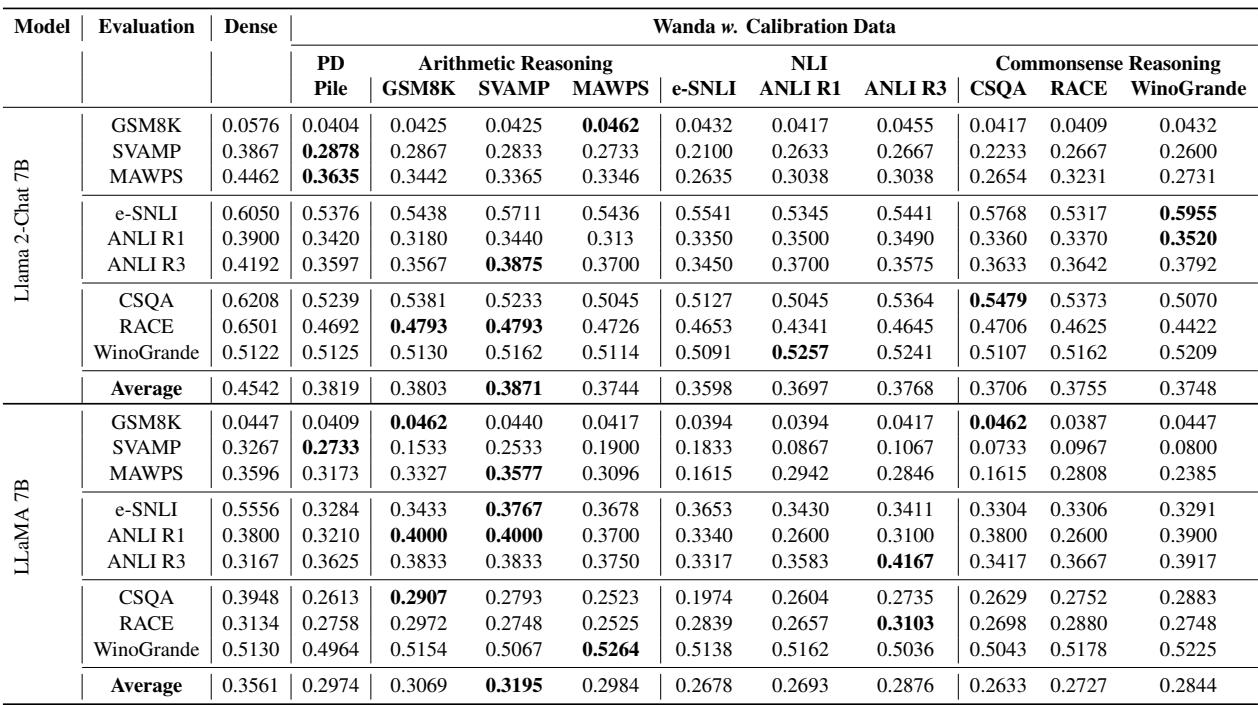
In Table 5, look at the “Average” row at the bottom.
- The Pile (Pre-training Data): 38.19% average accuracy.
- SVAMP (Math Data): 38.71% average accuracy.
A dataset consisting entirely of math word problems produced a better general model than a dataset containing the sum of human knowledge (The Pile). This suggests that the activations triggered by solving logic and math problems cover a critical set of weights that are essential for broad intelligence.
4. Does the Data Need to Make Sense?
A common question in pruning is whether the semantic content matters, or if we just need to light up the neurons with any signal. The researchers tested this by using:
- Ellipses: A file containing just “……”
- Random Alphanumeric: “a03x93js…”
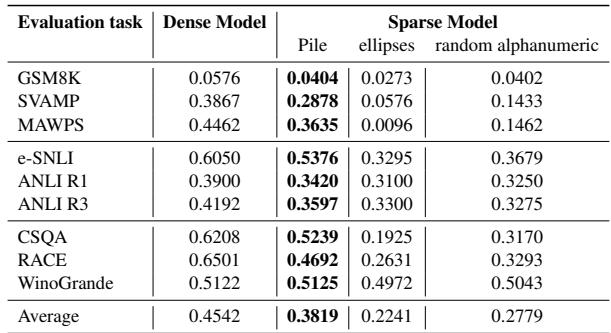
Table 8 puts this question to rest.
- The Pile: 38.19% average accuracy.
- Random Alphanumeric: 27.79% average accuracy.
- Ellipses: 22.41% average accuracy.
While random data is better than nothing (ellipses), it causes a massive drop in performance. The calibration data must be “sensible”—it needs to look like real language to properly activate the language processing pathways in the model.
Further Analysis: Quantity and Steps
The paper includes several interesting side-investigations that refine our understanding of calibration.
Does Chain-of-Thought Depth Matter?
If showing reasoning steps (Chain-of-Thought) helps, does showing more steps help more? The authors constructed datasets with answers containing exactly 3, 4, or 5 steps of reasoning.

As Table 6 shows, there is no clear linear relationship. A 5-step explanation isn’t necessarily better than a 3-step one for calibration purposes. The presence of reasoning helps, but the length of that reasoning has diminishing returns.
Quantity of Examples
The researchers also verified that “more is better” regarding the number of examples packed into the context window.
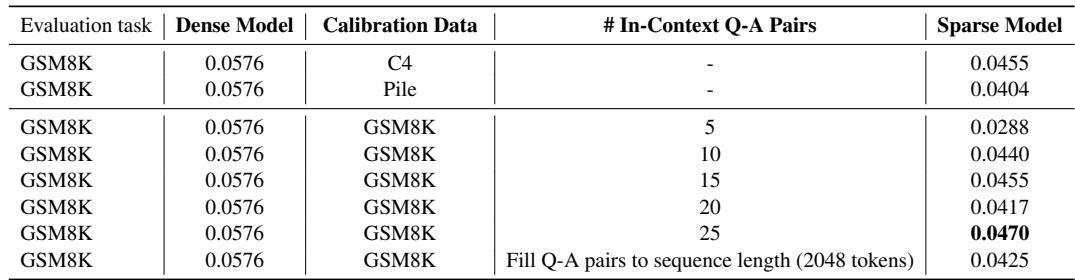
Table 7 demonstrates that filling the context window (2048 tokens) with as many Q&A pairs as possible yields the best results (0.0425 accuracy vs 0.0288 for just 5 pairs). This aligns with the “sensible data” finding—a dense, information-rich context provides a better signal for the pruning algorithm.
Conclusion & Implications
This paper serves as a wake-up call for the model compression community. For too long, the choice of calibration data was treated as a minor implementation detail, with C4 serving as the unquestioned default.
The Key Takeaways:
- Stop using C4 by default. If you are pruning a model, The Pile appears to be a strictly better choice for preserving performance.
- Format your data. Don’t just feed raw text chunks. Structuring calibration data as Question-Answer pairs (ICL) significantly helps the pruning algorithm identify important weights.
- Math makes models smart. Calibration data based on arithmetic reasoning (like SVAMP) is surprisingly effective at preserving general capabilities, likely because it activates critical reasoning circuits in the LLM.
- Data Quality > Data Quantity. A small set of high-quality, structured, sensible examples is vital. You cannot replicate these results with random noise or low-quality text.
As we move toward deploying LLMs on everything from laptops to smartphones, efficient pruning is non-negotiable. This research highlights that the path to better compression isn’t just about better algorithms (the math of how we cut)—it’s also about better data (the signal we use to decide what to cut). This “data-centric” approach to pruning opens a new frontier for optimization.