](https://deep-paper.org/en/paper/2410.07549/images/cover.png)
Introduction
Imagine reading a news headline: “Jordan played a magnificent game last night.”
As a human, you immediately look for context. Are we talking about Michael Jordan, the basketball legend? Jordan, the country in the Middle East? Or perhaps Jordan, a local high school player? This process of mapping a mention in text (like “Jordan”) to a specific, unique identity in a knowledge base (like a Wikipedia page) is called Entity Linking (EL).
For computers, this is incredibly difficult. For years, the gold standard for solving this problem involved training massive neural networks on millions of labeled examples. This works great for general topics, but what happens when you need to analyze legal documents, medical records, or obscure historical texts where you might only have five or ten examples? This is the few-shot learning challenge.
Traditional models fail here because they are “data-hungry.” They overfit to the few examples they see or rely on outdated information learned during their initial massive training.
In this post, we will deep dive into OneNet, a groundbreaking framework presented by researchers from the University of Science and Technology of China. OneNet proposes a novel way to solve Entity Linking using Large Language Models (LLMs) like GPT or LLaMA, but with a twist: it requires absolutely no fine-tuning.
We will explore how OneNet mimics human reasoning by simplifying data, using dual perspectives (context vs. prior knowledge), and employing a “judge” to prevent hallucinations.
The Problem: Ambiguity and Data Scarcity
Before understanding the solution, we must fully grasp the problem. Entity Linking is the bridge between unstructured text and structured knowledge graphs. It underpins search engines, recommendation systems, and question-answering bots.
The Three Scenarios of Failure
Traditional EL methods fall into two categories: Discriminative (calculating similarity scores) and Generative (generating the entity name directly). Both rely heavily on large datasets. When data is scarce (few-shot), they struggle in three specific ways, as illustrated below:
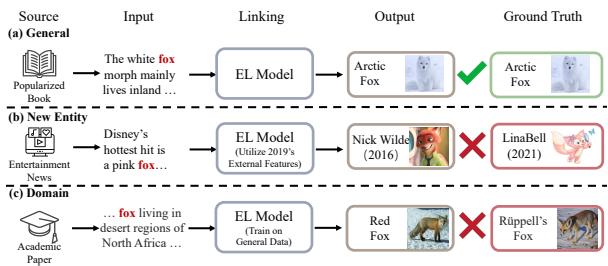
As shown in Figure 1, we can see the cracks in traditional modeling:
- Scenario (a) - The Ideal: In a general case involving an “Arctic Fox,” the model works fine because it has seen this data thousands of times.
- Scenario (b) - Outdated Knowledge: In entertainment news, the mention of a “pink fox” from Disney refers to LinaBell (introduced in 2021). However, a model trained on 2019 data might confidently link this to Nick Wilde (from 2016). This is the Temporal Adaptation problem.
- Scenario (c) - Domain Specificity: In an academic paper about North African deserts, “fox” likely refers to Rüppell’s Fox. A general model, biased towards common data, will incorrectly guess the common Red Fox.
Why not just use LLMs directly?
You might ask, “Why not just paste the text into ChatGPT?” Large Language Models have massive world knowledge and are great at “in-context learning” (learning from a few examples in the prompt). However, using them for EL directly presents three hurdles:
- Token Limits: EL often involves sorting through hundreds of candidate entities. Pasting their descriptions into a prompt exceeds the token limit of most models.
- Reasoning Balance: Advanced prompting techniques like Chain-of-Thought (CoT) can sometimes make the model “overthink” and ignore its own internal factual knowledge.
- Hallucination: LLMs are notorious for confidently making things up. In EL, accuracy is binary—it’s either the right link or it’s not.
The Solution: The OneNet Framework
The researchers developed OneNet to harness the power of LLMs while bypassing their limitations. The core philosophy is modularity. Instead of asking one giant prompt to do everything, OneNet breaks the workflow into three distinct stages.
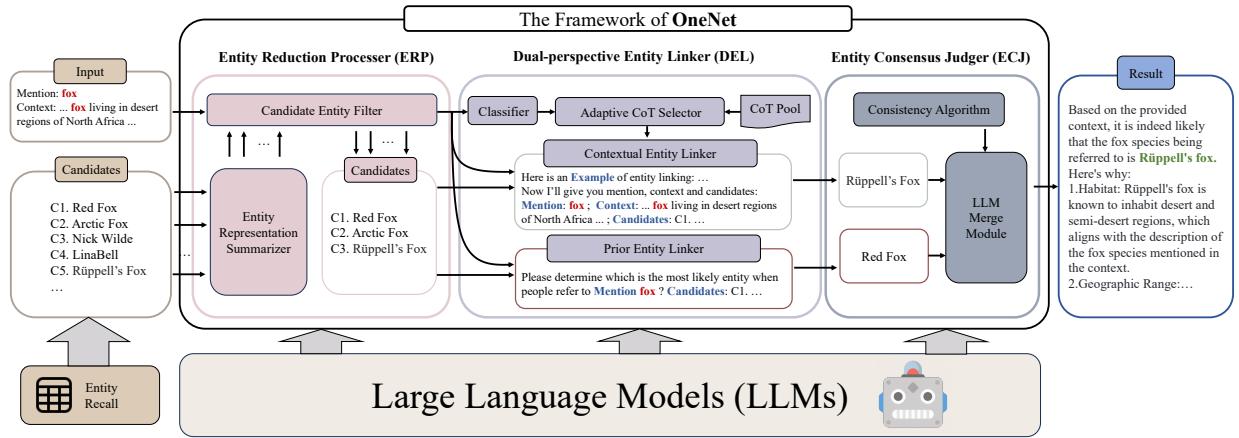
As illustrated in Figure 2, the framework consists of:
- Entity Reduction Processor (ERP): The filter. It reduces the noise before the LLM has to think too hard.
- Dual-perspective Entity Linker (DEL): The brain. It looks at the problem from two angles—context and prior knowledge.
- Entity Consensus Judger (ECJ): The judge. It decides which perspective is correct to ensure consistency.
Let’s break down each module.
Module 1: Entity Reduction Processor (ERP)
The first challenge is the Token Length Limitation. If a mention like “Fox” has 50 possible candidates in the database, feeding all 50 detailed descriptions into a prompt will crash the model or dilute its attention.
The ERP handles this in two steps:
- Summarization: It uses an LLM to condense the long descriptions of candidate entities into concise summaries. This drastically reduces input size.
- Filtering: It performs a “point-wise” check. It quickly scans candidates one by one against the mention and discards the obvious mismatches.
This effectively cleans the dataset, leaving only a handful of high-probability candidates for the heavy analytical lifting in the next stage.
Module 2: Dual-Perspective Entity Linker (DEL)
This is the heart of the framework. The researchers realized that humans solve ambiguity in two ways:
- Context: We read the surrounding sentence.
- Prior Knowledge: We rely on what we already know about the world (e.g., “Paris” is usually the city in France).
OneNet separates these distinct reasoning paths.
Path A: The Contextual Entity Linker
This module looks strictly at the text provided. It uses Chain-of-Thought (CoT) prompting, where the model is shown examples of how to reason step-by-step.
The prompt structure is sophisticated, designed to guide the LLM effectively:
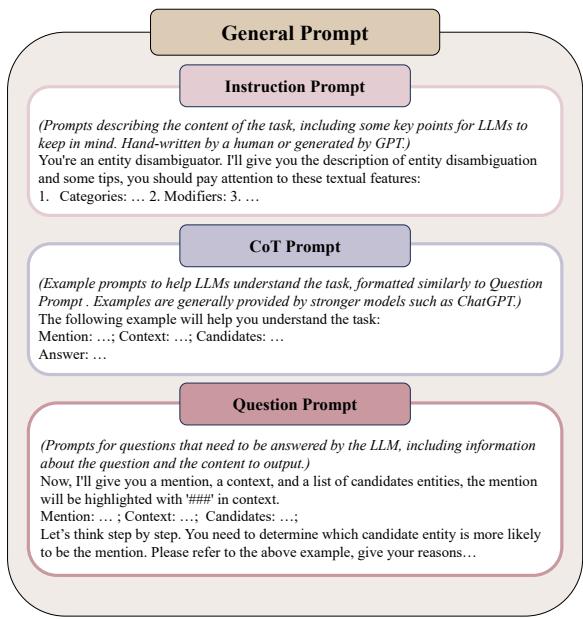
As seen in Figure 3, the prompt includes specific instructions, CoT examples (Input \(\to\) Reasoning \(\to\) Output), and the final test question.
The Adaptive CoT Selector: Crucially, OneNet doesn’t just use random examples for the CoT. It uses an Adaptive Selector. It looks for examples in the training set that are:
- Semantically similar to the current input.
- In the same category (e.g., if the input is about a person, it selects examples about people).
This ensures the LLM is “primed” with the most relevant reasoning patterns.
Path B: The Prior Entity Linker
Sometimes, the context is messy or misleading. The Prior Linker ignores the complex context and asks the LLM: “Based on your internal training data, what does this term usually refer to?”
This acts as a safety anchor. If the Contextual Linker gets confused by a weird sentence structure, the Prior Linker can ground the decision in general probability.
Module 3: Entity Consensus Judger (ECJ)
Now we have two answers: one from the Contextual Linker and one from the Prior Linker.
- If they agree: Great! That’s the answer.
- If they disagree: We have a conflict.
This is where the Entity Consensus Judger steps in. It serves as a specialized arbitration mechanism. It takes the original mention, the context, and the two conflicting answers, and essentially asks the LLM: “Here are two possibilities derived from different reasoning paths. Given the text, which one is actually correct?”
This step significantly reduces hallucinations because the model is no longer generating an answer from scratch; it is performing a multiple-choice verification task, which LLMs are generally much better at.
Putting it into Practice: Case Studies
To truly understand how OneNet works, let’s look at two specific examples from the paper where the dual-perspective approach saved the day.
Case 1: When Context Wins
In this example, the mention is “Sago”.
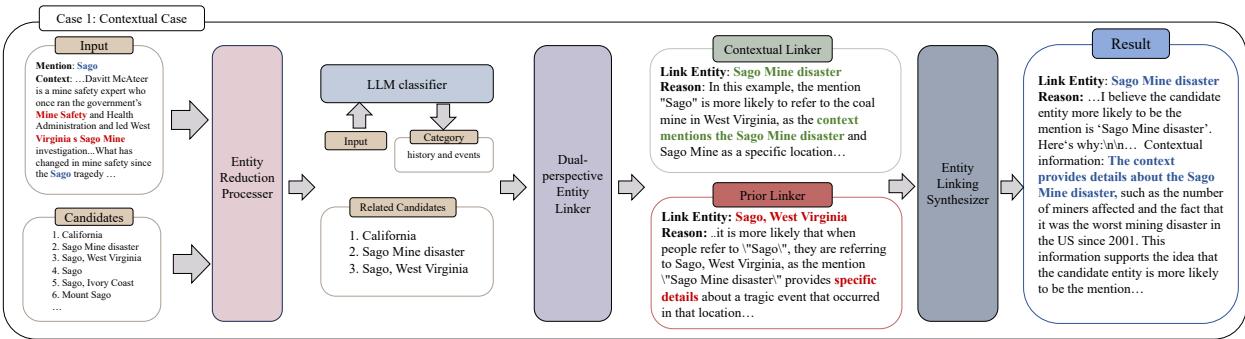
The Scenario (Figure 5): The text discusses “Davitt McAteer” leading an investigation into the “Sago Mine disaster.”
- The Conflict: The Prior Linker (relying on general probability) guesses “Sago, West Virginia,” because “Sago” usually refers to the town.
- The Contextual Linker: It analyzes the sentence, sees “Mine disaster” and “investigation,” and correctly links it to the specific entity “Sago Mine disaster.”
- The Verdict: The Judge (ECJ) sees the evidence in the text and sides with the Contextual Linker.
Case 2: When Prior Knowledge Wins
In this example, the mention is “Orange County”.
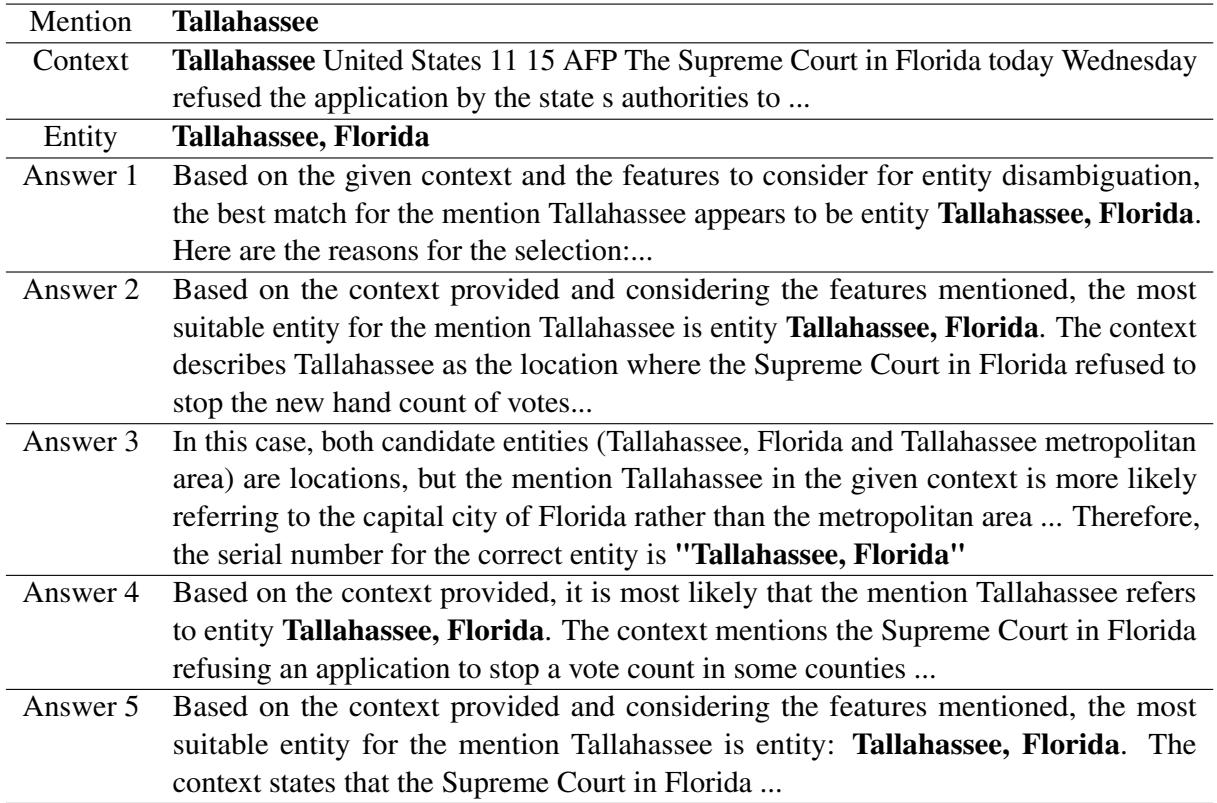
The Scenario (Figure 8): The text mentions “John Wayne Airport” in “Orange County.”
- The Conflict: The Contextual Linker gets confused. It sees “Airport” and mistakenly thinks the mention “Orange County” refers to the airport itself or a related transport entity.
- The Prior Linker: It utilizes its internal knowledge that John Wayne Airport is located in a place called Orange County, California.
- The Verdict: The Judge recognizes the relationship (Location vs. Object) and sides with the Prior Linker.
These cases demonstrate why relying on a single method is dangerous. The flexibility to switch between context-heavy reasoning and prior knowledge is OneNet’s superpower.
Experimental Results
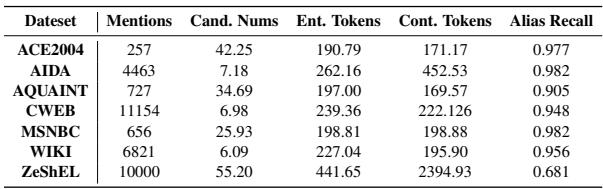
Does this actually work better than training a custom model? The authors tested OneNet on seven benchmark datasets, including generic ones (AIDA, WIKI) and specialized ones (medical, news).
The Datasets
First, a look at the variety of data used to ensure the tests were fair:
Performance Comparison
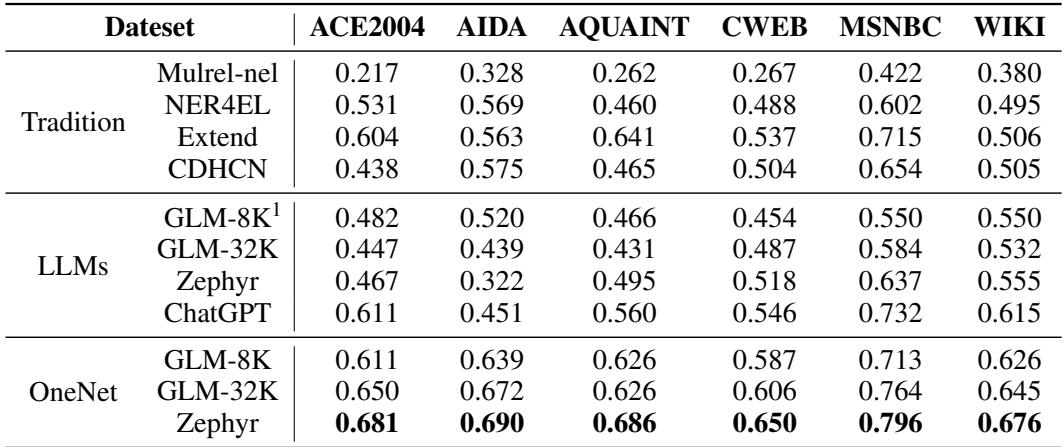
The results were compelling. OneNet was compared against traditional supervised methods (like Mulrel-nel) and standard LLM prompting (like direct ChatGPT or GLM).
Key Takeaways from Table 2:
- OneNet Superiority: OneNet (bottom rows) consistently outperforms traditional supervised methods in few-shot scenarios.
- Beating Raw LLMs: OneNet significantly outperforms using the base models (Zephyr, GLM) directly. This proves that the framework (ERP + DEL + ECJ) adds massive value beyond just the raw intelligence of the model.
- Consistency: It works across different base models (GLM vs. Zephyr), suggesting the architecture is robust regardless of the underlying AI.
Why Dual Perspectives Matter
The researchers also performed an “ablation study”—they broke the model to see which parts were essential.
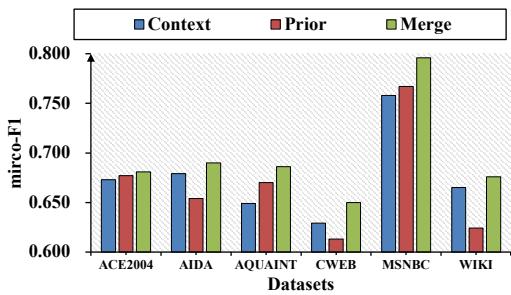
Figure 4 shows the F1 scores (accuracy) for:
- Context Only (Blue)
- Prior Only (Red)
- Merged/Consensus (Green)
In almost every case, the Merged bar (Green) is the highest. This mathematically confirms that combining contextual clues with prior knowledge yields better results than either method alone.
Conclusion
OneNet represents a significant shift in how we approach Entity Linking. Instead of treating EL as a pure pattern-matching problem requiring millions of training examples, OneNet treats it as a reasoning problem.
By leveraging the latent knowledge of Large Language Models and structuring their output through a multi-stage pipeline (Filter \(\to\) Reason \(\to\) Judge), OneNet achieves state-of-the-art results without the need for expensive fine-tuning.
Why This Matters
For students and researchers, this has huge implications:
- Accessibility: You don’t need a massive GPU cluster to train a model. You can implement state-of-the-art EL using API calls to existing LLMs.
- Adaptability: If you are working in a niche field (like 18th-century literature or quantum computing patents), OneNet allows you to build an effective linker with just a handful of examples.
- Explainability: Because the system uses Chain-of-Thought prompting, the model can actually tell you why it picked a certain entity (as seen in the case studies), which is a “black box” in traditional deep learning.
OneNet proves that sometimes, we don’t need more data; we just need to ask our models better questions.