](https://deep-paper.org/en/paper/2410.07652/images/cover.png)
Introduction
If you have spent any time working with Large Language Models (LLMs) like GPT-4, Llama, or Mistral, you are familiar with the “prompt engineering” struggle. You have a task—perhaps summarizing a document or classifying sentiment—and you spend hours tweaking the phrasing: “Rewrite this,” “Act as an expert,” “Think step by step.”
The performance of an LLM relies heavily on these handcrafted prompts. But finding the optimal prompt is often a process of trial and error, more art than science.
This leads to a compelling research question: Can we use AI to automate the creation of these prompts?
While researchers have explored “Automatic Prompt Tuning,” existing methods have significant drawbacks. Some methods, like “Soft Prompt Tuning,” optimize continuous embeddings that humans can’t read. Others use Reinforcement Learning (RL) to generate text prompts, but these are notoriously unstable—often suffering from mode collapse or requiring massive computational resources.
In this post, we are diving deep into a paper titled “StablePrompt: Automatic Prompt Tuning using Reinforcement Learning for Large Language Models.” The researchers propose a novel framework that stabilizes the Reinforcement Learning process, allowing smaller models to generate high-performance prompts that often outperform human-engineered ones.
Background: The Difficulty of Discrete Prompt Tuning
Before we look at the solution, we need to understand the problem. We are focusing on Discrete Prompt Tuning. Unlike soft prompting (which tweaks the model’s internal numbers), discrete tuning searches for actual intelligible words to feed the model.
There are two main ways to automate this currently:
- Generation-Based Methods: You ask an LLM (like GPT-4) to “generate a better prompt.” This is limited by the generator’s pre-trained capabilities. If the model doesn’t understand the task well, it can’t write a good prompt for it.
- RL-Based Methods: You treat prompt generation as a game. An “Agent” writes a prompt, a “Target” model tries to answer it, and if the answer is right, the Agent gets a reward.
The RL approach is theoretically more powerful because it learns from feedback. However, applying RL to language generation is difficult. The “action space” (the entire vocabulary of the language) is huge. Standard RL algorithms like PPO (Proximal Policy Optimization) often fail here; they either drift too far from a coherent language model (producing gibberish) or stick too closely to their initial state and never learn anything new.
The StablePrompt Framework
The researchers introduce StablePrompt, a framework designed to balance the stability of training with the flexibility needed to find creative prompts.
High-Level Architecture
The architecture involves two primary LLMs:
- The Agent Model (\(M_a\)): This model generates the prompt.
- The Target Model (\(M_T\)): This is the model we want to improve (e.g., Llama-3-8B). It takes the generated prompt and the input data to produce an answer.
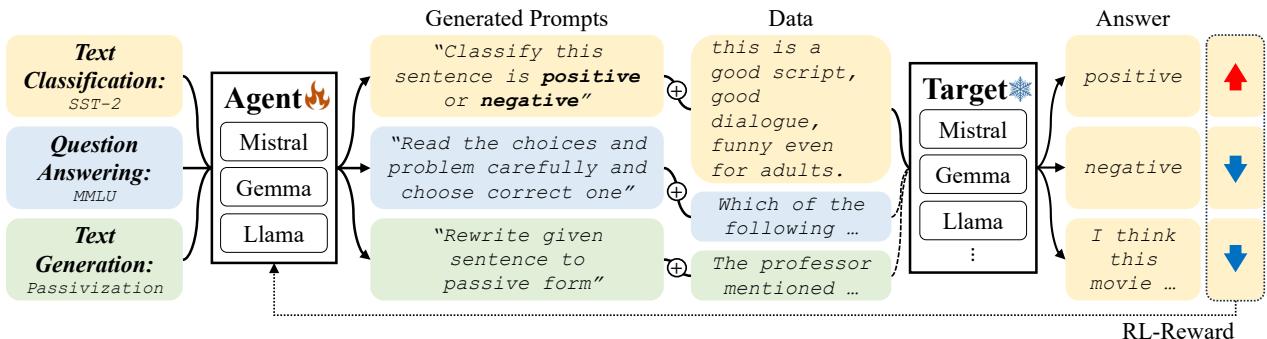
As shown in Figure 1, the process works in a loop. The Agent receives a task (like “Classify this text”). It generates a candidate prompt. The Target model uses that prompt to process the data. Finally, the system checks if the Target got the answer right and sends a “Reward” signal back to the Agent.
The Meta-Prompt
How does the Agent know what to do initially? The researchers use a Meta-Prompt. This is a task-agnostic template that frames the problem for the Agent.
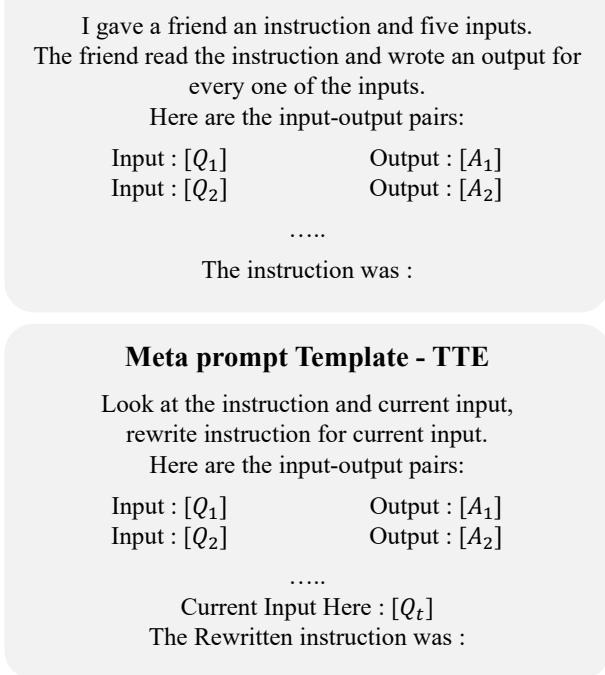
As seen in Figure 6 above, the meta-prompt shows the Agent a few examples of Input/Output pairs and asks it to generate the instruction that links them. This leverages the Agent’s pre-trained ability to perform “induction”—inferring a rule from examples.
The Mathematical Formulation
The goal is to find a discrete prompt \(\mathbf{z}\) that maximizes the reward \(R\).

Here, the Agent (\(M_a\)) generates the prompt tokens autoregressively. The optimization tries to maximize the expected reward when the Target model (\(M_T\)) uses those prompts.
The Core Innovation: Adaptive PPO (APPO)
The real breakthrough in this paper is how they train the Agent. They modify a popular Reinforcement Learning algorithm called PPO.
The Problem with Standard PPO
In standard PPO, when we update the model, we use a penalty term (KL Divergence) to ensure the model doesn’t change too drastically from the previous step.
- Issue: If you take many small steps away from the start, you can eventually drift into “bad territory” where the model outputs garbage text (mode collapse), even if the rewards seem high initially.
In RLHF (Reinforcement Learning from Human Feedback), researchers often constrain the model to stay close to the initial pre-trained model.
- Issue: This is too restrictive for prompt tuning. We want the model to explore new, creative phrasing that the original model wouldn’t normally say.
The Anchor Model Solution
StablePrompt introduces Adaptive PPO (APPO). Instead of constraining the model to the previous step or the very beginning, they introduce an Anchor Model.
The Anchor Model is a snapshot of the Agent saved at a specific point in time. It serves as a reference point.
- If the Agent improves significantly, the Anchor is updated to match the Agent (we save our progress).
- If the Agent performs worse, we can roll back to the Anchor.
- The KL penalty (the constraint) is calculated based on the distance from this Anchor Model, not the previous step.
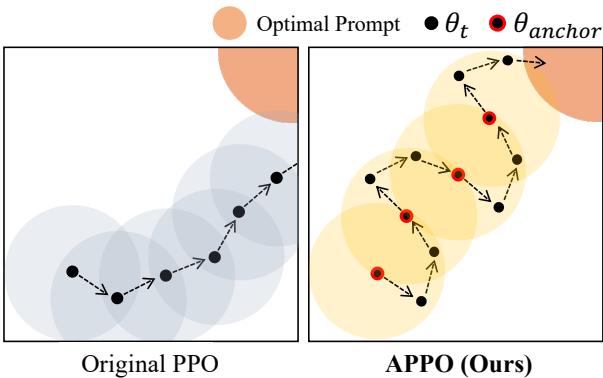
Figure 3 illustrates this beautifully.
- Original PPO (Left): The model updates step-by-step. Errors accumulate, and the trajectory can drift away from the optimal prompt into unstable regions.
- APPO (Right): The “Anchor” (red dots) acts as a base camp. The model explores around the anchor. When it finds a better spot, it moves the base camp. This allows for broad exploration without getting lost.
The mathematical change is subtle but powerful. The penalty term \(P\) becomes:

This term ensures the current policy \(\theta_t\) doesn’t diverge too far from the anchor policy \(\theta_{anchor}\).
The Reward Function
How do we score the prompts? For text generation, F1 score works well. But for classification (e.g., Sentiment Analysis), simply using Accuracy (1 or 0) produces a sparse signal—many prompts might get the same accuracy, making it hard to rank them.
StablePrompt uses a composite reward function:

It combines Accuracy with Softmax Difference (\(D\)). The Softmax difference measures the gap between the probability of the correct class and the highest incorrect class. This rewards the model not just for being right, but for being confident in the right answer.
Training Workflow
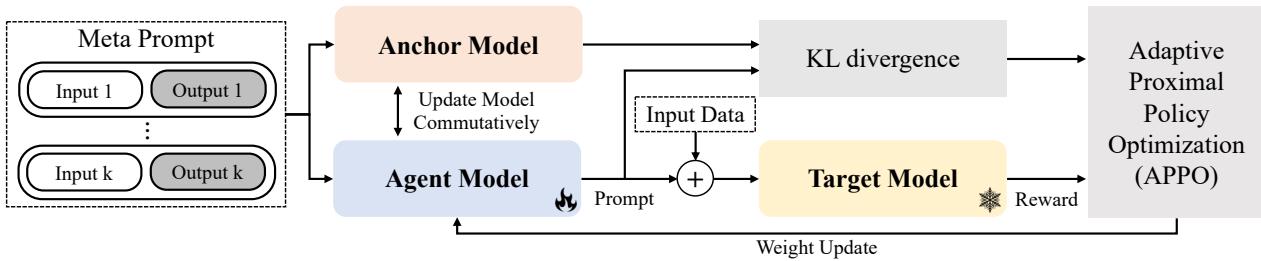
The complete training framework is visualized below. The system calculates the KL divergence between the Agent and the Anchor to keep training stable, while the reward signal drives the Agent toward better prompts.
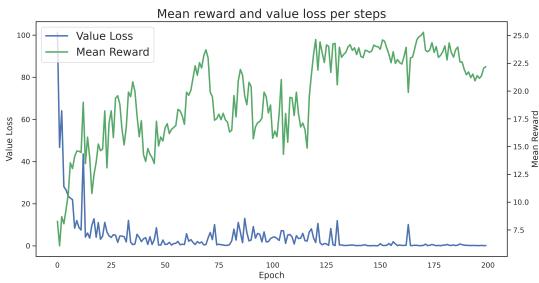
To verify stability, the researchers plotted the mean reward and value loss over time (Figure 7, below). Unlike many RL experiments where graphs oscillate wildly, StablePrompt shows a steady increase in reward (Green) and a convergence of loss (Blue), proving the stability of the method.
Extending the Method: Test-Time Editing
Sometimes, a single prompt isn’t enough for a whole dataset. Some inputs are harder than others. The researchers proposed TTE-StablePrompt (Test-Time Editing).
In this variant, the Agent sees the specific input query along with the meta-prompt. It generates a unique instruction just for that specific input. This allows the system to adapt its strategy on a case-by-case basis, essentially performing dynamic prompt engineering.
Experiments and Results
The researchers tested StablePrompt on a wide variety of tasks, including GLUE (classification), MMLU (Question Answering), and BigBench (reasoning).
1. Robustness Across Models
One of the most impressive results is that StablePrompt works regardless of the model size combination. They tested Agents and Targets ranging from 2B parameters (Gemma-2B) to 11B (Falcon-11B).
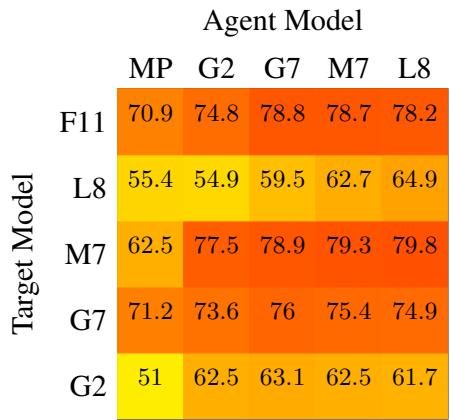
The heatmap above (Figure 4) shows the accuracy. The darker orange indicates higher performance.
- Key Finding: A small Agent (like Gemma-2B) can successfully tune prompts for a larger Target (like Llama-3-8B).
- Key Finding: StablePrompt consistently outperforms manual prompts (the “MP” column vs. the heatmap cells).
2. Outperforming Giants
How does it compare to other automated methods? The researchers compared StablePrompt (using a 7B model) against APE (which uses models as large as 175B).
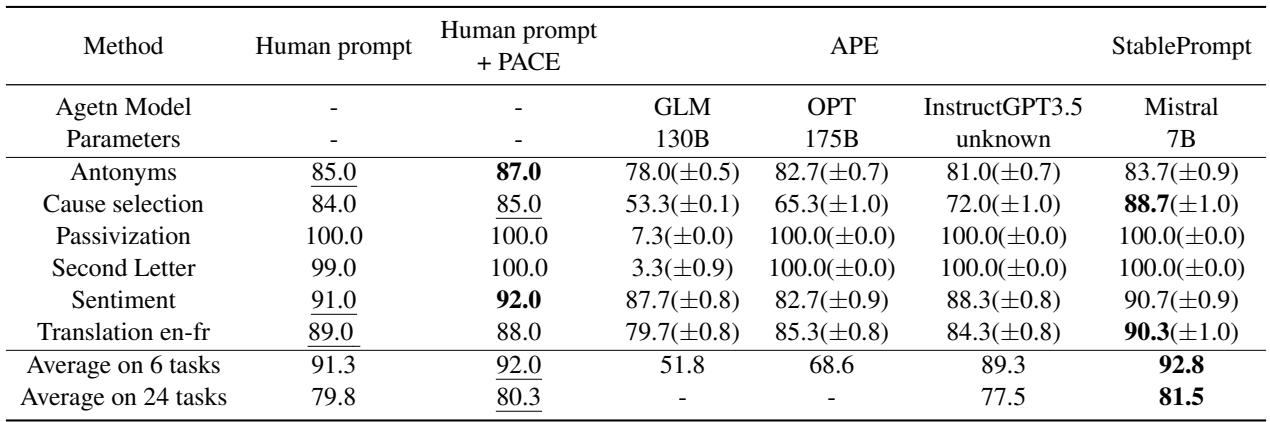
In the Instruction Induction task (Table 2), StablePrompt achieved an average score of 92.8, beating InstructGPT-3.5 (89.3) and the massive OPT-175B (68.6). This demonstrates that a smart training algorithm (APPO) is more important than raw model size for this task.
3. Question Answering (MMLU)
On the MMLU benchmark, which tests general knowledge across STEM, Humanities, and more, StablePrompt and its TTE variant again showed dominance.
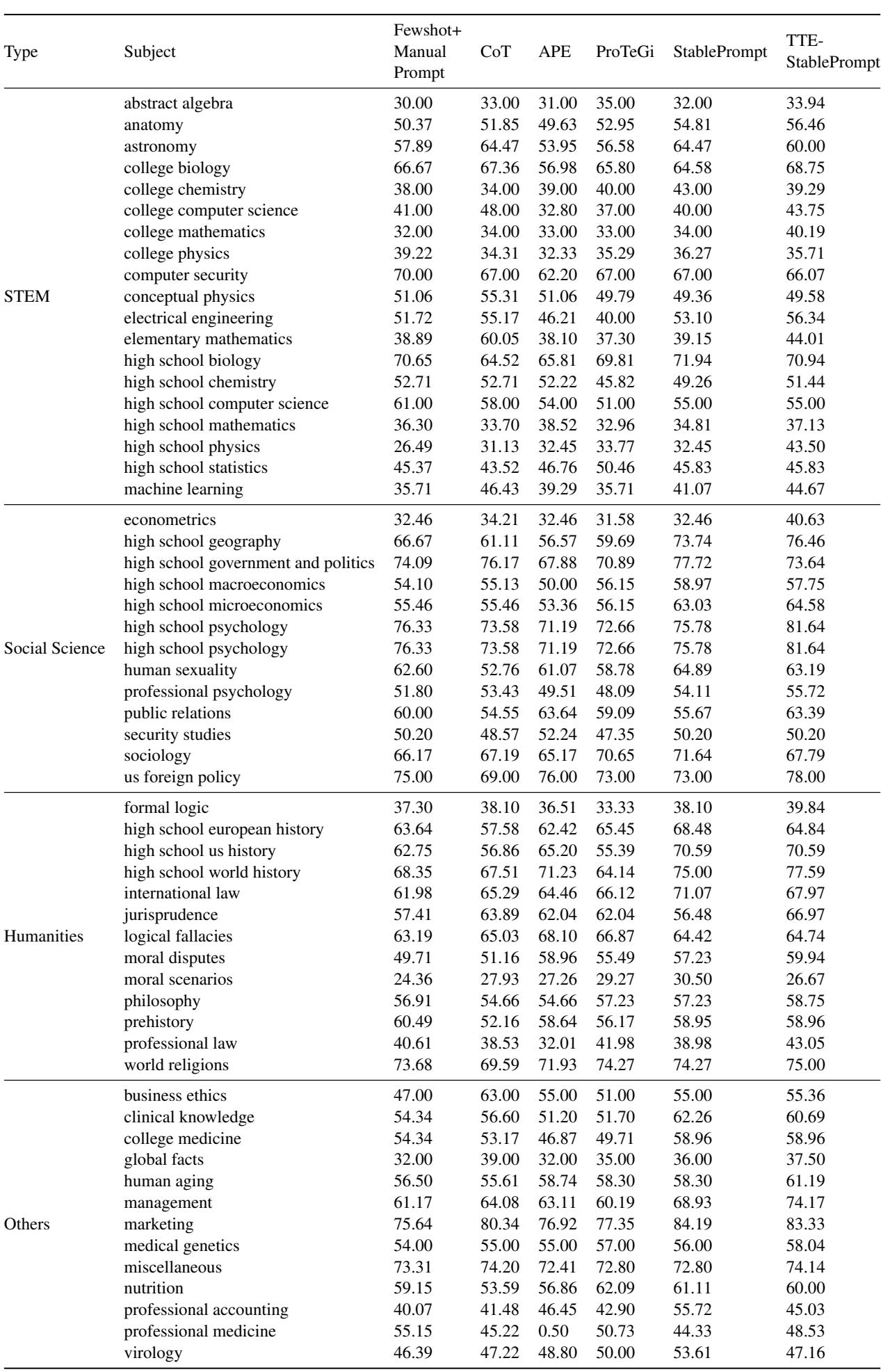
Table 13 shows that TTE-StablePrompt (Test-Time Editing) consistently achieves the highest scores across almost all categories. This confirms that allowing the Agent to customize the prompt for every specific question yields the best reasoning results.
Conclusion
StablePrompt represents a significant step forward in automating interactions with LLMs. By formulating prompt tuning as a reinforcement learning problem—and solving the stability issues with the Anchor Model strategy—the authors have created a tool that allows even small, open-source models to optimize prompts effectively.
Key Takeaways:
- RL is viable for Prompt Tuning: With the right constraints (APPO), we can prevent the instability that usually plagues text-based RL.
- Small Models can guide Big Models: You don’t need GPT-4 to write prompts for GPT-4. A tuned 7B model can generate highly effective prompts for larger models.
- Dynamic Prompting works: Adjusting the prompt for every specific input (Test-Time Editing) provides a significant performance boost over static prompts.
As LLMs continue to integrate into more complex workflows, tools like StablePrompt will likely become standard, moving us away from “prompt engineering” by hand and toward “prompt optimization” by algorithm.