](https://deep-paper.org/en/paper/2410.07673/images/cover.png)
Introduction: The Evolution of the Trap
We have all been there. You are scrolling through your social media feed, and you see an image of a celebrity paired with a shocking headline: “You Won’t Believe What Happened to Emma Watson!” Curiosity gets the better of you. You click.
The resulting article, however, has nothing to do with the headline. It is a generic piece of content, perhaps a slide show of unrelated advertisements. You have been “baited.”
For social media platforms, clickbait is a scourge. It degrades user experience and damages credibility. While detecting “You Won’t Believe #7” headlines was relatively easy for early AI models, the creators of clickbait are evolving. They are no longer just using loud, capitalized text. They are using “disguise” tactics—mixing innocent images with misleading text, or embedding bait triggers into otherwise normal-looking posts.
This presents a massive challenge for traditional Machine Learning (ML) detectors. Most detectors rely on correlation. If they see a specific pattern (like a specific celebrity’s face) often associated with clickbait labels in the training data, they assume any post with that face is clickbait. This is a spurious correlation—a bias that fails when the context changes.
In this post, we will dive deep into a paper by researchers from Sun Yat-sen University and Tencent, titled “Multimodal Clickbait Detection by De-confounding Biases Using Causal Representation Inference.” This work proposes a sophisticated method to move beyond simple correlation and instead uses Causal Inference to understand the why behind clickbait, allowing the model to spot even the most well-disguised traps.
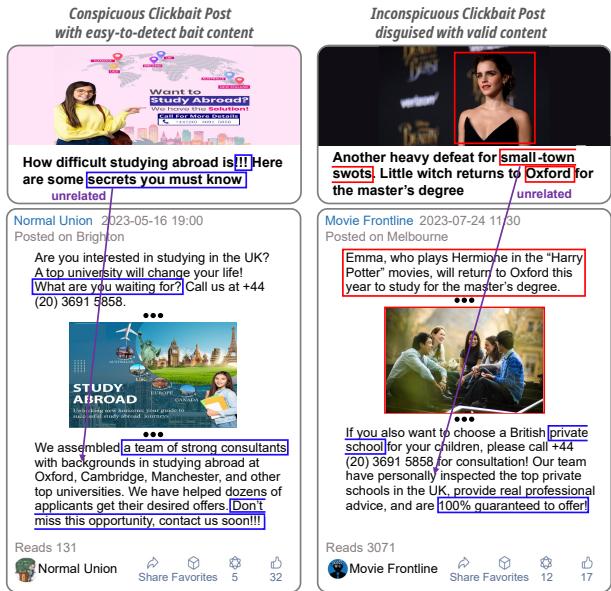
As shown in Figure 1, clickbait has evolved from the “Simple” type (left)—which screams for attention—to the “Complex” type (right), which disguises itself with valid content to fool detectors. The goal of this research is to unmask both.
The Problem: Spurious Correlations and Bias
To understand why this paper is significant, we first need to understand why current models fail.
Standard Deep Learning models are essentially pattern matchers. If you train a model on a dataset where 80% of clickbait posts feature a specific color palette or a specific trending topic, the model learns a shortcut: “If I see this color/topic, predict Clickbait.”
This is a Spurious Correlation. It works for a while, but it is not a causal relationship. The color didn’t cause the post to be clickbait; the malicious intent of the creator did.
When clickbait creators change their tactics (e.g., swapping the color palette or using a different celebrity), the “shortcut” fails. The model, relying on the wrong features (noise), makes incorrect predictions. This is particularly problematic in Multimodal learning (combining text and images), where the interaction between a headline and a thumbnail is often where the deception lies.
The Causal Perspective
The researchers argue that to build a robust detector, we must disentangle the input features into three distinct categories:
- Invariant Factors (IC): These are the core characteristics of clickbait that always indicate malicious intent, regardless of the scenario (e.g., a massive disconnect between the headline sentiment and the article body).
- Scenario-Specific Causal Factors (SC): These are deceptive patterns that appear in specific contexts or time periods (e.g., a specific style of misinformation used during an election cycle).
- Non-Causal Noise (NF): Irrelevant features that just happen to co-occur (e.g., the background color, the time of day).
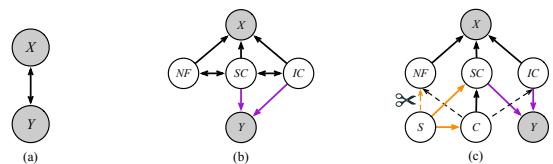
Figure 3 illustrates this concept.
- (a) Traditional models just map features (\(X\)) to labels (\(Y\)), capturing all the noise.
- (b) We want to separate \(X\) into Invariant Factors (\(IC\)), Scenario Factors (\(SC\)), and Noise (\(NF\)).
- (c) The researchers propose a De-confounding structure. By introducing a confounder (\(C\)) and scenario (\(S\)), they can mathematically isolate the invariant and causal factors from the noise.
The Solution: A Causal De-biasing Framework
The researchers propose a four-step framework that takes a raw post and processes it to extract the “truth” behind the content.
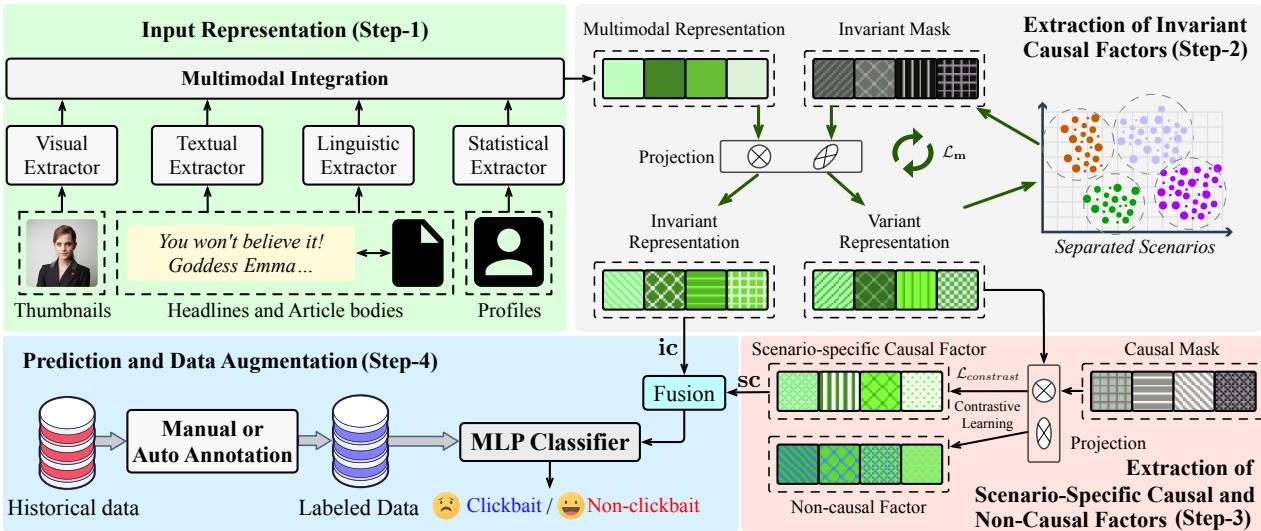
Let’s break down the architecture shown in Figure 2.
Step 1: Multimodal Feature Extraction
Before doing any causal magic, the model needs to “see” and “read” the post. The researchers extract five distinct types of features:
- Visual Features: Using a Swin Transformer to analyze the thumbnail and article images.
- Textual Features: Using BERT to understand the headline and article text. They also use OCR (Optical Character Recognition) to read text inside the images.
- Cross-modal Features: Using a specialized Transformer to analyze the relationship between the image and the text. (Does the image actually match the text?)
- Linguistic Features: Hand-crafted features that look for “baitiness”—e.g., overuse of punctuation ("!!!"), specific phrasing (“You won’t believe”), and sentiment analysis.
- Profile Features: Who posted this? Is it a verified account? How old is the account? (Malicious accounts often have short lifespans).
These features are concatenated into a single representation vector, \(x_i\).
Step 2: Disentangling the “Invariant” Factor
This is the core innovation of the paper. The vector \(x_i\) is a mix of good signals and bad noise. The goal is to learn a “mask” (\(\mathbf{m}\)) that filters out the noise.
The researchers use a technique called Invariant Risk Minimization (IRM).
Here is the intuition: Imagine we have different “scenarios” of data (e.g., sports news, fashion posts, political news). Spurious correlations (noise) change between scenarios. For example, “red bold text” might be clickbait in sports but normal in fashion. However, the core nature of clickbait (e.g., misleading claims) remains constant across all scenarios.
The model tries to find a feature mask \(\mathbf{m}\) that minimizes the error across all scenarios simultaneously. If a feature is only predictive in one scenario but not others, the model learns to ignore it. This leaves us with the Invariant Causal Factor.
Step 3: Handling Scenario-Specific Factors
Not all clickbait is universal. Some tactics are specific to a certain context (a “Scenario”). The model needs to capture these without getting confused by noise.
But wait—the dataset doesn’t come labeled with “Scenario A” or “Scenario B.” The model has to figure this out on its own.
Self-Supervised Scenario Estimation
The researchers use an iterative process:
- Guess: The model groups the data into clusters (scenarios) based on the current features.
- Learn: It trains a predictor for each scenario.
- Refine: It re-assigns samples to the scenario where they fit best.
This loop continues until the scenarios stabilize. Once the scenarios are defined, the model extracts Scenario-Specific Causal Factors.
To ensure these factors are actually “causal” (related to clickbait) and not just noise, they use Contrastive Learning. They define “Noise” as the features remaining after the causal features are extracted. They then test: If we swap the causal features with the noise features, does the prediction change? If it does, then the separation was successful.
Step 4: Prediction
Finally, the model combines the Invariant Factor (the universal clickbait signals) and the Scenario-Specific Factor (the context-aware signals) to make a final prediction: Clickbait or Non-Clickbait.
Experiments and Results
Does this complex causal machinery actually work better than just throwing a massive Transformer at the problem? The researchers tested their model on three popular real-world datasets: CLDInst (Instagram posts), Clickbait17 (Twitter posts), and FakeNewsNet.
They compared their method against several state-of-the-art baselines, including:
- dEFEND: A co-attention based model.
- MCAN: A deep multimodal fusion model.
- VLP: A large-scale video-language pre-training model.
Quantitative Performance
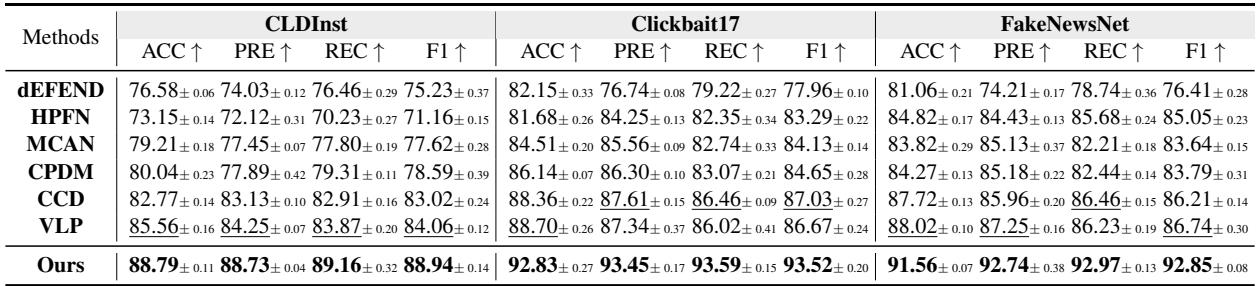
As shown in Table 1, the proposed method (“Ours”) consistently outperforms all baselines across all datasets.
- On Clickbait17, it achieved an accuracy of 92.83%, significantly higher than the next best (VLP at 88.70%).
- The gap is most noticeable in the Precision and Recall metrics, indicating that the model is not only catching more clickbait but is also making fewer false accusations (classifying normal posts as bait).
Visualizing the “De-confounding”
Numbers are great, but seeing the internal representation of the model is even better. The researchers used t-SNE to visualize how the model groups different posts in the feature space.
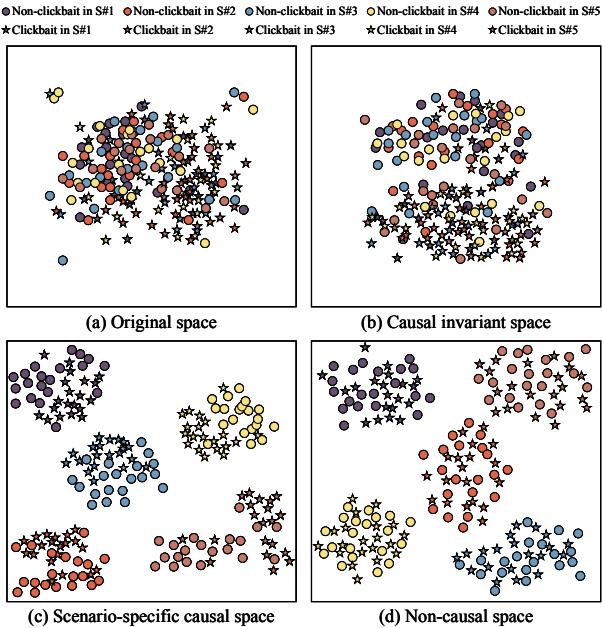
Figure 7 tells a compelling story:
- (a) Original Space: The raw features are a mess. Clickbait (stars) and Non-clickbait (circles) are mixed together. It’s hard to draw a line between them.
- (b) Causal Invariant Space: After applying the causal masking (Step 2), we see a clear separation. The clickbait samples are moving away from the non-clickbait samples.
- (c) Scenario-Specific Space: Here, the model has grouped data by scenario (the different colors), but within those clusters, it separates the bait from the non-bait.
This visualization proves that the model isn’t just memorizing data; it is actively restructuring the feature space to isolate the malicious content.
Robustness and Generalization
One of the key claims of the paper is that this method handles “disguised” clickbait better. The Precision-Recall (PR) curves confirm this.
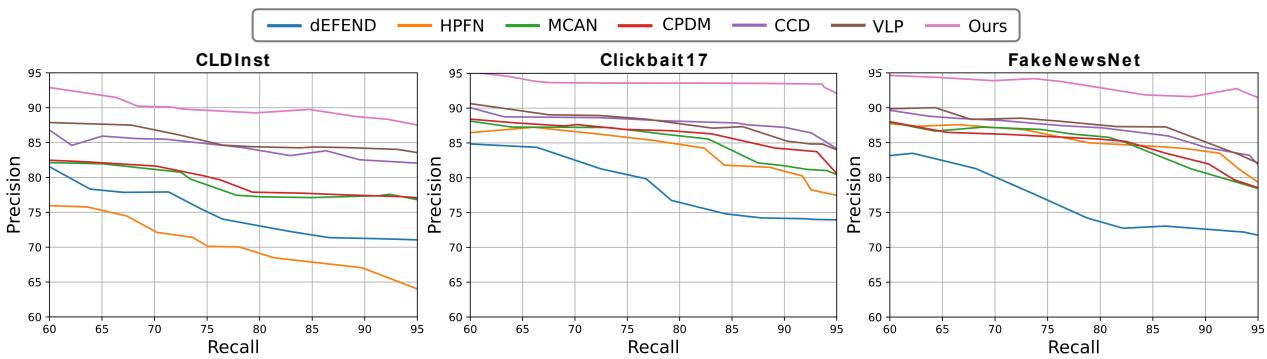
In Figure 4, the pink line (Ours) sits highest on the chart. A high PR curve means the model maintains high precision even as it tries to recall (find) more difficult samples. This is crucial for detecting inconspicuous clickbait that tries to blend in with legitimate content.
Conclusion: The Future of Deception Detection
Clickbait detection is an arms race. As detection algorithms get smarter, content farm creators get subtler. The significance of this paper lies in its move away from pure pattern recognition toward Causal Representation Learning.
By asking what causes this post to be clickbait rather than what does this post look like, the model becomes resilient. It stops relying on shallow shortcuts—like specific keywords or image styles—that can be easily changed by attackers. Instead, it looks for the invariant inconsistencies (like the gap between a headline’s promise and the article’s reality) that fundamentally define clickbait.
This approach has implications beyond just clickbait. The same principles of de-confounding biases can be applied to:
- Fake News Detection: Identifying misinformation regardless of the political topic.
- Hate Speech Detection: Spotting toxicity even when new slang or code words are used.
- Ad Fraud: Detecting bot traffic that mimics human behavior.
By teaching machines to understand causality, we move one step closer to an AI that doesn’t just read the internet, but truly understands it.