](https://deep-paper.org/en/paper/2410.08436/images/cover.png)
Introduction
In the world of Artificial Intelligence, Large Language Models (LLMs) like GPT-4 and Llama-3 have become akin to brilliant but occasionally unreliable students. Ask them a complex question, and they might give you the correct answer. However, if you ask them why they reached that conclusion, the explanation can sometimes be a hallucinated mess or a logical leap of faith.
For casual conversation, this is tolerable. But for high-stakes domains—legal analysis, scientific discovery, or complex logical puzzles—we need more than just an answer. We need a proof. We need to see the intermediate steps, the evidence used, and the logical structure that connects the premises to the conclusion.
While techniques like Chain-of-Thought (CoT) prompting have improved reasoning by asking models to “think step-by-step,” they largely treat reasoning as a linear path. But real-world logic isn’t always a straight line; it’s a tree, or more accurately, a graph. Premises combine to form intermediate conclusions, which branch out and merge to support a final hypothesis.
This brings us to a fascinating paper titled “Exploring the Role of Reasoning Structures for Constructing Proofs in Multi-Step Natural Language Reasoning with Large Language Models.” The researchers propose a novel framework that moves beyond simple linear reasoning. They investigate whether LLMs can learn to construct explicit proof graphs via in-context learning—providing the model with just a few carefully selected examples.
In this deep dive, we will explore how they equip LLMs with “Structure-Aware” capabilities, allowing these models to search for evidence, propose logical steps, and prune bad reasoning paths, effectively turning a black-box generator into a transparent reasoning engine.
The Problem: Why Linear Reasoning Isn’t Enough
To understand the contribution of this paper, we first need to look at the limitations of current state-of-the-art methods.
The Limits of Linear Chains
When an LLM uses standard Chain-of-Thought (CoT), it generates a sequence of thoughts one after another. This works well for sequential problems (A \(\rightarrow\) B \(\rightarrow\) C). However, complex reasoning often requires combining disparate pieces of evidence. You might need to combine Fact A and Fact B to prove point X, while simultaneously using Fact C and Fact D to prove point Y, before finally combining X and Y to prove the answer Z.
This is a non-sequential structure. If a model tries to flatten this into a single linear chain, it often loses track of the logical dependencies or hallucinates connections that don’t exist.
The Explainability Gap
Furthermore, mere text generation isn’t a strict proof. A robust system should output a Proof Graph: a structured representation where nodes are sentences (evidence or intermediate conclusions) and edges represent logical entailment. The goal of this research is to force the LLM to construct this graph explicitly.
The Solution: A Structure-Aware Framework
The researchers introduce a comprehensive framework that doesn’t rely on fine-tuning the model (which is expensive and requires massive datasets). Instead, they use in-context learning—giving the model examples in the prompt. But they don’t just pick random examples; they pick examples that share a similar reasoning structure to the problem at hand.
The framework consists of two main pillars:
- Structure-Aware Demonstration: Finding the right examples to show the model.
- Structure-Aware Pruning: Guiding the model’s search process to avoid redundancy and dead ends.
Let’s look at the complete architecture of their proposed system.
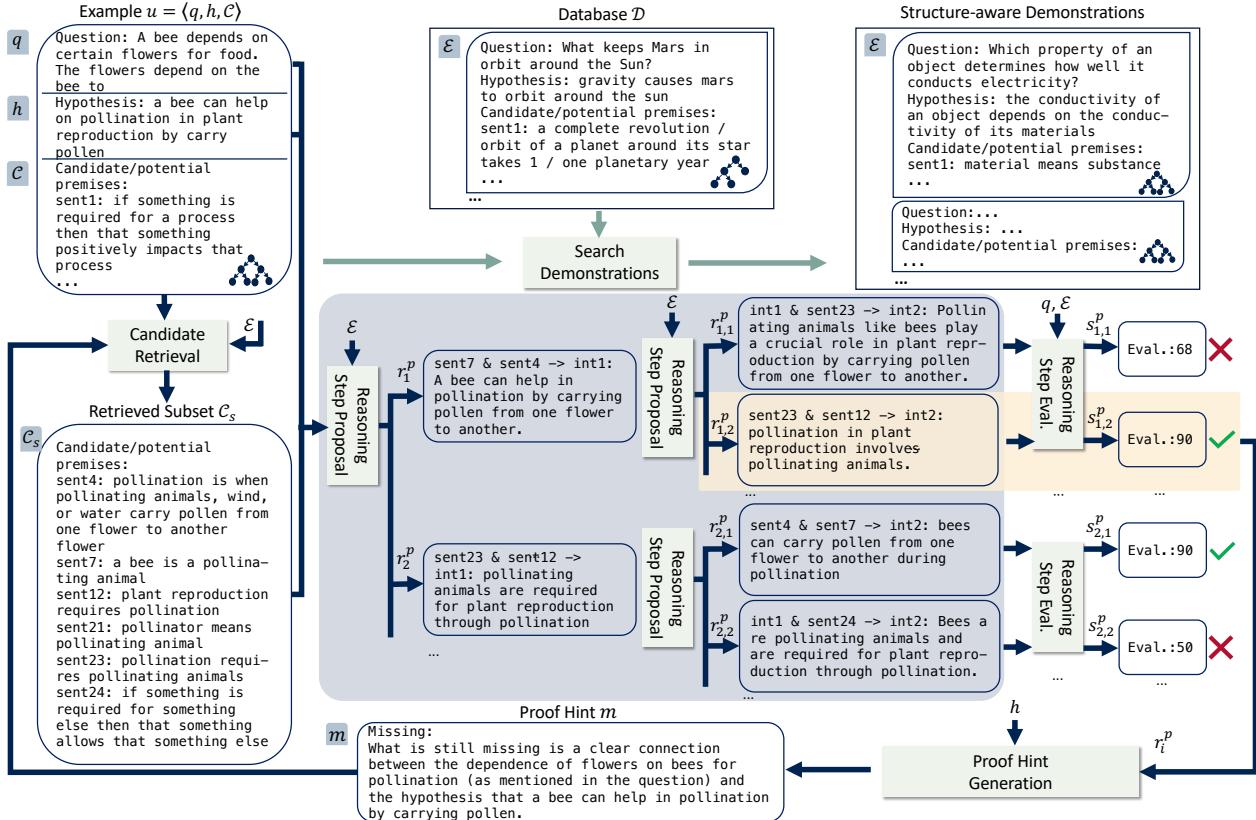
As shown in Figure 1, the process is iterative. It starts with a Question (\(q\)), a Hypothesis (\(h\)), and a Context (\(C\)) of potential evidence sentences. The system cycles through retrieving candidates, proposing reasoning steps, evaluating them, and generating hints, all while maintaining a proof graph.
Let’s break down these components step-by-step.
Part 1: Structure-Aware Demonstration
Standard in-context learning usually selects demonstrations (examples) based on semantic similarity. If your question is about “cats,” it finds other examples about “animals.”
The authors argue this isn’t enough. If your problem requires a “divergent” reasoning structure (one fact proving two different things), showing the model an example of “linear” reasoning won’t help, even if the topic is similar. You need an example with a similar logical skeleton.
The Chicken-and-Egg Problem
How do you find an example with a similar proof structure if you haven’t built the proof for your current problem yet?
The researchers solve this with a “Guess and Refine” strategy (labeled as the green arrows in Figure 1):
- Guess: They ask the LLM to generate a preliminary, “guessed” proof graph for the current problem.
- Encode: They use a Graph Attention Network (GATv2) to encode this guessed graph into a mathematical representation.
- Search: They compare this encoding against a database of solved problems to find the ones with the most structurally similar proofs.
- Prompt: These structurally similar examples are then used as the few-shot demonstrations for the actual reasoning phase.
This ensures the LLM is primed with the kind of logic it needs to perform, not just the topic.
Part 2: The Reasoning Pipeline
Once the demonstrations are selected, the model begins the actual proof construction. This is an iterative loop (the blue arrows in Figure 1).
1. Candidate Retrieval
The context (\(C\)) usually contains many irrelevant sentences (distractors). The first step is to filter these down. The model looks at the question (\(q\)), hypothesis (\(h\)), and the current state of the proof to retrieve a subset of relevant sentences, denoted as \(C_s\).
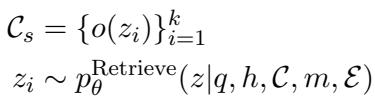
Here, \(z_i\) represents the generated output from the model which contains the IDs of the sentences it thinks are relevant. This reduces noise for the subsequent steps.
2. Reasoning Step Proposal
Now the model must act as a logician. It takes the retrieved sentences and proposes a logical step. For example, “Combine Sentence 7 and Sentence 4 to infer Intermediate Conclusion 1.”

The output \(r_i\) is parsed into a structured format (e.g., sent7 & sent4 -> int1). This is critical because it builds the explicit graph structure rather than just unstructured text.
3. Reasoning Step Evaluation
LLMs are known to be overconfident. To mitigate this, the framework includes a self-evaluation step. The model is asked to verify the validity of the step it just proposed.

The model assigns a score (\(s_i\)) to the reasoning step. If the score is too low (e.g., logical disconnect), the step is discarded.
4. Proof Hint Generation
This is one of the most innovative components. In complex reasoning, models often get “stuck” or drift away from the goal. To prevent this, the researchers implement a Proof Hint module.
At each step, the model compares the current intermediate conclusion with the final hypothesis (\(h\)). It explicitly generates a natural language hint describing what is missing.

Looking back at the bottom of Figure 1, you can see an example of this.
- Current State: We know “flowers depend on bees.”
- Goal: Prove “bees help pollination.”
- Generated Hint: “What is missing is the connection that bees help pollination.”
This hint \(m\) is fed back into the Candidate Retrieval step for the next iteration, acting as a search query to find exactly the piece of evidence needed to close the gap.
Part 3: Structure-Aware Pruning
The process described above generates a tree of possibilities. If we explored every possible combination of sentences, the computation would explode (combinatorial explosion). We need to prune the tree.
The researchers discovered that standard search methods often get stuck in loops or redundant branches. To fix this, they introduce Structure-Aware Pruning.
The “Diversity” Strategy
In their preliminary experiments, they found that models perform better when forced to use diverse evidence. If a model just used Sentence A to prove Conclusion B, it shouldn’t try to use Sentence A again immediately in the same branch to prove something else trivial.
The pruning algorithm discourages the model from growing the proof graph from nodes that were just generated in the immediate previous step. It forces the model to look at other branches of the tree, ensuring that different parts of the logical argument are developed in parallel before being merged. This mimics how a human might solve a puzzle: “I’ve figured out this corner, now let me work on that corner, and connect them later.”
Experiments and Results
The researchers tested their framework on three challenging benchmark datasets:
- EntailmentBank: A dataset specifically designed for explaining answers with entailment trees.
- AR-LSAT: Analytical Reasoning tasks from the Law School Admission Test (very hard logic puzzles).
- PrOntoQA: A synthetic dataset with rigorous first-order logic structures.
They compared their method against strong baselines:
- CoT: Chain-of-Thought (standard linear reasoning).
- CoT-sc: Self-Consistency (running CoT multiple times and voting).
- ToT: Tree-of-Thoughts (exploring multiple reasoning branches).
- RAP: Reasoning-via-Planning.
Main Performance
The results were impressive. Let’s look at Table 1.
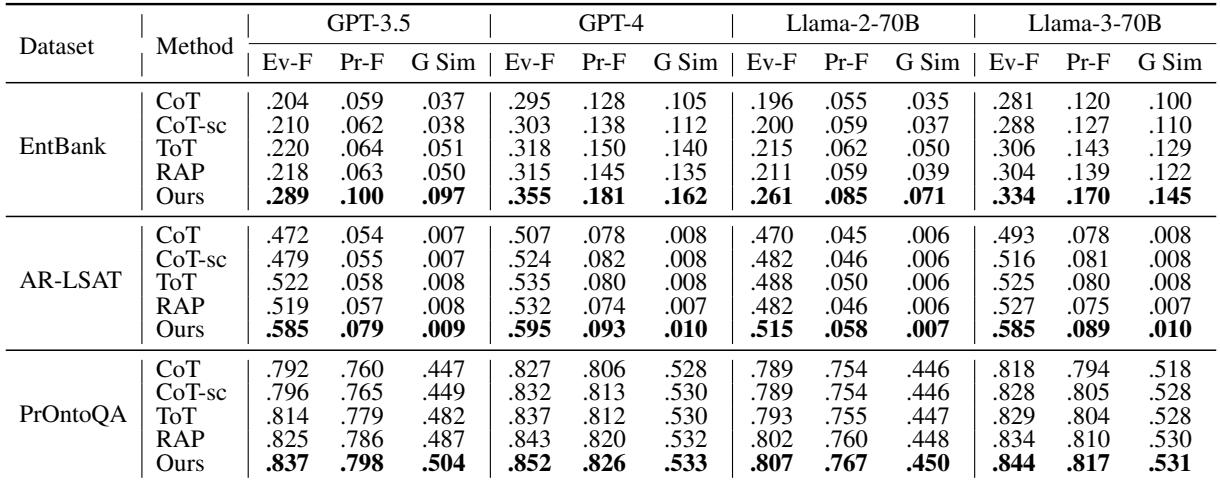
Key Metrics Explained:
- Ev-F (Evidence F1): Did the model find the correct supporting sentences?
- Pr-F (Proof F1): Did the model build the correct logical steps (nodes and edges)?
- G Sim (Graph Similarity): How closely does the overall shape of the predicted graph match the correct proof graph?
The Takeaway: The proposed method (“Ours”) consistently outperforms the baselines across all datasets and models (GPT-3.5, GPT-4, Llama-2/3).
- On EntailmentBank with GPT-4, the method achieves a G Sim of 0.162, significantly higher than CoT (0.105) and ToT (0.140).
- The improvement in Evidence F1 suggests that the “Proof Hint” mechanism effectively helps the model find the right needle in the haystack.
Does the Structure Really Matter?
To prove that the “structure-aware” parts of the model are doing the heavy lifting, the authors conducted an ablation study (removing parts of the system to see what breaks).
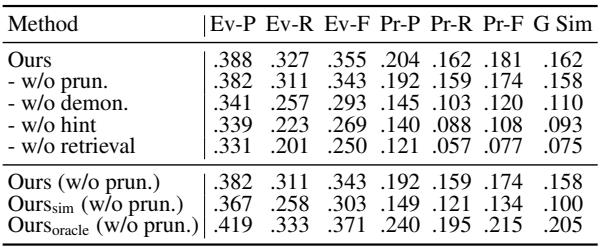
In Table 2, we see the breakdown:
- w/o prun: Removing structure-aware pruning drops performance.
- w/o demon: Removing structure-aware demonstrations (and using just random/text-similar ones) causes a massive drop (Ev-F goes from .355 to .293).
- w/o hint: Removing the “Proof Hint” generation also significantly hurts the ability to find evidence.
This confirms that simply having a smart model isn’t enough; guiding it with structure-based examples and hints is crucial.
Sequential vs. Non-Sequential Reasoning
One of the most interesting analyses in the paper is how the model handles complexity. The researchers categorized the test problems into “Sequential” (linear chains) and “Non-sequential” (branching graphs).
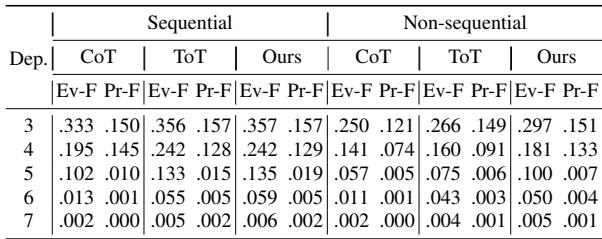
Table 3 reveals a critical insight:
- On Sequential problems, the proposed method performs comparably to Tree-of-Thought (ToT). This makes sense; if the logic is a straight line, a tree search doesn’t add much value.
- On Non-sequential problems, the proposed method outperforms ToT. This validates the hypothesis that structure-aware demonstrations help the model navigate complex, branching logic that standard methods struggle with.
Further Analysis
The paper also provides deeper cuts into the data. For example, Table 12 compares different internal strategies.
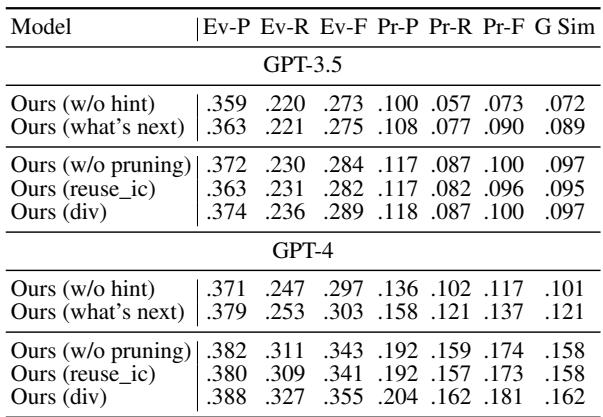
Here, “Ours (div)” refers to the diversity-based pruning strategy discussed earlier. You can see it outperforms “Ours (reuse_ic),” which allows reusing intermediate conclusions immediately. This mathematical confirmation supports the intuition that reasoning needs to be broad and diverse, not repetitive.
Finally, Table 13 provides qualitative examples showing the “Proof Hint” in action.
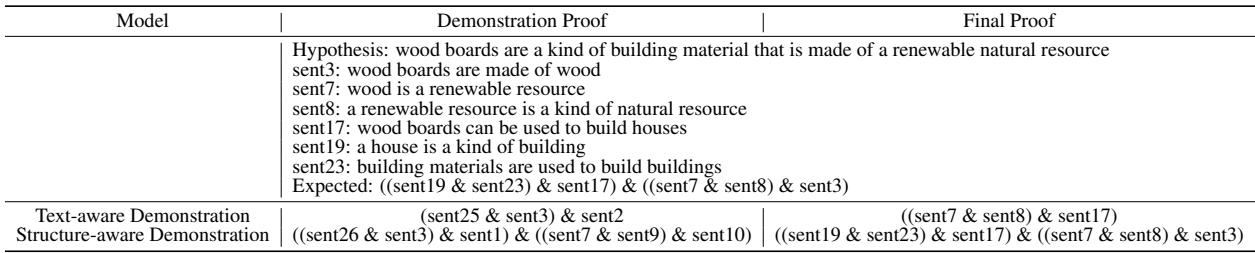
In Case 1 (top row), the model without hints gets lost. The model with hints explicitly notes: “What is still missing is a direct connection… that ’taking in carbon dioxide’ is indeed a step…” This self-reflection allows it to retrieve the specific sentence needed to bridge the logical gap, whereas the version without hints fails to make the connection.
Conclusion & Implications
This research marks a significant step forward in making Large Language Models “explainable.” By forcing the model to construct an explicit proof graph, we move away from “trust me, I’m an AI” to “here is my work, verify it.”
The key takeaways are:
- Structure Matters: In-context learning is more effective when demonstrations share the same logical structure, not just the same topic.
- Guided Search: LLMs need help navigating the reasoning space. Mechanisms like “Proof Hints” and diversity-based pruning prevent the model from getting lost in the weeds.
- Beyond Linearity: As AI tackles more complex real-world problems (law, science, logistics), reasoning will rarely be linear. Frameworks that embrace graph-based structures are essential for the next generation of intelligent agents.
While the method increases computational cost (due to the iterative search and multiple API calls), the tradeoff is a measurable increase in reliability and transparency. For students and researchers entering the field, this paper serves as a perfect example of how to combine classical algorithms (like Graph Neural Networks and Search) with modern Generative AI to solve hard problems.