](https://deep-paper.org/en/paper/2410.08696/images/cover.png)
Introduction: The Problem with “One Size Fits All”
In the rapidly evolving world of Large Language Models (LLMs), prompt engineering has become an art form. We spend hours crafting the perfect instructions, tweaking adjectives, and adding “Let’s think step by step” to squeeze better performance out of models like GPT-4.
However, there is a fundamental limitation in how we currently approach this: Linearity.
Most automatic prompt optimization methods—and even human engineers—tend to create a “single flow” of instructions. We try to write one coherent paragraph that covers every possible scenario. But real-world tasks are messy. A medical diagnosis problem requires a different logical path than a general knowledge question. When we force an LLM to follow a single rigid path for diverse inputs, performance suffers.
What if prompts could adapt? What if, instead of a straight line, our prompts looked more like a decision tree?
This is the core proposition of a fascinating new paper titled “AMPO: Automatic Multi-Branched Prompt Optimization.” The researchers argue that to handle complex tasks, we need prompts that can branch out, handling different patterns with specific logic—just like a programmer uses if-else statements.
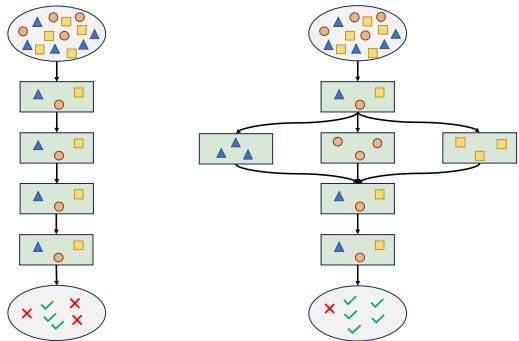
As shown in Figure 1 above, a standard optimizer creates a single sequence of steps (left). AMPO (right) creates a structure that can diverge into different branches based on the input, allowing the model to handle diverse patterns effectively before converging on a solution.
In this post, we will tear down how AMPO works, why “branching” is a game-changer for complex reasoning tasks, and look at the impressive results it achieved against state-of-the-art competitors.
Background: From Manual Tuning to Auto-Optimization
To appreciate AMPO, we first need to understand the current landscape of Automatic Prompt Optimization (APO).
Early on, prompt engineering was manual trial-and-error. Then came methods like OPRO (Optimization by PROmpting) and APO (Automatic Prompt Optimization). These methods generally work by treating the prompt as a variable to be optimized. They take a batch of training data, see where the LLM failed, and ask another LLM to “rewrite the prompt to fix these errors.”
While effective, these methods have a ceiling. When they encounter a failure, they usually try to add more detail to the existing steps. If an LLM fails on a math problem and a history problem using the same prompt, the optimizer tries to mush the fixes into one long, often contradictory, instruction.
This leads to two problems:
- Complexity Bottleneck: A single set of instructions cannot cover all edge cases without becoming confusing.
- Regression: Fixing the prompt for one type of error often breaks it for cases that were previously working.
The AMPO researchers realized that the solution wasn’t just rewriting the text, but changing the structure of the prompt itself.
The Core Method: How AMPO Works
AMPO stands for Automatic Multi-Branched Prompt Optimization. Its goal is to iteratively build a prompt that contains conditional logic (branches) derived from actual failure cases.
The system is designed as a feedback loop involving three specific modules. The entire framework is visualized below:
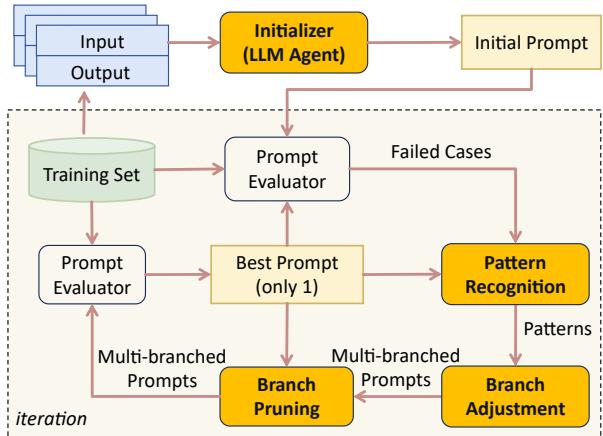
Let’s break down the three distinct modules that make this engine run: Pattern Recognition, Branch Adjustment, and Branch Pruning.
1. Pattern Recognition: Finding the “Why”
In standard optimization, if the model gets 10 questions wrong, the optimizer might try to fix all 10 individually. This is inefficient and leads to bloated prompts.
AMPO takes a smarter approach using two sub-agents:
- The LLM-Analyzer: It looks at a batch of failed cases and performs a root cause analysis for each one.
- The LLM-Summarizer: This is the crucial efficiency step. It takes all the individual reasons from the Analyzer and groups them into Patterns.
For example, in a medical task, the Summarizer might notice that 5 errors were due to “misinterpreting clinical vs. non-clinical context” and 3 were due to “ignoring patient history.” Instead of 8 fixes, AMPO now knows there are just 2 main patterns to address.
2. Branch Adjustment: The Decision Maker
Once the patterns are identified, the system moves to the LLM-Revisor. This agent has a unique choice to make that standard optimizers don’t have. It can:
- Deepen the Prompt: Add more details to an existing step (standard optimization).
- Widen the Prompt: Create a new branch (e.g., “If the input is X, do Y; else do Z”).
This adaptive structure is vital. For simple errors, a rewrite is fine. But for structural misunderstandings, the Revisor inserts conditional logic.
The “Motivating Example” The authors describe a search query task. A user’s intent depends heavily on their history.
- Refinding Query: User types the same thing again -> They want the same page.
- Reformulation Query: User changes a word -> They are filtering or expanding.
A single instruction struggles here. AMPO creates branches: “IF the query matches history, prioritize revisit. IF query is modified, prioritize refinement.”
3. Branch Pruning: Keeping it Lean
There is a risk with this approach: Overfitting. If we create a new branch for every tiny error, we end up with a monstrous prompt that memorizes the training data but fails on new data.
AMPO implements Branch Pruning to solve this.
- Pre-pruning: Stops the optimization if the validation error doesn’t decrease.
- Post-pruning: Explicitly asks the LLM to review the final multi-branched prompt and cut any branches that are too specific or redundant. This ensures the final prompt remains generalizable.
Experiments & Results
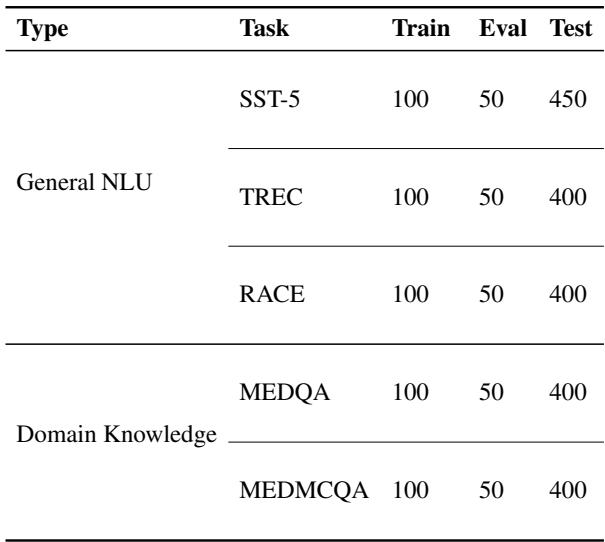
The researchers tested AMPO against a suite of strong baselines, including Chain-of-Thought (CoT), OPRO, APO, and PromptAgent. They used diverse datasets ranging from general Natural Language Understanding (TREC, SST-5) to complex Domain Knowledge tasks (MedQA, MedMCQA).
Performance Gains
The results were consistent and impressive. AMPO achieved the highest accuracy across all five tasks.
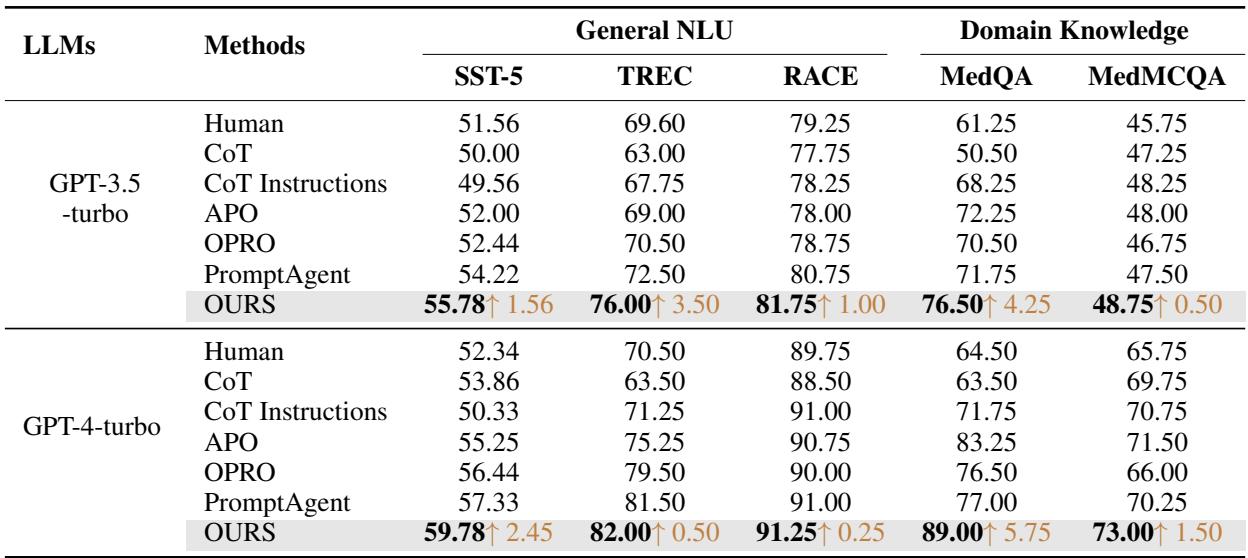
As seen in Table 1, the gains are particularly stark in complex domains.
- MedQA (Medical Question Answering): Using GPT-4-turbo, AMPO achieved 89.00% accuracy, a massive jump compared to the human baseline (64.50%) and significantly higher than the next best automated method, APO (83.25%).
- General Tasks: Even on standard tasks like SST-5 (sentiment analysis), AMPO squeezed out improvements where other methods plateaued.
The authors note that the “multi-branched” nature is the key differentiator. By categorizing problems before solving them, the LLM can apply specific expert knowledge rather than generic reasoning.
Efficiency: Doing More with Less
One of the hidden costs of automated prompt engineering is the token usage. Some methods, like MCTS-based PromptAgent, require generating hundreds of intermediate prompts to find a good one.
AMPO is surprisingly efficient. Because the Summarizer groups errors into patterns, the system doesn’t waste cycles solving the same problem twice.
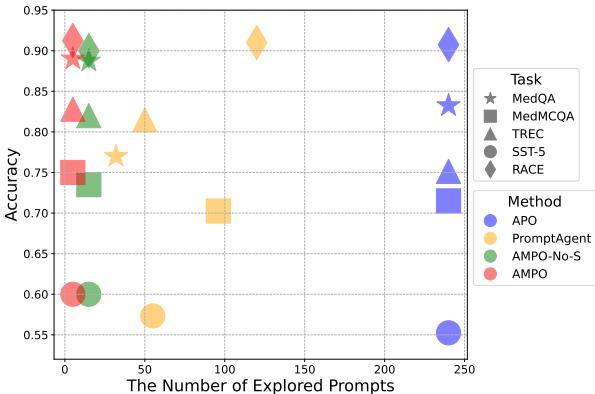
Figure 4 illustrates this efficiency. The horizontal axis represents the number of prompts explored, and the vertical axis is accuracy.
- PromptAgent (Orange line) and APO (Blue line) require significantly more iterations and explorations to reach high accuracy.
- AMPO (Red stars) shoots up to the top left—meaning it finds the best prompt with the fewest attempts.
In the MedQA task, AMPO used roughly 48 times fewer explored prompts than APO to achieve a better result.
Convergence Analysis
How quickly does the method “learn”?
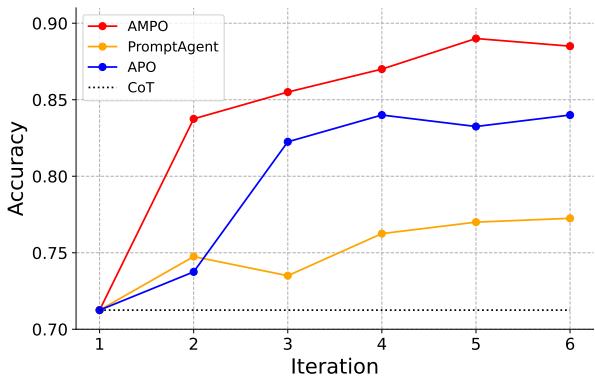
Looking at the convergence graph (Figure 5), we see that AMPO (red line) makes a dramatic leap in performance almost immediately (Iteration 2). This suggests that the initial “branching” action—identifying the major failure patterns and creating logic for them—provides the bulk of the value very quickly. In contrast, other methods grind out slow, incremental gains.
Why Summarization Matters
The authors also performed an ablation study (removing parts of the system to see what breaks). They found that the Summarizer is critical.
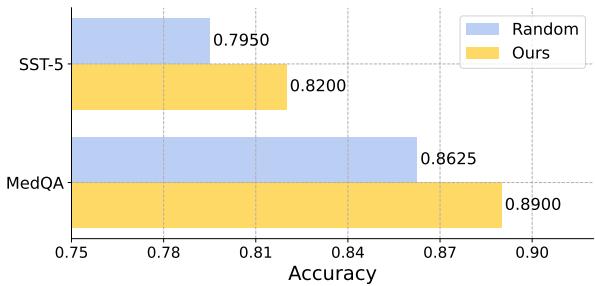 (Note: While the figure caption refers to pattern selection strategy, the logic applies to how summarization enables this efficient selection).
If you look at the ablation data provided in the paper, removing the “Add New Branches” capability caused the biggest drop in performance. This confirms the hypothesis: Structure matters more than wording.
Case Study: Medical Diagnosis
To make this concrete, let’s look at a specific example from the MedQA dataset where other methods failed, but AMPO succeeded.
The Scenario: A 67-year-old man presents with chest pain and specific symptoms of myocardial infarction. The Prompt: Notice the structure of the AMPO-Optimized prompt in the image. It doesn’t just ask for the answer. It creates a logic flow:
- Is this clinical or non-clinical? -> Clinical.
- Is it diagnostic or treatment-oriented? -> Treatment.
- Are there contraindications?
By forcing the LLM to traverse this decision tree, AMPO guides it to the correct conclusion (Hemoptysis as a complication of the treatment) rather than getting distracted by other symptoms. A single linear prompt likely failed here because it couldn’t balance the diagnostic rules with the treatment side-effects simultaneously.
Conclusion and Implications
The AMPO paper marks a significant shift in how we think about prompt engineering. It moves us away from the idea of the “perfect sentence” and toward the idea of the “perfect logic structure.”
Key Takeaways:
- Logic over Wording: Complex tasks require conditional (if-else) logic, not just better adjectives.
- Pattern Recognition is Key: Grouping errors allows for efficient, targeted optimization.
- Scalability: Multi-branched prompts scale better to difficult, domain-specific tasks like medicine.
For students and practitioners, this suggests that when you are struggling with a prompt, you shouldn’t just rephrase it. Ask yourself: Are there two or three different types of inputs here that need completely different instructions? If so, you might need to branch out.
AMPO demonstrates that with the right architecture, LLMs can self-correct not just their content, but the very structure of their reasoning process.