](https://deep-paper.org/en/paper/2410.08972/images/cover.png)
Introduction
In the era of Large Language Models (LLMs), we often marvel at zero-shot capabilities. Yet, for critical applications, supervised fine-tuning remains the gold standard. The challenge, as always, is the data. Collecting high-quality, labeled data is expensive, slow, and labor-intensive. This “annotation bottleneck” is the primary driver behind Active Learning (AL).
The goal of Active Learning is simple: maximize model performance while minimizing the amount of data we need to label. Instead of labeling a random 10% of a massive dataset, an AL algorithm scans the unlabeled pool and tells us, “Label these specific examples; they are the most important.” Typically, these algorithms look for instances where the model is uncertain or confused.
But there is a hidden flaw in this traditional approach. Real-world datasets are messy. They often contain “shortcuts”—spurious correlations between input features and labels. For example, in an occupation classification dataset, a model might incorrectly learn that specific demographics are a “shortcut” for predicting specific jobs. When an Active Learning algorithm interacts with these datasets, it often amplifies the problem, ignoring under-represented groups and reinforcing the model’s reliance on these lazy shortcuts.
In this post, we will explore a research paper that tackles this issue head-on: ALVIN (Active Learning Via INterpolation). The researchers propose a novel method that forces the model to stop taking shortcuts by exploring the “hidden” space between data groups.
The Background: Shortcuts and Subgroups
To understand why ALVIN is necessary, we first need to understand the limitations of current Active Learning methods.
The Shortcut Problem
Deep learning models are notoriously lazy. If they can find a simple pattern (a shortcut) that works for the majority of the training data, they will use it, even if that pattern is logically irrelevant.
Consider a Natural Language Inference (NLI) task where the model must decide if a hypothesis entails a premise.
- Majority Group: In many datasets, if the hypothesis contains the word “not,” the label is often “contradiction.” The model learns: “See ’not’? Predict ‘contradiction’.”
- Minority Group: However, there are valid entailment examples that contain the word “not.” These are the minority group.
Because the majority group is so dominant, the model achieves high accuracy by relying on the shortcut. When tested on out-of-distribution (OOD) data—where the shortcut doesn’t hold—the model fails catastrophically.
Why Traditional Active Learning Fails
Standard AL strategies, like Uncertainty Sampling, select examples that the model finds confusing (high entropy). The problem is that models are often confidently wrong about minority groups because they are over-reliant on shortcuts.
If a model sees a minority example (an entailment with the word “not”), it might confidently (and incorrectly) predict “contradiction” because of the shortcut. Since the model is confident, the Uncertainty Sampling algorithm ignores this example. Consequently, the human annotator never gets asked to label it, the model never learns from it, and the shortcut remains.
The Solution: ALVIN
The researchers introduce ALVIN to break this cycle. The core hypothesis is that to stop shortcut learning, we must force the model to explore the representation space between the well-represented (majority) groups and the under-represented (minority) groups.
ALVIN operates on a clever intuition: it artificially creates “anchors” in the mathematical space between these groups and then hunts for real, unlabeled data points that sit near these anchors.
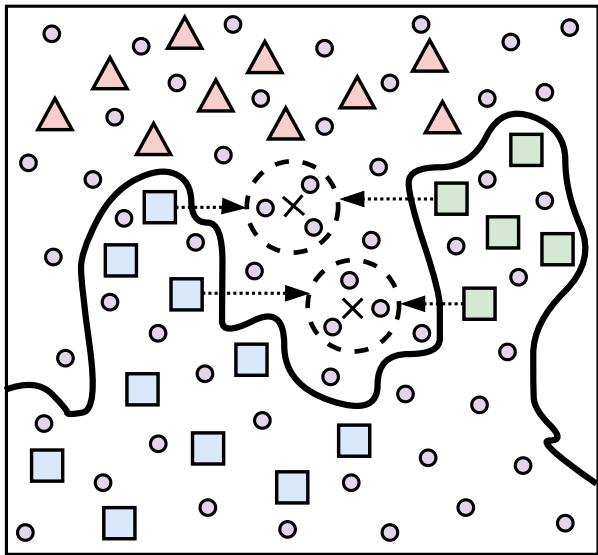
As shown in Figure 1, ALVIN does not just pick points at the existing decision boundary. It creates interpolations (the ‘X’ marks) that bridge the gap between majority and minority examples. It then selects unlabeled instances (circles) that are close to these anchors.
The Algorithm: Step-by-Step
The ALVIN process occurs in rounds. In every round of active learning, the algorithm performs three distinct steps:
1. Identifying Minority and Majority Examples
Before it can interpolate, ALVIN needs to know which labeled examples belong to the “minority” (hard) group and which belong to the “majority” (easy/shortcut) group. It does this without needing explicit group labels (like “gender” or “negation”).
Instead, it uses Training Dynamics. The researchers observe that models learn simple, majority examples very quickly, while minority examples are often learned late or fluctuate between being classified correctly and incorrectly.
- Minority: Examples where the model’s prediction flips (correct \(\to\) incorrect) or where the model is consistently wrong.
- Majority: Everything else (examples the model learns easily and consistently gets right).
2. Creating Anchors via Interpolation
Once the groups are identified, ALVIN generates “anchors.” For a specific class, the algorithm samples a minority example (\(x_i\)) and a majority example (\(x_j\)). It then mixes their internal representations (embeddings) to create a new, artificial point called an anchor (\(a_{i,j}\)).
The mathematical formulation for creating an anchor is:

Here, \(f_{enc}\) is the model’s encoder (like the layers of BERT before the final classifier). The value \(\lambda\) (lambda) controls the mix. If \(\lambda\) is 0.5, the anchor is exactly halfway between the minority and majority example. If \(\lambda\) is close to 1, it’s closer to the minority example. ALVIN samples \(\lambda\) from a Beta distribution, ensuring a diverse set of anchors that cover the path between the two groups.
3. Selecting Unlabeled Instances
The anchors are hypothetical points—they don’t exist in the real dataset. The final step is to find real data that resembles these anchors.
ALVIN uses K-Nearest Neighbors (KNN) to scan the pool of unlabeled data and find the instances whose representations are closest to the generated anchors.
From this subset of “anchor-neighbor” candidates, ALVIN selects the top-\(b\) instances that have the highest uncertainty. This effectively filters for points that are both:
- Structurally significant: They lie in the feature gap between majority and minority groups.
- Informative: The model is not fully confident about them (after the interpolation check).
Experiments and Results
The researchers evaluated ALVIN across six datasets covering sentiment analysis (SA), natural language inference (NLI), and paraphrase detection. They compared ALVIN against several state-of-the-art methods:
- Random: Random sampling.
- Uncertainty: Standard entropy-based sampling.
- BADGE: A gradient-based clustering method.
- CAL: Contrastive Active Learning.
- ALFA-Mix: A previous interpolation-based method.
Main Performance
The results were compelling. The table below details the In-Distribution (ID) and Out-Of-Distribution (OOD) accuracy.
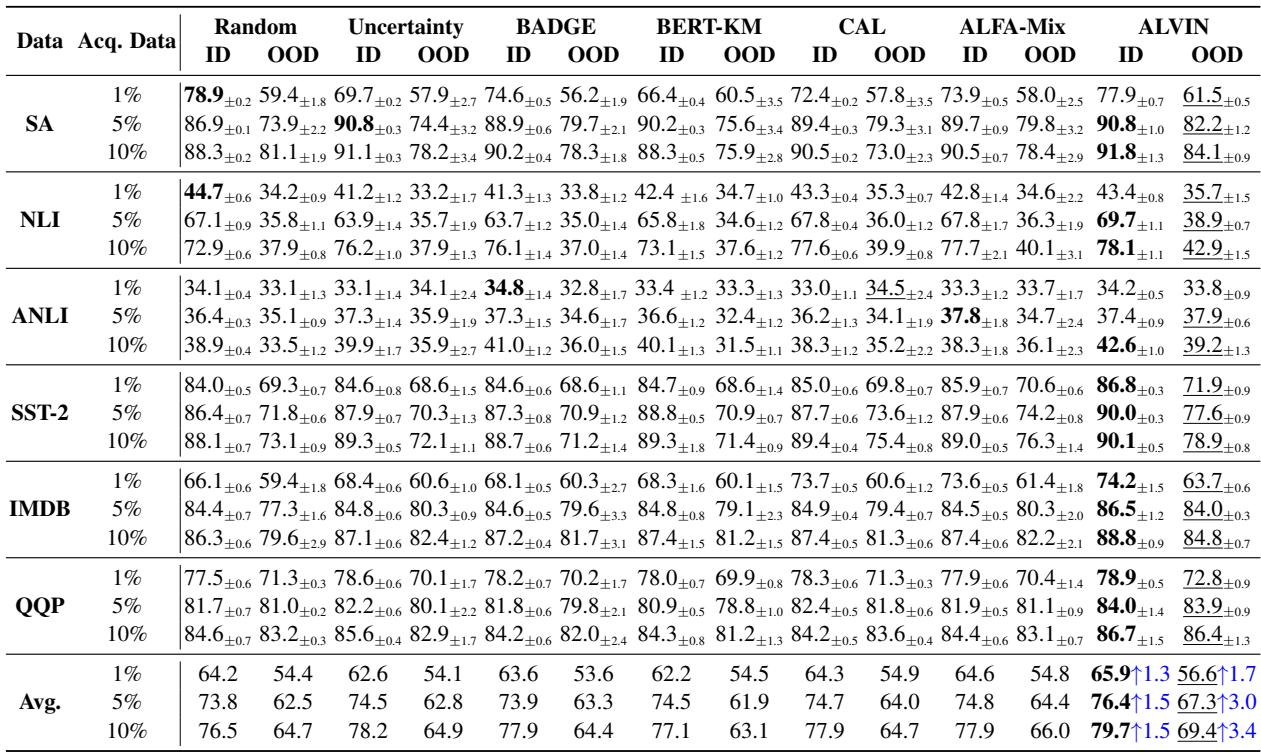
Key Takeaways from the Data:
- OOD Dominance: Look at the “OOD” columns. ALVIN consistently outperforms the baselines. This confirms that the method is successfully preventing the model from learning shortcuts that fail when the data distribution shifts (e.g., applying an IMDB movie review model to Yelp reviews).
- ID Competitiveness: Even on In-Distribution data (where shortcuts often help maximize scores artificially), ALVIN remains highly competitive or superior.
- Budget Efficiency: These improvements hold true whether the model is trained on 1%, 5%, or 10% of the data.
Stress Testing Robustness
To further verify if ALVIN actually reduces reliance on shortcuts, the researchers subjected the models to the NLI Stress Test. This test specifically targets known weaknesses in language models, such as negation or word overlap.
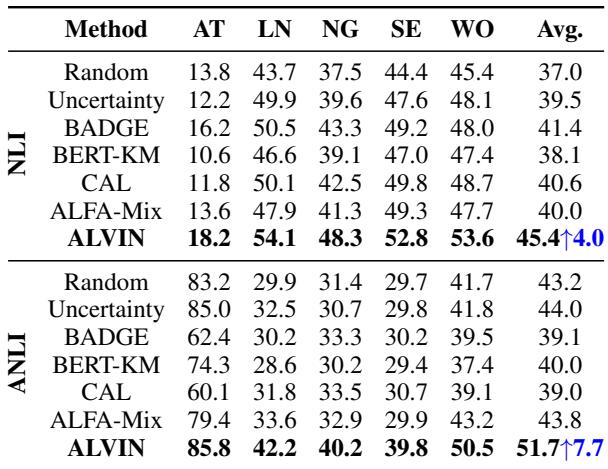
The results in Table 2 are striking. In the “Avg” (Average) column, ALVIN demonstrates a massive improvement—4.0 points higher on NLI and 7.7 points higher on ANLI compared to the next best method. This provides strong empirical evidence that ALVIN-trained models are learning “real” linguistic reasoning rather than brittle heuristics.
Analysis: Why does it work?
The researchers went beyond raw accuracy numbers to analyze what ALVIN is actually selecting.
Quality of Selected Instances
Does ALVIN pick weird outliers? Or useful, diverse data? The analysis compared the selected data points based on Uncertainty, Diversity, and Representativeness.
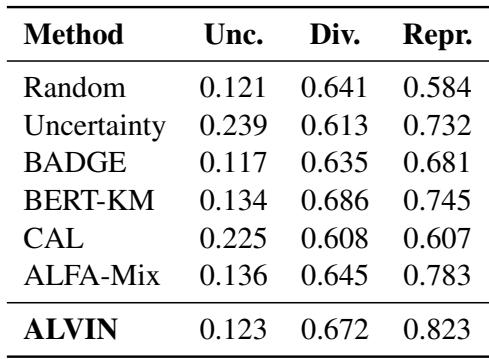
Table 3 reveals the character of ALVIN’s selection strategy:
- Representativeness (0.823): This is the highest score among all methods. It means ALVIN avoids outliers. The “anchors” successfully guide the selection toward dense regions of the data that actually matter, rather than sparse, noisy edges.
- Diversity (0.672): ALVIN selects a highly diverse set of examples, preventing redundancy in the training batch.
- Uncertainty (0.123): Interestingly, the raw uncertainty of the selected batch is lower than pure Uncertainty Sampling. This confirms that ALVIN finds examples the model thought it knew (low uncertainty) but which are crucial for bridging the gap between subgroups.
Hyperparameter Sensitivity
How much does the “shape” of the interpolation matter? The parameter \(\alpha\) (alpha) in the Beta distribution controls where the anchors are placed.
- \(\alpha = 0.5\) (U-shaped): Anchors cluster near the endpoints (very close to minority or majority).
- \(\alpha = 2.0\) (Bell-shaped): Anchors cluster in the middle.
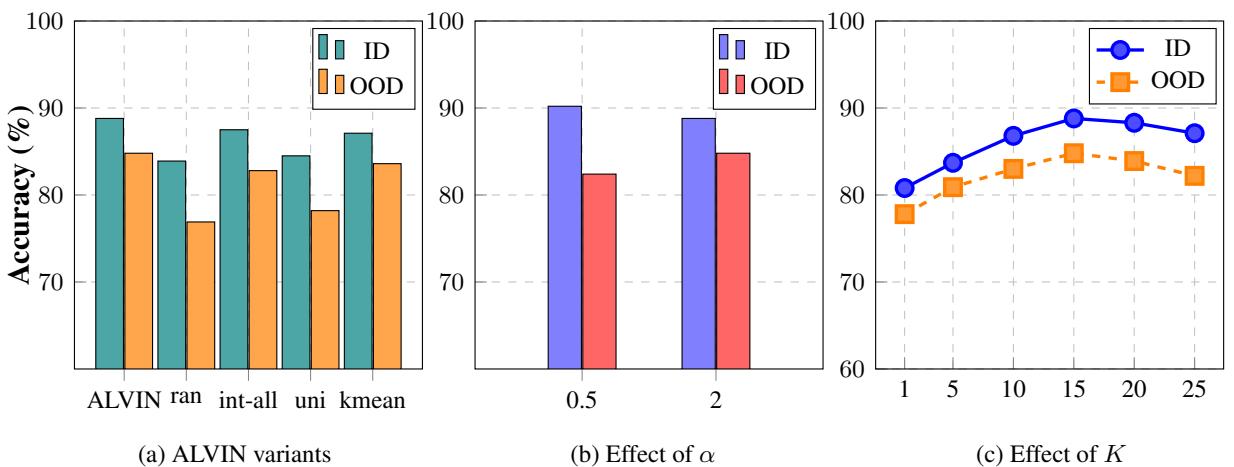
Figure 2 (b) shows that a bell-shaped distribution (\(\alpha = 2\)) generally performs better for Out-Of-Distribution (OOD) tasks. This makes sense: by placing anchors in the middle of the interpolation path, the algorithm forces the model to explore the “gray area” between groups, rather than just reinforcing the boundaries.
Figure 2 (c) illustrates the impact of \(K\) (the number of anchors generated per pair). Performance improves as we generate more anchors, saturating around \(K=15\). This suggests that a thorough exploration of the space is beneficial, but diminishing returns eventually set in.
Computational Efficiency
One valid concern with advanced Active Learning methods is speed. Complex clustering or gradient calculations can be slow.

As shown in Table 6, ALVIN is surprisingly efficient. It is orders of magnitude faster than BADGE (which requires heavy clustering of gradients). While not quite as instant as simple Uncertainty sampling, the computational cost is negligible compared to the gains in model robustness.
Conclusion
Active Learning has traditionally focused on “what confuses the model.” ALVIN shifts this paradigm to “what lies between what the model knows.”
By acknowledging that classes are not monoliths—they contain majority groups full of shortcuts and minority groups that require genuine understanding—ALVIN forces the model to mature. It uses mathematical interpolation to illuminate the hidden regions of the feature space, selecting training examples that act as bridges between concepts.
The implications for students and practitioners are clear:
- Beware of Shortcuts: High accuracy on a test set doesn’t mean your model understands the task; it might just be exploiting demographic or lexical biases.
- Geometry Matters: Thinking about data as points in a geometric space (and interpolating between them) is a powerful way to debug and improve models.
- Efficiency: You don’t always need complex gradients or heavy compute to improve selection; sometimes, smart geometric heuristics (like ALVIN’s anchors) offer the best trade-off.
ALVIN demonstrates that by simply changing which data we label, we can drastically improve a model’s ability to generalize to new, unseen worlds.