](https://deep-paper.org/en/paper/2410.09123/images/cover.png)
Knowledge Graphs (KGs) are the silent engines behind many of the AI applications we use daily. From search engines to recommendation systems, KGs structure real-world facts into triplets: (Head Entity, Relation, Tail Entity). For example, (Leonardo da Vinci, painted, Mona Lisa).
However, KGs suffer from a chronic problem: incompleteness. While common relations like “born in” have millions of examples, many specific or newly emerging relations—such as a specific biological interaction or a new corporate acquisition type—have very few recorded instances. This is where Few-Shot Relation Learning (FSRL) comes into play. FSRL aims to predict new facts for a relation given only a handful of examples (the “shots”).
For years, the dominant approach to FSRL has been meta-learning. Models like MAML (Model-Agnostic Meta-Learning) try to learn a “global prior”—a general understanding of how relations work—that can be quickly adapted to a new task.
But there is a hidden flaw in this standard approach. Traditional meta-learning assumes that the tasks used for training and the new tasks encountered in testing are Independently and Identically Distributed (i.i.d.). In plain English, it assumes all relations behave somewhat similarly.
In this post, we will dive into a research paper that challenges this assumption. We will explore RelAdapter, a novel framework that acknowledges that not all relations are created equal. By using a context-aware adapter, RelAdapter customizes the learning process for each specific relation, achieving state-of-the-art results without the heavy computational cost of training massive models.
The Problem: The “One Size Fits All” Trap
To understand why RelAdapter is necessary, we first need to look at the limitation of prior work. Most FSRL methods treat the transition from meta-training (learning from base relations) to meta-testing (predicting novel relations) as a seamless hop between similar tasks.
The researchers behind RelAdapter tested this hypothesis empirically. They analyzed the embeddings of different relations across standard datasets (WIKI, FB15K-237, and UMLS) and calculated the cosine similarity between pairs of relations.
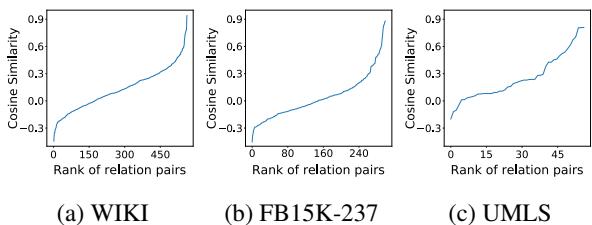
As shown in Figure 1, there is a massive variance in similarity. Some relations are very similar, while others are drastically different (distribution shift).
- If you look at the WIKI chart (a), you see similarities ranging from negative values up to high positives.
- This creates a problem: A global prior learned during training might be perfect for relations that are similar to the training set, but it will likely fail for “out-of-distribution” relations in the testing set.
The researchers identified two specific challenges to solving this:
- Model Level: How do we design a module that can aggressively adapt to a specific relation without forgetting the useful global knowledge?
- Data Level: When we only have 1 or 3 examples (shots), how do we get enough data to make a good decision?
The Solution: RelAdapter
The proposed solution is RelAdapter. It creates a “Context-Aware Adapter” that sits inside the meta-learning framework. Instead of applying the exact same logic to every relation, RelAdapter inserts a small, tunable neural network (the adapter) that adjusts the model’s predictions based on the specific context of the relation at hand.
Here is the high-level architecture of the system:
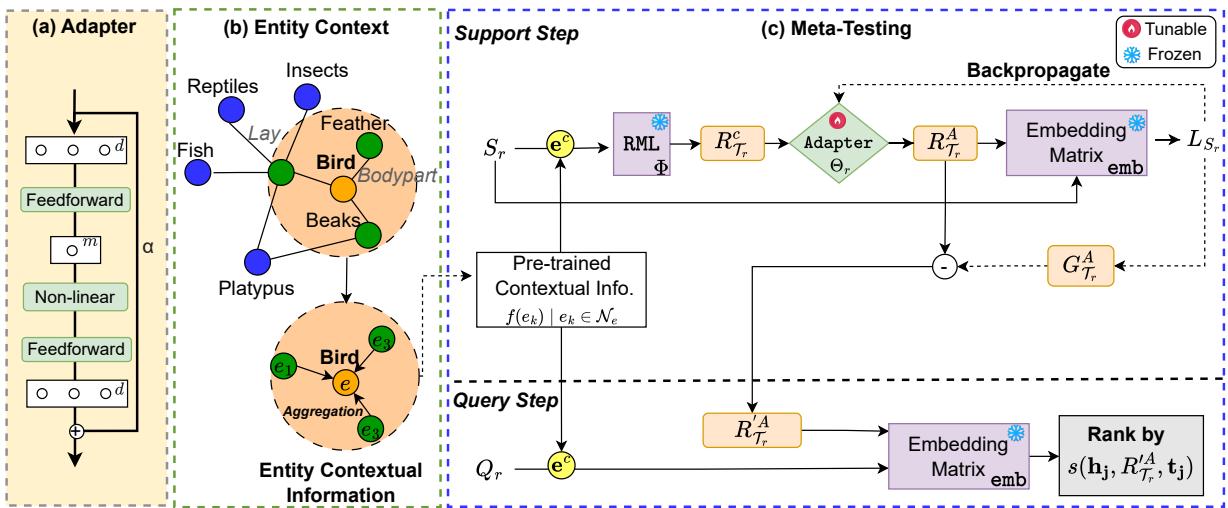
Let’s break down the two main components shown above: the Entity Context (Data Level) and the Adapter (Model Level).
1. The Context: Enriching Data without Labels
In a few-shot scenario, data is scarce. If you are trying to learn a relation based on three examples, you need every bit of information possible.
RelAdapter introduces Context-Awareness. Instead of looking at an entity (like “Bird”) in isolation, the model looks at the entity’s neighbors in the graph (like “Feathers,” “Beaks,” or “Lay”). This is based on the intuition that an entity is defined by its connections.
The model augments the embedding of an entity by aggregating the embeddings of its pre-trained neighbors. The formula for the augmented entity embedding \(\mathbf{e}^c\) combines the original entity embedding with the mean of its neighbors:
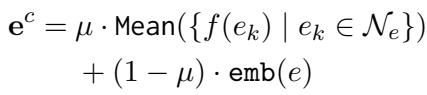
Here, \(\mu\) is a hyperparameter that controls how much weight is given to the context versus the original embedding.
Once the entities are enriched with context, the model generates a Context-Aware Relation Meta (\(R^c\)). In meta-learning, the “relation meta” is essentially a vector prototype that represents the relation. It is calculated by averaging the encoded support set (the few known examples):

By doing this, the input to the model is no longer just a static ID; it is a rich, context-heavy representation of the entities involved.
2. The Adapter: Parameter-Efficient Tuning
This is the core innovation of the paper. In standard meta-learning, the model tries to find a parameter set that is “close” to good solutions for all tasks.
RelAdapter says: “Let’s keep the global knowledge, but add a small, flexible module that we can retrain from scratch for each new relation.”
The Adapter is a lightweight Feed-Forward Network (FFN) with a residual connection. It takes the relation meta (generated from the global prior) and transforms it into a version specifically tuned for the current task.

In this equation:
- \(R_{\mathcal{T}_r}\) is the original relation meta.
- \(\Theta_r\) are the parameters of the adapter, specific to relation \(r\).
- \(\alpha\) is a fusion ratio (a hyperparameter) that decides how much the adapter changes the original representation.
Why is this efficient?
The adapter uses a “bottleneck” architecture. It projects the input down to a smaller dimension and then back up. This means it has very few parameters compared to the full model. During the testing phase (meta-testing), the massive pre-trained embeddings and the global prior are frozen. The model only updates the tiny adapter parameters.
The Meta-Learning Workflow
How do these pieces fit together? The process follows a standard few-shot learning pipeline, split into a Support Step and a Query Step.
The Support Step (Learning)
- The model receives a task with a few examples (Support Set \(S_r\)).
- It calculates the context-aware entity embeddings.
- It generates a relation prototype (\(R^c\)).
- This prototype is passed through the Adapter.
- The adapter parameters \(\Theta_r\) are optimized using the loss from the support set.
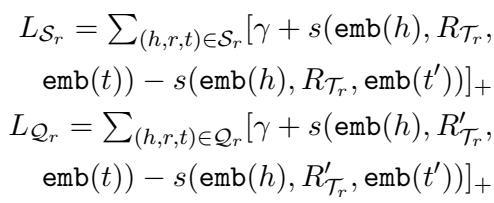
The gradient update for the adapter looks like this:
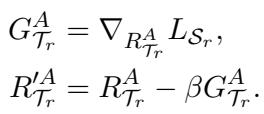
Crucially, in the meta-testing stage, the adapter is randomly initialized for each new relation. This ensures that the adapter isn’t biased by the training relations; it learns specifically for the new relation using the global prior as a solid foundation.
The Query Step (Prediction)
Once the adapter is tuned (which happens very quickly), the model uses the adapted relation meta to score the candidates in the Query Set.
The scoring function measures the distance between the head entity plus the relation vector, and the tail entity. The goal is to minimize this distance for true facts.
Experimental Results
The researchers compared RelAdapter against several baselines, including:
- Supervised Learning: TransE, DistMult, RGCN (Graph Convolutional Networks).
- Few-Shot Relation Learning (FSRL): GMatching, MetaR, GANA, and HiRe.
The experiments were conducted on three benchmark datasets: WIKI (Wikipedia), FB15K-237 (Freebase), and UMLS (Medical).
Performance Comparison
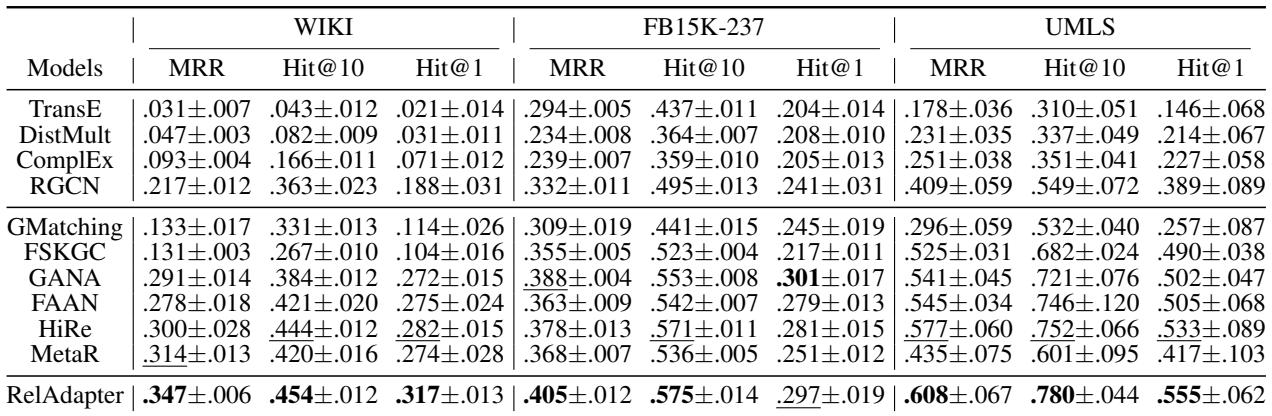
The table below shows the results for 3-shot learning (the model sees only 3 examples). The metrics used are MRR (Mean Reciprocal Rank - higher is better) and Hit@10 (accuracy in the top 10).
Key Takeaways:
- Superiority: RelAdapter (bottom row) achieves the best performance across almost all metrics and datasets.
- Comparison to MetaR: Since RelAdapter is built upon the MetaR framework, the direct comparison is telling. On the WIKI dataset, RelAdapter improves MRR from 0.314 to 0.347. On the difficult UMLS dataset, it jumps from 0.435 to 0.608—a massive improvement.
- Outperforming Complex Models: It even outperforms HiRe, a sophisticated hierarchical model, by nearly 10% in average MRR.
Efficiency
One might worry that adding an adapter makes the model heavy or slow. The experiments prove otherwise. Because the adapter is a bottleneck network, it adds a negligible number of parameters.
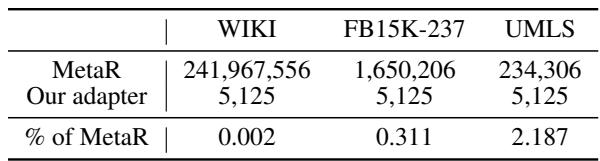
As shown in Table 4, the adapter adds only roughly 5,000 parameters. On the WIKI dataset, which has over 240 million parameters in the full model, the adapter represents just 0.002% of the total size. This confirms that the method is highly parameter-efficient.
Sensitivity Analysis
Finally, the authors analyzed how robust the model is to changes in hyperparameters.
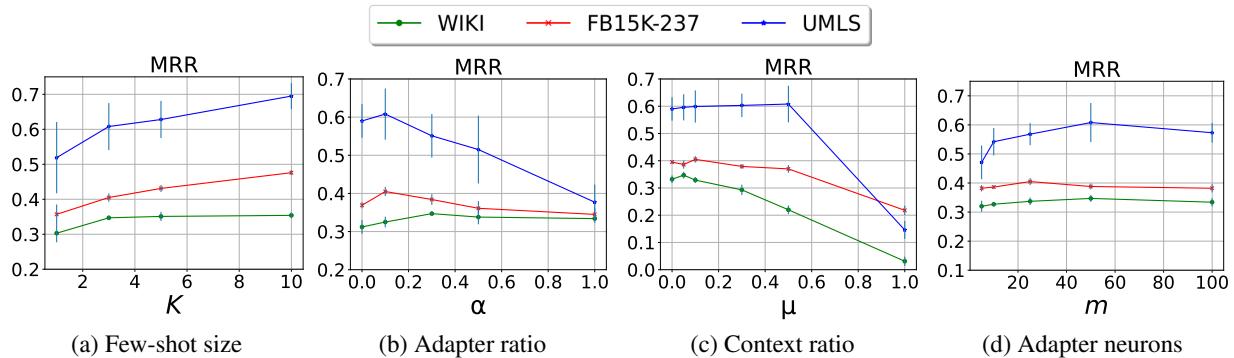
- (a) Few-shot size (\(K\)): As expected, providing more shots (training examples) improves performance, though gains plateau after about 5-6 shots.
- (b) Adapter Ratio (\(\alpha\)): This controls how “strong” the adapter’s influence is. The sweet spot seems to be between 0.1 and 0.3. If \(\alpha\) is too high, the adapter changes the prior too much, potentially overfitting to the few shots available.
- (c) Context Ratio (\(\mu\)): Similar to the adapter ratio, a moderate amount of context (0.1 - 0.3) is beneficial. Too much noise from neighbors can hurt performance.
Conclusion
The RelAdapter paper makes a compelling argument for moving away from the assumption that all relations in a Knowledge Graph behave the same way. By acknowledging the distribution shifts between meta-training and meta-testing tasks, the authors designed a system that is both context-aware and adaptive.
The combination of graph-based contextual enrichment (using neighbors) and a lightweight, tunable adapter allows the model to “custom fit” its predictions for new, unseen relations. Most impressively, it does this with a tiny parameter footprint, making it a practical solution for real-world Knowledge Graph completion where data is sparse and dynamic.
For students and researchers in Graph Learning, RelAdapter demonstrates the power of Parameter-Efficient Fine-Tuning (PEFT) techniques—concepts often borrowed from Large Language Models (LLMs)—applied successfully to structured graph data.