](https://deep-paper.org/en/paper/2410.09554/images/cover.png)
Imagine you are building a search system for an online retailer with millions of products, or a tagging system for Wikipedia articles with hundreds of thousands of categories. This is the realm of Extreme Multi-label Classification (XMC).
In these scenarios, you aren’t just choosing between “Cat” or “Dog.” You are selecting a relevant subset of labels from a massive universe of possibilities. To solve this, Data Scientists often rely on linear models because they are simple and fast. However, they face a massive bottleneck: Space.
Storing a model that can handle millions of labels usually requires terabytes of memory, often forcing engineers to use “pruning” techniques—deleting small weights to save space—which can accidentally hurt the model’s accuracy.
But what if we’ve been looking at the problem wrong? What if the most efficient models naturally prune themselves?
In this post, we will dive into a fascinating research paper, “Exploring Space Efficiency in a Tree-based Linear Model for Extreme Multilabel Classification,” which challenges the common assumption that tree-based models are memory hogs. We will uncover the concept of “Inherent Pruning” and see how utilizing data sparsity can reduce model size by over 90% without lifting a finger.
The Bottleneck of Extreme Classification
To understand the solution, we first need to understand the architectural problem. In linear methods for multi-label classification, there are generally two approaches: One-vs-Rest (OVR) and Tree-based methods.
The One-vs-Rest (OVR) Approach
The simplest way to handle multiple labels is the One-vs-Rest method. If you have \(L\) labels, you train \(L\) independent binary classifiers. For label \(j\), the model learns a weight vector \(w_j\) that decides “Yes/No” for that specific label.
The objective function looks like this:
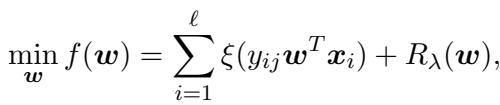
While conceptually simple, OVR hits a wall when \(L\) becomes “extreme.” If you have 1 million labels and 1 million features, and you store them as dense vectors, the memory requirement grows linearly. For a dataset like Wikipedia-500k, a standard linear OVR model might require 5 Terabytes of space. That is simply infeasible for most single machines.
The Tree-based Alternative
To solve the efficiency problem, researchers turned to Label Trees. Instead of checking every single label one by one (which takes forever), we organize labels into a hierarchy.
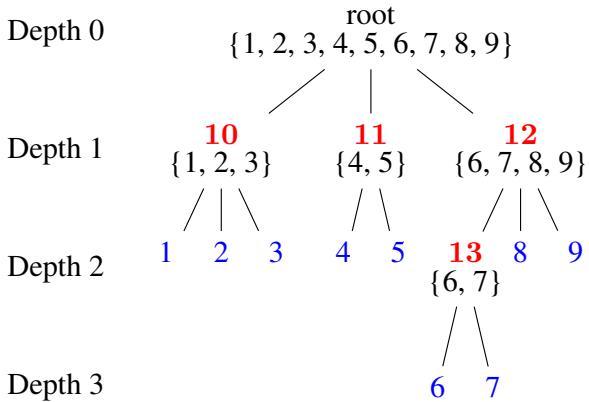
As shown in Figure 1, the system works via “Divide and Conquer”:
- Root: The top node splits the labels into clusters (in this image, 3 clusters).
- Internal Nodes: Each branch further splits into smaller clusters.
- Leaves: The bottom nodes represent the actual single labels.
This structure allows for incredibly fast training and prediction. Instead of \(O(L)\) time, it takes roughly \(O(\log L)\) time.
However, there is a catch. In a tree structure, we aren’t just training classifiers for the leaves; we are training classifiers for every internal node (the “meta-labels”) as well.
Mathematically, the number of classifiers in a tree is actually higher than in OVR:
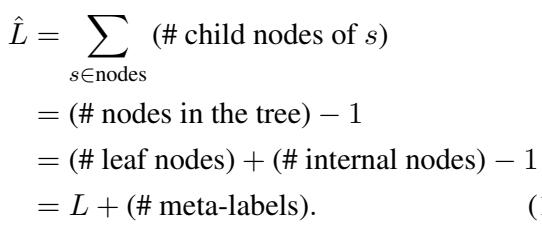
This leads to a pervasive assumption in the field: Tree models must require more storage space than OVR models.
Because of this assumption, almost all previous work applies aggressive weight pruning—forcing small weights to zero to save space. But as the authors found (see Table 3 in the original paper), blindly pruning weights can lead to a drop in precision. The researchers asked a simple question: Is this trade-off actually necessary?
The Core Insight: Data Sparsity
The researchers argue that we are overestimating the size of tree models because we are ignoring the nature of text data.
In XMC, we are usually dealing with text (like product descriptions or wiki articles). These are represented as “Bag-of-Words” vectors. While the vocabulary might have 1 million words, a single document might only contain 100 unique words. The feature vector is sparse—mostly zeros.
How Trees Utilize Sparsity
In an OVR model, every classifier sees every training instance. If a feature appears anywhere in the dataset, it likely gets a non-zero weight in the classifier.
But a Tree model is different. As we move down the tree, we partition the data.
- Root Node: Sees all data.
- Depth 1: Sees only a subset of data relevant to that branch.
- Depth 2: Sees an even smaller subset.
Here is the key realization: As the subset of data gets smaller, the number of active features drops.
Consider the example below. We are at a specific node (Meta-label 12) handling a subset of labels {6, 7, 8, 9}.
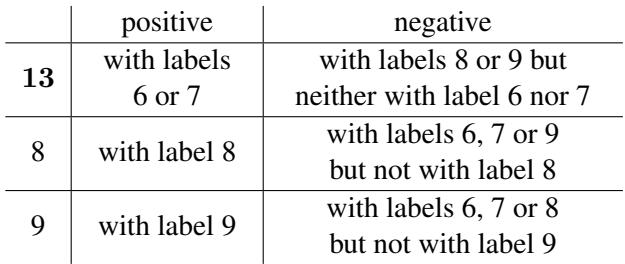
When training the classifier for this node, we only use instances associated with labels 6, 7, 8, or 9. Words that appear only in documents about label 1 or 2 are completely absent here. If a feature is always zero for all instances in a node, the weight for that feature will naturally remain zero (assuming we initialize at zero).
We don’t need to “prune” it manually. It effectively doesn’t exist. This is what the authors call Inherent Pruning.
Theoretical Analysis: The Math of Reduction
The authors provide a rigorous theoretical proof to quantify this space saving. Let’s break it down using a balanced tree model.
Assume we have a tree with depth \(d\) and a branching factor \(K\) (number of clusters per split).
- At Depth 0, we use all \(n\) features.
- At Depth 1, the data is split. We assume the number of active features drops by a ratio \(\alpha\) (where \(\alpha < 1\)).
- At Depth \(i\), the active features are \(\alpha^i n\).
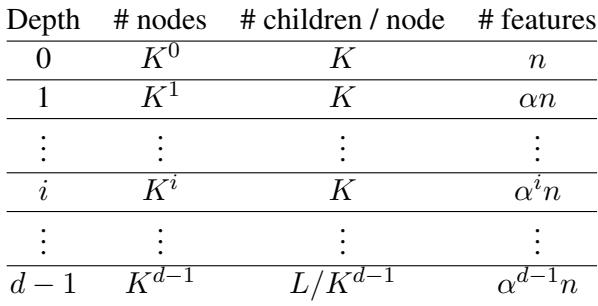
If we sum up the storage requirements for the whole tree, accounting for this decaying feature set, we get a much different picture than the dense assumption.
The researchers compared the number of non-zero weights in a Tree model versus an OVR model. The ratio is derived in the following equation:

This equation might look intimidating, but its behavior is simple. Because \(\alpha\) (the feature reduction rate) is less than 1, the term \(\alpha^{d-1}\) shrinks rapidly as the tree gets deeper.
Visualizing the Theoretical Drop
The authors plotted this ratio for different values of \(\alpha\) (feature retention rate) and tree depth.
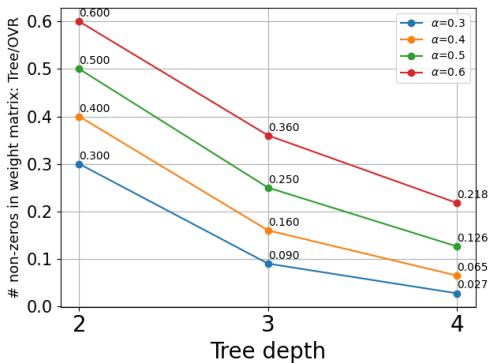
Look at the trend in Figure 3. Even if \(\alpha = 0.6\) (meaning each level retains 60% of the active features of its parent), a tree with depth 4 is only about 20% the size of an OVR model. If \(\alpha = 0.3\), the tree model is a tiny fraction of the size.
This theoretical bound proves that deep trees are naturally space-efficient on sparse data.
Experiments & Results
Theory is good, but does it hold up with real-world data? The researchers tested this hypothesis on several massive datasets, including Amazon product data and Wikipedia articles.
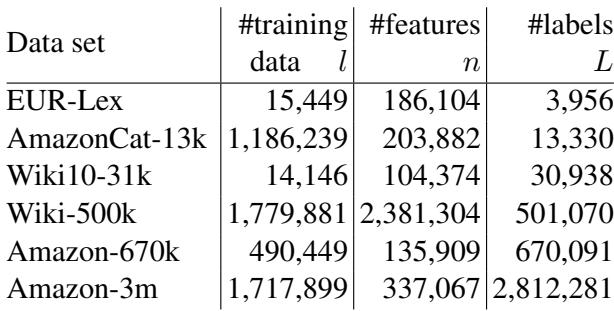
They compared the actual memory usage of Tree models (using K-means clustering for the tree construction) against OVR models. They did not apply any artificial pruning; they simply stored the weights using a sparse matrix format (only saving non-zero values).
The Real-World Size Reduction
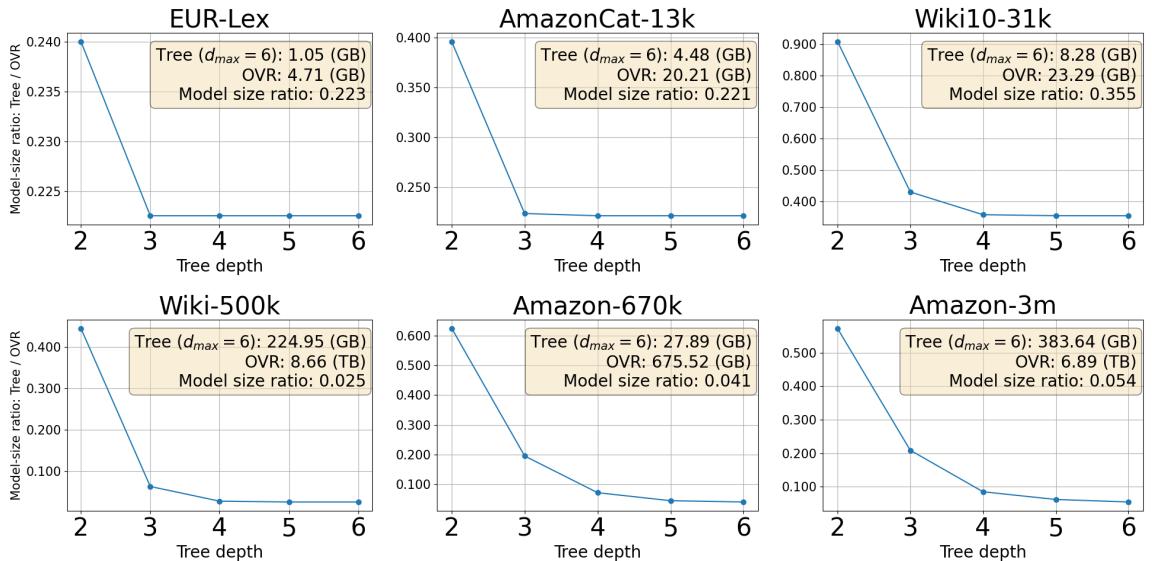
The results were stunning. Below, Figure 4 shows the ratio of Tree Model Size to OVR Model Size across the datasets.
Key Takeaways from the Experiments:
- Massive Reduction: For the larger datasets (Wiki-500k, Amazon-670k, Amazon-3m), the tree models are less than 10% the size of the OVR models.
- Depth Matters: As predicted by the theory, deeper trees (Depth 4, 5, 6) are significantly smaller than shallow trees.
- Feasibility: Look at the beige box for “Amazon-3m” in Figure 4. An OVR model would require huge resources. The Tree model is just 0.03 (3%) of the size. This turns a multi-terabyte problem into a gigabyte problem, solvable on standard hardware.
Validating the Feature Reduction (\(\alpha\))
The entire theory rests on the assumption that \(\alpha\) (the ratio of used features) is small. The authors measured this empirically.
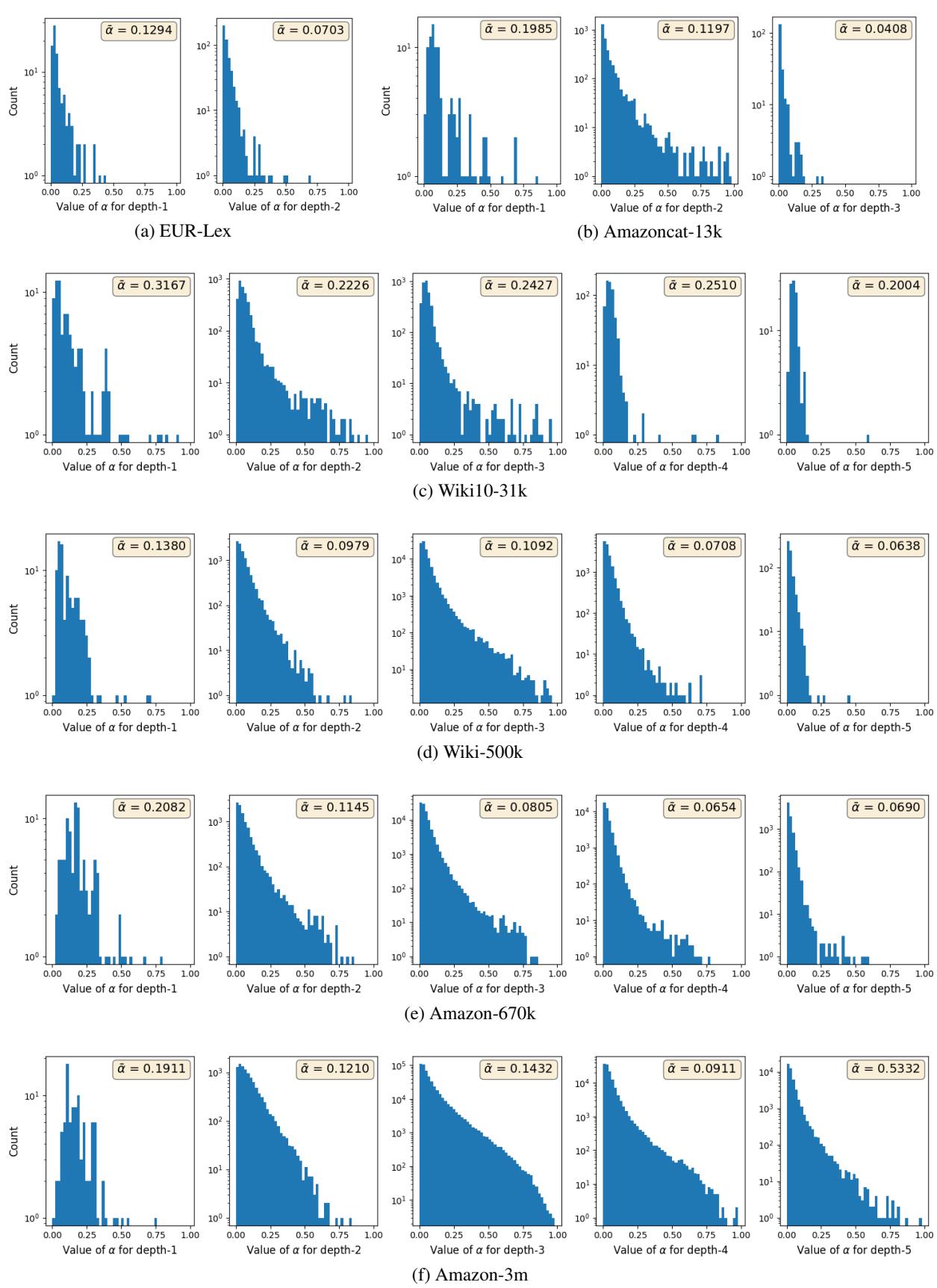
Figure 7 confirms that for most nodes, \(\alpha\) is very low (often below 0.2). This means that when we split labels into clusters, the vocabulary used to describe those specific clusters is very distinct. A cluster of “Electronics” labels won’t use words found in “Gardening” labels. The model naturally ignores the gardening features, saving massive amounts of space.
Implications and Conclusion
This research flips a standard machine learning assumption on its head. For years, practitioners avoided tree-based linear models or aggressively pruned them because they feared the “metadata overhead” of storing classifiers for internal nodes.
The authors of this paper demonstrated that:
- Sparsity is key: In XMC problems involving text, the feature space naturally shrinks as you traverse down the label tree.
- Inherent Pruning: You don’t need complex algorithms to remove weights. The tree structure prevents unnecessary weights from ever being learned.
- Predictability: The authors provide a method to estimate the model size before training (based on the label tree structure).
A Practical Takeaway
If you are working on extreme multi-label classification, do not assume you need a cluster of servers to hold your model. A well-constructed label tree might fit comfortably in the RAM of a single workstation.
Before you apply threshold pruning—which risks degrading your model’s accuracy—calculate the sparse size of your tree. You might find that the “Inherent Pruning” has already done the work for you.