](https://deep-paper.org/en/paper/2410.09949/images/cover.png)
Introduction
In the span of a single decade, the architecture of information consumption has fundamentally changed. We have moved from an era of curated news broadcasts to one of algorithmic “filter bubbles,” where social media feeds reinforce our existing beliefs and insulate us from opposing viewpoints. This environment has proven to be a fertile breeding ground for misinformation—sensational, often false stories that spread faster and farther than the truth.
The consequences are not merely academic; they threaten democratic processes, public health, and economic stability. Traditionally, platforms have tried to combat this using what researchers call a “knowledge deficit” model. The assumption is simple: if you give people the facts, they will correct their views. Platforms apply “False” tags or link to Snopes articles, hoping that critical thinking will kick in.
But there is a problem. Humans are not purely rational agents processing data neutrally. We are driven by confirmation bias, evaluating counter-partisan news critically while accepting pro-partisan news at face value. Furthermore, professional fact-checking is slow and expensive, unable to keep pace with the torrent of content generated daily.
This brings us to a pivotal research paper: “MisinfoEval: Generative AI in the Era of ‘Alternative Facts’”. The researchers—spanning UCLA, MIT, and Dartmouth—propose a novel framework that leverages the very technology often blamed for generating spam: Large Language Models (LLMs). Their work investigates whether Generative AI (specifically GPT-4) can be used to generate scalable, personalized interventions that not only fact-check news but explain why it is false in a way that aligns with a user’s specific background and values.
The Scalability and Bias Problem
Before diving into the solution, we must understand the limitations of current fact-checking.
- Scalability: Human fact-checking is a bottleneck. By the time a professional organization verifies a claim, it may have already gone viral.
- User Bias: A simple “False” label often triggers a defensive reaction. If a user distrusts the “mainstream media,” a label from a mainstream source might ironically reinforce their belief in the conspiracy.
- The “Community Notes” Approach: Platforms like X (formerly Twitter) have tried crowdsourced fact-checking. While scalable, this system is vulnerable to being hijacked by partisan mobs or disinformation agents.
The authors of MisinfoEval argue that LLMs offer a way out. They process information instantly and, as this study reveals, possess a surprising capacity for cognitive modeling—understanding how to frame an argument to be persuasive to specific audiences.
The MisinfoEval Framework
The researchers developed a comprehensive testing ground called MisinfoEval. Rather than just analyzing text offline, they created a simulated social media environment that mimics the look and feel of platforms like Facebook or X.
They recruited over 4,000 participants to interact with this feed. The feed contained a mix of true news and false claims (headlines known to be misinformation). Users could interact with posts by liking, sharing, or flagging them. Crucially, they could also click a “Find out more” button, which triggered an intervention.
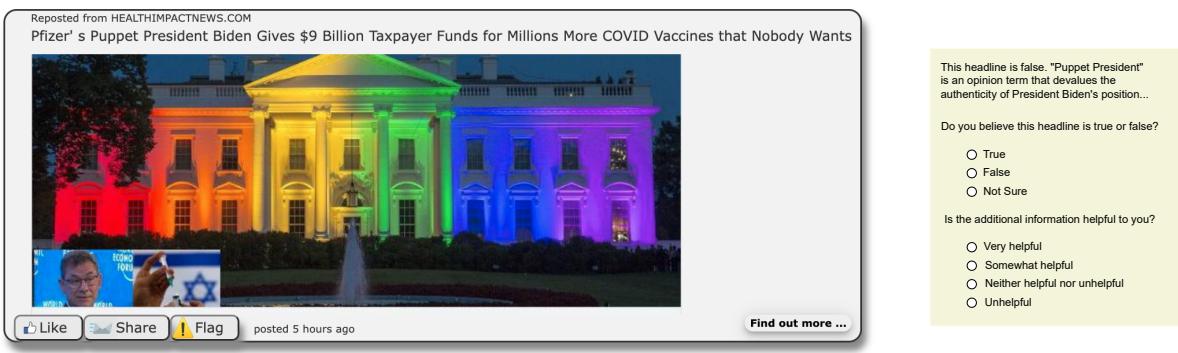
As shown in Figure 1, the interface is familiar. The intervention on the right is where the experiment takes place. It provides a verdict (True/False) and, depending on the experimental group, an explanation.
Phase I: Testing Intervention Types
The first phase of the study was an A/B test comparing five different ways of correcting misinformation. The goal was to see if AI-generated explanations were any better than standard labels or human-written explanations.
The five methods tested were:
- Label Only: A simple “This claim is false.”
- Methodology (AI): A generic explanation stating an AI model checked the claim.
- Methodology (Human): A generic explanation stating professional fact-checkers checked the claim.
- Reaction Frame: A template based on psychological framing, explaining why the headline is manipulative (e.g., “This headline is trying to make you feel angry…”).
- Zero-shot GPT-4 Explanation: A custom explanation generated by GPT-4 specifically for that news item, without any knowledge of the user.
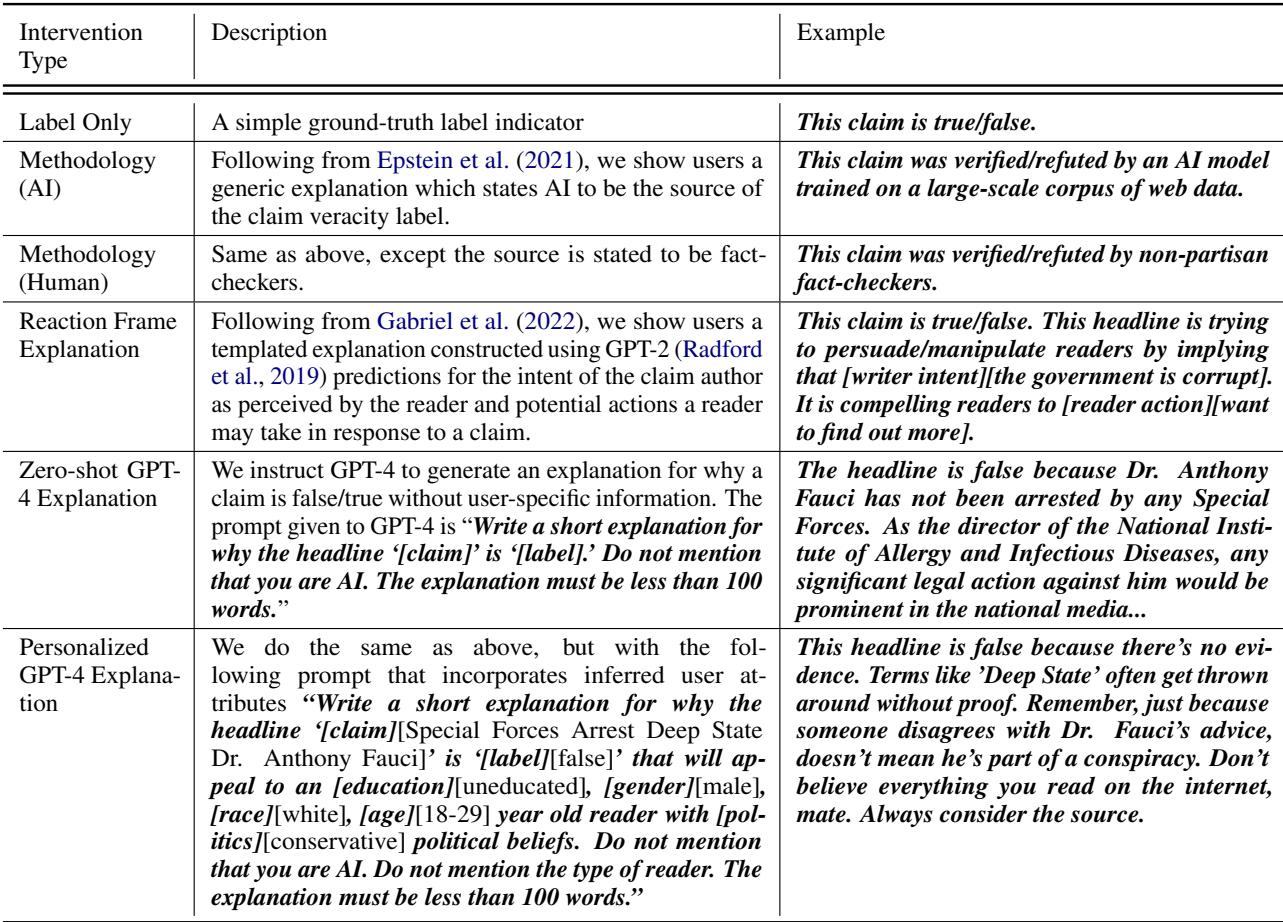
Table 1 details these methods. The “Reaction Frame” and “GPT-4 Explanation” represent a shift from simply labeling what is wrong to explaining why it is wrong.
Phase II: The Personalization Experiment
The second, and perhaps more groundbreaking, phase of the study introduced Personalized GPT-4 Explanations.
The hypothesis was rooted in the “filter bubble” concept. If algorithms usually feed us content that confirms our biases, can an algorithm use those same demographic insights to debunk misinformation?
The researchers gathered demographic data on users (age, gender, political affiliation, education level). They then prompted GPT-4 to generate explanations tailored to those attributes.
For example, a prompt might look like this:
“Write a short explanation for why the headline… is false that will appeal to an uneducated, male, white, 18-29 year old reader with conservative political beliefs.”
The resulting text would adjust its tone, vocabulary, and framing to resonate with that specific persona, theoretically lowering the user’s defensive barriers.
Experimental Results: Does AI Work?
The results from Phase I were highly encouraging for the use of LLMs in content moderation. The researchers measured “Accuracy” (the user’s ability to correctly identify true vs. false news after the intervention) and “Engagement” (sharing or flagging behavior).
Accuracy and Interaction
The baseline was concerning: without any intervention, users struggled significantly to distinguish fact from fiction.
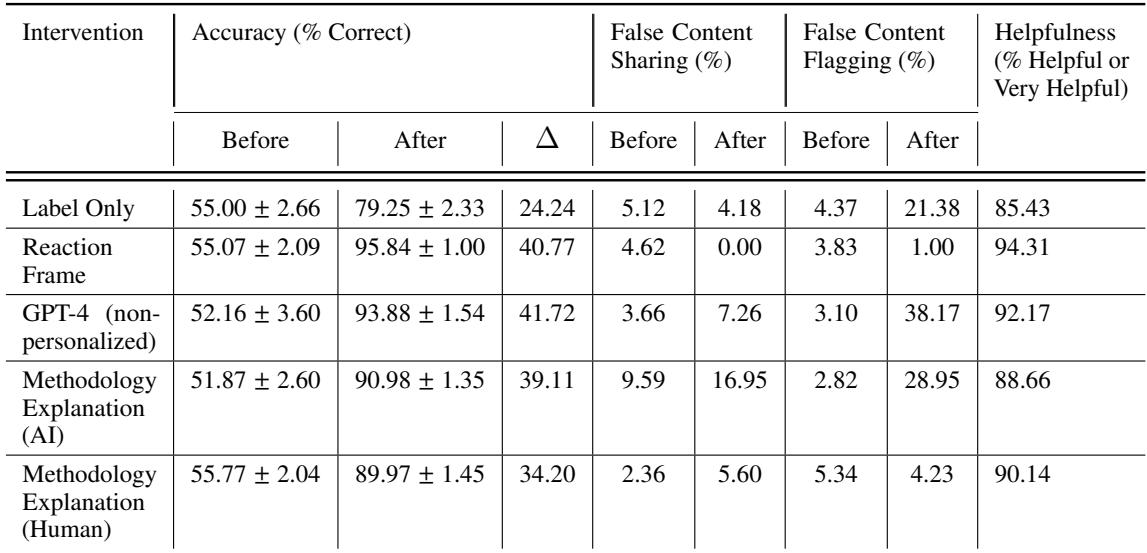
Table 2 presents the key findings:
- Massive Accuracy Gains: All interventions worked to some degree, but explanation-based interventions outperformed simple labels. The “Label Only” approach raised accuracy to roughly 79%. However, the GPT-4 (non-personalized) and Reaction Frame methods pushed accuracy up to 93.88% and 95.84% respectively.
- Improvement Delta: The improvement (\(\Delta\)) for GPT-4 was a massive 41.72%.
- Flagging Behavior: Interestingly, GPT-4 explanations were the most effective at encouraging users to flag false content (38.17% post-intervention), suggesting that users felt confident enough in the explanation to take action against the misinformation.
There was, however, a curious anomaly. As seen in the “False Content Sharing” column, some interventions actually increased the sharing of false content slightly. The authors hypothesize that users might be sharing the content to “fact-check” it with their own social circles, or perhaps the engagement with the pop-up made the content more memorable. This highlights that “sharing” is a complex metric that doesn’t always equal “belief.”
The Impact of Personalization
In Phase II, the researchers analyzed whether tailoring the explanation to the user made a difference. They calculated an “Alignment Score” (\(0\) to \(1\)), representing how many of the user’s attributes (e.g., “Liberal,” “Female,” “Ph.D.”) were used to generate the explanation they saw.
The results confirmed that alignment matters.
Looking at the bar chart on the left of Figure 2, users rated explanations as more “Helpful” when they were highly aligned with their demographics (Score > 0.4 or 0.6).
More importantly, this perception of helpfulness translated into actual discernment.
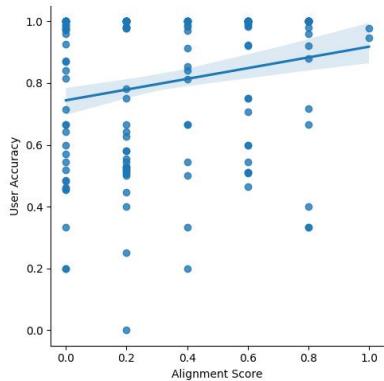
The linear regression model above illustrates a clear positive correlation. As the Alignment Score increases (moving right on the X-axis), User Accuracy increases (moving up on the Y-axis).
Users shown personalized explanations had an average accuracy of 85.89%, compared to 76.65% for those shown non-personalized explanations in this specific sub-experiment. This suggests that when an explanation “speaks your language,” you are more likely to internalize the fact-check.
The Black Box: How Does the AI Do It?
While the results are promising, the researchers conducted a “safety check” to understand how the AI was achieving these results. This is critical because trusting an AI to moderate truth requires understanding its reasoning process.
The Factuality Bottleneck
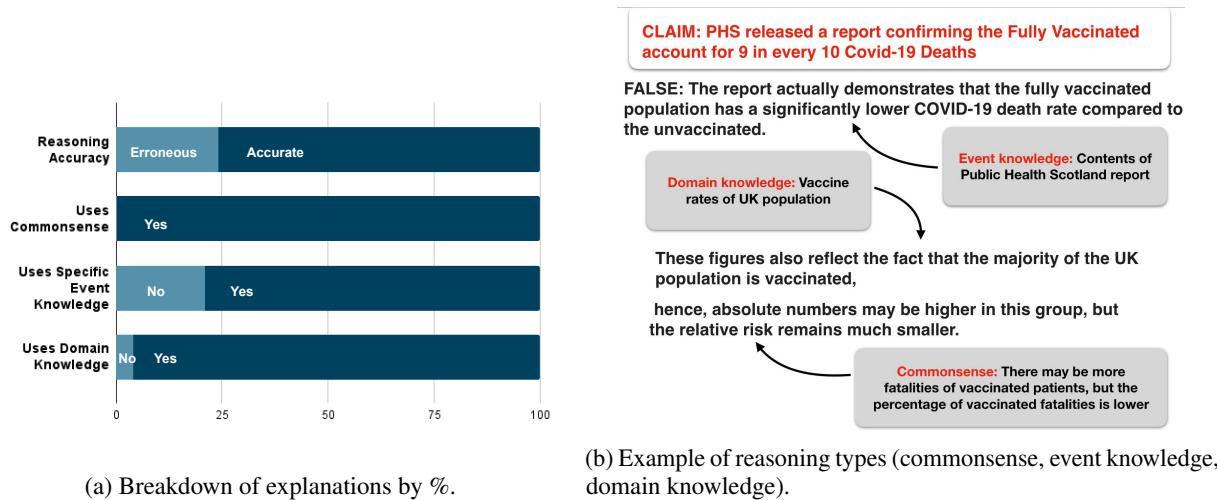
The study identified a risk they call the “Factuality Bottleneck.” In an oracle setting (where the AI is told the ground truth), it performs well. However, when analyzing the generated explanations, the researchers found that 24.13% of the explanations contained erroneous reasoning, even if the final verdict was correct.
The AI relies heavily on “Event Knowledge” (specific news events it memorized during training) rather than just common sense. If the AI’s training data is outdated or contains hallucinations, it could confidently generate a persuasive but factually incorrect explanation. This suggests that for real-world deployment, such systems would need to be augmented with Retrieval-Augmented Generation (RAG) to access real-time, verified data.
Linguistic Stereotyping
The second risk involves the ethics of personalization. If we ask an AI to write for an “uneducated” audience, how does it change its language? Does it become condescending?
The researchers analyzed the linguistic properties of the generated text across different demographic targets.
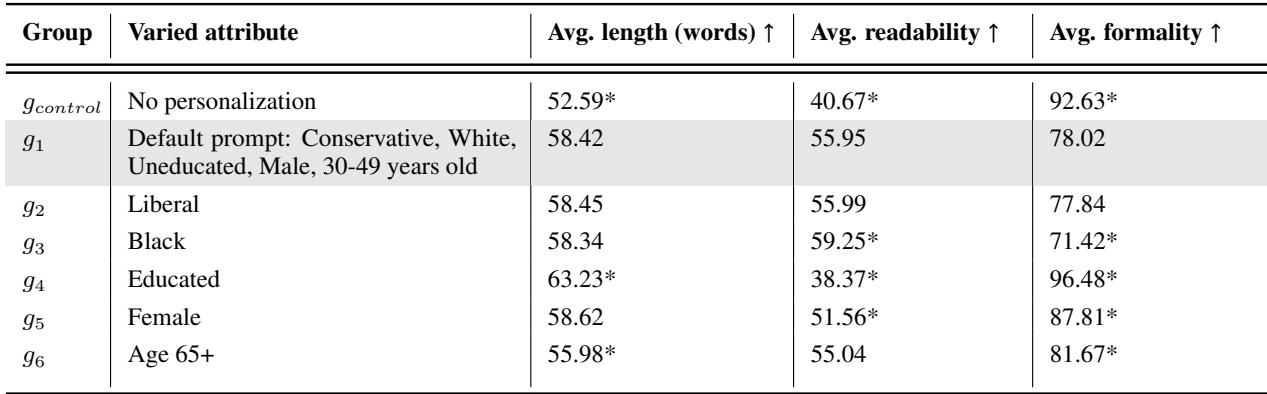
Table 3 reveals significant linguistic shifts:
- Education: When the target audience was specified as “Educated” (\(g_4\)), the AI significantly increased the complexity (lower readability score) and formality of the text. Conversely, for “Uneducated” groups, it simplified the text.
- Race: When the target was specified as “Black” (\(g_3\)), the AI produced the lowest formality scores.
While tailoring reading levels can increase accessibility, the drop in formality based on race indicates that the model holds latent stereotypical associations. This “mimetic” behavior is a double-edged sword: it makes the tool persuasive, but it also risks reinforcing stereotypes or pandering rather than informing.
Conclusion and Future Implications
The MisinfoEval paper provides a compelling argument that we are moving beyond the era of simple “True/False” tags. The sheer scale of misinformation requires an automated solution, and Generative AI has the persuasive capability to meet that challenge.
The key takeaways are:
- Explanation Beats Labeling: Telling users why something is false is significantly more effective than just telling them it is false.
- AI is Highly Effective: GPT-4 generated explanations improved user discernment accuracy by over 40% in some cases.
- Personalization Works: Tailoring the explanation to the user’s political and demographic background breaks down resistance to fact-checking.
However, the authors end with a note of caution. The same tools that can personalize a fact-check to make it more persuasive can also be used by bad actors to personalize disinformation to make it more viral. Furthermore, the reliance on the model’s internal knowledge base (which can hallucinate) and its potential for stereotyping means that human oversight and architectural safeguards (like RAG) remain essential.
As we head into future election cycles and global crises, frameworks like MisinfoEval will be crucial in defining how we build the immune system of the internet. The technology to cure the “infodemic” exists, but deploying it responsibly is the next great challenge.