](https://deep-paper.org/en/paper/2410.10604/images/cover.png)
In the rapidly evolving world of medical artificial intelligence, the scarcity of labeled data is a persistent bottleneck. While deep learning models thrive on massive datasets, obtaining pixel-perfect annotations for medical scans—like outlining a brain tumor slice by slice—requires highly trained radiologists and hours of manual labor.
To solve this, researchers have turned to Self-Supervised Learning (SSL). The idea is simple but powerful: let the AI teach itself the structure of the anatomy using unlabeled data before it ever sees a human-made label.
However, existing SSL methods often hit a wall when dealing with the complex reality of medical imaging. Most approaches treat images as single, isolated inputs (uni-modal), or they demand a strict, complete set of scans for every patient. This ignores a fundamental truth of clinical practice: patients often undergo Multi-Parametric MRI (mpMRI) exams, resulting in grouped scans (modalities) that show the same anatomy through different “lenses.” Furthermore, in the real world, data is often messy and incomplete—some patients might miss a specific scan type.
In this post, we are diving deep into BrainMVP, a novel framework presented in the paper “Multi-modal Vision Pre-training for Medical Image Analysis.” This research introduces a way to leverage the rich correlations between different MRI modalities, handle missing data gracefully, and achieve state-of-the-art performance on downstream tasks like tumor segmentation and disease classification.
The Problem: The Uni-Modal Trap
To understand why BrainMVP is necessary, we first need to look at how medical imaging works. When a patient gets a brain MRI, they don’t just get one picture. They usually get a “study” consisting of multiple modalities, such as:
- T1-weighted: Good for structural detail.
- T2-weighted: Good for detecting edema (swelling).
- FLAIR: Suppresses fluids to highlight lesions.
- T1CE: Uses a contrast agent to see blood flow in tumors.
Most current SSL methods (like MAE or SimMIM) are borrowed from natural computer vision. They treat a T1 scan and a T2 scan as totally unrelated images. They ignore the fact that these scans depict the exact same brain, at the exact same moment, just with different physical contrasts.
By failing to model the relationship between these modalities, standard models miss out on crucial anatomical cues. Furthermore, if a model expects a fixed set of four inputs (T1, T2, FLAIR, T1CE) and a patient is missing one, the model often fails.
BrainMVP addresses this by treating multi-modal data as a naturally grouped set of views, as illustrated below.
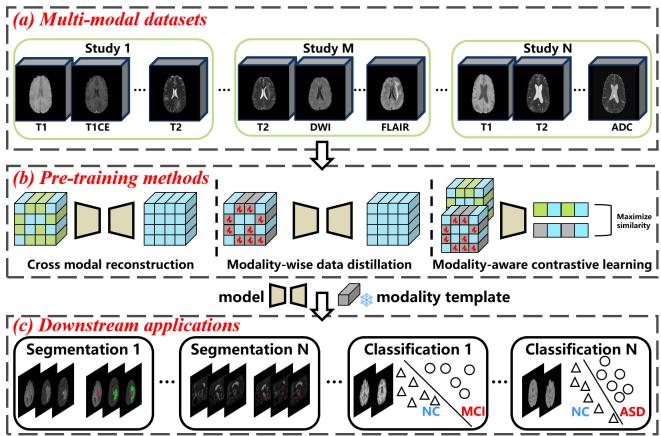
The researchers propose a method that doesn’t just look at images in isolation but actively learns the correlations between them. Let’s explore how they achieved this.
The BrainMVP Architecture
The core philosophy of BrainMVP is to build a “foundation model” for brain MRI that is robust to missing modalities and highly generalizable. The authors collected a massive pre-training dataset of 16,022 scans from 3,755 patients, covering over 2.4 million 2D slices.
The framework is built on three novel “proxy tasks”—challenges the AI must solve during training to learn useful features.
- Cross-Modal Reconstruction (CMR)
- Modality-Wise Data Distillation (MD)
- Modality-Aware Contrastive Learning (CL)
Let’s break down the architecture visually before diving into the mechanics of each task.
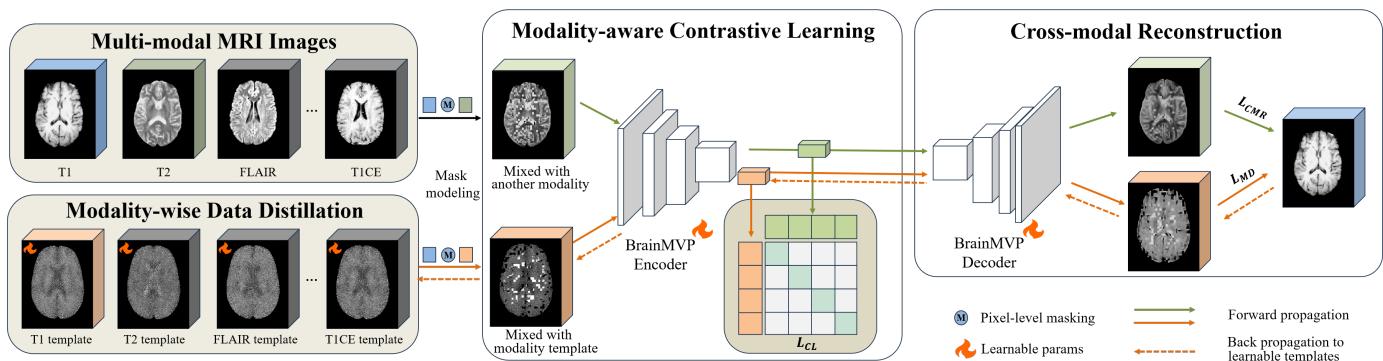
1. Cross-Modal Reconstruction (CMR)
The first pillar of BrainMVP is Cross-Modal Reconstruction. Traditional Masked Image Modeling (MIM) works by hiding parts of an image (masking) and asking the AI to guess what’s missing based on the visible pixels.
BrainMVP adds a twist. Since we have multiple modalities for the same patient (e.g., a T1 and a T2 scan), we can mask a region in the input image (say, T1) and fill that hole with the corresponding patch from a different modality (say, T2).
Why does this work? T1 and T2 scans share the same anatomy (shape of the ventricles, position of the tumor) but look different texturally. By forcing the model to reconstruct the original T1 pixels using information from the T2 patch, the model must learn disentanglement. It has to understand: “I see the shape of a tumor here in the T2 patch, so I need to paint that shape in the T1 style.”
This forces the network to learn deep anatomical structures rather than just surface-level textures.
The loss function for this task is defined as:

Here, \(\Phi_{modal}(X_{im}, X_{in})\) represents the operation of taking image \(m\), masking it, and filling the gaps with patches from image \(n\).
2. Modality-Wise Data Distillation (MD)
The second pillar tackles the issue of generalization. The researchers introduced a concept called Modality-Wise Data Distillation.
Inspired by dataset distillation (where you try to compress a whole dataset into a few representative images), BrainMVP learns a set of Modality Templates. Think of these templates as the “Platonic ideal” of a T1 scan or a FLAIR scan—a condensed representation of what that modality generally looks like, stripped of specific patient details.
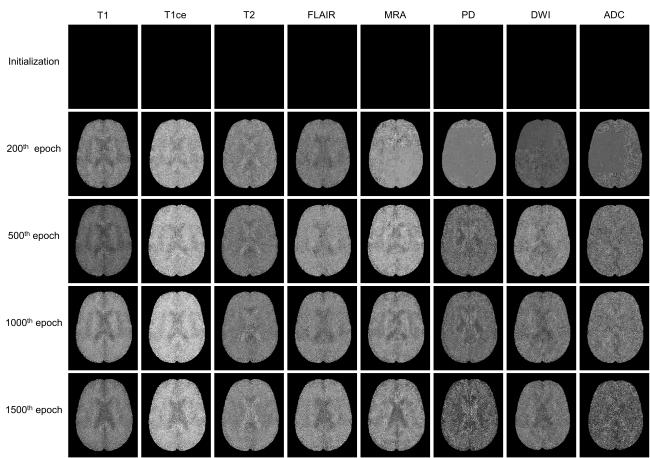
During pre-training, the model maintains these learnable templates (initialized as zeros and updated via backpropagation). The proxy task here involves masking the input image and filling the holes not with another patient scan, but with patches from these learnable templates.
This serves two purposes:
- It teaches the model the general statistical properties of each modality.
- It creates a “bridge” for downstream tasks. Since these templates are learned and stored, they can be used later to help the model adapt to new datasets where some modalities might be missing.
The process of learning these templates is visually fascinating. You can see how they evolve from noise into recognizable brain structures over the training epochs:
The loss function for distillation is similar to reconstruction, but uses the template \(T_m\):

3. Modality-Aware Contrastive Learning (CL)
The final piece of the puzzle ensures consistency. We now have two different ways of processing an image:
- Masking it with another modality (CMR).
- Masking it with a template (MD).
Both processes should theoretically yield a representation of the same underlying anatomy. Modality-Aware Contrastive Learning forces the neural network’s internal features (embeddings) to be similar for these two variations.
This is crucial because it makes the model’s understanding invariant. Whether the information comes from a T2 scan or a distilled template, the model recognizes “this is the left ventricle.” This aligns the features in a high-dimensional space.
The contrastive loss function pulls these positive pairs together while pushing apart unrelated samples:


The Unified Objective
BrainMVP combines all three tasks into a single powerful training objective. The total loss function balances the reconstruction of the image (from cross-modal inputs), the reconstruction from templates, and the contrastive alignment of features.
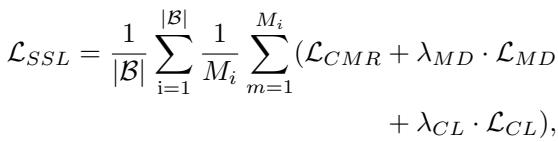
By minimizing this combined loss, the model learns a robust, flexible representation of the brain that understands both the specific textures of different scans and the underlying anatomical geometry.
Downstream Applications
The beauty of a foundation model lies in its application to specific medical problems. Once BrainMVP is pre-trained, it can be fine-tuned for specific tasks like segmenting brain tumors or classifying Alzheimer’s disease.
A unique advantage of BrainMVP is how it uses the Distilled Modality Templates during this phase.
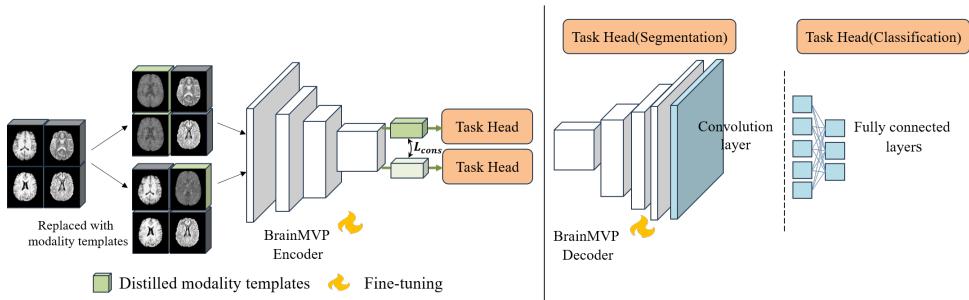
In downstream tasks, the researchers use a clever augmentation strategy. They randomly replace real input modalities with the distilled templates (which are now frozen). This acts as a regularizer, preventing the model from over-relying on specific patient details and ensuring it remains robust even if the input data quality varies.
The fine-tuning loss includes a consistency term (\(\mathcal{L}_{cons}\)) that ensures the features remain stable whether the input is real data or a template-augmented version:

Experiments and Results
The authors put BrainMVP to the test on 10 different benchmarks, covering both segmentation (drawing boundaries around lesions) and classification (diagnosing diseases).
Segmentation Performance
Segmentation is one of the hardest tasks in medical imaging. The researchers compared BrainMVP against training from scratch, general computer vision SSL methods (like MAE3D and SimMIM), and medical-specific SSL methods (like Swin-UNETR and M³AE).
The results were decisive. In tumor segmentation tasks (BraTS), BrainMVP consistently outperformed the competition.
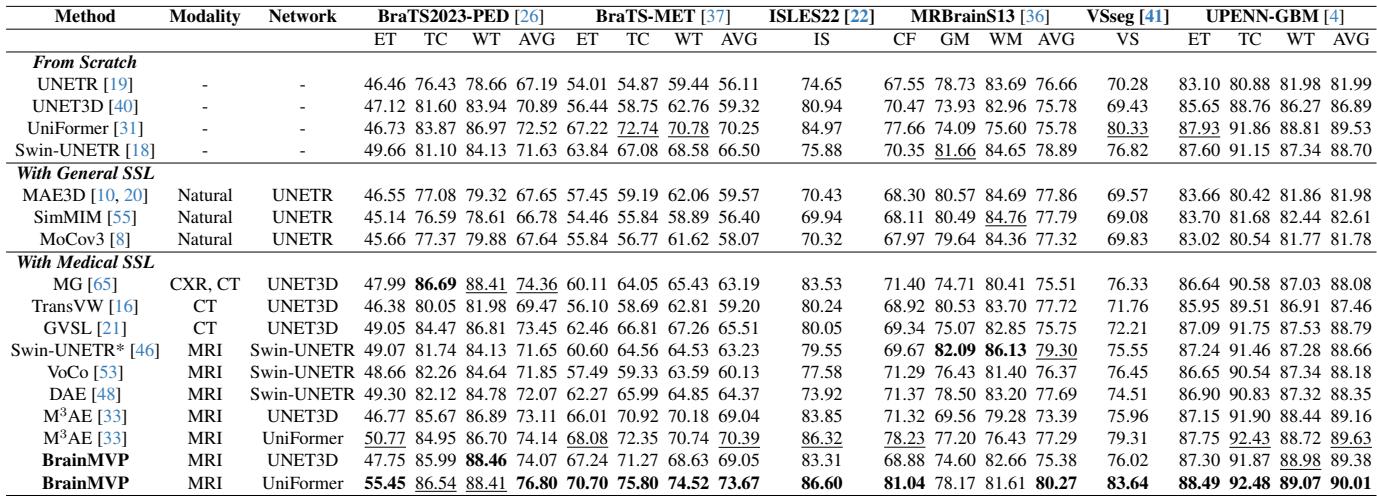
For example, on the BraTS2023-PED dataset (pediatric tumors), BrainMVP achieved a Dice Score of 76.80%, significantly higher than the general SSL method MAE3D (67.65%). This huge gap highlights that naive transfer of computer vision techniques isn’t enough for medical data; the specific multi-modal handling of BrainMVP is essential.
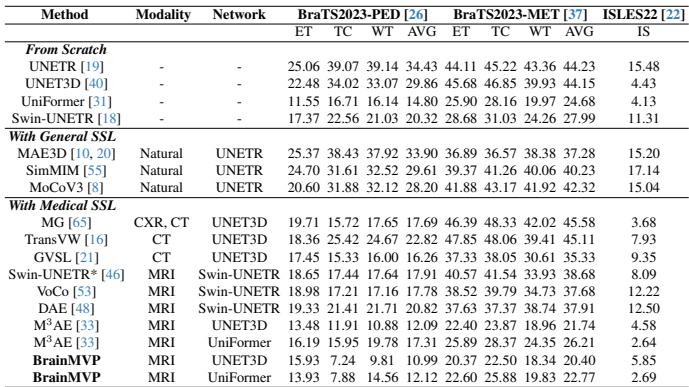
The structural accuracy of the segmentations was also superior. The HD95 metric (Hausdorff Distance), which measures the worst-case error in the boundary of the segmentation (lower is better), showed BrainMVP producing much tighter, more accurate contours.
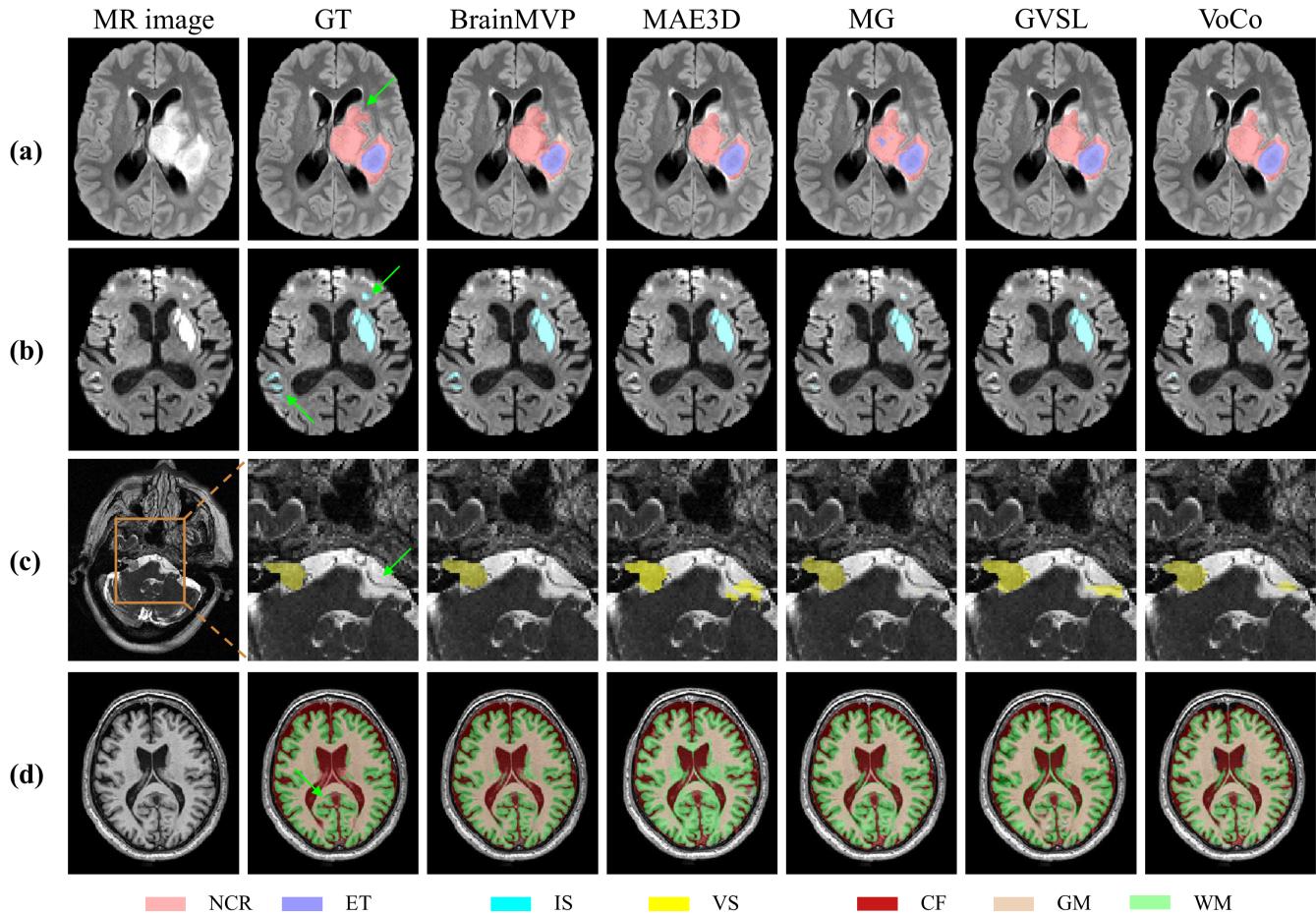
Qualitative visualizations confirm these numbers. In the figure below, look at the green arrows. You can see BrainMVP (second column) capturing tumor boundaries that other methods miss or over-segment.
Classification and Generalization
BrainMVP isn’t just a “segmentation bot.” It also excelled at classification tasks, such as distinguishing between High-Grade and Low-Grade Gliomas (BraTS2018) or detecting Alzheimer’s (ADNI).
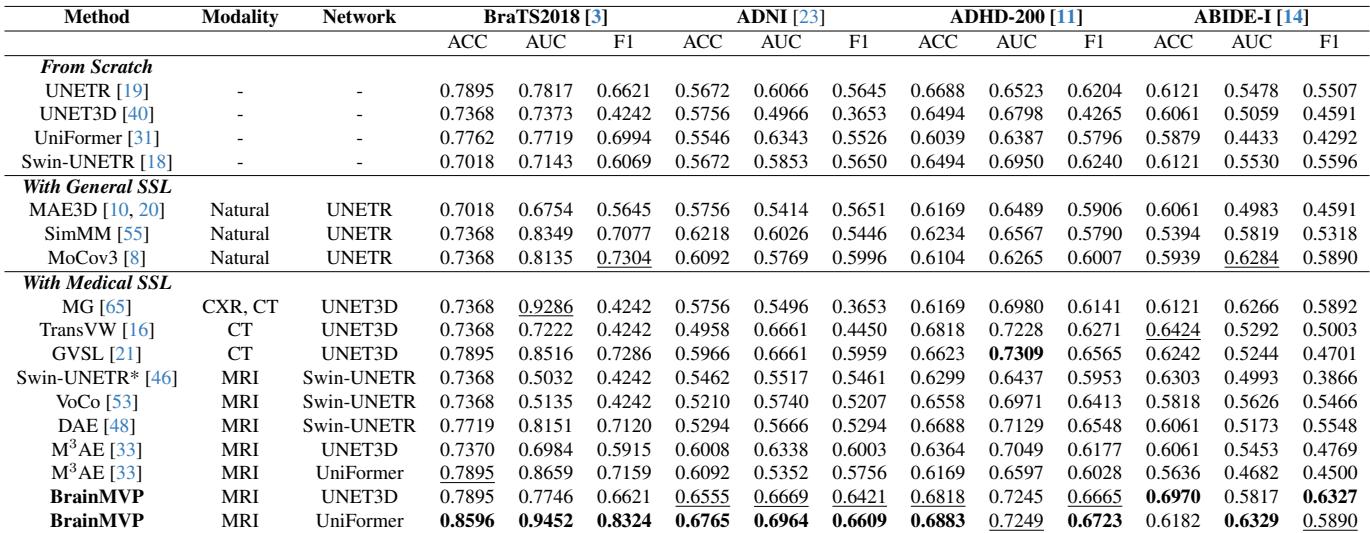
On the ADNI dataset (Alzheimer’s detection), BrainMVP achieved an accuracy of 67.65%, beating the previous best of 60.92%. This proves that the features learned during pre-training are semantically rich and useful for diagnosing pathology, not just drawing lines.
Label Efficiency: Doing More with Less
Perhaps the most impactful result for real-world adoption is label efficiency. In clinical settings, we rarely have thousands of labeled cases.
The researchers tested how BrainMVP performs when only a fraction of the training data is labeled (20%, 40%, etc.).
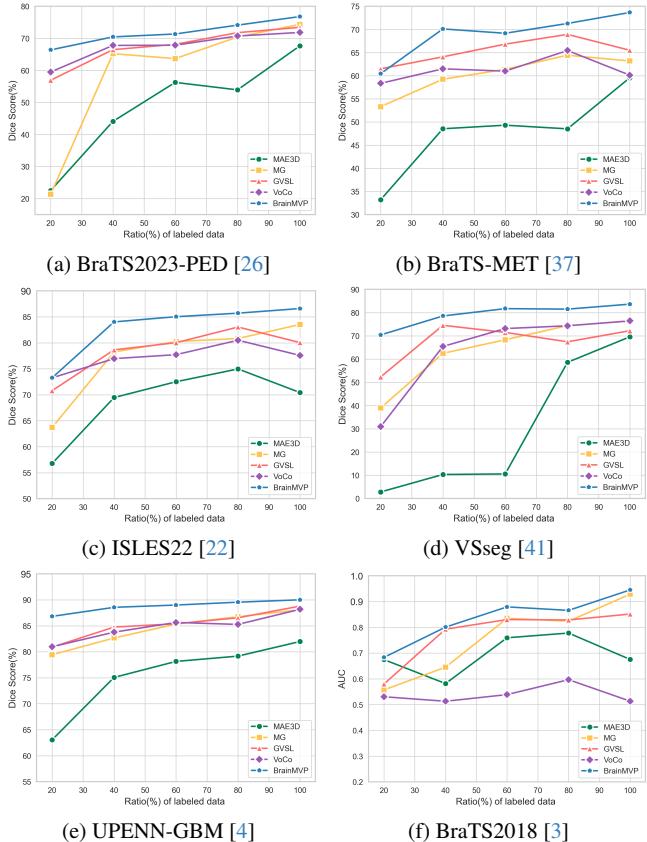
The charts above reveal a striking capability: BrainMVP can often match the performance of fully supervised methods using only 40% of the labeled data. For hospitals with limited resources for annotation, this is a game-changer.
Conclusion and Implications
BrainMVP represents a significant step forward in medical image analysis. By respecting the multi-modal nature of medical scans and designing proxy tasks that specifically exploit these correlations, the authors have created a model that is:
- Scalable: It handles arbitrary numbers of modalities via single-channel processing.
- Robust: It effectively manages missing data using cross-modal reconstruction and distillation.
- Generalizable: It achieves state-of-the-art results across diverse tasks, from pediatric tumors to Alzheimer’s classification.
The introduction of Modality-Wise Data Distillation—creating “universal templates” for MRI sequences—is particularly innovative. It provides a clever way to bridge the gap between large-scale pre-training data and specific, often smaller, clinical datasets.
As we move toward universal medical foundation models, frameworks like BrainMVP provide the blueprint for how AI can learn to “see” inside the human body with the sophistication and flexibility required for real-world healthcare.