](https://deep-paper.org/en/paper/2410.10859/images/cover.png)
Large Language Models (LLMs) like GPT-4 and Llama 2 are incredible feats of engineering. They can write poetry, code in Python, and summarize history. But they have a fatal flaw: they are frozen in time. An LLM trained in 2021 believes Joe Biden is the latest US President, but it might struggle with events from last week. Even worse, models often hallucinate, confidently asserting incorrect facts.
When a model gets a fact wrong, how do we fix it? Retraining the entire model—which costs millions of dollars and takes months—is not a viable solution for correcting a single error. This dilemma has given rise to the field of Model Editing: surgical techniques to alter a model’s knowledge without retraining it.
However, existing research in this field has a “practicality” problem. Most benchmarks ask models to learn fake facts (e.g., “The Eiffel Tower is in Rome”) to test plasticity, rather than fixing real errors. Today, we are diving into a paper that aims to solve this. We will explore FAME, a benchmark focused on real-world factuality, and SKEME, a novel method that uses caching mechanisms to keep models up-to-date.
The Problem: Hallucinations and Stale Knowledge
Imagine you ask an LLM, “Who is the Prime Minister of the UK?” Depending on when the model was trained, it might say Boris Johnson, Liz Truss, or Rishi Sunak. If the answer is outdated, the model is providing misinformation.
In critical fields like law or medicine, these errors are unacceptable. We need a way to “edit” the model.
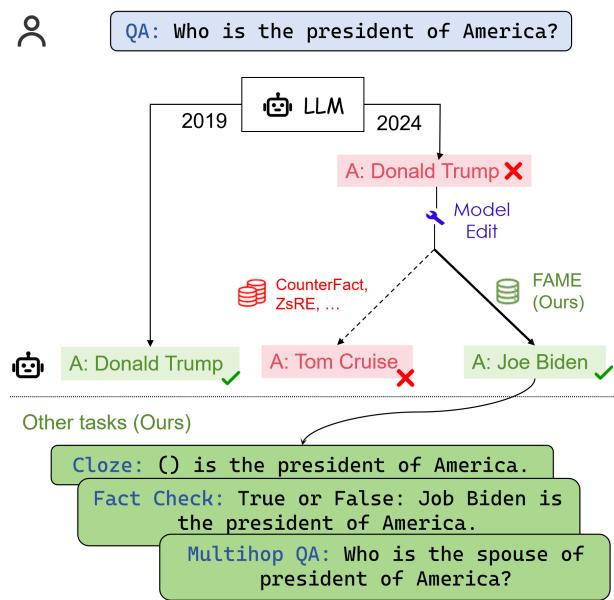
As shown in Figure 1 above, the goal is straightforward:
- Pre-edit: The model answers incorrectly (e.g., claiming Trump is President).
- Edit: We inject the correct knowledge (Biden is President).
- Post-edit: The model answers correctly and maintains its ability to answer other questions (like the President of France) correctly.
Background: The State of Model Editing
Before understanding the authors’ contribution, we need to categorize how researchers currently try to fix LLMs. Generally, there are two camps:
- Parameter-Modifying Methods (e.g., MEMIT, FT): These methods treat the LLM’s weights like a hard drive. They use gradient descent or hyper-networks to physically change the numbers inside the neural network to “overwrite” a specific memory.
- Parameter-Preserving Methods (e.g., IKE, MeLLo): These methods leave the model alone. They use external memory or retrieval systems (like RAG—Retrieval Augmented Generation) to provide the correct context to the model at runtime.
The authors of this paper argue that previous benchmarks used to test these methods are flawed. Datasets like CounterFact or ZsRE use “counterfactuals”—fake data designed to see if the model can change, not if it should. Teaching a model that “Bananas are blue” is interesting for theory, but useless for practical application. Furthermore, these datasets usually test simple Question-Answering (QA) tasks, ignoring complex scenarios like dialogue or multi-hop reasoning.
To address this, the authors introduce FAME.
FAME: A Benchmark for Reality
FAME (FActual Multi-task model Editing) is a massive dataset designed to test how well editing methods work in the real world. Unlike its predecessors, FAME is built on Practicality.
1. Real-World Truths
FAME comprises 128,000 real data items sourced from Wikidata and DBpedia. The researchers collected “triples” (Subject, Relation, Object)—for example, (America, Head of Government, Joe Biden). They rigorously filtered these to ensure they represent current, actual facts, not hypothetical ones.
2. Diverse Task Formats
Real users don’t just ask simple questions. They have conversations, ask for sentence completions, or require fact-checking. FAME tests editing performance across:
- Single-hop QA: “Who is the President?”
- Cloze Tests: “The President is [MASK].”
- Fact Checking: “True or False: Trump is President.”
- Conversational Dialogue: A chat history where the fact is referenced.
3. Multi-Hop Reasoning
This is the ultimate test of knowledge integration. If you teach the model that “The US President is Biden” and it already knows “Biden’s wife is Jill,” does it automatically know the answer to “Who is the First Lady of the US?”
This requires the model to hop from US \(\rightarrow\) President \(\rightarrow\) Spouse.
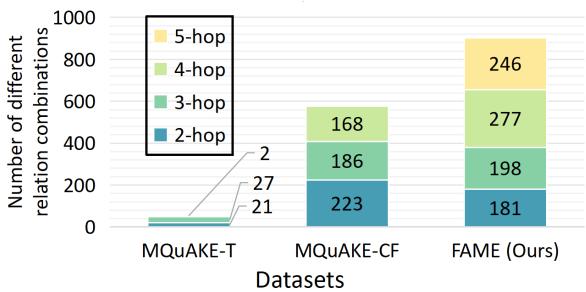
As visualized in Figure 11, FAME significantly expands the complexity of reasoning chains compared to previous benchmarks like MQuAKE, testing up to 5 hops of reasoning.
The Core Method: SKEME
To conquer this new, difficult benchmark, the authors propose SKEME (Structured Knowledge retrieved by Exact Matching and reranking Editing).
SKEME belongs to the “Parameter-Preserving” camp. It doesn’t try to perform brain surgery on the LLM’s neurons. Instead, it gives the model a dynamic, up-to-date “cheat sheet.”
SKEME draws inspiration from computer operating systems—specifically, the concept of a Cache.
The Architecture of SKEME
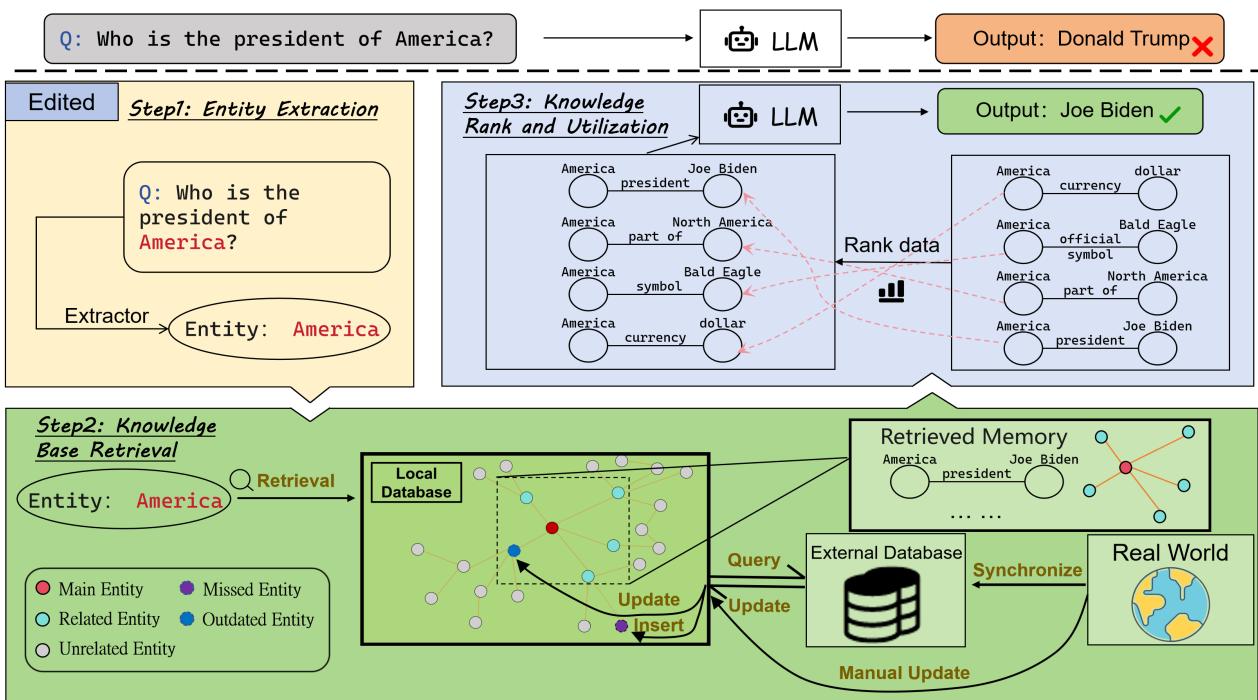
Let’s break down the workflow illustrated in Figure 2:
Entity Extraction: When a user asks, “Who is the president of America?”, SKEME first identifies the key subject. Using a lightweight extraction process, it isolates “America” as the entity of interest. This filters out noise from the phrasing of the question.
Knowledge Base Retrieval (The Caching Mechanism): This is SKEME’s main innovation. It maintains a Local Structured Knowledge Base (The Cache).
- Fast & Slow Tables: Similar to how a CPU has a fast cache and slower main RAM, SKEME looks in its local cache first. If the fact isn’t there (a “cache miss”), it queries the massive external database (Wikidata/DBpedia), retrieves the fact, and updates the local cache.
- Synchronization: The system ensures the local cache is synced with the real world. If the President changes, the external database updates, and SKEME pulls that new fact into its local cache.
- Knowledge Rank and Utilization: Once the relevant facts (triples) are retrieved, SKEME ranks them by relevance. It then uses In-Context Learning. It constructs a prompt that effectively says to the LLM: “Here is some verified information: (America, President, Joe Biden). Use this to answer the user’s question.”
Formalizing the Edit
Mathematically, model editing attempts to change the function of the model \(f\) to a new function \(f'\).

This equation defines the goal:
- If the input \(x_e\) corresponds to the fact we want to edit (\(I\)), output the new target \(y_f\).
- If the input relies on that fact for reasoning (\(EX\), or extended set), output the answer derived from the new fact.
- For everything else (\(O\), or outside set), keep the model’s behavior exactly the same.
Evaluating Success: The SURE Metric
How do we know if an edit was “good”? There are two competing forces:
- Accuracy (EM): Did the model get the new fact right?
- Locality/Drawdown (DD): Did we accidentally break something else? (e.g., We updated the President, but now the model forgot the capital of France).
The authors argue that the balance between these two depends on the application. A medical bot needs high accuracy; a creative writing bot needs stability. They introduce SURE (Statistical and Unbiased Real-world Evaluation).

This metric allows users to tune parameters (\(\alpha\) and \(\beta\)) to weight accuracy vs. side effects according to their specific needs.
Experiments and Results
The researchers compared SKEME against popular methods like FT (Fine-Tuning), MEMIT (Mass Editing Memory in a Transformer), and MeLLo (another retrieval method).
1. Handling Time and Transitions
One of the hardest things for “weight-modifying” methods (like MEMIT or FT) is updating the same fact multiple times. If the US President changes from Obama \(\rightarrow\) Trump \(\rightarrow\) Biden, you have to overwrite the same neurons repeatedly.
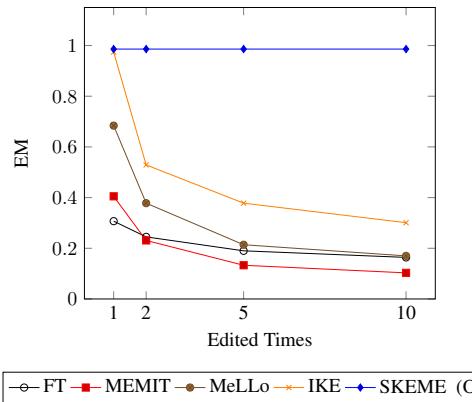
Figure 3 shows a dramatic result. As the number of edits to the same fact increases (X-axis), the performance of parameter-modifying methods (MEMIT, FT) collapses. They essentially “destroy” the model’s weights. SKEME (blue diamonds), however, stays at perfect accuracy. Because it uses a cache, updating a fact is as simple as overwriting a text entry in a database.
2. Scaling Up: Massive Edits
What if we need to update 10,000 facts at once?
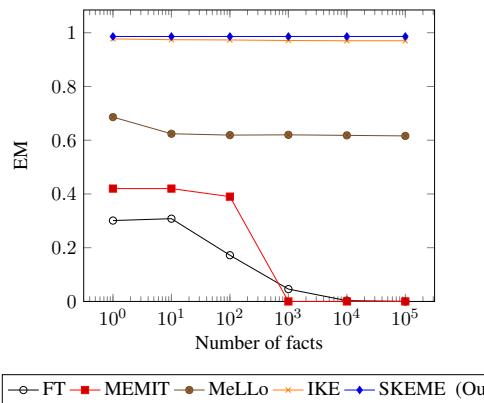
Figure 4 demonstrates that as the number of edited facts grows to \(10^5\) (100,000 facts), traditional editing methods fail completely. Their capacity to store new knowledge in weights is limited. SKEME maintains high performance regardless of scale because it offloads memory to the retrieval system.
3. Generalization
SKEME also showed superior performance in multi-hop reasoning. Because it retrieves the structured fact (e.g., Biden is President), the LLM can use its internal reasoning engine to deduce that Biden’s wife is the First Lady. Methods that just try to overfit the answer “Biden” to the question “Who is President?” often fail to support this downstream reasoning.
Conclusion
The paper “FAME: Towards Factual Multi-Task Model Editing” makes a compelling case for shifting the focus of model editing from theoretical “neuron surgery” to practical, retrieval-based systems.
By introducing FAME, the authors provide the community with a rigorous, realistic benchmark that exposes the fragility of current weight-editing techniques. With SKEME, they offer a robust solution: treat knowledge as a separate, dynamic layer (a cache) rather than trying to bake every new fact into the model’s frozen weights.
For students and researchers, the takeaway is clear: while modifying neural weights is a fascinating scientific endeavor, retrieval-augmented strategies currently offer the most practical, scalable path toward LLMs that can keep up with our ever-changing world.