](https://deep-paper.org/en/paper/2410.10867/images/cover.png)
Breaking the Chains of Reference: A Robust, Reference-Free Metric for AI Summarization
In the rapidly evolving world of Natural Language Processing (NLP), abstractive summarization—the ability of an AI to read a document and write a concise, original summary—remains a “holy grail” task. However, building these systems is only half the battle. The other half, often more treacherous, is evaluating them. How do we know if a summary is actually good?
For years, the standard approach has been to compare the AI’s output against a “gold standard” human-written reference summary. Metrics like ROUGE (Recall-Oriented Understudy for Gisting Evaluation) calculate the overlap between the machine’s text and the human’s text. Ideally, a high overlap means a high-quality summary.
But there is a major flaw in this logic: What if the human reference isn’t perfect?
Obtaining high-quality reference summaries is expensive and time-consuming. Often, references are noisy, or they contain artifacts of the source text (a phenomenon known as “translationese”). Furthermore, just because a summary is different from the reference doesn’t mean it is wrong; there are many ways to summarize a story.
In a recent paper, researchers argue that our reliance on reference-based metrics is a bottleneck. They introduce a novel reference-free metric designed to evaluate the relevance of a summary without needing a human cheat sheet. This new method is not only cheap to compute but also correlates surprisingly well with human judgment, offering a way to make traditional evaluations more robust against low-quality data.
This post will take a deep dive into their research, breaking down the mathematics of their proposed metric, analyzing their experimental results, and exploring how we can move toward a more autonomous evaluation of AI systems.
The Problem with “Gold Standard” Evaluation
To understand why a new metric is necessary, we must first look at the limitations of the current standard.
The Ingredients of a Good Summary
When humans evaluate a summary, they look for four specific qualities:
- Fluency: Is the grammar and spelling correct?
- Coherence: Is the structure logical?
- Faithfulness (or Factual Consistency): Does the summary stick to the facts of the source?
- Relevance: Does the summary capture the main ideas?
Automatic metrics try to approximate these human judgments. The most common metrics, like ROUGE or BLEU, measure lexical overlap—literally counting how many n-grams (sequences of n words) the system summary shares with the reference summary.
The Reference Quality Bottleneck
The implicit assumption of overlap metrics is that the reference summary is the “ground truth.” However, studies have shown that human references often contain hallucinations or are merely extractive (copy-pasting parts of the source) rather than truly abstractive.
If a reference summary is poor—for example, if it just copies the first three sentences of a news article—a sophisticated AI that writes a truly original summary will get a low ROUGE score. This creates a penalty for creativity and paraphrasing.
Furthermore, relying on references limits the scale of evaluation. You cannot evaluate a system on millions of new documents if you have to pay humans to write references for all of them first.
The Rise of LLM-as-a-Judge
One modern alternative is using Large Language Models (LLMs) like GPT-4 to act as judges. You feed the source and the summary to the LLM and ask it to rate the quality. While this correlates well with human judgment, it is computationally expensive, slow, and relies on proprietary “black box” models.
The researchers behind this paper aimed to find a middle ground: a metric that is interpretible, cheap to compute, reference-free, and highly correlated with human perceptions of relevance.
The Core Method: Importance-Weighted N-Gram Overlap
The researchers propose a method that shifts the focus from “Does this match the reference?” to “Does this capture the important parts of the source?”
The intuition is simple: A relevant summary should contain the most “important” words or phrases (n-grams) found in the source document. If we can mathematically determine which parts of a document are semantically heavy, we can score a summary based on whether it includes those parts.
Step 1: Defining Importance
How do we know which words are important? The authors utilize established information retrieval concepts, specifically TF-IDF (Term Frequency-Inverse Document Frequency) and BM25.
These algorithms weigh words based on how distinct they are. Common words like “the” or “and” get low scores, while specific terms central to the topic get high scores.
Step 2: The Weighting Function
The researchers define the importance \(W\) of an n-gram \(t\) in a document \(d\) (from a corpus \(D\)). They don’t just use the raw TF-IDF score; they normalize it using a specific function to ensure stability.
The formula for the weight is:
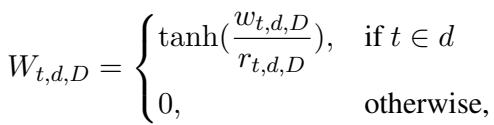
Here is what these variables mean:
- \(w_{t,d,D}\): This is the raw importance score (e.g., the TF-IDF score) of the n-gram.
- \(r_{t,d,D}\): This is the rank of that n-gram in the document based on its importance. For example, the most important word has rank 1, the second most has rank 2, etc.
- \(\tanh\): The hyperbolic tangent function. This is a “squashing” function that keeps the output value bounded between 0 and 1 (mostly), preventing any single keyword from dominating the score entirely.
By dividing the raw score by the rank (\(w/r\)), the metric heavily prioritizes the absolute top keywords. If a word is important but ranked 50th, its contribution drops significantly. This mirrors human relevance judgment: we care most about the headline topics.
Step 3: Calculating the Metric
Once every n-gram in the source document has an assigned weight, scoring the summary (\(\hat{s}\)) is a matter of checking which weighted n-grams appear in it.
The metric, denoted as \(m(\hat{s}, d, D)\), is calculated as follows:

Let’s break down this equation:
- The Summation (\(\Sigma\)): We look at every n-gram \(t\) present in the proposed summary \(\hat{s}\). If that n-gram exists in the source document, we add its weight (\(W_{t,d,D}\)) to our total. If the n-gram isn’t in the source (i.e., a hallucination or a completely new phrasing not mapped to the source), it contributes nothing.
- Normalization (\(N_{d,D}\)): We divide the sum by the total possible weight of the source document (\(N_{d,D} = \Sigma_{t\in d}W_{t,d,D}\)). This turns the score into a percentage: “What fraction of the source’s semantic mass did you capture?”
- The Length Penalty (\(\alpha_{\hat{s}, d, D}\)): This is a critical component. Without this penalty, the optimal strategy for a summarization system would be to simply copy the entire source document. That would capture 100% of the weights, resulting in a perfect score, but it wouldn’t be a summary.
Step 4: The Length Penalty
The authors introduce a dynamic length penalty, \(\alpha\), which adjusts the score based on the ratio between the summary length \(|\hat{s}|\) and the document length \(|d|\).
The penalty function \(f\) is defined as:
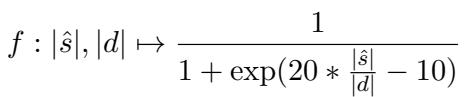
To visualize how this works, look at the curve below. The x-axis represents the compression ratio (summary length / document length), and the y-axis is the penalty multiplier.
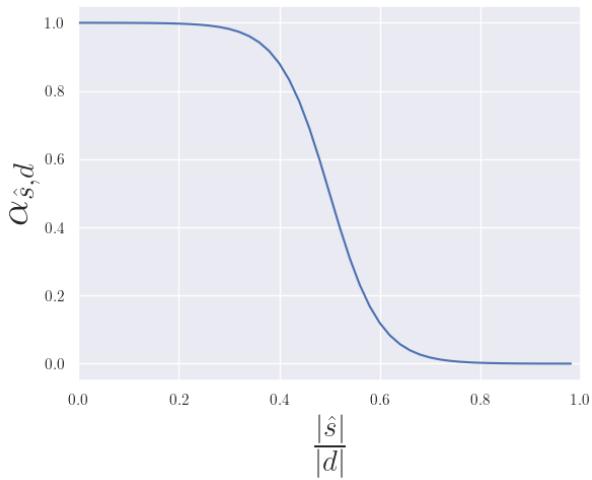
As you can see, if the summary is very short (near 0 on the x-axis), the multiplier is close to 1 (no penalty). As the summary grows longer, approaching 40% or 50% of the document length, the multiplier crashes toward zero.
This forces the metric to favor conciseness. To get a high score, a system must capture the high-weight n-grams while using as few words as possible.
Experiments: Does It Work?
The researchers tested their metric on several datasets, including SummEval (news summaries), ArXiv and GovReport (long document summarization), and RoSE. They compared their metric against human judgments of relevance.
System-Level Correlation
One of the key findings is that this simple, reference-free metric correlates well with human judgment, especially as the number of evaluation samples increases.
Figure 1 shows how the correlation improves as we evaluate more summaries per system.
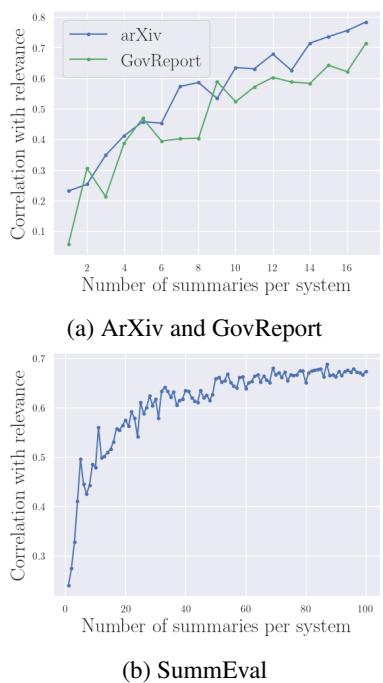
On datasets like ArXiv (the blue line in the left chart), the correlation reaches nearly 0.8 when enough summaries are considered. This is impressive for a metric that doesn’t use a neural network or a human reference. It suggests that statistically, if a system consistently captures weighted n-grams, it is producing relevant summaries.
The “Killer Feature”: Robustness to Noisy References
The most compelling argument for this metric is its stability. To prove this, the authors designed a stress test. They took the “gold standard” reference summaries and deliberately corrupted them.
They replaced the high-quality human references with random sentences from the document (a “RAND-3” alteration). They then measured how well standard ROUGE-1 scores correlated with human judgment as the references became increasingly garbage.
The results, shown in Figure 2, are striking.
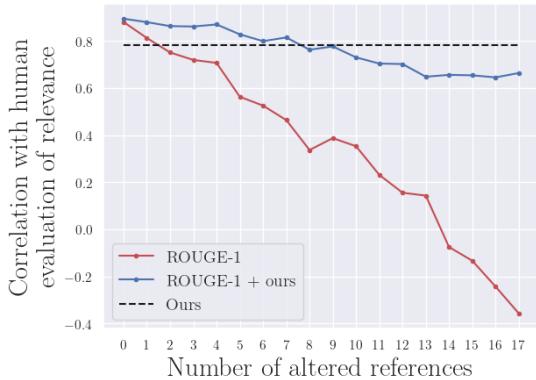
- Red Dashed Line (ROUGE-1): As the number of altered (bad) references increases (moving right on the x-axis), the correlation with human judgment plummets, eventually dropping below zero. This means ROUGE becomes useless if the references are bad.
- Black Dash-Dot Line (Ours): The proposed metric is reference-free, so it doesn’t care about the bad references. Its line is perfectly flat.
- Blue Solid Line (ROUGE-1 + Ours): This is the hybrid approach. By averaging the ROUGE score and the new metric, the correlation remains high (>0.6) even when the references are completely ruined.
This proves that the new metric can act as a safety net. In real-world scenarios where reference quality is unknown or variable (like web-crawled datasets), mixing this metric with ROUGE ensures the evaluation remains valid.
Similar Trends with Different Corruptions
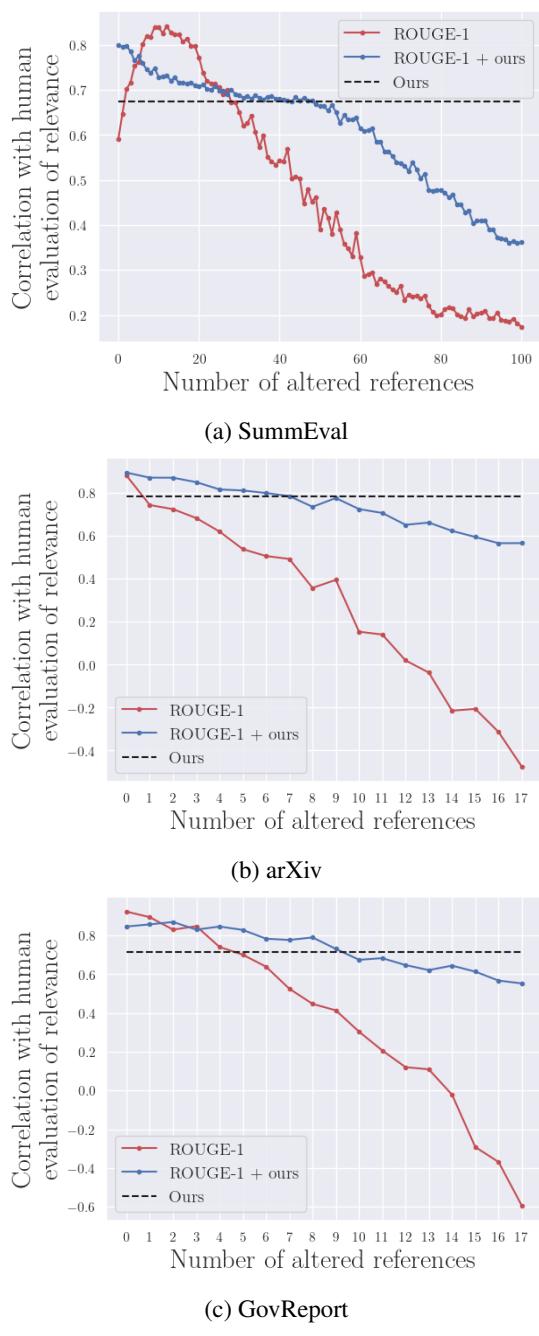
The authors didn’t just stop at random sentences. They also tested “Lead-3” (first three sentences) and “Tail-3” (last three sentences) corruptions.
Lead-3 Alteration (Figure 7):
Tail-3 Alteration (Figure 8):
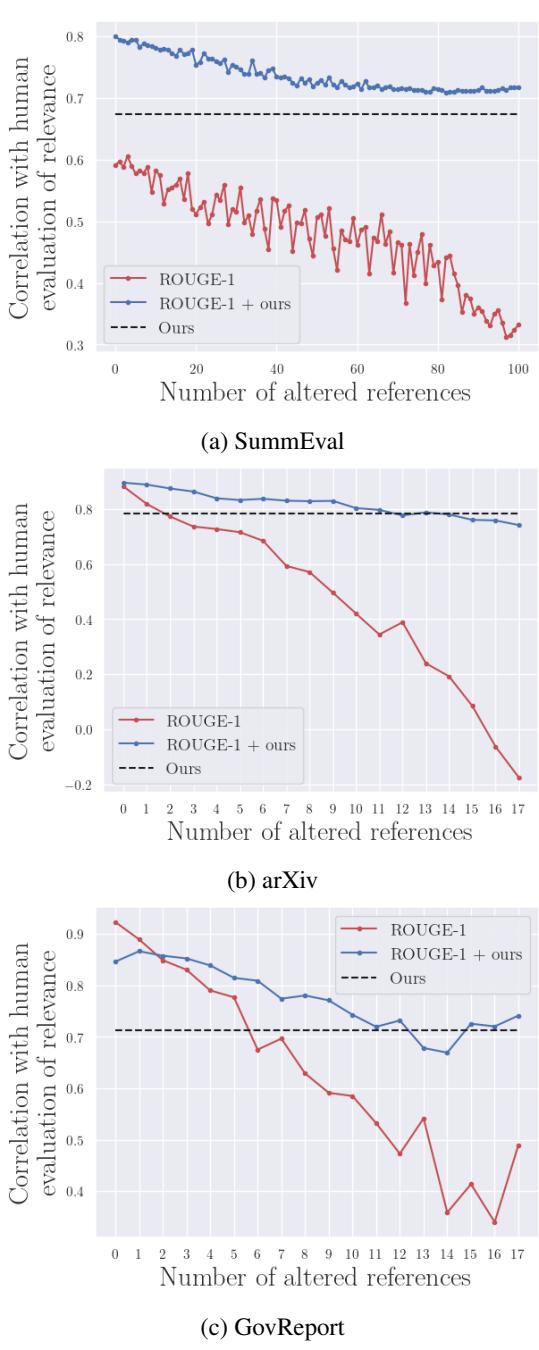
In all cases, the trend holds: ROUGE degrades, but the proposed metric maintains a strong correlation with human relevance scores. This consistency validates the metric’s reliability across different types of noise.
Complementarity: Better Together
The authors are not suggesting we throw away ROUGE. Instead, they argue that their metric captures a different aspect of quality.
They visualized the “complementarity” of various metrics on the SummEval dataset using a heatmap.
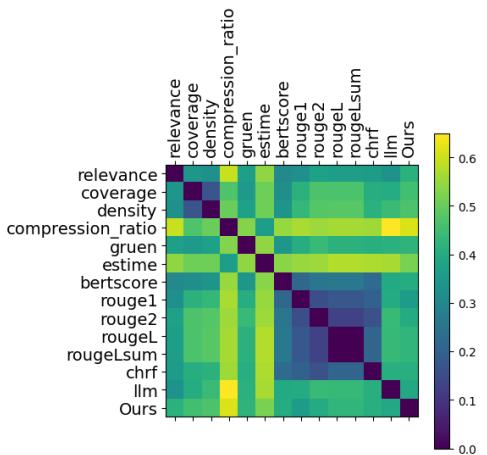
In this chart, lighter colors indicate higher complementarity. The proposed metric shows high complementarity with ROUGE and chrF. This implies that these metrics are measuring different things. ROUGE measures strict lexical overlap with a reference; the new metric measures semantic coverage of the source. Using them together provides a more holistic view of summary quality.
Comparison with State-of-the-Art
Table 1 compares the proposed metric against sophisticated model-based metrics (like BERTScore) and LLM-as-a-judge (using Gemini 1.5).
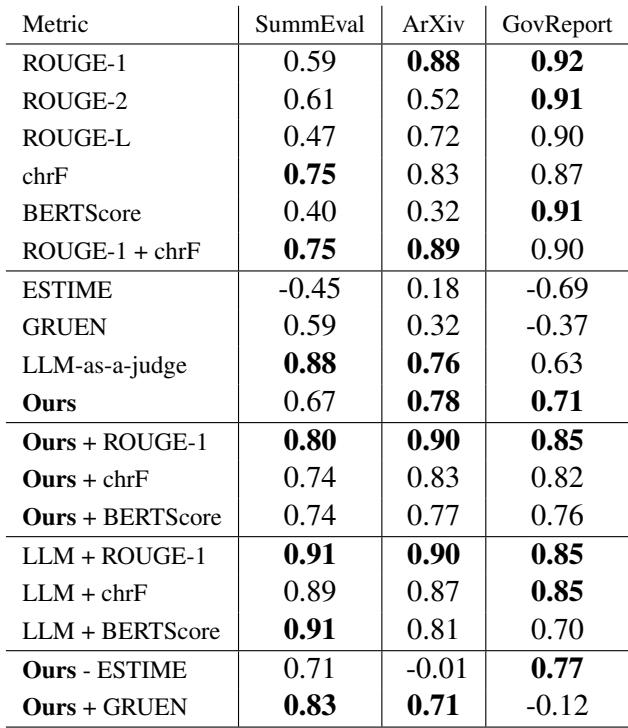
The results are revealing:
- Simplicity Wins: The proposed metric (“Ours”) often outperforms sophisticated metrics like BERTScore on correlation with relevance.
- Hybrid Power: “Ours + ROUGE-1” (0.90 on ArXiv) rivals the performance of LLM-as-a-judge (0.90 on ArXiv), but at a fraction of the computational cost.
- Consistency: While LLM-as-a-judge is powerful, the proposed metric is strictly defined mathematically, making it more predictable and free from the “black box” biases of LLMs.
Technical Nuances: Tuning the Metric
The authors performed an ablation study to find the best settings for their metric. They looked at different tokenizers, n-gram sizes (bigrams, trigrams), and weighting schemes.
Figure 5 illustrates the distribution of correlations across these settings.
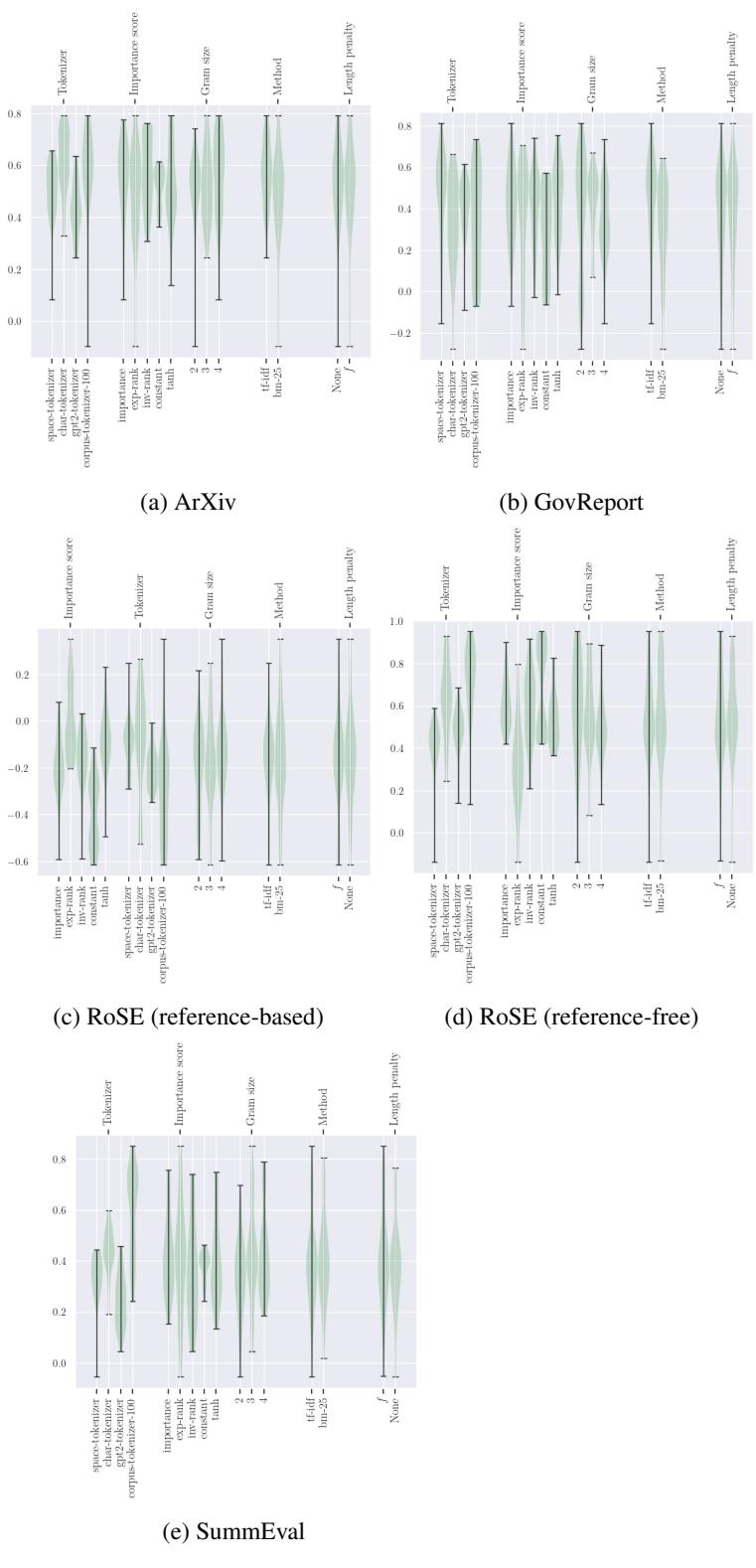
The violin plots show that the metric is somewhat sensitive to the choice of tokenizer and weighting method (e.g., TF-IDF vs. BM25). However, the chosen configuration (Trigrams, TF-IDF, Tanh importance, length penalty) consistently yields correlations in the high positive range (0.6 - 0.8) across datasets.
What kind of summaries does it like?
An interesting analysis is checking what scores different types of summaries receive. Ideally, a machine summary should score higher than a random selection of sentences.
Figure 9 shows the range of values the metric assigns to different summary types.
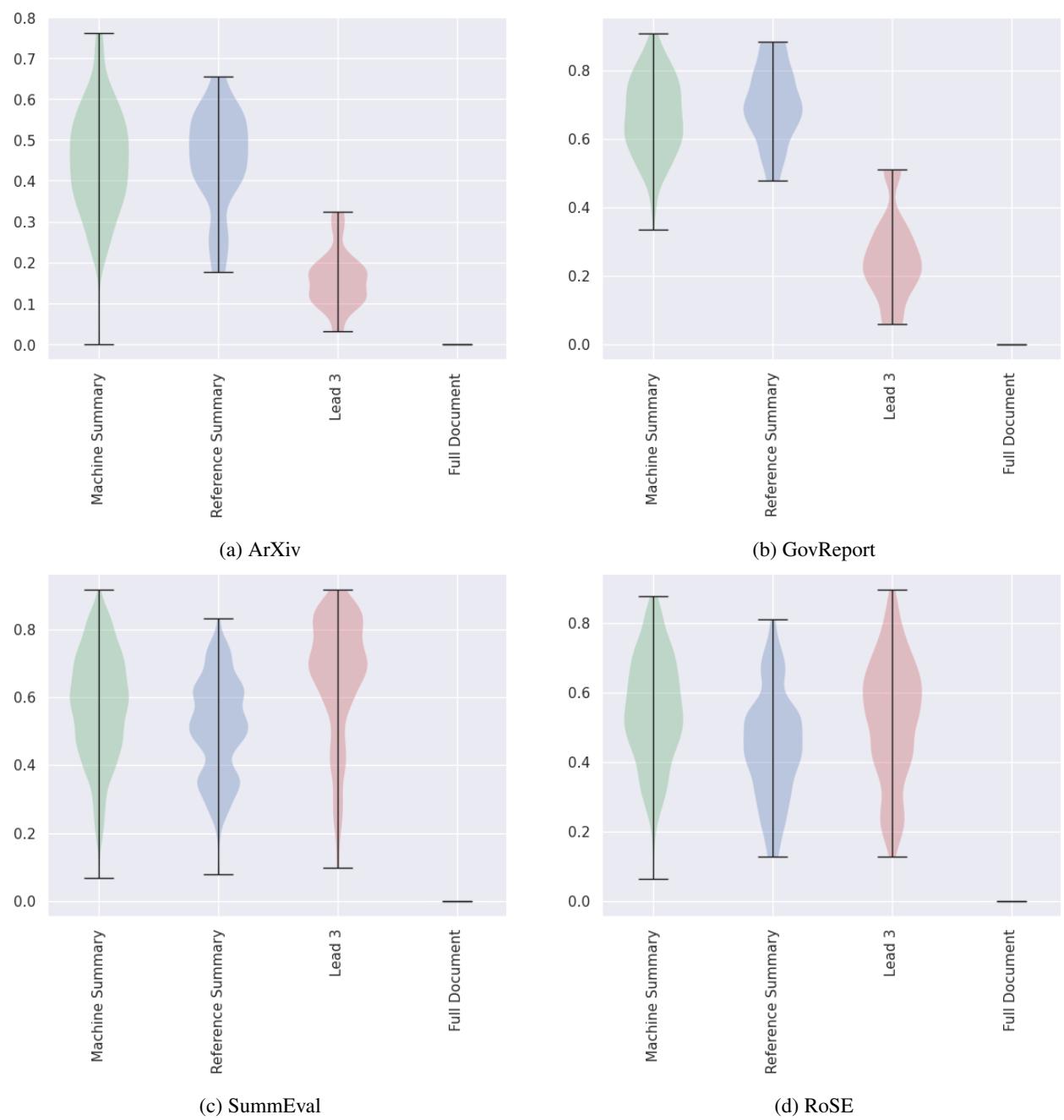
Notice that on the ArXiv and GovReport datasets (Plots a and b), the “Machine Summary” (leftmost violin) generally scores higher or comparable to the “Reference Summary.” Interestingly, the “Full Document” (rightmost) gets a score near zero due to the aggressive length penalty.
Contrast this with the standard ROUGE-1 scores in Figure 10:
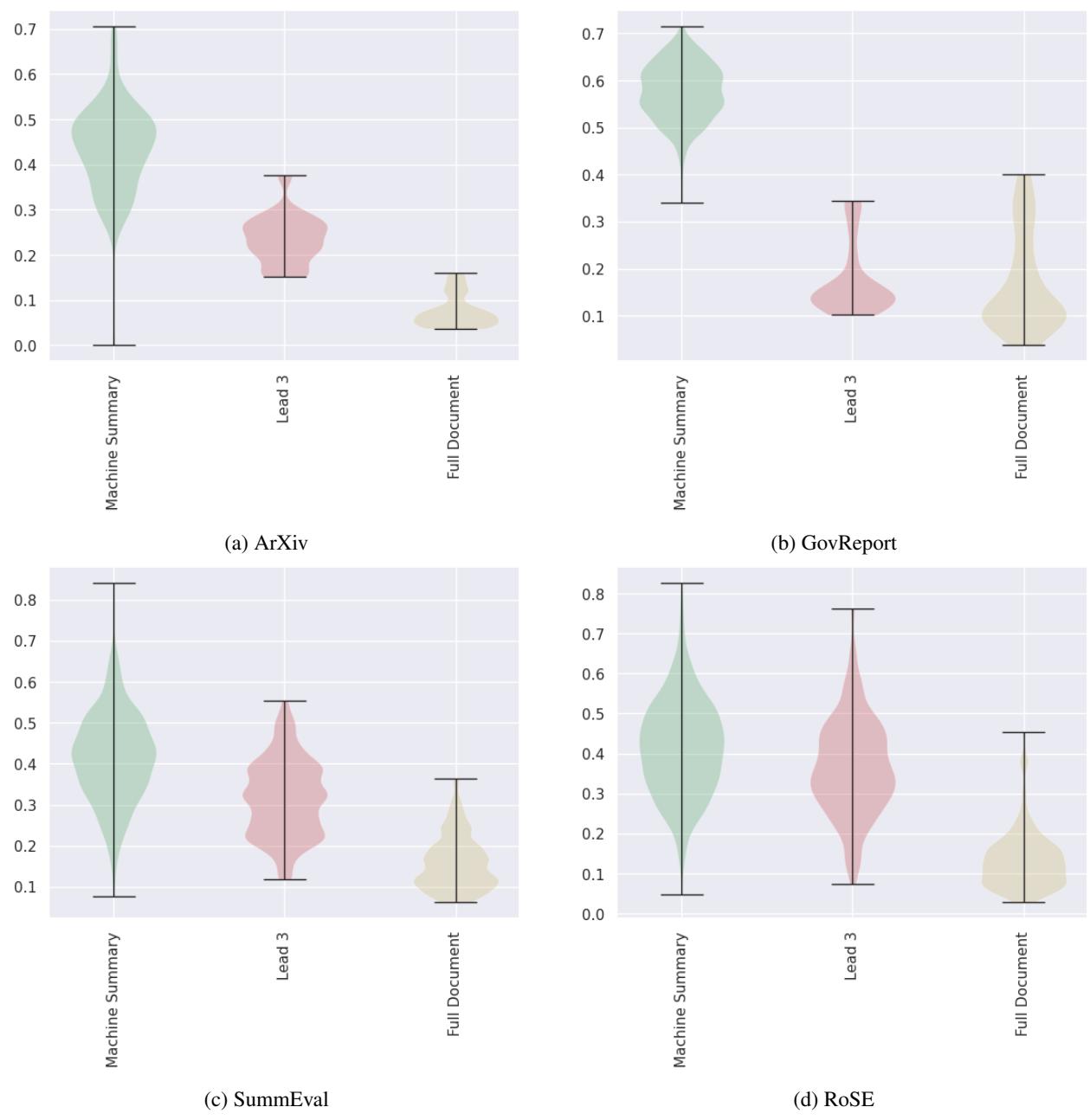
ROUGE-1 also rates machine summaries highly, but it is entirely dependent on the reference. If the reference is merely a copy of the “Lead-3” sentences, ROUGE becomes biased toward extractive systems. The proposed metric avoids this bias by looking only at the source content.
Spurious Correlations?
One danger in reference-free metrics is that they might accidentally correlate with simple features like length rather than actual quality. For example, if humans prefer longer summaries, a metric that just rewards length will look like it works, even if it’s dumb.
The authors checked for this in Table 2.
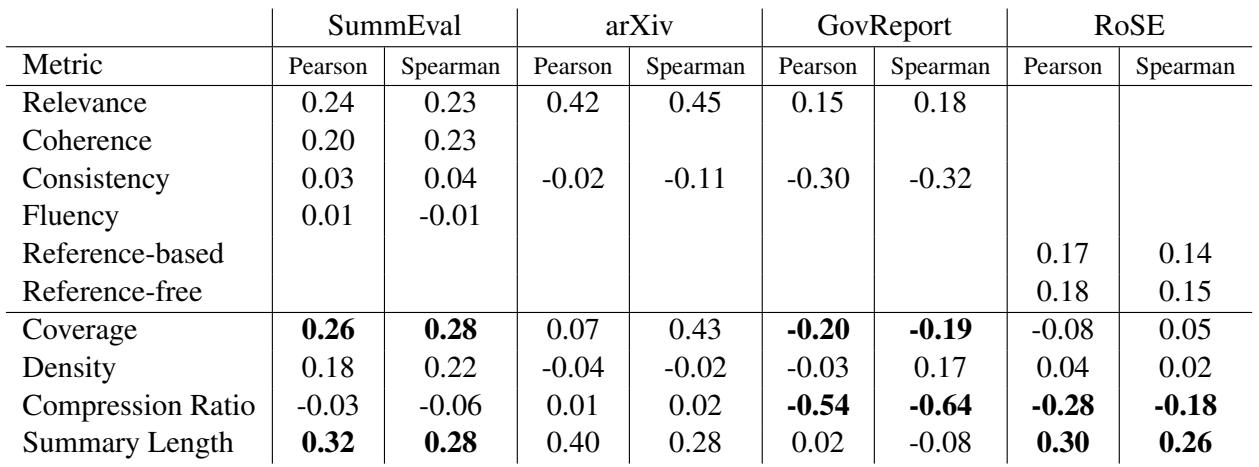
The table shows the correlation of the metric with things like “Summary Length” and “Compression Ratio.” While there is some correlation with coverage (which is expected—more relevant content implies better coverage), the correlations with “spurious” features are generally lower than the correlations with human relevance judgments (shown in other tables). This suggests the metric is genuinely measuring content quality, not just counting words.
Conclusion and Implications
This research addresses a critical gap in the NLP pipeline. As we move toward summarizing longer documents and using larger datasets, the reliance on expensive, potentially flawed human references becomes a liability.
The proposed metric offers a compelling solution:
- It is autonomous: No human references required.
- It is efficient: Simple math, no heavy GPU usage.
- It is effective: High correlation with human judgment on relevance.
- It is robust: It stabilizes evaluation when references are noisy.
Why does this matter for students?
For students entering the field of NLP, this paper teaches a valuable lesson: Always question your ground truth.
We often treat datasets as infallible, assuming that if the label says “X,” then “X” is the absolute truth. But in abstractive summarization, truth is subjective. By moving toward reference-free evaluation, we acknowledge that a summary’s quality depends on its relationship to the source, not its similarity to one specific human’s interpretation.
While LLMs are currently taking the spotlight as the ultimate evaluators, lightweight, interpretable metrics like this one remain essential. They provide a baseline that is transparent, reproducible, and incredibly fast—qualities that “black box” models simply cannot match.