](https://deep-paper.org/en/paper/2410.11782/images/cover.png)
Imagine you are managing a team of experts to solve a complex problem—say, designing a new software application. You have a programmer, a mathematician, a tester, and a project manager. How should they talk to each other?
Should they sit in a circle and shout ideas simultaneously? Should they pass a file down the line one by one? Or should they report to a central leader?
In the world of Large Language Models (LLMs), this is known as the Multi-Agent Communication Topology problem. We know that teams of AI agents outperform single models, but organizing them is tricky. If the structure is too simple, the agents might miss crucial insights. If it’s too complex, the cost (in terms of computing and money) skyrockets, and the noise can drown out the solution.
Today, we are diving deep into G-Designer, a novel framework proposed by researchers from CUHK, Tongji University, and others. G-Designer moves beyond static team structures. Instead, it uses Graph Neural Networks to dynamically design the perfect communication architecture tailored to the specific task at hand.
The Dilemma of Digital Teamwork
Before we understand the solution, we must understand the landscape of current multi-agent systems (MAS).
When researchers started connecting LLM agents, they looked at human organizational structures. As illustrated below, these structures fall into several categories:
- Chain: A sequential assembly line (A talks to B, B talks to C).
- Tree: Hierarchical structures where a root node manages subordinates.
- Star: A central hub communicates with all spokes.
- Graph: Complex networks, including complete graphs where everyone talks to everyone.
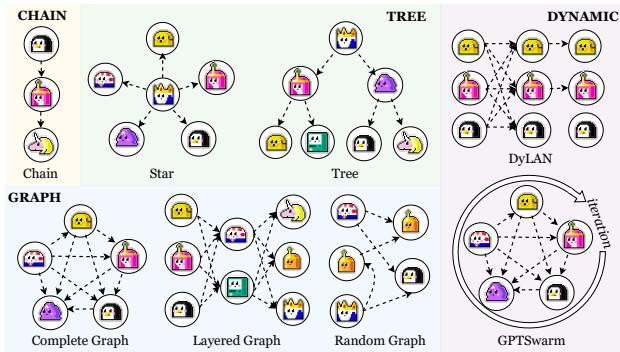
While these structures work, they are usually “static.” This means a researcher decides beforehand, “We will use a Chain structure for everything.”
The problem? Not every task requires a boardroom meeting.
The researchers highlighted this issue with a compelling comparison using the MMLU benchmark (a test covering massive multitask language understanding). They found that for easy tasks, like “High School Biology,” a simple Chain structure is efficient and effective. However, for “College Mathematics,” the Chain fails, and a complex GPTSwarm (a dynamic graph structure) is required to get the right answer.
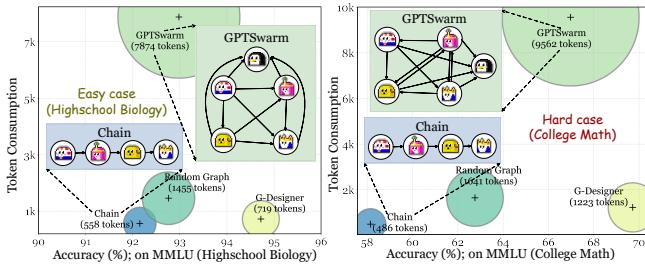
As shown in Figure 2, using a complex swarm for biology is overkill—it burns thousands of tokens (money) for marginal gain. Conversely, using a chain for calculus leads to failure.
Practitioners are left with a difficult question: How do I design a topology that maximizes performance while minimizing cost, without manually tweaking it for every single query?
The Proposed Protocol: MACP
To solve this, the authors first formalized what “success” looks like by proposing the Multi-Agent Communication Protocol (MACP). They argue that an optimal topology isn’t just about getting the right answer. It must satisfy three criteria:
- Effectiveness: It must solve the problem accurately.
- Adaptiveness: It should adjust its complexity based on the task difficulty (low overhead for easy tasks).
- Robustness: It should not collapse if one agent is attacked or makes a mistake.
Mathematically, they define the objective function as minimizing a combination of negative utility (bad performance), graph complexity (cost), and deviation under attack:

Here, \(\mathcal{G}\) is the graph (the team structure), \(u\) is the utility (performance), and \(||\mathcal{G}||\) represents the cost. The goal of G-Designer is to find the \(\mathcal{G}\) that balances this equation perfectly.
G-Designer: The Architect
G-Designer is an automated system that acts as the architect for the AI team. It takes a user query and a pool of agents, then uses deep learning to “draw” the blueprint for how those agents should interact.
The workflow operates in four stages: Materials, Construct, Design, and Optimize.
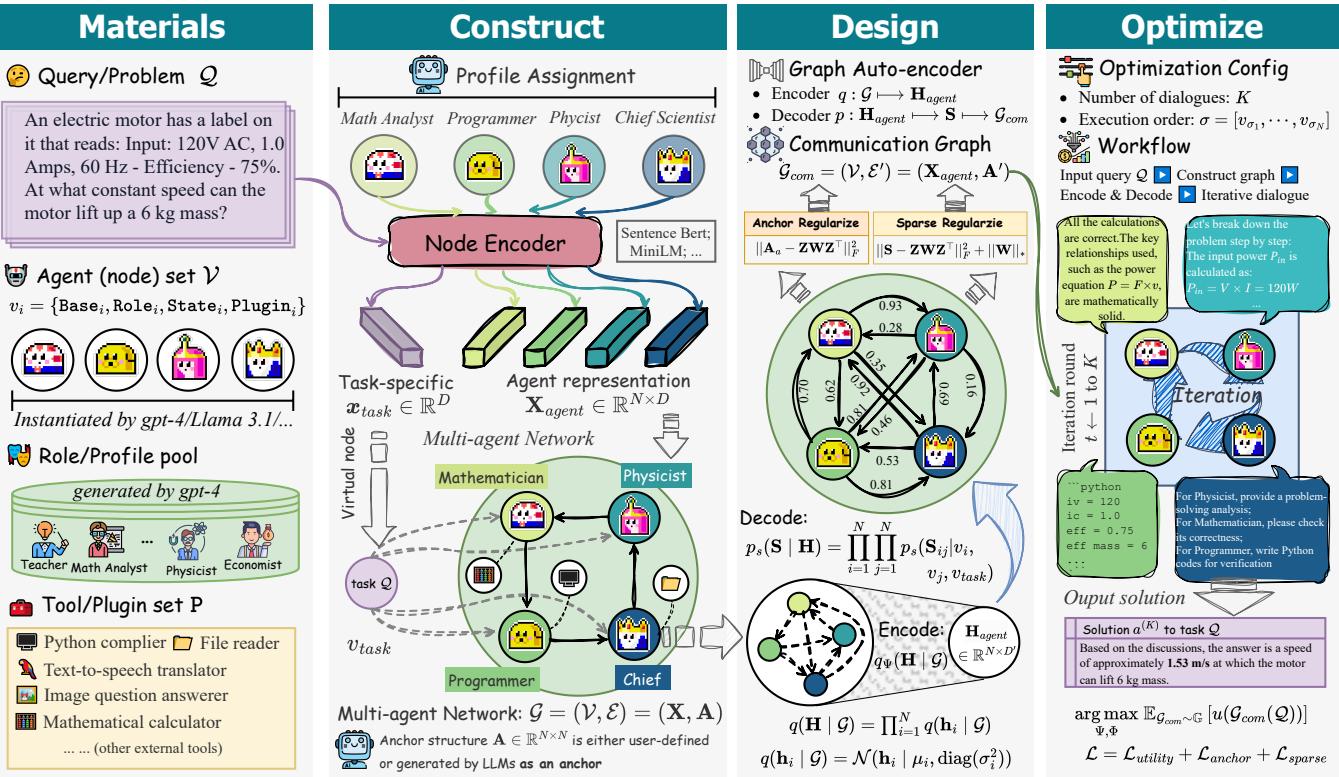
Let’s break down the technical magic happening in the Construct and Design phases.
1. Constructing the Network
First, G-Designer needs to understand who is on the team. It represents each agent (\(v_i\)) as a node containing its base LLM, its assigned role (e.g., “Math Analyst”), its state, and any tools it can use (e.g., a calculator or Python compiler).

To make this mathematically usable, G-Designer uses a Node Encoder (specifically a Sentence-BERT model) to turn these text descriptions into vector embeddings (\(\mathbf{x}_i\)).

The Task Node: This is a crucial innovation. G-Designer doesn’t just look at the agents; it adds a virtual task node (\(v_{task}\)) to the graph. This node represents the specific user query (e.g., “Calculate the velocity of…”). By connecting every agent to this task node, the system ensures the topology design is task-aware.
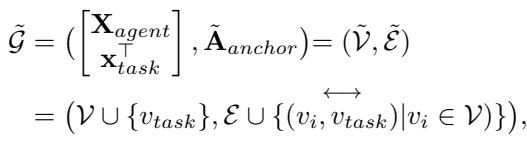
2. Designing via Variational Graph Auto-Encoders (VGAE)
Now that we have a graph of agents and a task, how do we decide who talks to whom? G-Designer uses a Variational Graph Auto-Encoder (VGAE).
Think of an auto-encoder as a compression algorithm. It takes the “raw” graph (which starts with a basic anchor structure, like a chain), compresses it into a latent (hidden) representation that captures the essential relationships, and then reconstructs it.
The Encoder (\(q\)): The encoder looks at the agents and the task and produces a probability distribution for the hidden representation (\(\mathbf{H}\)). It uses Graph Neural Networks (GNNs) to aggregate information.

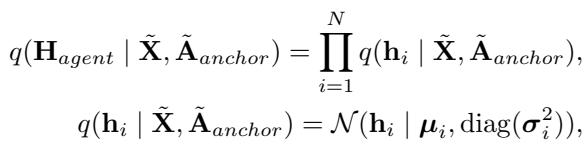
The Decoder (\(p\)): This is where the decision-making happens. The decoder takes those hidden representations and decides the probability of a connection (an edge) existing between any two agents.

It calculates the probability of an edge between agent \(i\) and agent \(j\) based on their features and the task features.

3. Regularization: Keeping it Clean
If we left the decoder to its own devices, it might create a messy, dense graph where everyone talks to everyone (a “complete graph”), which is expensive.
To enforce the Adaptiveness part of the MACP protocol, the authors introduce a specialized loss function during the decoding phase. They use Sparsity Regularization.
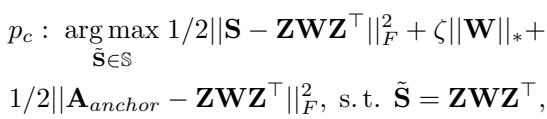
This equation does two things:
- Anchor Regularization: It keeps the topology somewhat close to a sensible starting point (the anchor), ensuring the design doesn’t go completely off the rails.
- Sparsity Regularization: It penalizes the system for adding too many connections (\(||\mathbf{W}||_*\)). This forces G-Designer to be economical—only adding a communication link if it is truly necessary for the task.
The result is a clean, efficient adjacency matrix \(\mathcal{E}_{com}\) that dictates the conversation flow.

4. Optimization via Policy Gradient
Finally, how does G-Designer learn? It uses Reinforcement Learning. The system generates a topology, the agents execute the task, and the system receives a reward based on the answer’s accuracy.
Because the process of selecting a graph is discrete (you either have an edge or you don’t), the authors use Policy Gradient methods to update the neural network parameters (\(\Theta\)).

This allows G-Designer to improve over time. If a specific structure (e.g., “Programmer talks to Reviewer”) consistently yields correct code, the network learns to predict that structure for similar future tasks.
Experimental Results
Does this complex architecture actually pay off? The authors tested G-Designer against state-of-the-art baselines like AutoGen, MetaGPT, DyLAN, and GPTSwarm across six major benchmarks, including math reasoning (GSM8K) and code generation (HumanEval).
1. Performance Superiority
The results in Table 1 are striking. G-Designer achieves the highest performance in almost every category.
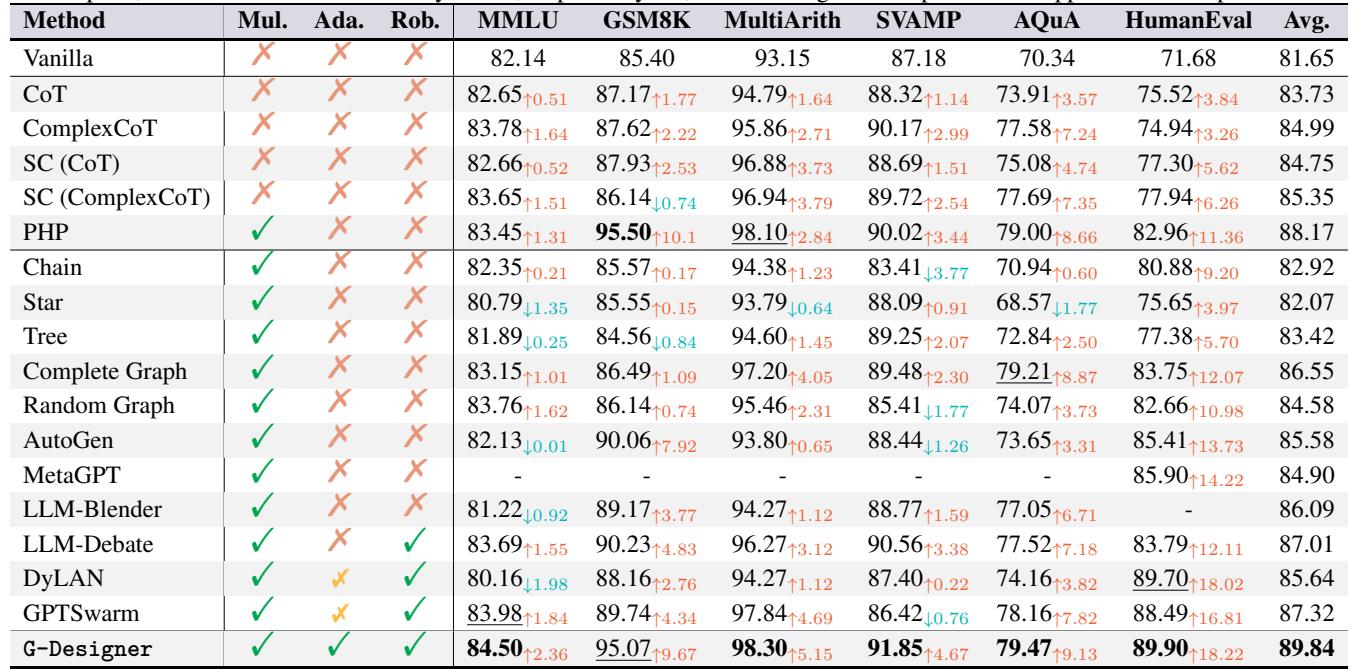
For example:
- On MMLU, G-Designer reached 84.50% accuracy, beating GPTSwarm.
- On HumanEval (coding), it reached 89.90% pass rate, significantly higher than the standard Chain or Star topologies.
2. Efficiency (Token Consumption)
High accuracy usually comes with a high price tag in tokens. However, because G-Designer aggressively prunes unnecessary connections via its sparsity regularization, it remains incredibly efficient.
The bubble charts below visualize this trade-off. The ideal spot is the bottom-right (high accuracy, low token consumption).
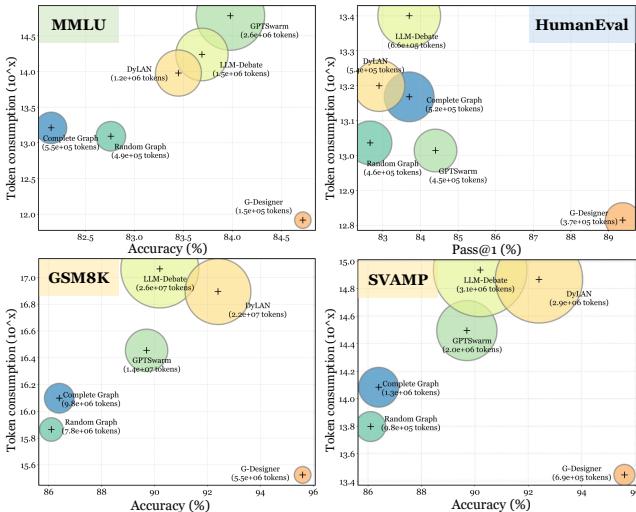
Look at the GSM8K (bottom-left) and MMLU (top-left) plots.
- GPTSwarm (large bubbles) sits high on the Y-axis, consuming massive amounts of tokens.
- G-Designer sits lower on the Y-axis but further to the right on the X-axis (accuracy).
- On HumanEval, G-Designer reduces token consumption by up to 92.24% compared to heavy baselines, while still winning on accuracy.
3. Adversarial Robustness
One of the most surprising findings was G-Designer’s resilience. In multi-agent systems, if a malicious prompt (“jailbreak”) affects one agent, the bad information often spreads like a virus through the network.
The researchers simulated attacks on the agents. As shown in Figure 5, standard structures like Chain, Tree, and even AutoGen suffered significant performance drops (the difference between the brown and blue bars).
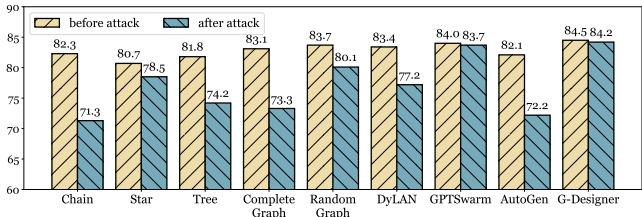
G-Designer (far right) remained almost perfectly stable, with a drop of merely 0.3%. Why? Because the topology is dynamic. The VAG-Encoder detects the features of the compromised node and, during the design phase, can effectively isolate or bypass the “infected” agent, preventing the bad logic from contaminating the final result.
Comparison with Other Methods
To understand where G-Designer fits, let’s look at the efficiency analysis in Table 2.
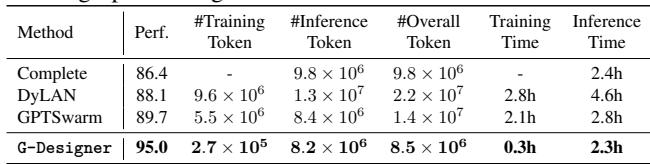
While methods like DyLAN and GPTSwarm take hours to train or infer and consume tens of millions of tokens, G-Designer optimizes in a fraction of the time (0.3h vs 2.1h for GPTSwarm) and uses significantly fewer training tokens. This makes it not just a theoretical novelty, but a practical tool for deployment.
Conclusion
G-Designer represents a significant leap forward in “Agentic AI.” It moves us away from rigid, human-designed workflows toward systems that self-organize. By treating the communication structure as a learnable graph problem, G-Designer proves that how agents talk is just as important as what they know.
Key takeaways for students and practitioners:
- One size fits none: Static topologies (Chains, Stars) are inefficient for diverse workloads.
- Less is more: You don’t need a “complete graph” where everyone talks to everyone. A sparse, intelligent graph saves money and improves clarity.
- Graph Neural Networks are not just for social networks or molecular chemistry; they are powerful tools for architecting the internal logic of AI systems.
As LLMs continue to evolve, tools like G-Designer that automate the “management” of these models will be essential for building scalable, robust, and economically viable AI applications.