](https://deep-paper.org/en/paper/2410.12048/images/cover.png)
Introduction
In the age of information overload, the ability to distinguish between a sound argument and a deceptive one is more critical than ever. We often rely on Large Language Models (LLMs) to summarize news, analyze debates, or verify facts. However, while LLMs are incredibly fluent in generating text, they frequently struggle with the nuance of logical reasoning. They can be easily swayed by arguments that sound coherent but are structurally flawed.
This brings us to the problem of Logical Fallacy. A logical fallacy is a pattern of reasoning that is invalid or faulty. Consider the statement: “The region reports flu incidents after people took the vaccination; therefore, vaccinations cause the flu.” This is a classic “False Cause” fallacy (specifically post hoc ergo propter hoc). The sentence uses strong logical markers like “therefore” and “cause,” which might trick a standard language model into perceiving a valid causal relationship where none exists.
In a recent paper titled “Boosting Logical Fallacy Reasoning in LLMs via Logical Structure Tree,” researchers Yuanyuan Lei and Ruihong Huang propose a novel solution. They argue that LLMs fail to detect these fallacies because they process text sequentially and often miss the hierarchical structure of the argument. Their solution is to explicitly model the logic using a Logical Structure Tree (LST).
In this post, we will break down how this method works, how it bridges the gap between linguistic semantics and logical structure, and why it significantly boosts the performance of models like Llama-2 and T5 in detecting misinformation.
Background: The Deception of Connectives
To understand why this research is necessary, we must first understand how fallacies disguise themselves. Logical fallacies often rely on discourse connectives—words like “because,” “therefore,” “however,” and “likewise”—to indicate a relationship between two ideas.
In a valid argument, the content supports the relationship. In a fallacy, there is a mismatch. The connective implies a relationship (e.g., Causality) that the semantic content (the actual meaning of the text) does not support.
Standard LLMs, which process text as a sequence of tokens, sometimes over-index on these connective words or fail to verify if the surrounding text actually justifies their use. Existing detection methods often treat the text as a flat sequence or mask out content words entirely, missing the interplay between the structure and the content.
The researchers hypothesize that if we can force the model to explicitly “see” the logical hierarchy—separating the connectives from the arguments—we can help it recognize when the two don’t match.
The Core Method: The Logical Structure Tree
The heart of this approach is the Logical Structure Tree (LST). This is a hierarchical representation of a sentence where:
- Non-terminal nodes (Parents) are the relation connectives (e.g., “therefore,” “likewise”).
- Terminal nodes (Children) are the textual arguments (the actual claims).
This tree structure allows the model to track the “logic flow” of the statement.
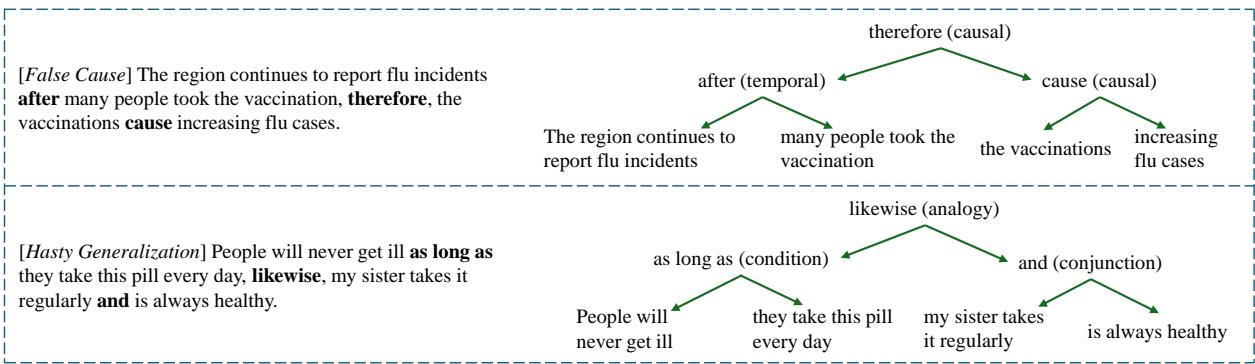
As seen in Figure 1, looking at the top example (False Cause), the tree isolates the connective “therefore (causal)” as the root. It then branches out to the premise (“after many people took the vaccination…”) and the conclusion (“vaccinations cause increasing flu cases”). This explicit separation makes it easier to ask: Does the left branch actually support the right branch via this specific connective?
Step 1: Building the Taxonomy
Before constructing the tree, the researchers established a taxonomy of logical relations. They identified ten common logical relations used in argumentation, such as Conjunction, Contrast, Condition, and Causal.
For each relation, they compiled a list of trigger words (connectives).
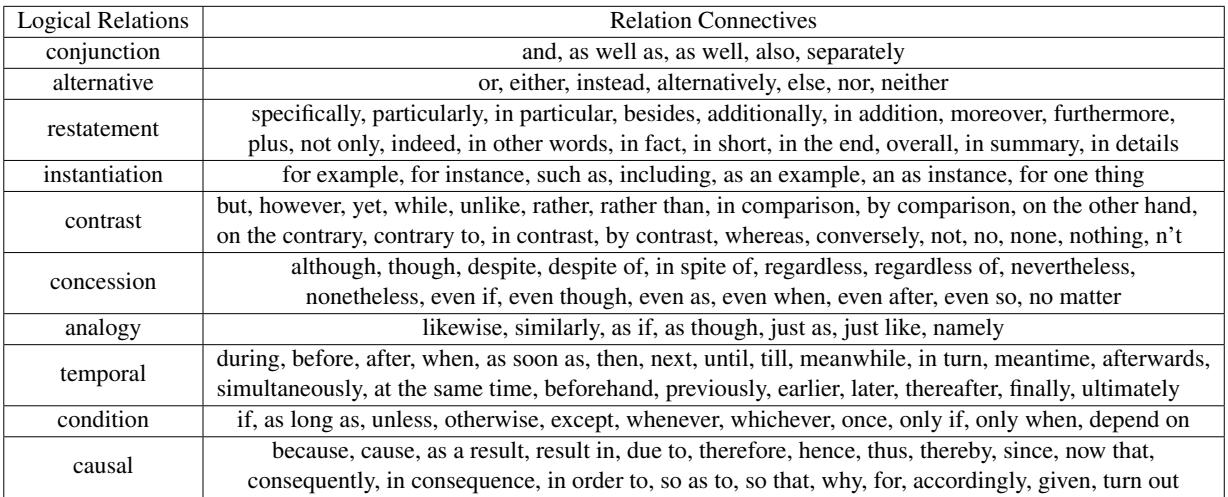
As shown in Table 1, if a sentence contains “as long as,” it flags a Condition relation. If it contains “likewise,” it flags an Analogy. This taxonomy acts as the dictionary for building the logical tree.
Step 2: Constructing the Tree
Constructing this tree does not require human annotation (which is expensive and slow). Instead, the authors use an unsupervised, rule-based algorithm:
- Constituency Parsing: First, they use a standard NLP tool (Stanza) to generate a constituency tree, which breaks the sentence into grammatical phrases.
- Top-Down Search: They traverse this tree to find any connective words from their taxonomy (Table 1).
- Recursive Splitting: Once a connective is found, it becomes a parent node. The text creates a left child (Argument 1) and a right child (Argument 2). The algorithm then recursively searches the children for more connectives.
This results in a structured tree that captures the full logical depth of the sentence, not just the linear sequence of words.
Step 3: Integrating the Tree into LLMs
Having a tree is useful, but LLMs cannot “read” trees directly—they consume text or vectors (embeddings). The researchers developed two complementary strategies to feed this structural information into the LLM.
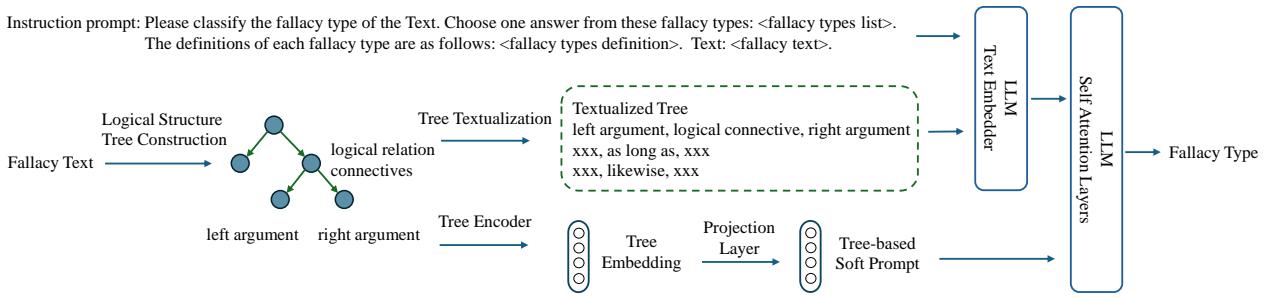
Figure 2 illustrates the overall architecture with two parallel paths:
- Textualized Tree (Upper Path): Converting the tree into a text description.
- Tree-based Soft Prompt (Lower Path): Converting the tree into a mathematical embedding.
Strategy A: The Textualized Tree (Hard Prompt)
The simplest way to use the tree is to describe it in natural language. The researchers convert the tree into a structured table format listing the Left Argument, Logical Relation, and Right Argument.
This textual description is processed by the Text Embedder and appended to the model’s input prompt.

In this equation, \(h_t\) represents the embedding of the text description of the tree. This acts as a “Hard Prompt”—explicit text instructions telling the LLM what the logical structure looks like.
Strategy B: Tree-based Soft Prompt (Embedding)
The second strategy is more sophisticated. It involves encoding the tree directly into a vector space that the LLM can understand, serving as a “Soft Prompt.” A soft prompt is a learnable vector that is inserted into the input sequence, acting like a virtual token that guides the model’s behavior.
To do this, they build the embedding bottom-up:
1. The Base Encoder: For a simple logical unit (a connective with two text arguments), they calculate the embedding \(e_s\) using a relation-specific encoder \(W^r\).

Here:
- \(e_l\) and \(e_r\) are the embeddings of the left and right text arguments (from RoBERTa).
- \(e_c\) is the embedding of the connective word.
- \(\oplus\) denotes concatenation.
- \(W^r\) and \(b^r\) are distinct neural network weights for that specific relation type (e.g., a “Causal” encoder is different from a “Contrast” encoder).
2. The Recursive Step: For hierarchical trees, the embedding of a parent node is calculated using the embeddings of its children subtrees (\(\hat{e}_l\) and \(\hat{e}_r\)).

This ensures that the final vector \(e_t\) (at the root) contains compressed information about the entire logical structure below it.
3. Projection: Finally, since the tree encoder (based on RoBERTa dimensions) might not match the target LLM’s dimension (e.g., Llama-2 or T5), a projection layer aligns the dimensions.

The resulting \(\hat{e}_t\) is inserted into the LLM as a soft prompt, allowing the model to “feel” the logical structure mathematically, complementing the explicit text description from Strategy A.
Experiments and Results
The researchers tested their method on four diverse datasets: Argotario, Reddit, Climate (Climate Change articles), and Logic (Educational materials). They performed two tasks:
- Fallacy Detection: Simply answering “Yes” or “No”—does this text contain a fallacy?
- Fallacy Classification: Identifying exactly which fallacy (e.g., Ad Hominem, Slippery Slope) is present.
Does the Tree Help?
The results showed consistent improvements across the board. Incorporating the Logical Structure Tree (LST) improved F1 scores by up to 3.45% for detection and 6.75% for classification.
To understand exactly what part of the system contributed to this success, the authors performed an Ablation Study. They tested the model using only the textualized tree (Hard Prompt), only the tree embedding (Soft Prompt), and both combined.
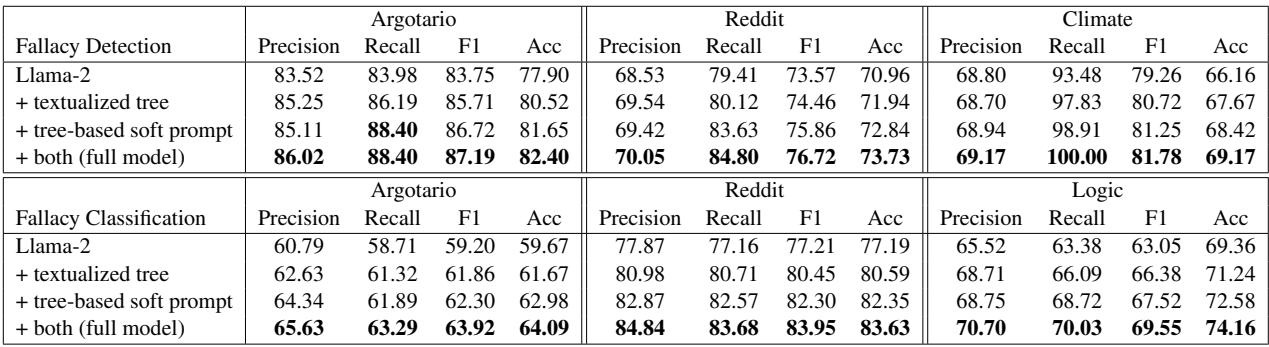
Table 5 reveals several key insights:
- Both strategies work: Using just the textualized tree or just the soft prompt improves performance over the baseline Llama-2 model.
- Soft Prompt is slightly stronger: The tree-based soft prompt generally outperforms the textualized version, suggesting that the dense mathematical representation captures nuance that raw text descriptions might miss.
- Combination is Best: The “Full Model” (combining both) achieves the highest scores. The hard prompt gives the LLM explicit instructions, while the soft prompt provides a rich signal for fine-tuning.
Performance by Fallacy Type
One of the most interesting findings is that the LST helps with some fallacies more than others. The researchers analyzed the performance changes for specific fallacy types on the Reddit dataset.

Looking at Table 7, we see massive jumps in performance for:
- Irrelevant Authority: +10.26%
- Ad Populum: +14.64%
- Naturalistic Fallacy: +5.25%
This makes sense because these fallacies rely heavily on structural patterns (e.g., Ad Populum often uses specific connectives linking a premise about “the majority” to a conclusion of “truth”).
However, for fallacies that rely heavily on pure sentiment rather than logic structure, such as Appeal to Emotion (shown in other datasets), the improvement was less dramatic. This confirms that the model is specifically boosting the reasoning capabilities related to logical structure.
Conclusion
The paper “Boosting Logical Fallacy Reasoning in LLMs via Logical Structure Tree” presents a compelling step forward in making AI more logically robust. By acknowledging that logical fallacies are often structural traps disguised by connective words, the researchers successfully designed a method to unmask them.
Key takeaways for students and practitioners:
- Structure matters: Treating text as a flat sequence isn’t enough for complex reasoning. Hierarchical trees provide necessary context.
- Hybrid approaches work: Combining symbolic-style structures (trees/parsing) with neural networks (LLM embeddings) often yields better results than either approach alone.
- Hard vs. Soft Prompts: The study demonstrates that explicit text instructions (Hard Prompts) and latent vector tuning (Soft Prompts) are complementary techniques in Prompt Engineering.
As LLMs continue to integrate into high-stakes environments like news verification and education, techniques like the Logical Structure Tree will be essential in ensuring these models can reason soundly, rather than just sounding like they do.