](https://deep-paper.org/en/paper/2410.13098/images/cover.png)
Introduction
In the current landscape of Artificial Intelligence, data is the new oil, but the wells are running dry. From the early days of BERT to the massive scale of GPT-4, the growth of Language Models (LMs) has been fueled by an exponential increase in training data. However, we are approaching a critical bottleneck: high-quality, human-annotated data is expensive, slow to produce, and difficult to scale for specialized tasks.
Faced with this “data hunger,” researchers and engineers have turned to a promising alternative: Synthetic Data. If modern Large Language Models (LLMs) are so smart, why not ask them to generate the training data for the next generation of models? It sounds like the perfect perpetual motion machine—AI teaching AI, eliminating the need for costly human labor.
But is it really that simple? Can we completely remove humans from the loop without consequences?
A fascinating research paper titled “A Little Human Data Goes A Long Way” by Dhananjay Ashok and Jonathan May investigates this exact question. Focusing on Fact Verification (FV) and Question Answering (QA), the researchers explore what happens when you incrementally replace human data with synthetic data.
Their findings reveal a surprising “cliff edge” in performance. While you can get away with a significant amount of automation, completely eliminating human insight leads to drastic failures. More importantly, they discover that adding a tiny “sprinkle” of human data—as little as 125 examples—can rescue a model’s performance.
In this deep dive, we will unpack their methodology, analyze the “synthetic cliff,” and explore the economic trade-offs of human versus machine annotation.
The Background: The Promise and Peril of Synthetic Data
Before understanding the solution, we must understand the problem. For complex Natural Language Processing (NLP) tasks, models usually require supervised fine-tuning. This means showing the model thousands of examples of “input” and “correct output.”
For example:
- Fact Verification (FV): Given an evidence text (e.g., a news article), determine if a specific claim is True or False.
- Question Answering (QA): Given a paragraph, answer a specific question based on that text.
Traditionally, creating these datasets requires humans to read texts, formulate claims or questions, and label them. This is slow and expensive.
The Synthetic Approach
The alternative is using a powerful LLM (like GPT-4 or GPT-3.5) to act as the annotator. You feed the LLM an evidence text and prompt it: “Generate a true claim based on this text” or “Write a question and answer pair for this paragraph.” Suddenly, you have infinite training data at a fraction of the cost.
However, prior research has shown mixed results. While synthetic data helps in pre-training, relying on it entirely for specific tasks can lead to “model collapse” or degradation. This paper provides the first systematic investigation into the ratio of human-to-synthetic data for FV and QA tasks.
The Core Method: Mixing Man and Machine
The researchers aimed to simulate a scenario where a developer has a fixed budget for training data but can choose the source. To do this, they selected eight diverse datasets covering science, news, social media, and fiction.
The Generation Pipeline
The team used a method called Few-Shot In-Context Learning. They took a powerful “Prompt Model” (GPT-3.5-Turbo) and showed it three real human examples of (Evidence, Claim, Label). Then, they provided a new evidence text and asked the model to generate a new data point.
This resulted in a “shadow dataset” for every human dataset—same size, same evidence texts, but with synthetic labels and questions.
The Experiment: The Incremental Replacement
Here is the heart of the study. The researchers trained multiple smaller models (like Llama-3 and Mistral) on datasets of a fixed size (e.g., 5,000 examples).
They didn’t just compare “All Human” vs. “All Synthetic.” Instead, they varied the Synthetic Fraction from 0.0 (all human) to 1.0 (all synthetic).
- Synthetic Fraction 0.5: 2,500 human points + 2,500 synthetic points.
- Synthetic Fraction 0.9: 500 human points + 4,500 synthetic points.
- Synthetic Fraction 1.0: 5,000 synthetic points.
This allowed them to plot a performance curve to see exactly when the model starts to fail.
The Results: The “Synthetic Cliff”
The results of this experiment revealed a striking pattern across almost every dataset tested.
1. The Stability Zone (0% to 90%)
At first glance, synthetic data looks incredibly powerful. As the researchers increased the synthetic fraction from 0% up to 80% or even 90%, the model’s performance barely dropped. In some cases, it remained statistically identical to the fully human-trained model.
This is a massive win for efficiency. It suggests that you can generate the vast majority of your training data cheaply using LLMs without sacrificing accuracy.
2. The Crash (90% to 100%)
However, the story changes dramatically at the very end of the spectrum. As the dataset approaches 100% synthetic (pure automation), performance nosedives.
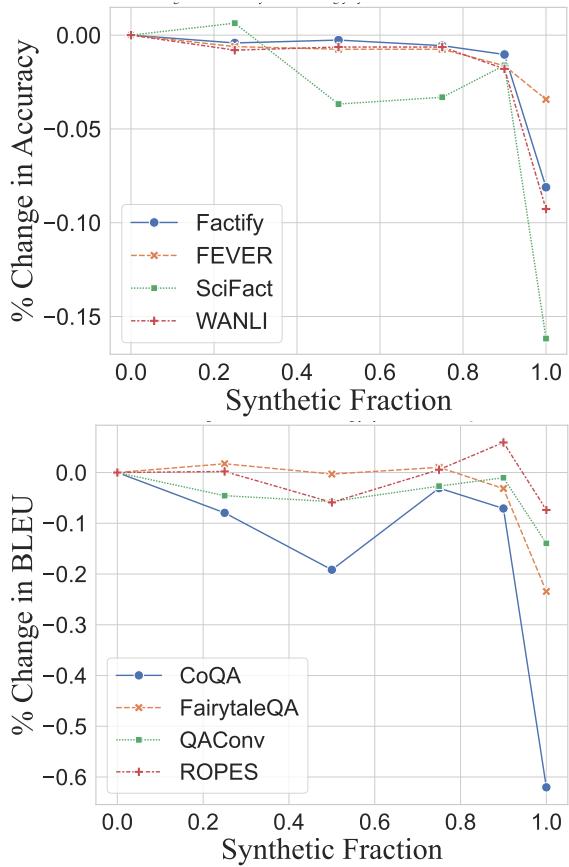
Figure 1 above illustrates this phenomenon. Look at the top chart (Accuracy for Fact Verification). The lines for datasets like Factify (blue) and SciFact (green) stay relatively flat for a long time. But look at the far right of the x-axis. As the Synthetic Fraction moves from 0.9 to 1.0, the curves drop sharply.
The bottom chart (BLEU scores for QA) shows an even more dramatic decline for datasets like CoQA and ROPES. The message is clear: You can replace most humans, but you cannot replace all humans.
3. The Magic of 2.5%
To understand this crash better, the researchers zoomed in on the interval between 95% and 100%. They tested distinct splits: 95% synthetic, 97.5% synthetic, and 100% synthetic.
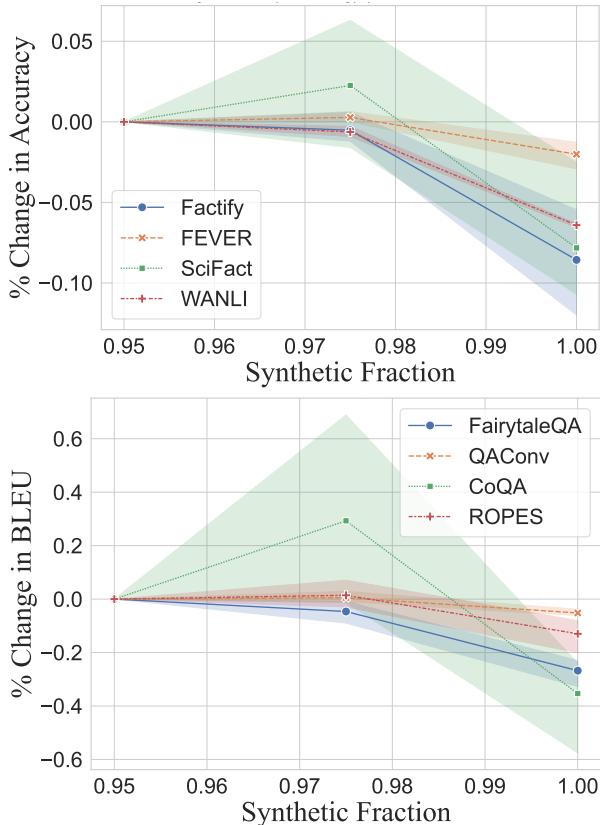
Figure 2 shows this close-up view.
- The x-axis represents the synthetic fraction (0.95 to 1.0).
- The y-axis represents the change in performance.
Notice the slope. The difference between 97.5% synthetic (where 2.5% of the data is human) and 100% synthetic is significant. For a dataset of 5,000 points, 2.5% is just 125 data points.
This is the paper’s “headline” finding: Including as few as 125 human-generated examples can prevent the performance collapse associated with fully synthetic training. A tiny amount of human signal stabilizes the noise of thousands of synthetic examples.
The Economic Trade-off: What is a Human Worth?
If a little human data is necessary, how do we decide if it’s “worth” the cost? Human annotation is expensive (paying workers), while synthetic annotation is cheap (API costs).
The researchers quantified this by asking: How many additional synthetic points does it take to match the performance gain of adding just 200 human points?
Imagine you have a purely synthetic dataset. You have two choices to improve accuracy:
- Pay humans to create 200 new examples.
- Pay OpenAI/Anthropic to generate \(N\) thousand new synthetic examples.
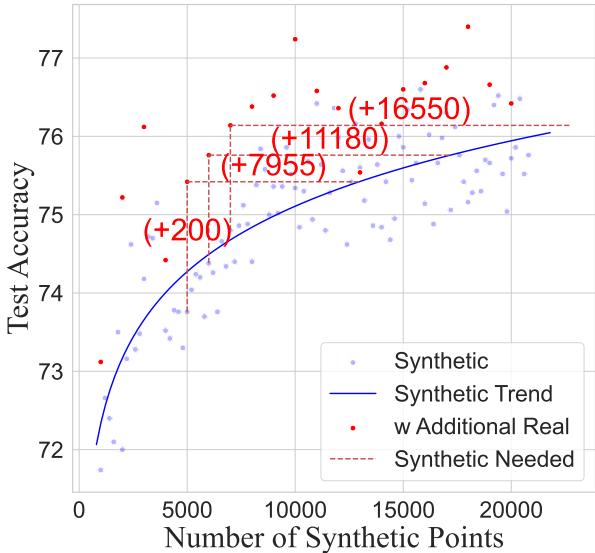
Figure 4 visualizes this trade-off for the WANLI dataset.
- The Blue Line shows the slow, logarithmic improvement of adding more synthetic data.
- The Red Dots show the jump in performance when adding small batches of human data.
The annotation (+16550) indicates that to match the accuracy gain provided by those human points, you would have needed 16,550 additional synthetic points.
The “Price Ratio”
This helps researchers calculate a break-even point. If generating a synthetic point costs \(0.01, and a human point costs \)0.50, the human point is 50x more expensive. However, if the human point provides 80x the value (in terms of data efficiency), then human annotation is actually the more cost-effective solution.
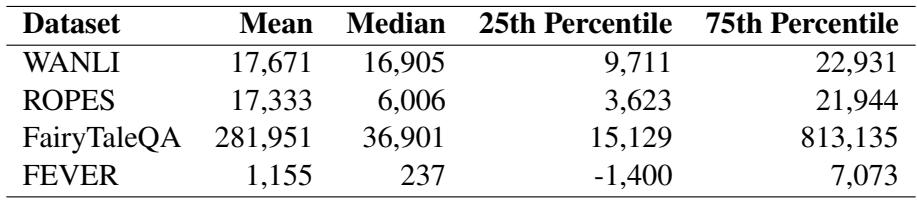
Table 1 (above) breaks this down for other datasets.
- For FairyTaleQA, the number is astronomical (281,951). This suggests that for some complex tasks, synthetic data hits a “ceiling” that it simply cannot break through, no matter how much you generate. Human data unlocks performance that synthetic data cannot reach.
Why Does This Happen? The “Uncanny Valley” of Data
Why is synthetic data inferior at the extremes? Is it just hallucinating? The authors conducted a detailed analysis of the linguistic properties of the data to find out.
1. Synthetic Data is Too Verbose
One of the most consistent findings in LLM research is that models love to talk.
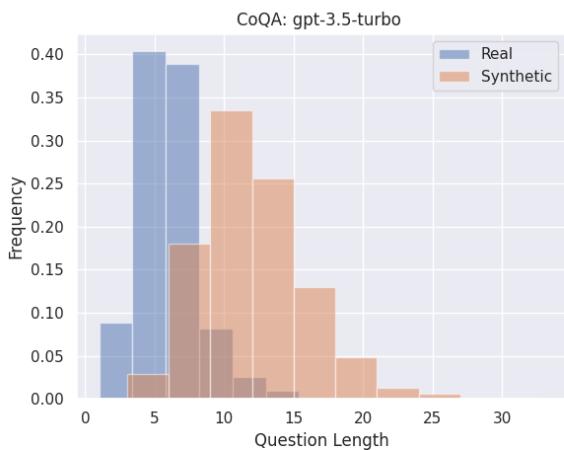
Figure 5 compares the length of questions in the CoQA dataset. The blue bars (Real) are shifted to the left, indicating shorter, punchier questions. The orange bars (Synthetic) are shifted right. Synthetic data tends to be flowery and verbose, which might confuse a model being trained for concise reasoning.
2. The “Lazy” Human Bias
Interestingly, the researchers found that synthetic models are actually more thorough than humans in some ways—but this works against them.
When humans write questions based on a text, they are “cognitively miserly.” They tend to pick answers found at the very beginning of the paragraph to finish the task quickly. Synthetic models, having no fatigue, pick information uniformly from the entire text.
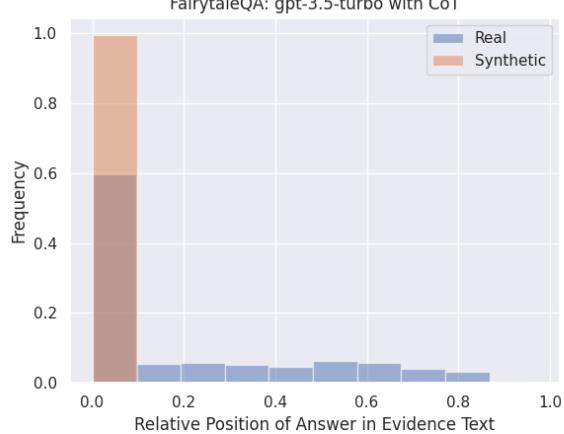
Figure 22 illustrates the “Relative Position” of the answer within the evidence text.
- Blue (Real): Notice the massive spike at
0.0(the start of the text). Humans love the first sentence. - Brown (Synthetic): The distribution is flatter and more spread out.
While the synthetic distribution seems “better” (more diverse), the downstream models trained on human data expect the human distribution. The synthetic data is too perfect, lacking the specific biases and patterns of human communication that we often want our systems to replicate.
3. Extractiveness
The study also found that synthetic claims and questions have higher n-gram overlap with the source text. In simple terms, AI annotators like to copy-paste. Humans are more likely to rephrase, abstract, or use synonyms. This “abstractiveness” forces the model to learn actual semantic meaning rather than just pattern-matching words.
Robustness: Is this just a fluke?
One might wonder if these results are specific to the English language or the specific models used. The authors covered their bases here.
Multilingual Validation
They ran the same experiments on X-Fact, a multilingual dataset, covering Arabic, Georgian, and Indonesian.
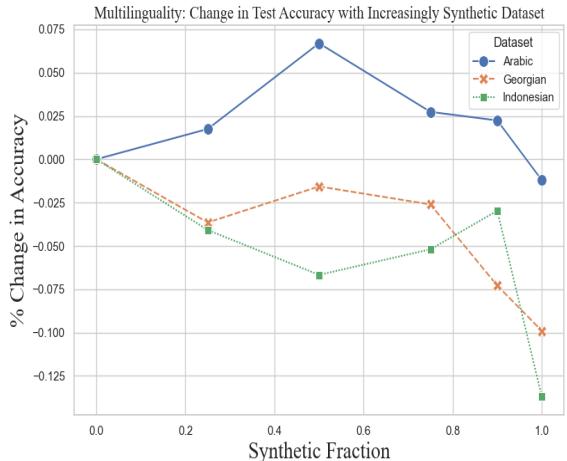
Figure 9 shows that the trend holds globally. Whether in Arabic or Indonesian, increasing synthetic data to 100% causes a performance drop. Interestingly, the “drop-off” point varies by language, likely due to how “low-resource” the language is, but the necessity of human data remains constant.
Different Models
They also verified that this isn’t just an artifact of using GPT-4 or Llama-2.
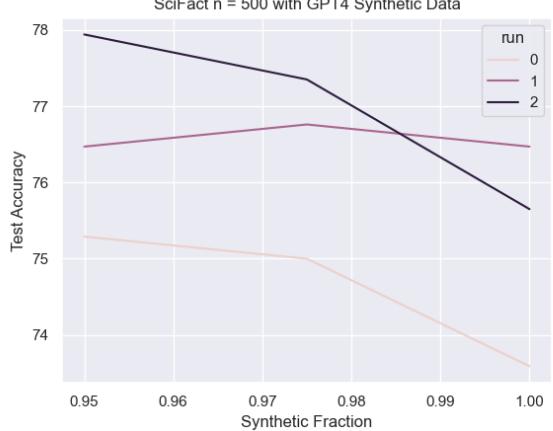
Figure 11 confirms that even when using different fine-tuning models (like Mistral 7B) or different prompting models (GPT-4), the cliff edge at 100% synthetic remains.
Conclusion and Implications
The paper “A Little Human Data Goes A Long Way” provides a crucial correction to the “scale is all you need” narrative. As we move toward a world dominated by AI-generated content, this research highlights the irreplaceable value of human cognition.
Key Takeaways for Students and Practitioners:
- Don’t Go 100% Synthetic: If you are building a dataset, you can save a lot of money by generating 90% of it with AI. But you must invest in human annotation for that final 10% (or even just the final 2.5%).
- The “Golden Set” Strategy: A smart workflow is to use massive synthetic datasets for the bulk of training (the heavy lifting) and then fine-tune or “align” the model with a small, high-quality human dataset.
- Cost-Benefit Analysis: Don’t assume synthetic is always cheaper. If you need 200,000 synthetic examples to match the quality of 200 human examples, the API costs might actually outweigh the cost of human labor.
- Quality over Quantity: The unique properties of human data—abstraction, brevity, and even our specific biases—provide a signal that current LLMs struggle to simulate.
In the end, AI is not replacing humans in the data loop; it is changing our role. We are moving from being the “factory workers” producing every single data point to being the “craftsmen” providing the high-quality examples that guide the machines. A little human data truly goes a long way.