](https://deep-paper.org/en/paper/2410.13179/images/cover.png)
Imagine you are preparing for a difficult exam. If you simply flip through your textbook and read random pages—some of which are blank, some containing trivial information you already know, and only a few containing complex concepts—your study session won’t be very efficient. A better strategy would be to identify the topics you find most difficult and focus your energy there. Furthermore, you wouldn’t start with the hardest problems on day one; you would start with the basics and progressively tackle harder questions as you get smarter.
This intuitive human learning process is exactly what researchers from the University of Maryland have applied to Artificial Intelligence in their paper, EH-MAM: Easy-to-Hard Masked Acoustic Modeling.
In the world of Self-Supervised Learning (SSL) for speech, models usually learn by guessing missing parts of an audio signal. Traditionally, these missing parts are chosen at random. EH-MAM changes the game by asking: Why mask silence or simple sounds? Why not force the model to solve the hardest parts of the speech?
In this post, we will dive deep into how EH-MAM works, the “easy-to-hard” curriculum strategy it employs, and why this approach sets a new state-of-the-art for low-resource speech recognition.
The Problem with Randomness
To understand EH-MAM, we first need to understand the current landscape of Self-Supervised Learning in speech. Models like wav2vec 2.0 and HuBERT rely on a technique called Masked Acoustic Modeling (MAM). The model receives an audio waveform, but certain time-steps (frames) are masked out (hidden). The model’s job is to use the surrounding context to reconstruct or predict what was in those masked frames.
The standard approach is Random Masking. The algorithm simply picks frames to hide without looking at the audio content.
The problem? Speech is non-uniform. An audio file contains silence, background noise, and highly predictable stationary sounds. If the model is asked to reconstruct a silent frame, it learns very little—it’s too easy. Conversely, if it masks a critical transition between phonemes, the learning signal is strong.
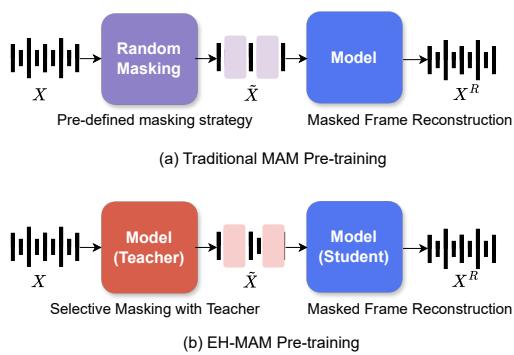
As illustrated in Figure 1 above, random masking treats all frames equally. EH-MAM, however, introduces a Selective Masking strategy. It uses a “Teacher” model to scan the audio first, identify the regions that are hardest to reconstruct, and then specifically masks those regions for the “Student” model to learn.
The Hypothesis: Harder is Better
The core hypothesis behind this paper is simple: Hard regions serve as stronger learning signals.
If a specific segment of audio is difficult for the model to reconstruct, it likely contains complex acoustic information or semantic context that the model hasn’t fully grasped yet. By focusing on these areas, the model should theoretically learn more robust representations.
The researchers validated this hypothesis with a preliminary experiment. They compared the Word Error Rate (WER) of a model when using random masking versus selective masking (masking frames with high reconstruction error).
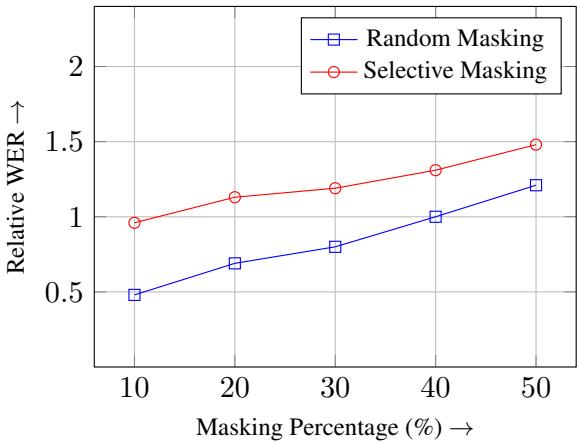
As shown in Figure 2, selective masking consistently results in a higher relative WER during inference compared to random masking. This confirms that these “hard” frames indeed carry more critical information. If they are masked, the model struggles more, which implies that correctly reconstructing them requires a deeper understanding of the speech context.
The EH-MAM Architecture
EH-MAM operates on a Teacher-Student framework, similar to other self-distillation methods like data2vec. The goal is for the Student network to reproduce the representations of the Teacher network.
Here is the high-level workflow:
- Input: A speech sample \(Z\) is fed into the Teacher.
- Difficulty Assessment: The Teacher predicts how hard each frame is to reconstruct (the loss value).
- Masking: Based on these predictions, a mask is generated. This mask covers a mix of random frames and “hard” frames.
- Reconstruction: The masked input is fed to the Student. The Student tries to reconstruct the Teacher’s original representations for the masked parts.
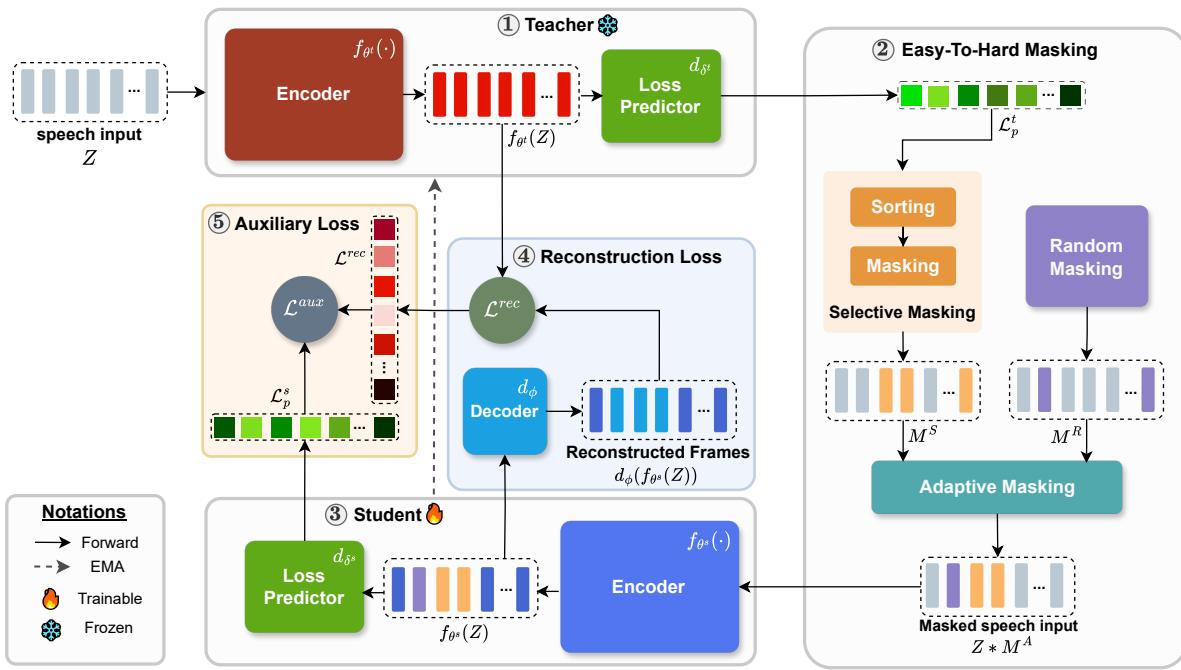
Let’s break down the key components illustrated in Figure 3.
1. The Teacher and Student Setup
The Student and Teacher are identical neural networks. The Student is updated via gradient descent (standard training), while the Teacher is updated via an Exponential Moving Average (EMA) of the Student’s weights. This ensures the Teacher is slightly more stable and provides consistent targets.

2. The Loss Predictor
This is where EH-MAM innovates. How does the model know which frames are “hard” before it masks them?
The researchers introduced a lightweight Loss Predictor module (\(d_{\delta}\)). This small convolutional network sits on top of the encoder. Its job is to look at the speech representations and predict the reconstruction loss for each frame.
If the predictor thinks frame \(t\) will result in a high reconstruction error, the system flags it as a “hard region.”
3. The Easy-to-Hard Curriculum
You might think the best strategy is to only mask the hardest frames. However, the researchers found that jumping straight into the “deep end” is detrimental.
In the early stages of training, the model is untrained and “dumb.” It finds everything hard to reconstruct. The reconstruction losses are high everywhere, and the Loss Predictor hasn’t learned to rank difficulty effectively yet.
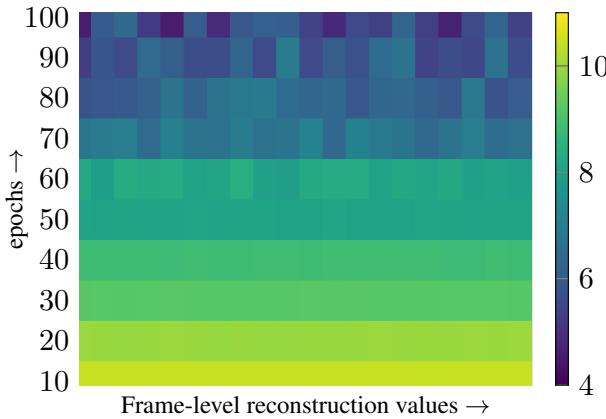
Figure 4 illustrates this phenomenon. At the start of training (bottom of the y-axis), reconstruction values are uniformly high (yellow/bright). There is low distinctiveness between frames. If we applied selective masking here, it would be stochastic and noisy.
To solve this, EH-MAM uses an Easy-to-Hard Masking Strategy:
- Early Training: The model uses mostly Random Masking. This allows the model to learn basic patterns and simple statistics of speech (the “Easy” phase).
- Late Training: As the epochs progress, the algorithm linearly increases the proportion of Selective Masking (masking hard regions). This forces the model to refine its understanding and focus on complex context (the “Hard” phase).
This progression mimics human learning: master the basics, then tackle the edge cases.
The Mathematics of Difficulty
To make this system work, the model needs to optimize two things simultaneously: reconstructing the audio and correctly predicting which parts are hard.
The Reconstruction Loss
The primary goal is still to reconstruct the masked audio. The Student network produces a representation, passed through a decoder (\(d^R_\phi\)), to match the Teacher’s representation of the unmasked original audio.

Here, \(M^A\) represents the adaptive mask. The model minimizes the difference (L2 norm) between the Teacher’s view of the original data and the Student’s reconstruction from the masked data.
The Auxiliary Loss (Training the Predictor)
The Loss Predictor needs to be trained to identify “hardness.” However, we don’t need it to predict the exact floating-point loss value. We just need it to know that Frame A is harder than Frame B.
The researchers treat this as a ranking problem. They define an auxiliary loss (\(\mathcal{L}^{aux}\)) that encourages the relative order of predicted losses to match the relative order of actual losses.
First, they define the “ground truth” relationship \(I_{i,j}\) between two masked frames \(i\) and \(j\):

This simply says: If the actual reconstruction error of frame \(i\) is greater than frame \(j\), then \(I_{i,j} = 1\). Otherwise, it is 0.
Next, they calculate the probability \(S_{i,j}\) that the predicted loss of \(i\) is greater than \(j\), using a sigmoid function:

Finally, the Auxiliary Loss is the Cross-Entropy between the true relationship \(I\) and the predicted relationship \(S\):

By minimizing this loss, the Loss Predictor learns to rank frames accurately, ensuring that the masking strategy selects truly difficult regions.
The Joint Objective
The final training objective combines the reconstruction loss (learning speech) and the auxiliary loss (learning difficulty).

The parameter \(\alpha\) (alpha) balances the two tasks. The researchers found that setting \(\alpha = 0.05\) worked best, ensuring the auxiliary task doesn’t overpower the main goal of speech representation.
Experimental Results
Does this intelligent masking strategy actually translate to better performance? The researchers tested EH-MAM on standard benchmarks, specifically comparing it to giants like wav2vec 2.0, HuBERT, and data2vec.
Low-Resource ASR Performance
The most significant gains were seen in low-resource settings, where labeled training data is scarce. This is the “holy grail” of SSL—making great models with very little human annotation.
The table below shows Word Error Rates (WER) on the LibriSpeech and LibriLight datasets. Lower numbers are better.
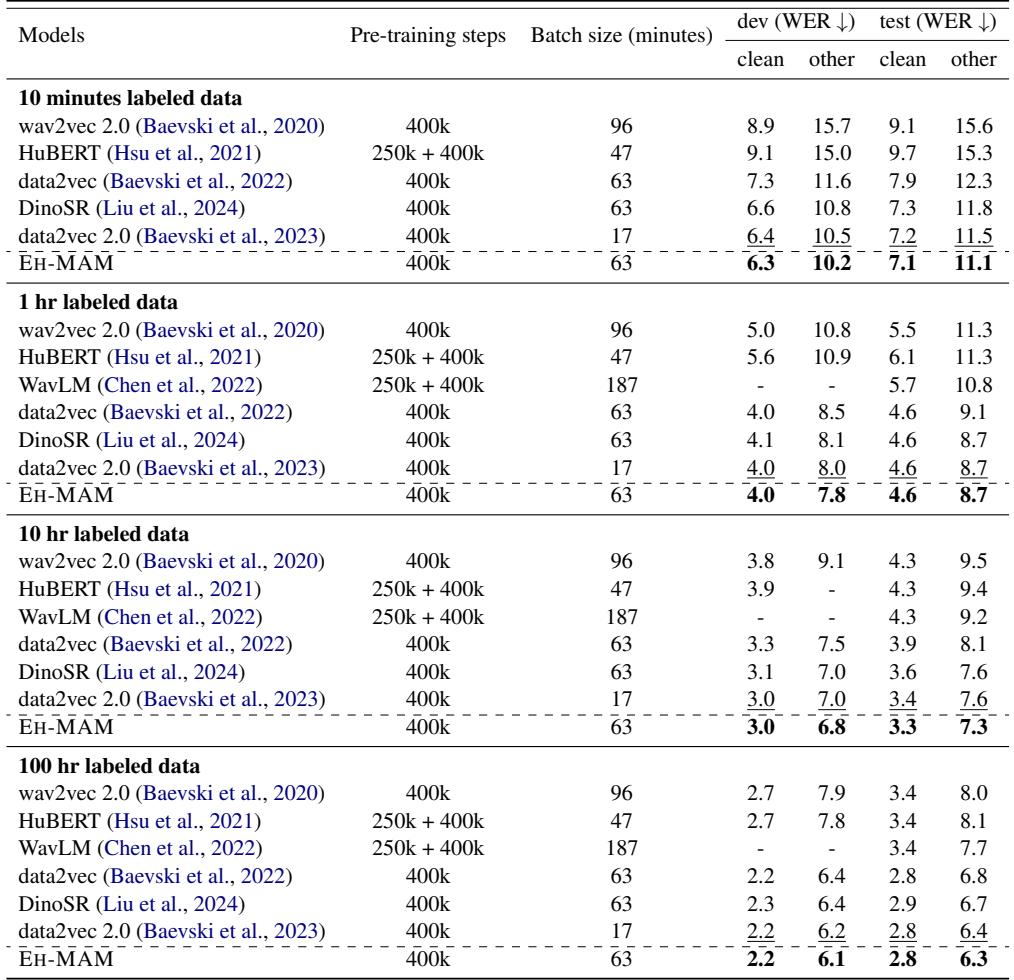
Notice the “10 minutes” and “1 hour” labeled data columns. EH-MAM consistently achieves the lowest WER compared to all baselines. For example, with only 10 minutes of labeled data, EH-MAM achieves a WER of 6.3 on the “clean” dev set, beating data2vec 2.0 (6.4) and significantly outperforming wav2vec 2.0 (8.9). While the margins seem small, in speech recognition, a 5-10% relative improvement on these benchmarks is substantial.
SUPERB Benchmark
The researchers also evaluated the model on SUPERB (Speech Processing Universal PERformance Benchmark), which tests a model’s ability to handle various downstream tasks beyond just transcription, such as Keyword Spotting (KS), Intent Classification (IC), and Slot Filling (SF).
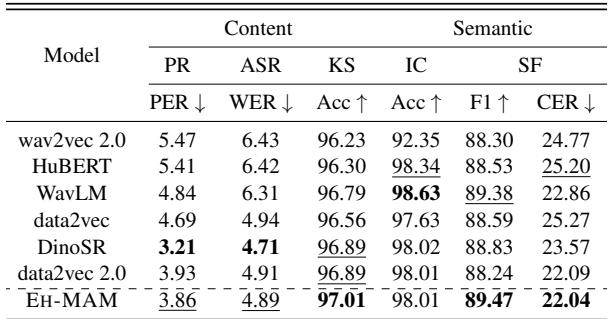
EH-MAM sets a new state-of-the-art on several metrics (bolded), particularly in Phoneme Recognition (PR) and Semantic tasks like Slot Filling. This suggests that by struggling through “hard” frames, the model is learning deeper semantic structures of language, not just acoustic patterns.
Why it Works: Analysis
To wrap up, let’s look at why EH-MAM works better. Is it really masking useful context?
The researchers performed an analysis where they took a trained model and checked the impact of their masking strategy.
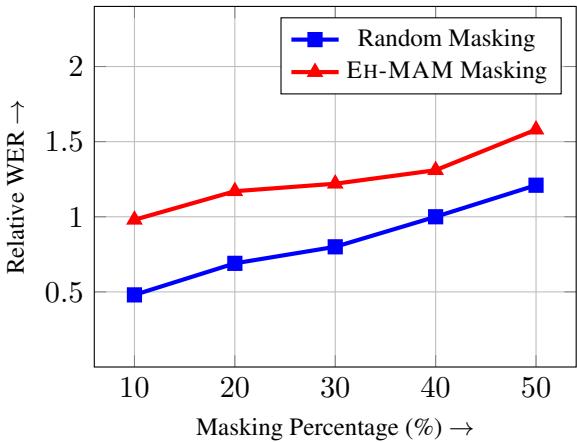
Figure 5 shows that masking frames selected by EH-MAM (red triangles) damages the model’s performance (increases WER) much more than random masking (blue squares). This confirms that the Loss Predictor effectively targets the “load-bearing” pillars of the speech signal. Removing them causes the structure to collapse, meaning the model must pay attention to them during training.
Finally, does the “Easy-to-Hard” curriculum actually help convergence?
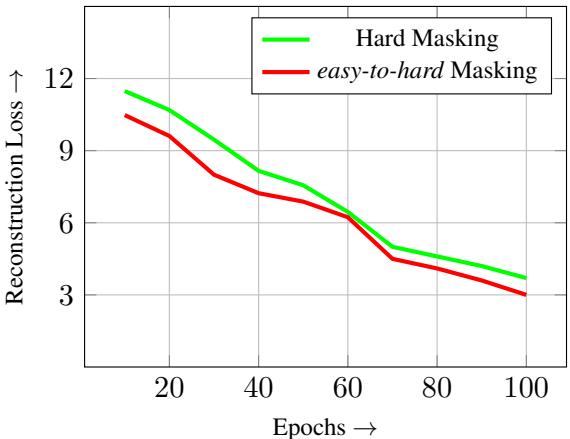
Figure 6 compares two strategies: masking only hard regions from the start (green) vs. the Easy-to-Hard progressive strategy (red). The Easy-to-Hard approach results in a lower reconstruction loss over time, indicating better convergence. By easing the model into the difficulty, it learns more effectively than if it were overwhelmed by hard samples immediately.
Conclusion
EH-MAM represents a significant step forward in self-supervised speech learning. It moves away from the brute-force randomness of previous generations and introduces an intelligent, adaptive learning process.
By equipping the model with a “Teacher” that can assess difficulty, and a “Curriculum” that ramps up complexity, EH-MAM mimics the most effective strategies of human education. The result is a model that extracts richer, more robust representations from speech, proving that in AI, as in life, we learn the most when we challenge ourselves with the hardest problems—at the right time.