](https://deep-paper.org/en/paper/2410.13181/images/cover.png)
The current landscape of Artificial Intelligence presents a frustrating dichotomy for engineers and users alike. On one side, we have Cloud-based Large Language Models (LLMs) like GPT-4 or Claude 3 Opus. They are incredibly smart, capable of complex reasoning, and hold vast amounts of knowledge. However, they are expensive to run, rely on internet latency, and raise data privacy concerns.
On the other side, we have Local LLMs—smaller models like Llama-3-8B or Phi-3 that can run directly on your laptop or even a phone. They are fast, free to run after deployment, and private. The catch? They often struggle with complex reasoning. Ask them a multi-step logic puzzle, and they are prone to “hallucinating” or losing the thread of logic halfway through.
For a long time, the industry solution was binary: either pay the premium for the cloud or accept the limitations of the local device. But what if there was a middle ground? What if a local model could handle the easy stuff and only “phone a friend” (the cloud model) when it got stuck?
This is the premise behind ADASWITCH, a fascinating new framework proposed by researchers from Peking University, Baidu Inc, and others. In this deep dive, we will explore how ADASWITCH allows small local agents to collaborate adaptively with large cloud agents, achieving the performance of a giant model with a fraction of the computational cost.
The Core Concept: Collaborative Intelligence
The inspiration for ADASWITCH comes from human behavior. Imagine a junior intern working on a complex project. The intern can handle 80% of the routine tasks independently. However, when they encounter a particularly difficult calculation or a strategic decision, they don’t just guess; they stop, recognize they might make a mistake, and ask a senior mentor for help. Once the mentor guides them through that specific step, the intern resumes the work.
ADASWITCH applies this logic to LLMs. It consists of two primary modules:
- The Local Agent: A smaller, efficient model (e.g., DeepSeek-Coder-1.3B) that handles routine reasoning steps.
- The Cloud Agent: A massive, powerful model (e.g., Llama-30B or larger) that steps in for intricate reasoning.
The “magic” isn’t just connecting them; it’s teaching the small agent to be introspective. The local agent needs to know when it is about to fail so it can proactively ask for help.
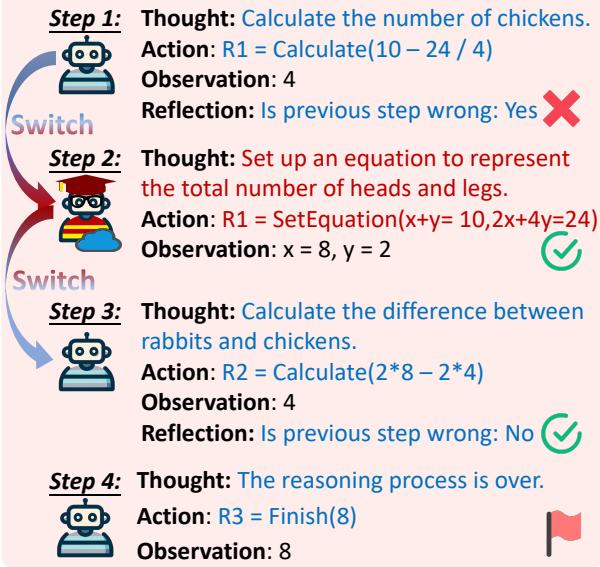
As shown in Figure 1, consider a math problem about chickens and rabbits. The Local Agent tries to calculate the number of chickens but realizes its logic is flawed (indicated by the “Is previous step wrong? Yes” check). Instead of continuing down a wrong path, it swaps roles. The Cloud Agent steps in, sets up the correct equation, and hands control back. The Local Agent then finishes the easy calculation (8 chickens minus 4 rabbits) to get the final answer.
Methodology: Teaching a Model to “Know Thyself”
The researchers didn’t just hard-code a set of rules for switching. They developed a three-stage learning paradigm to train the local agent to become self-aware.
The Agent Framework
Before diving into the training stages, let’s establish the mathematical foundation. In this framework, an agent (LLM \(\mathcal{M}\)) generates a “thought” (\(s_t\)) and an “action” (\(a_t\)) based on previous history (\(\tau_{t-1}\)). The environment then returns an observation (\(o_t\)).
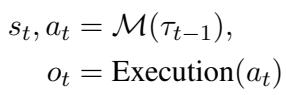
The goal is to optimize this loop so that the Local Agent performs the generation (\(\mathcal{M}\)) most of the time, but hands over \(\tau_{t-1}\) to the Cloud Agent when necessary.
Stage 1: Self-Practicing
The first stage is straightforward supervised fine-tuning. The local agent is trained on a standard dataset (like GSM8K for math) where questions are paired with ground-truth reasoning steps.
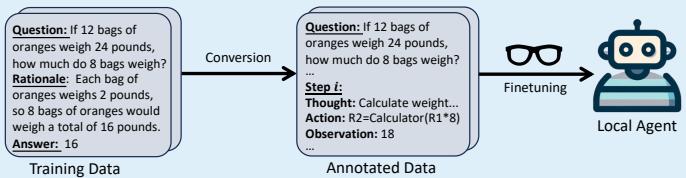
In Stage 1, the model learns the basics of how to use tools (like a calculator) and how to structure a chain of thought. This builds the “basic reasoning ability” required to attempt problems.
Stage 2: Collaborative Examination
This is where the ADASWITCH methodology becomes innovative. Once the local agent has basic skills, it is forced to take an “exam” on the training set.
The researchers let the local agent try to solve problems. However, they employ a supervisor (using rule-based checks or a stronger model) to monitor the steps.
- If the local agent takes a step that matches the correct reasoning path, it keeps going.
- If the local agent makes a mistake, the Cloud Agent is immediately activated to erase the wrong step and generate the correct one.
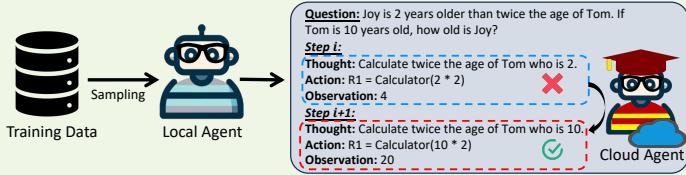
Crucially, this process creates a new, rich dataset of “mistake-correction trajectories.” It captures exactly where the small model tends to fail and how a smart model fixes it.
Stage 3: Reflective Learning
The local agent is now retrained on the trajectories generated in Stage 2. This is different from Stage 1 because the data now contains moments of failure and correction.
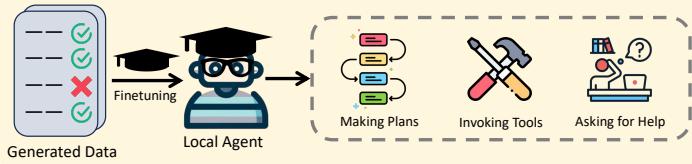
By training on these mixed trajectories, the local agent learns two critical new skills:
- Self-Correction: It learns to recognize patterns that lead to errors.
- Adaptive Switching: It learns that when it reaches a state of high uncertainty (a “hard step”), the next correct token usually comes from the external helper.
Collaborative Inference
Once deployed, the Local Agent operates in a mode called “Collaborative Inference.” It generates a thought and calculates a probability score for its own confidence.
If the probability that the previous step was wrong exceeds a threshold \(p\), the system invokes the Cloud Agent.
The activation threshold (\(p\)) acts as a dial for the user:
- Low \(p\): Ask for help often. (Higher accuracy, higher cost).
- High \(p\): Try to solve it alone. (Lower cost, potentially lower accuracy).
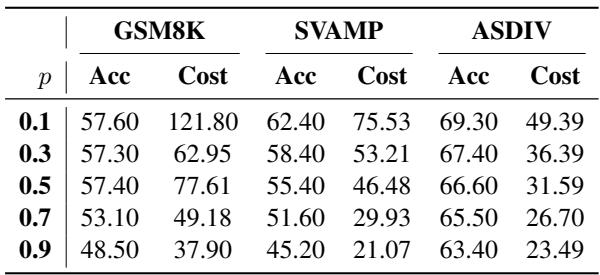
As seen in Table 2, the trade-off is clear. With a threshold of 0.1, the agent achieves 57.60% accuracy on GSM8K but costs 121.80 FLOPs. Raising the threshold to 0.9 drops the cost drastically to 37.90 FLOPs, but accuracy dips to 48.50%. ADASWITCH gives users the power to choose their sweet spot.
Experiments and Key Results
The researchers evaluated ADASWITCH on 7 benchmarks covering Mathematical Reasoning (e.g., GSM8K, SVAMP) and Complex Question Answering (e.g., HotpotQA, MuSiQue).
They used varying sizes of local agents (1.3B and 3B parameters) and cloud agents (up to 30B and 70B parameters).
1. Performance Gains
The results were compelling. The hybrid approach consistently outperformed the local agent significantly and often rivaled the cloud agent’s performance.
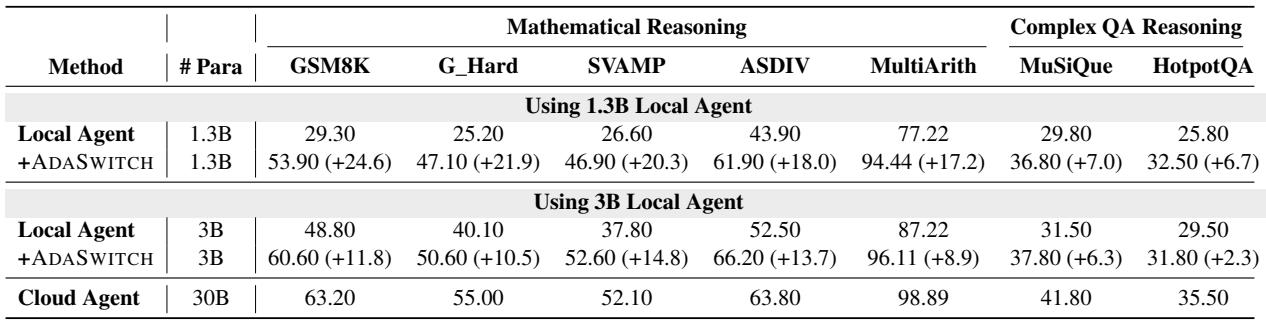
Looking at the Table 1 (above), specifically the section “Using 1.3B Local Agent”:
- The standalone 1.3B Local Agent scored only 29.30% on GSM8K.
- When augmented with ADASWITCH, that score jumped to 53.90%. That is a relative improvement of over 80%.
- On the “G_Hard” dataset (harder math problems), the performance nearly doubled from 25.20% to 47.10%.
This confirms that the local agent isn’t just “guessing” when to ask for help; it is successfully identifying the hardest steps that it cannot solve alone.
2. Ablation Study: Do we need the Cloud?
You might wonder: “Maybe the improvement just comes from the local model reflecting on its own errors?” The researchers tested this by removing the cloud agent (Self-Reflection only) and removing the reflection mechanism entirely.
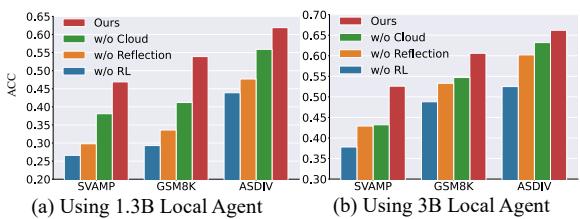
Figure 3 shows the breakdown.
- Blue bars (w/o RL): Baseline performance.
- Orange bars (w/o Reflection): Slight improvement.
- Green bars (w/o Cloud): The agent tries to self-correct. This helps, but the small model often lacks the knowledge to fix its own mistakes.
- Red bars (Ours): Full ADASWITCH. The jump from Green to Red proves that external help is necessary for significant gains. A small model can realize it’s wrong, but it often needs a “big brain” to show it what’s right.
3. Cost-Effectiveness
The ultimate goal of this research is efficiency. Is ADASWITCH actually cheaper than just using the cloud for everything?
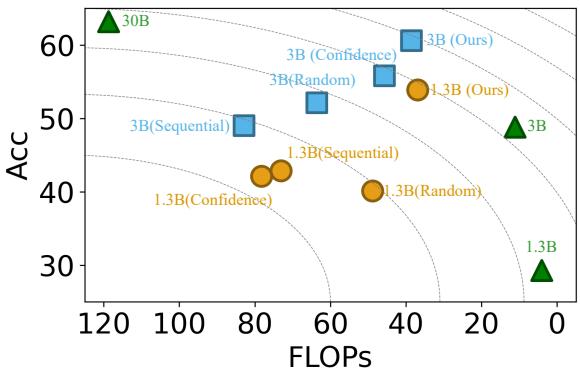
Figure 4 plots Cost (x-axis) vs. Accuracy (y-axis). The ideal spot is the top-left (high accuracy, low cost).
- The green triangles (standalone local agents) are cheap but have low accuracy.
- The cloud models (not plotted, but implied as the ceiling) would be far to the right in terms of cost.
- ADASWITCH (the red stars) occupies a “Pareto optimal” position. It achieves high accuracy while keeping costs relatively low. The paper notes that ADASWITCH can achieve results similar to larger models while utilizing 3x to 5x less computational overhead.
Case Study: Seeing it in Action
To truly understand how the switch happens, let’s look at a concrete example provided in the paper involving a math word problem about music practice.
Question: Carolyn practices the piano for 20 minutes a day and the violin for three times as long… How many minutes does she practice in a month (4 weeks)?
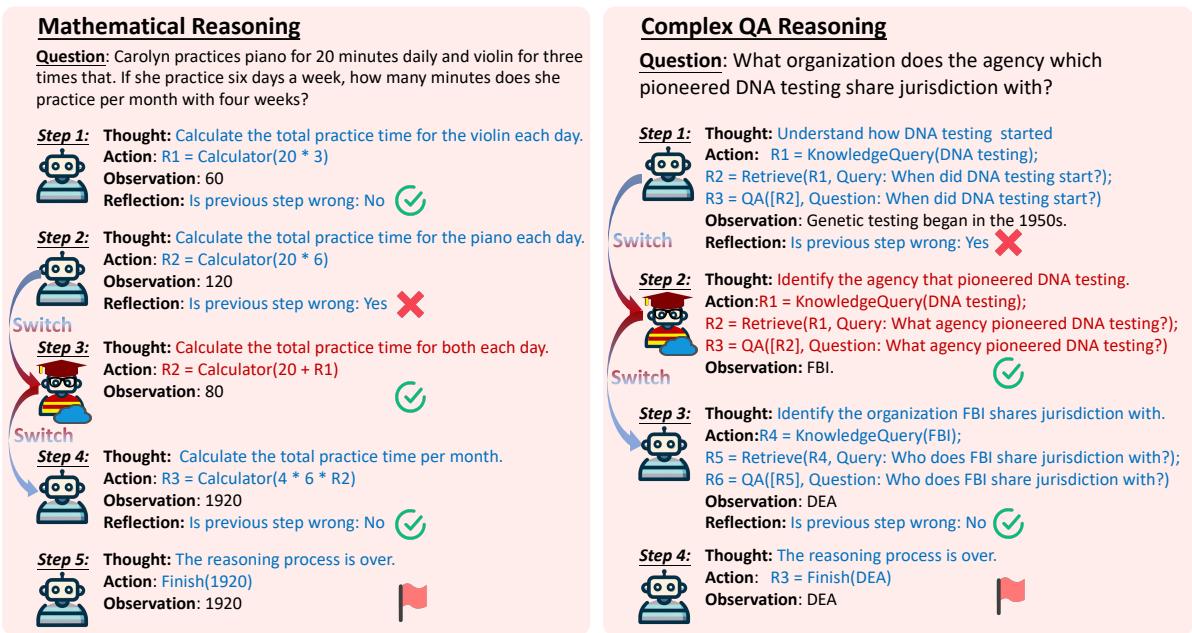
In the left panel of Figure 5:
- Step 1 (Blue): The Local Agent correctly calculates the violin time (20 * 3 = 60).
- Step 2 (Blue): The Local Agent attempts to calculate the total daily time. It calculates
60 + 60(incorrectly assuming piano time equals violin time, or a similar logic error). - Reflection: The Local Agent catches itself! It marks the previous step as “Wrong.”
- Switch (Red): The Cloud Agent steps in. It correctly calculates
20 + 60 = 80. - Step 4 (Blue): Now back on track, the Local Agent takes over for the multiplication (
80 * 6 * 4) to get the final answer.
Without the cloud intervention, the local agent would have cascaded that initial addition error through the rest of the problem, resulting in a wrong answer. Without the local agent, the cloud would have had to waste compute on the trivial multiplications in Steps 1 and 4.
Conclusion and Implications
ADASWITCH represents a significant step forward in “Edge-Cloud Collaboration.” It moves us away from the idea that we must choose between the privacy/speed of local devices and the intelligence of the cloud.
By treating the interaction as a mentorship—where the local model learns to identify its own weaknesses—we create a system that is:
- Efficient: Offloading only the hardest 10-20% of reasoning steps.
- Effective: Drastically boosting the capabilities of small models (DeepSeek-Coder-1.3B performing like a much larger model).
- Adaptive: Allowing users to tune the cost/accuracy ratio dynamically via thresholds.
As mobile devices become more powerful and “Small Language Models” (SLMs) get better, frameworks like ADASWITCH will likely become the standard for deploying AI applications. Your future smartphone assistant might handle your daily scheduling locally, but seamlessly ping a server for a split second when you ask it to solve a complex riddle, giving you the best of both worlds without draining your battery or your wallet.