](https://deep-paper.org/en/paper/2410.13206/images/cover.png)
Introduction
We’ve all been there: a friend says “I’m fine,” but their crossed arms, avoided eye contact, and stiff posture scream the exact opposite. As humans, a massive chunk of our communication relies on these nonverbal cues. We interpret intent, emotion, and social dynamics not just by listening to words, but by “reading the room.”
For Artificial Intelligence, specifically Video Large Language Models (VideoLLMs), this is a frontier that remains largely unconquered. While models like GPT-4o or Gemini are getting remarkably good at describing what objects are in a video, understanding the emotional subtext of human movement is a different beast entirely. Human body language lacks formal rules; it is fluid, culturally dependent, and often unconscious.
If we want robots or AI assistants to truly coexist with us, they need to know when we are frustrated, joyful, or embarrassed, even if we don’t say it outright. A misinterpretation here could lead to awkward, or even harmful, interactions.
In this deep dive, we are exploring a fascinating research paper from the Nara Institute of Science and Technology (NAIST). The researchers have introduced a new benchmark called BQA (Body Language Question Answering). Their goal? To rigorously test whether today’s most advanced AI models can actually understand human emotion through body language, or if they are just guessing.
The Background: Moving Beyond Simple Poses
To understand why BQA is necessary, we have to look at how computers traditionally “see” humans. For years, computer vision focused on pose estimation. This involves mapping the human body as a stick figure—identifying where the elbows, knees, and head are in 3D space. While impressive, knowing where an elbow is doesn’t tell you why it’s there. Is the person raising their hand in anger, or to high-five a friend?
Previous datasets, such as the Body Language Dataset (BoLD), offered a massive collection of video clips annotated with 26 different emotion labels. However, BoLD was designed for older types of machine learning models that simply output a classification score.
The era of Large Language Models (LLMs) requires something different. These models thrive on natural language. They don’t want to just output a number; they want to answer questions, reason through problems, and engage in dialogue. The researchers realized that to truly test modern VideoLLMs, they needed to convert raw data into a reasoning task. They needed a dataset that asks: “What emotion does the man in the video appear to be exhibiting?”
Core Method: Constructing the BQA Dataset
Creating a high-quality dataset for AI evaluation is not as simple as taking a video and tagging it “Happy.” The researchers developed a sophisticated, four-step pipeline to transform the raw BoLD footage into a structured Question-Answering (QA) challenge.
Step 1: The Emotional Landscape
The foundation of the BQA dataset is the categorization of emotions. The original BoLD dataset utilized 26 distinct emotion labels. To create a multiple-choice structure that is both challenging and fair, the researchers grouped these 26 emotions into four broad psychological categories: Happiness, Anger, Sadness, and Pleasure.
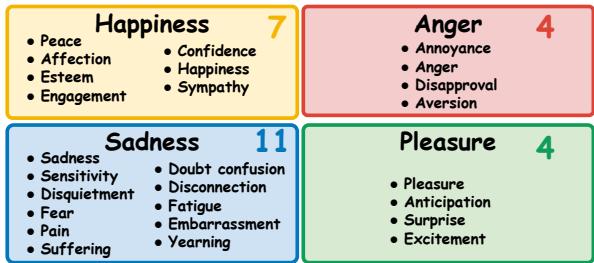
As seen in Figure 2 above, the grouping allows for a clever strategy in generating multiple-choice options. When creating a question for a specific video, the system selects:
- The Correct Answer: The emotion with the highest empathy score from human annotators.
- Three Distractors: Incorrect options drawn specifically from the other three groups.
For example, if the correct answer is “Surprise” (from the Pleasure group), the distractors might be “Confidence” (Happiness), “Anger” (Anger), and “Embarrassment” (Sadness). This ensures that the AI isn’t just distinguishing between similar nuances (like “Sadness” vs. “Suffering”) but has to distinguish between fundamentally different emotional states.
Step 2: Question Generation via AI
Instead of manually writing thousands of questions, the researchers employed Gemini, one of the most capable multimodal models available. They fed Gemini the video clip and the four candidate options and prompted it to generate a natural language question.
The prompt ensures the question is objective, such as “What feeling does the man in the video seem to express when he is smiling?” This simulates a real-world user asking an AI to interpret a scene.
Step 3: The Safety Filter
Automated generation comes with risks. Sometimes an AI might generate a “giveaway” question like, “The man looks so shocked, which emotion is it?” (where the word “shocked” gives away the answer “Surprise”). Or, it might generate harmful content.
To prevent this, the researchers included a filtering step, again using Gemini. This step acts as a quality control gatekeeper. It analyzes the generated question to ensure it is objective, does not contain the answer, and is safe for use.
Step 4: Assessing Difficulty (The “Easy” vs. “Hard” Test)
This is perhaps the most innovative part of the methodology. How do you know if a question is hard? You ask an expert.
The researchers had Gemini attempt to solve the very questions it helped generate.
- Easy: If Gemini could correctly answer the question based on the video.
- Hard: If Gemini failed to answer correctly.
This distinction is crucial for analysis. It separates questions that are solvable by current state-of-the-art tech from those that are genuinely confusing or ambiguous.
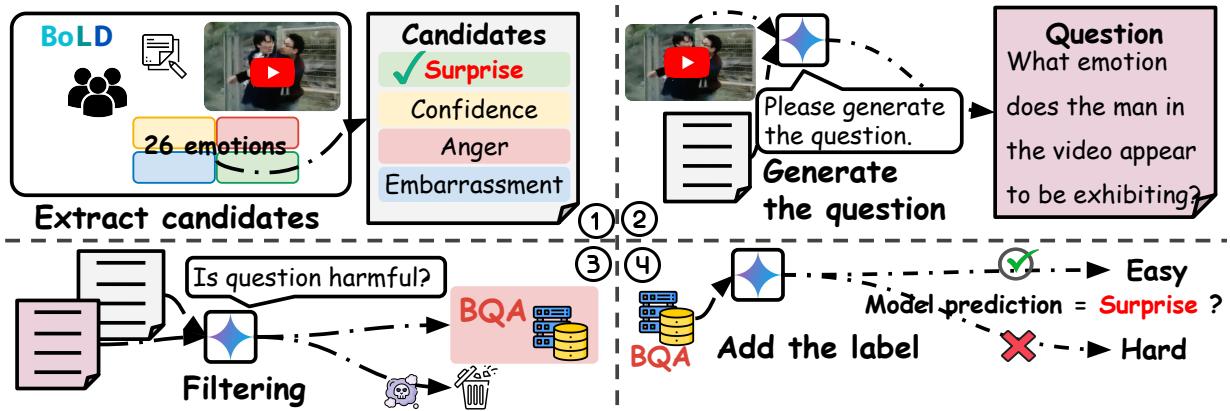
Figure 1 summarizes this entire pipeline. By the end of this process, the raw video data is transformed into a structured, validated QA dataset split into training, validation, and testing sets.
What Does the Data Look Like?
The resulting dataset is rich, but it also reflects the biases inherent in the source material (movies and film clips). Understanding the demographics of the data is vital for interpreting the results later.
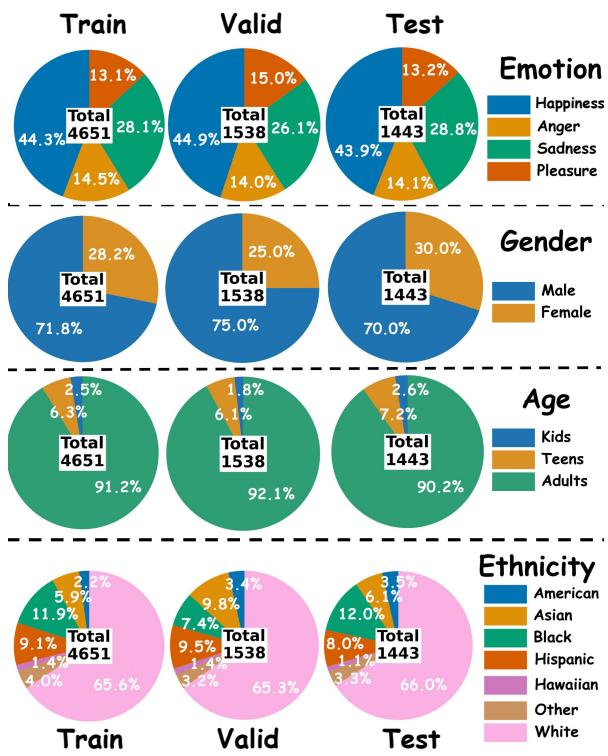
As shown in Figure 3, the dataset is somewhat unbalanced.
- Gender: Heavily skewed toward males (over 70%).
- Age: Predominantly adults (roughly 90%).
- Ethnicity: A significant majority of the subjects are White (>65%).
This lack of diversity is a common plague in AI datasets, and as we will see in the results section, it has real consequences for model performance across different groups.
Here is an actual example of what a model sees in the BQA dataset:
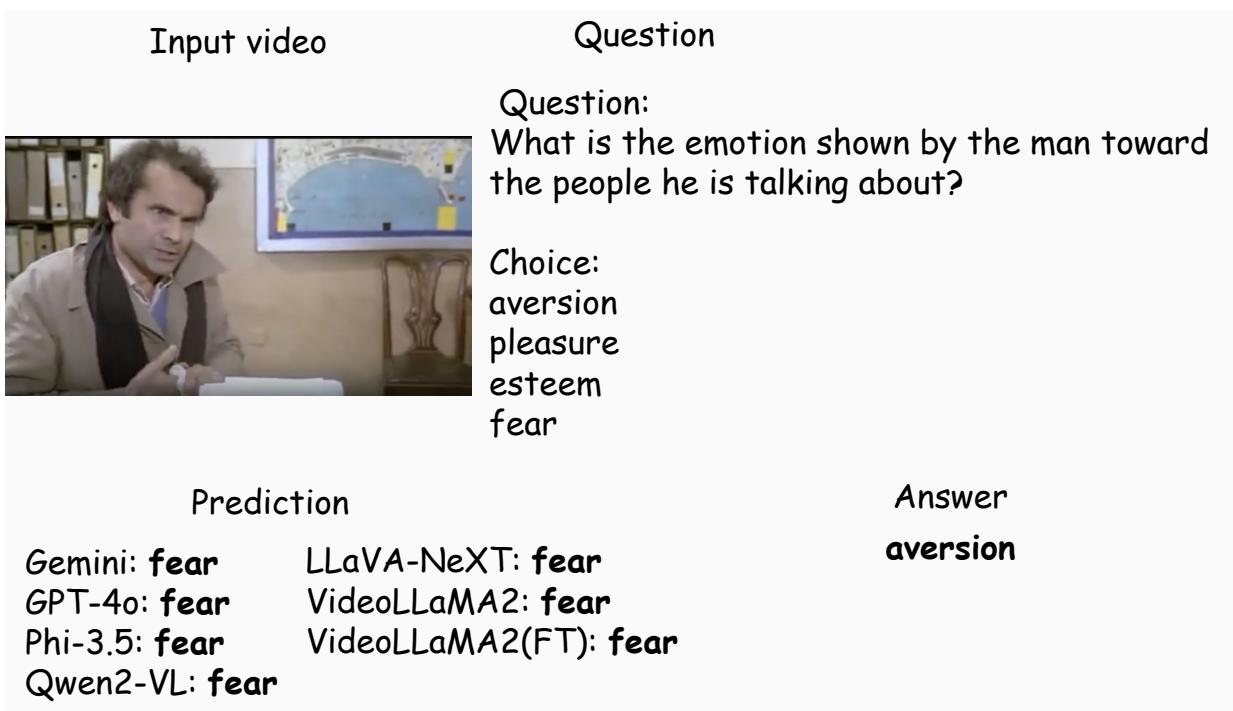
In this example (Figure 7), the model must look at the man’s interaction and determine that the correct emotion is “aversion.” Interestingly, in this specific case, every single model tested—from Gemini to LLaVA—predicted “fear” instead. This highlights the subtle ambiguity of body language; aversion and fear can look physically similar (pulling away, tense posture), but the context differentiates them.
Experiments & Results: How Smart are the Models?
The researchers pitted several leading VideoLLMs against the BQA dataset. The lineup included proprietary giants like GPT-4o and Gemini, as well as open weights models like VideoLLaMA2, LLaVA-NeXT, Qwen2-VL, and Phi-3.5.
They also ran a human evaluation baseline, where real people tried to answer the questions to set a “gold standard.”
The Scoreboard
The results were sobering. Body language is hard for AI.
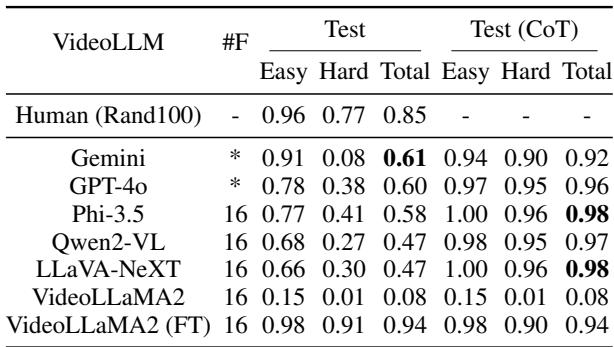
Table 1 reveals several key insights:
- Humans are still winning: Humans achieved an accuracy of 85%. We are naturally tuned to read these cues.
- The “Smartest” Models Struggle: Even Gemini, which generated the questions, only achieved 61% accuracy on the test set. GPT-4o followed closely with 60%. This suggests that even the best AI today misses the emotional mark 40% of the time.
- The “Hard” Subset is Brutal: On the questions labeled “Hard” (the ones Gemini got wrong during creation), performance plummeted. Gemini scored only 8% on these, and VideoLLaMA2 (before fine-tuning) scored a near-zero 1%.
- Fine-Tuning Works: The standard VideoLLaMA2 model performed terribly (8% total accuracy). However, after LoRA-Tuning (a method to efficiently fine-tune the model on the BQA training data), its performance skyrocketed to 94%. This proves that models can learn these patterns if specifically trained on them, but they don’t necessarily know them “out of the box.”
The “Chain of Thought” Dilemma
The researchers also tested Multimodal Chain of Thought (CoT). This is a technique where the model is asked to explain its reasoning (“The man is smiling and leaning in, therefore…”) before giving the final answer.
While CoT improved scores significantly (pushing models into the 90% range), the authors included a strong warning. They found that the generated “rationales” often leaked the answer. For example, the explanation might say, “The man is displaying anger because he is shouting,” which trivializes the final selection. Therefore, high scores with CoT might be artificially inflated and not truly representative of the model’s visual understanding.
Analysis: Where Do Models Fail?
The raw accuracy numbers tell us that models fail, but they don’t tell us why. The researchers broke down the errors by demographic and emotion, uncovering some uncomfortable truths about bias in AI.
Demographic Bias
Does an AI understand a teenager’s body language as well as an adult’s? Does it read emotions correctly across different ethnicities?
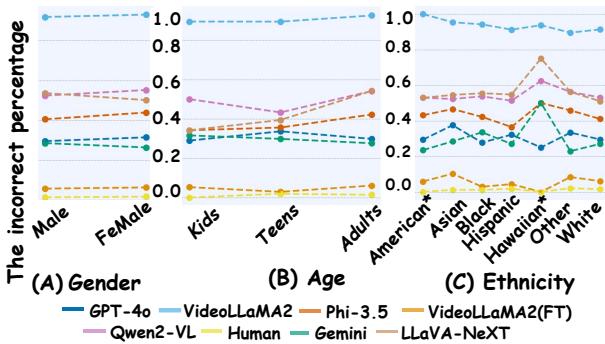
Figure 4 provides a breakdown of error rates (higher bars mean more mistakes).
- Gender (A): The models generally performed consistently across genders, though some showed slightly higher error rates for females.
- Age (B): Most models struggle more with Children (Kids) and Teenagers than with Adults. This is likely because the training data is dominated by adults, making the unique mannerisms of younger people harder for the AI to decode.
- Ethnicity (C): This is the most striking finding. Look at the performance on “Native Hawaiian” and “American” categories. Models like LLaVA-NeXT and Gemini had significantly higher error rates for Native Hawaiian subjects (approaching 60-70% incorrect). In contrast, error rates for White subjects were much lower. This indicates that the models have not seen enough diversity during training to generalize emotional cues across different cultures.
The “Face” Problem
Another critical finding was where the models were looking. The researchers noticed that questions became “Hard” when:
- The subject’s face was neutral.
- The subject wore glasses, hats, or sunglasses.
This implies that VideoLLMs are cheating. They aren’t really reading body language (posture, hand gestures, stance); they are relying almost entirely on facial expressions. When the face is obscured or expressionless, the model is blind to the emotion, even if the body is clearly conveying information (like slumped shoulders or clenched fists).
Emotional Confusion
Finally, which emotions confuse the AI the most?
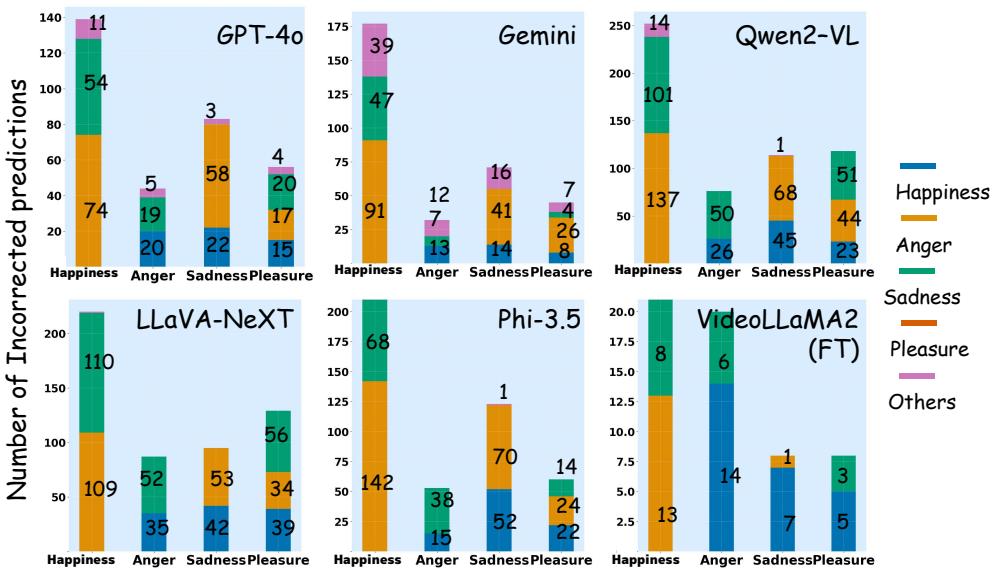
Figure 5 shows the confusion matrix. The X-axis represents the correct emotion, and the colored bars show what the model guessed instead.
- Happiness is Hard: Surprisingly, when the answer was “Happiness,” models frequently guessed opposing emotions like “Sadness” or “Anger.”
- Pleasure is Distinct: The models rarely guessed “Pleasure” incorrectly, perhaps because actions associated with pleasure (celebrating, cheering) are visually distinct.
Conclusion
The BQA paper is a wake-up call for the field of Multimodal AI. It demonstrates that while we can build models that write code or identify a cat in a picture, the subtle, human art of reading body language is still a major hurdle.
The creation of the BQA dataset provides a standardized way to measure this capability. It highlights that current models are:
- Too reliant on faces: Ignoring the “body” in body language.
- Biased: Struggling with non-adult and non-white subjects.
- Inconsistent: capable of confusing Happiness with Anger.
For students and future researchers, this paper opens up exciting avenues. How do we train models to look at hands and posture, not just faces? How do we curate datasets that represent global cultures so that AI works for everyone?
As we move toward a future where AI assistants are integrated into our daily lives, solving these problems isn’t just about accuracy numbers—it’s about empathy, understanding, and creating technology that truly gets us.