](https://deep-paper.org/en/paper/2410.13343/images/cover.png)
Large Language Models (LLMs) like GPT-4, Gemini, and LLaMA have taken the world by storm. We marvel at their ability to write code, compose poetry, and reason through complex logic. But there is a lingering question in the AI research community: Are these models actually understanding the content, or are they just really good at guessing based on superficial patterns?
Imagine a student who aces a history exam not because they understand the geopolitical causes of a war, but because they memorized that every time the word “treaty” appears in a question, the answer is “C”. This is effective for that specific test, but useless in the real world. In machine learning, this phenomenon is called Shortcut Learning.
In this post, we will dive deep into a fascinating research paper titled “Do LLMs Overcome Shortcut Learning? An Evaluation of Shortcut Challenges in Large Language Models.” The researchers developed a comprehensive testing framework called Shortcut Suite to expose these hidden weaknesses in state-of-the-art LLMs.
By the end of this article, you will understand what shortcut learning is, how researchers catch models in the act, and why even the most powerful models can be tricked by simple logical fallacies.
1. The Problem: Robustness vs. “Cheating”
The introduction of techniques like In-Context Learning (ICL) and Chain-of-Thought (CoT) prompting has revolutionized Natural Language Processing (NLP). Models can now perform tasks they weren’t explicitly trained for. However, “performance” on a standard benchmark doesn’t always equal “robustness.”
If an LLM relies on dataset biases—shortcuts—it might perform perfectly on standard test data (which has the same biases as the training data) but fail spectacularly in real-world scenarios or “Out-Of-Distribution” (OOD) tests.
The authors of this paper set out to answer a critical question: Do modern LLMs still rely on these shortcuts, and if so, how does that impact their ability to generalize?
To answer this, they focused largely on Natural Language Inference (NLI) tasks. In NLI, the model is given a Premise and a Hypothesis and must decide if the Hypothesis is an Entailment (true based on the premise), a Contradiction (false based on the premise), or Neutral. This task is perfect for testing logic because it requires understanding the relationship between two sentences, not just keyword matching.
2. Introducing Shortcut Suite
To systematically test LLMs, the researchers created Shortcut Suite. This isn’t just a random collection of tricky questions; it is a designed stress test comprising six specific types of shortcuts.
The core idea is to see if a model ignores the actual meaning of a sentence and instead relies on a heuristic (a rule of thumb).
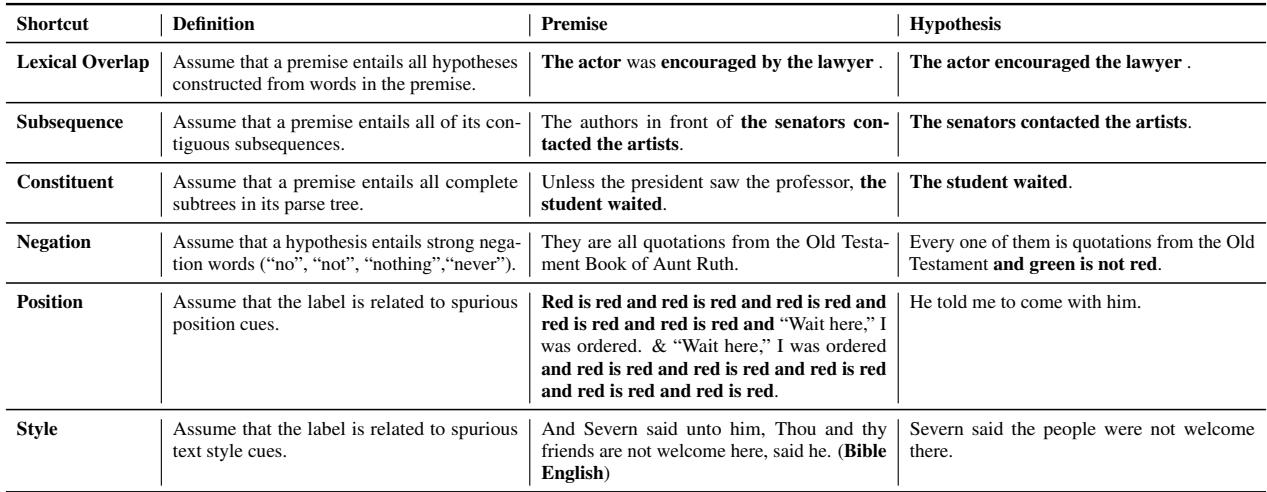
As shown in Table 1 above, the suite tests six distinct distinct shortcuts:
- Lexical Overlap: The model assumes that if the Premise and Hypothesis share many of the same words, it must be an Entailment.
- Trap: “The actor was encouraged by the lawyer” vs. “The actor encouraged the lawyer.” Same words, totally different meanings.
- Subsequence: The model assumes that if the Hypothesis is a contiguous phrase found inside the Premise, it must be true.
- Trap: “The authors in front of the senators contacted…” The model sees “The senators contacted…” and marks it true, ignoring the context.
- Constituent: Similar to subsequence but based on the grammatical parse tree.
- Negation: The model assumes that strong negation words like “no” or “not” automatically imply a Contradiction.
- Position: This tests if the model is paying attention to the actual text or just where the text is located. The researchers inject tautologies (meaningless true statements like “red is red”) to see if the model gets distracted.
- Style: Does the model get confused if the text is written in a specific style, such as Biblical English?
Visualizing the Failure
What does it look like when a model fails? Look at Figure 1 below.
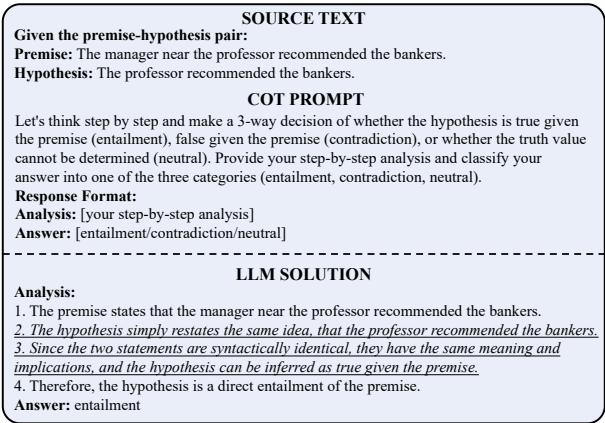
In this example, the model (Gemini-Pro) sees the phrase “The professor recommended the bankers” inside the source text. It ignores the crucial context—that it was actually the manager near the professor who made the recommendation. Because the words match a subsequence, the model takes the shortcut and confidently answers “Entailment.” This is a classic case of skipping semantic analysis in favor of pattern matching.
3. Beyond Accuracy: Measuring Explanation Quality
One of the paper’s major contributions is that it doesn’t just look at whether the model got the answer right or wrong (Accuracy). It also analyzes the reasoning the model provides.
When we ask an LLM to “think step-by-step” (Chain-of-Thought), we want to know if its reasoning makes sense. To measure this, the authors introduced new metrics.
Semantic Fidelity Score (SFS)
Does the model’s explanation actually relate to the input text? The SFS measures the cosine similarity between the embeddings of the prompt (\(P\)) and the generated content (\(c\)).

If the model starts hallucinating or talking about irrelevant topics, the SFS will drop.
Internal Consistency Score (ICS)
Does the model contradict itself? It is common for a hallucinating model to say “X is true” in step 1 and “X is false” in step 3. The researchers use a separate NLI model to check for contradictions between different steps of the generated reasoning chain.
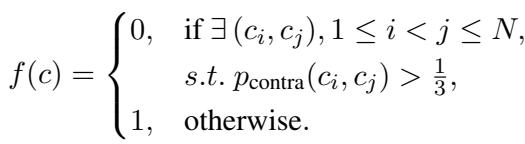
Here, \(f(c)\) returns 0 if a contradiction is found (probability \(> 1/3\)) and 1 otherwise. The score is the average consistency across steps.
Explanation Quality Score (EQS)
Finally, they combine these two to get a holistic view of the explanation quality.

By weighing fidelity and consistency equally (\(w_1 = w_2 = 0.5\)), they can quantify how “sensible” the model’s thought process is.
4. Experimental Setup
The researchers went big. They didn’t just test one model; they tested a spectrum of closed-source and open-source models:
- Closed-source: GPT-3.5-Turbo, GPT-4, Gemini-Pro.
- Open-source: LLaMA-2 (7B, 13B, 70B), Mistral-7B, ChatGLM3.
They also tested four different prompting strategies to see if the way we ask the question changes the shortcut behavior:
- Zero-shot: Just ask the question.
- Few-shot ICL: Provide a few examples (In-Context Learning).
- Zero-shot CoT: Ask the model to “think step by step.”
- Few-shot CoT: Provide examples that include reasoning steps.
5. Key Results and Analysis
The results of the experiments were revealing, confirming that shortcut learning is a pervasive issue, even for the most advanced models.
5.1 The Performance Drop
The most immediate finding is the massive drop in accuracy when models face shortcut-laden datasets compared to standard datasets.
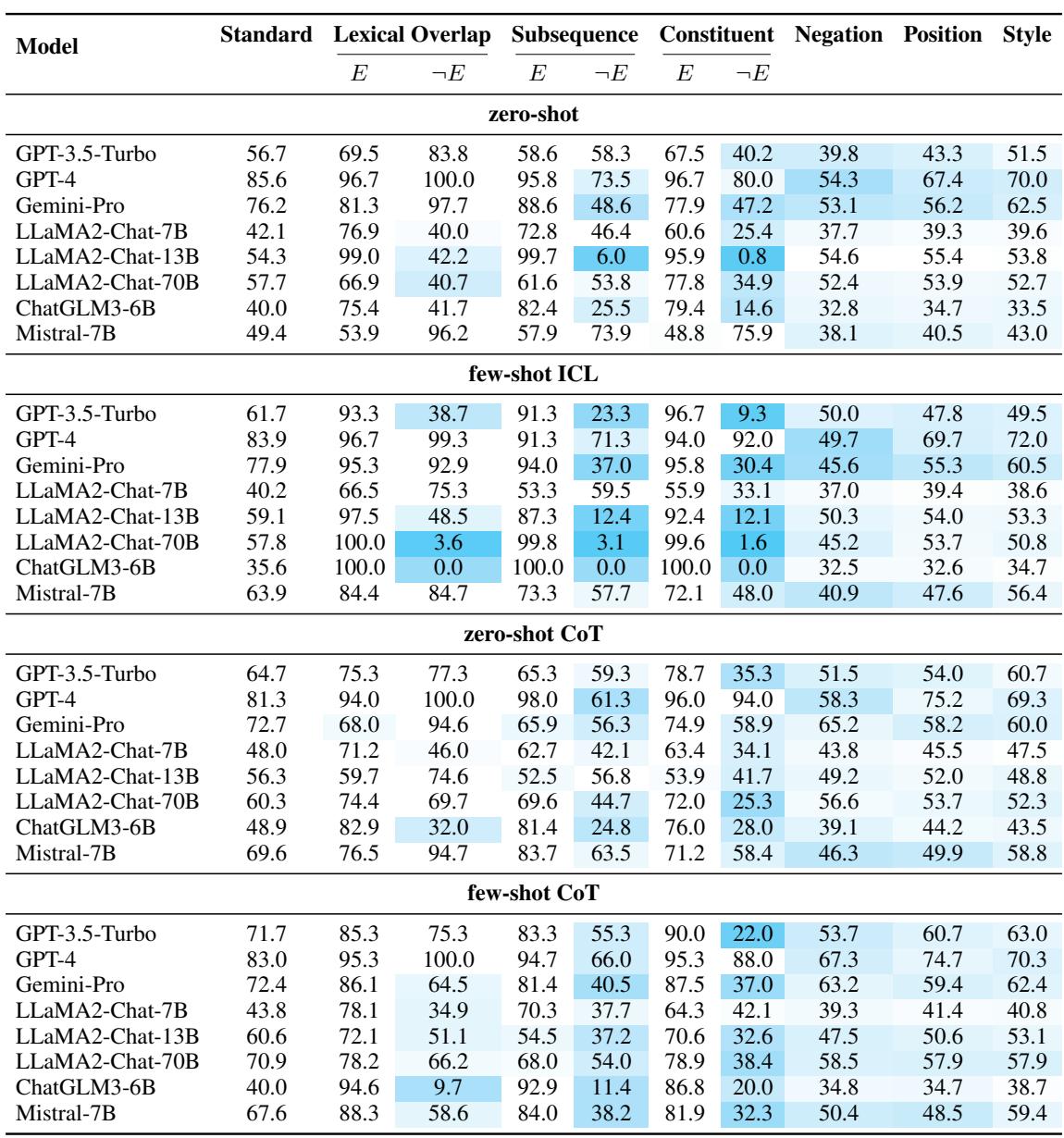
In Table 2, look at the sea of blue highlighting. The “Standard” column shows how models perform on normal data (often 80%+). But look at the Constituent (\(\neg E\)) column or the Negation column.
- GPT-3.5-Turbo drops from 56.7% on Standard to just 39.8% on Negation.
- Gemini-Pro drops from 76.2% to 47.2% on Constituent (\(\neg E\)).
This confirms that models are heavily relying on shortcuts. When the shortcut (like word overlap) aligns with the correct answer (Entailment), accuracy is high. But when the shortcut is a trap (Non-Entailment \(\neg E\)), performance collapses—often becoming worse than a random guess.
5.2 The “Inverse Scaling” Surprise
A common belief in AI is “bigger is better.” Usually, adding more parameters (going from 7B to 70B) solves reasoning problems.
However, this paper found a counter-intuitive result known as Inverse Scaling. In the Zero-shot and Few-shot settings, larger models were sometimes more prone to shortcuts than smaller ones.
Why? Because larger models are better learners. They capture the spurious correlations in the pre-training data more effectively than smaller models. If the training data teaches that “not = contradiction,” the 70B model learns that rule harder than the 7B model. It takes advanced prompting (like CoT) to unlock the reasoning capabilities of the larger models and overcome this.
5.3 The Power of Chain-of-Thought (CoT)
If you look closely at Table 2 again, compare the “Zero-shot” block with the “Zero-shot CoT” block. Accuracy generally improves significantly.
- Mistral-7B is a standout performer here. With CoT prompting, it rivals much larger models, showing that even smaller models have reasoning capabilities if they are forced to articulate their logic.
- CoT forces the model to slow down. Instead of jumping to the shortcut conclusion (“The words match!”), it has to explain the relationship, which often reveals the trap.
5.4 Overconfidence
One of the most dangerous aspects of LLMs is that they are confidently wrong. The researchers compared the models’ Confidence Scores (how sure the model said it was) against their actual accuracy.
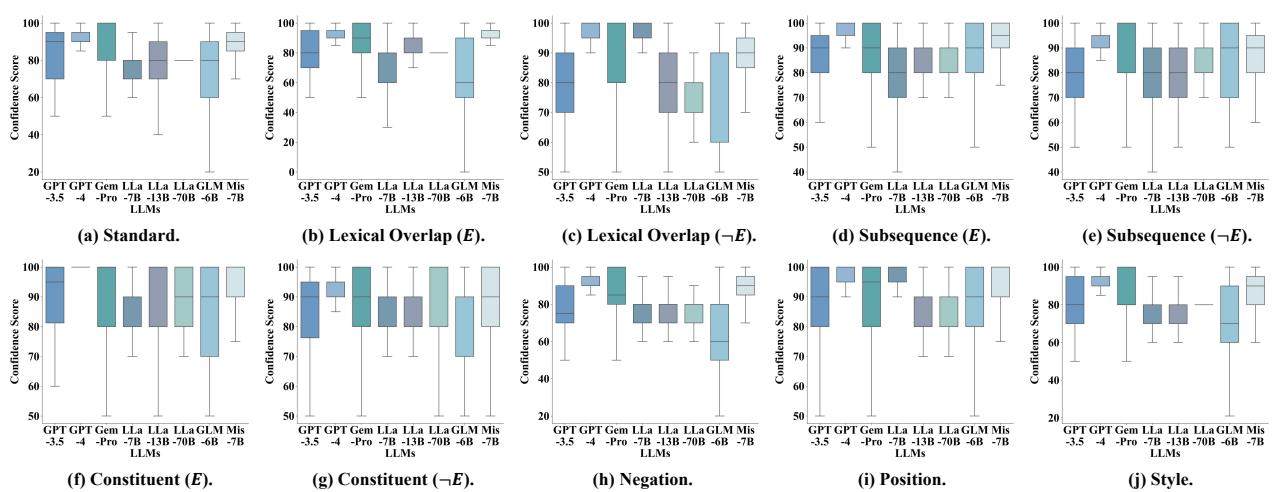
Figure 2 paints a worrying picture. The Y-axis represents confidence. Notice how the boxes are consistently high, often hovering near 100% (the top of the graph). Even in the Constituent (\(\neg E\)) dataset (subplot g), where we know accuracy was terrible (sometimes <20%), the models still report high confidence.
This implies that when an LLM uses a shortcut, it doesn’t “feel” like it’s guessing. It feels certain, because the heuristic (e.g., “word overlap implies truth”) is a strong signal in its internal weights.
5.5 Distraction by “Tautologies”
In the Position shortcut test, researchers added meaningless sentences like “Red is red” or “Up is up” to the text. This shouldn’t change the logic of the passage. However, models frequently got distracted.
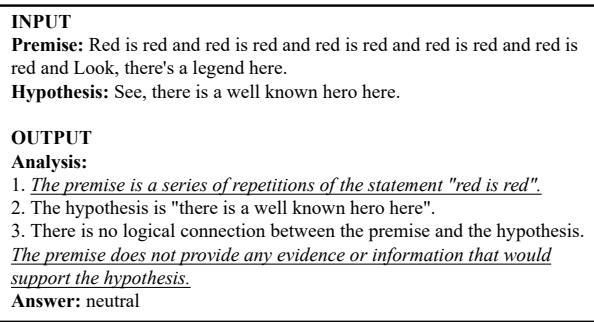
As seen in Figure 4, the model (GPT-3.5) gets confused by the repetition of “red is red.” Instead of analyzing the legend/hero relationship, it concludes that there is “no logical connection” because of the noise.
Furthermore, Table 3 (below) shows that models are biased by where the information is.
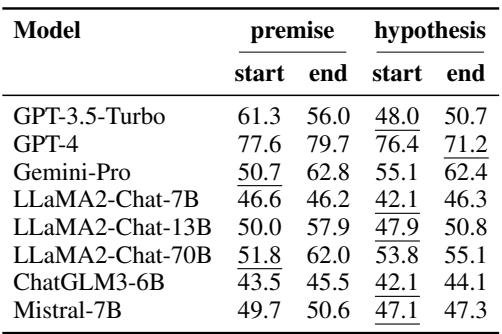
Models tend to perform worse when the distracting text is at the start of the premise. This suggests LLMs might over-prioritize the beginning of a sequence, a behavior known as the “primacy effect.”
6. Types of Errors
The authors categorized the reasoning errors into three distinct buckets. This helps us understand how the thinking process breaks down.
1. Distraction
As discussed above, the model focuses on irrelevant information (tautologies) rather than the core semantic relationship.
2. Disguised Comprehension
This is tricky. The model appears to understand the words, but it swaps concepts. It might treat “The doctor believed the manager” as identical to “The manager believed the doctor.” It grasps the entities but fails to track the directional relationship between them.
3. Logical Fallacy
The model attempts to reason but uses flawed logic.
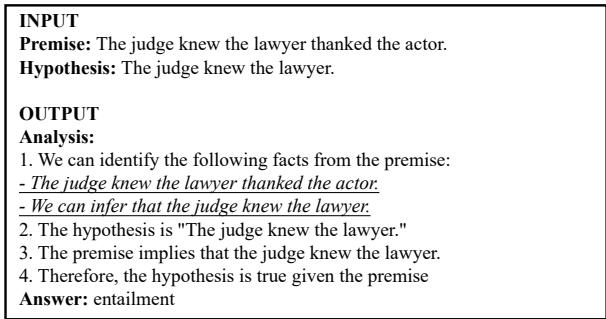
In Figure 7, the model tries to connect “The judge knew the lawyer” with “The lawyer thanked the actor.” It concludes that the judge knew the lawyer. While this specific output happens to match the hypothesis, the reasoning path (Step 3: “The premise implies that the judge knew the lawyer”) often involves a leap in logic or a circular argument based on the subsequence shortcut.
7. Broader Implications (Sentiment Analysis & Paraphrasing)
To prove this isn’t just an NLI problem, the researchers extended their evaluation to Sentiment Analysis (SA) and Paraphrase Identification (PI).
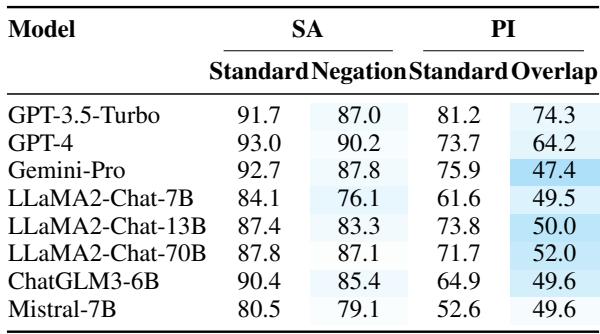
Table 5 shows the same pattern. When negations are introduced in Sentiment Analysis, accuracy drops (Blue highlights). When word scrambling is used in Paraphrase Identification (making two sentences look similar but mean different things), models like Gemini-Pro drop from 75.9% to 47.4%.
This is further visualized in Figure 8, which shows the label distribution shifts.
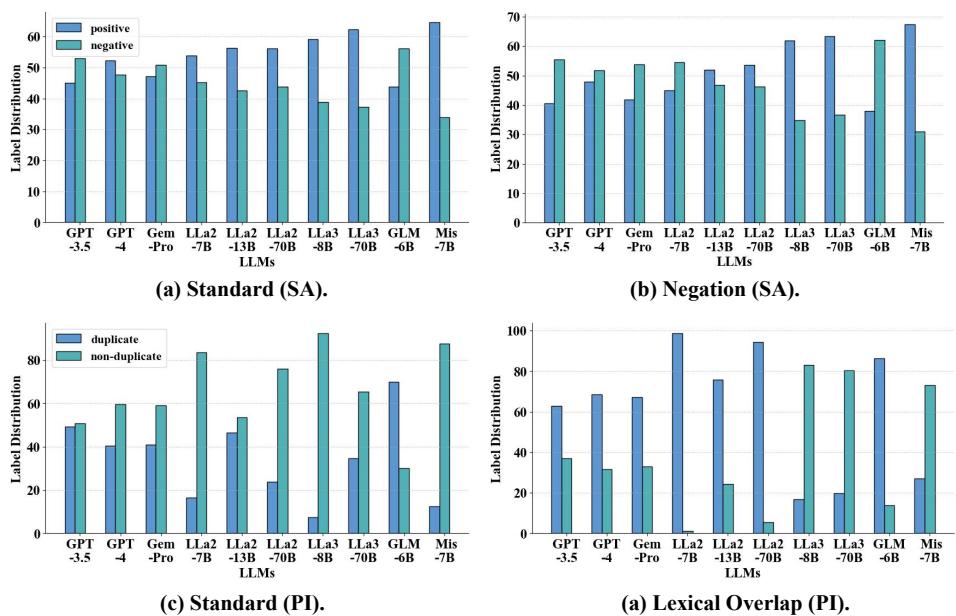
In chart (b), notice the massive teal bars? That’s the Negation dataset. Models overwhelmingly predict “Negative” sentiment just because they see a negation word, even if the sentence isn’t actually negative.
8. Conclusion
The paper “Do LLMs Overcome Shortcut Learning?” provides a sobering look at the current state of Large Language Models. While these models are incredibly powerful, they are far from perfect reasoners.
Key Takeaways:
- Shortcuts are Everywhere: LLMs rely heavily on heuristics like word overlap and negation cues rather than deep understanding.
- Size Doesn’t Fix Everything: Larger models can be more susceptible to shortcuts because they learn dataset biases more effectively.
- Prompting Matters: Chain-of-Thought (CoT) is currently one of the best defenses against shortcut learning, as it forces the model to verify its own heuristics.
- Confidence is Deceptive: Never trust an LLM’s confidence score; they are often confidently wrong when using a shortcut.
What does this mean for the future? For students and practitioners, this highlights the importance of robust evaluation. Testing a model on a standard dataset isn’t enough. We need stress tests—like the Shortcut Suite—to ensure our AI systems are truly understanding the world, not just memorizing the “cheat codes.” As we move toward AGI, overcoming these shortcuts will be one of the most significant hurdles to clear.