](https://deep-paper.org/en/paper/2410.15148/images/cover.png)
In the world of Natural Language Processing (NLP), we are currently living in an era of abundance. We have massive pre-trained models like BERT and RoBERTa, and we have platforms like the HuggingFace Hub hosting hundreds of thousands of datasets.
Theoretically, this is a goldmine. If you are building a model to detect emotions in tweets but have very little labeled data, you shouldn’t just fine-tune a raw BERT model. Instead, you should look for a “stepping stone”—an intermediate task. Perhaps fine-tuning BERT on a movie review sentiment dataset first, and then fine-tuning on your tweet emotion data, would yield better results.
This technique is known as Intermediate Task Transfer Learning. It works brilliantly in theory. In practice, however, it creates a paralyzing decision problem: Which task should you choose?
With over 160,000 datasets available, you cannot possibly test them all. Even smart ranking algorithms usually require downloading large models and running computationally expensive forward passes for every single candidate. It’s a bottleneck that renders the massive resources of the open-source community largely inaccessible for practical optimization.
In this post, we are diving deep into a paper titled “Less is More: Parameter-Efficient Selection of Intermediate Tasks for Transfer Learning” by Schulte, Hamborg, and Akbik. They propose a novel, lightweight solution called Embedding Space Maps (ESMs). This method drastically slashes the computational cost and disk usage required to find the best intermediate tasks, potentially democratizing access to optimal transfer learning.
The Context: Why Intermediate Tasks Matter
To appreciate the solution, we first need to understand the workflow. The standard recipe for modern NLP is:
- Take a Pre-trained Language Model (PLM) like BERT.
- Fine-tune it on your Target Task.
However, when your target dataset is small (data scarcity), the model often struggles to generalize. Research has shown that inserting an intermediate step helps:
- Take a PLM.
- Fine-tune on an Intermediate Task (where data is abundant).
- Fine-tune on your Target Task.
The intermediate task acts as a bridge, teaching the model concepts (like “sentiment” or “logic”) that are relevant to your final goal.
The Selection Bottleneck
The problem isn’t doing the transfer; it’s selecting the source.
- Brute Force: Fine-tuning on every available dataset to see what works is impossible.
- Task Embeddings (TaskEmb): Some methods try to represent tasks as vectors, but these vectors can be as large as the model itself.
- Model-Based Scoring (LogME, LEEP): These are the current state-of-the-art. They pass your target data through a source model to score compatibility. The issue? You need the fully fine-tuned source model for every single candidate. If you have 1,000 candidates, you need to store and run 1,000 different neural networks.
This is where the paper’s contribution changes the game.
The Core Innovation: Embedding Space Maps (ESMs)
The researchers asked a fundamental question: Do we really need the entire fine-tuned model to predict if a task is useful?
When you fine-tune a model from a base state (\(f_0\)) to a fine-tuned state (\(f_T\)), the way the model represents text (its embeddings) changes. The authors hypothesize that this change can be approximated by a simple function. Instead of storing the massive fine-tuned model, what if we just trained a tiny network to mimic the shift in embeddings that the fine-tuning caused?
This tiny network is the Embedding Space Map (ESM).
How ESM Works
An ESM is a lightweight neural network—specifically, a linear transformation—that sits on top of the base model. Its job is to approximate the output of the fine-tuned model.
Let’s look at the mathematics of this approximation.

Here is what this equation tells us:
- \(f_0(x)\) is the embedding from the Base Model (e.g., standard BERT).
- \(f_T(x)\) is the embedding from the Fine-Tuned Model (e.g., BERT trained on Sentiment Analysis).
- \(\phi_{0 \to T}\) is the ESM.
The ESM tries to take the base embedding and transform it so that it looks like the fine-tuned embedding. If the approximation is good, \(\phi_{0 \to T}(f_0(x))\) becomes a cheap stand-in for the expensive \(f_T(x)\).
The visual workflow below illustrates this parallel pathway.
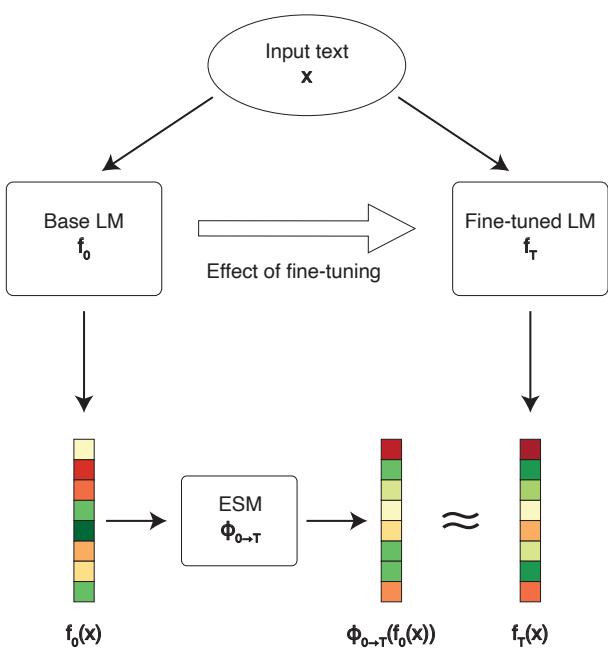
On the left, you have the standard base model. On the right, the fine-tuned model. The arrow labeled “Effect of fine-tuning” is what the ESM learns to replicate.
Why is this “Parameter-Efficient”?
A standard BERT model has about 110 million parameters. To store 1,000 intermediate tasks, you’d need massive storage servers.
The ESM proposed here is a single linear layer. It reduces the parameter count from ~110M to less than 0.6M.
- Disk Space: Reduced by a factor of 278.
- Compute: You only run the heavy Base Model once to get the initial embeddings. Then, you run the lightweight ESMs to simulate 1,000 different fine-tuned models in a fraction of the time.
Does the Approximation Actually Work?
It sounds risky to replace a deep neural network with a single linear layer. Can a linear map really capture the complex semantic shifts of fine-tuning?
To verify this, the authors used t-SNE (a dimensionality reduction technique) to visualize how different models cluster data. They looked at the SNLI dataset, which involves determining if sentences contradict or entail each other.
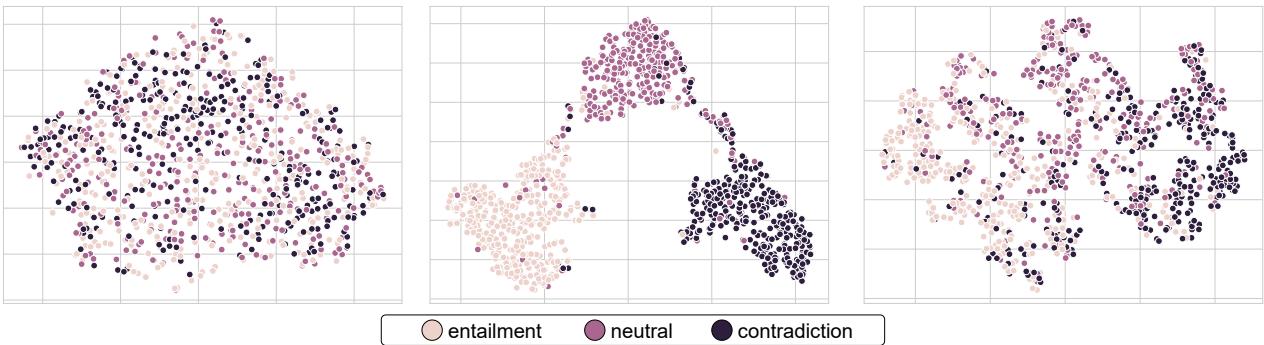
Let’s break down the visualization above:
- Left (BERT): The base model has messy clusters. It doesn’t clearly separate “entailment” from “contradiction.”
- Middle (Fine-tuned BERT): This is the gold standard. The classes are separated into distinct islands.
- Right (BERT + ESM): This is the approximation. While not as perfect as the middle plot, notice that the “purple” and “pink” dots are clearly separating.
The ESM successfully captured the direction and structure of the semantic shift required for the task, even if it didn’t capture every nuance. For the purpose of ranking which task is best, this approximation turns out to be sufficient.
The Selection Workflow: ESM-LogME
The authors don’t just use ESMs in isolation. They integrate them into a ranking workflow called ESM-LogME.
LogME is an existing metric that estimates how well a set of embeddings can predict labels. Usually, LogME requires the real fine-tuned embeddings. In this new workflow:
- Phase 1 (One-time Setup): For every source dataset in the hub, someone (e.g., the hub maintainer) trains a tiny ESM and uploads it. This is fast and cheap.
- Phase 2 (User Selection):
- You have your target dataset (e.g., low-resource tweet data).
- You compute embeddings using the Base Model (one forward pass).
- You download the tiny ESMs for 1,000 potential tasks.
- You apply the ESMs to your embeddings (extremely fast matrix multiplications).
- You run the LogME scorer on these “simulated” embeddings.
- You pick the highest-scoring task.
Experimental Setup and Results
The authors conducted the largest study of its kind to date, utilizing 1,553 source datasets and 8 diverse target datasets (ranging from sentiment analysis to gender bias detection).
They compared ESM-LogME against several baselines, including:
- LogME (Standard): The slow, high-accuracy upper bound.
- TaskEmb / TextEmb: Vector-based approaches.
- Vocabulary Overlap: A simple baseline checking if datasets share words.
Performance vs. Efficiency
The results were evaluated using Regret@k. This metric asks: “If I pick one of the top \(k\) tasks suggested by the algorithm, how much performance do I lose compared to the actual best possible task?” A lower score is better.
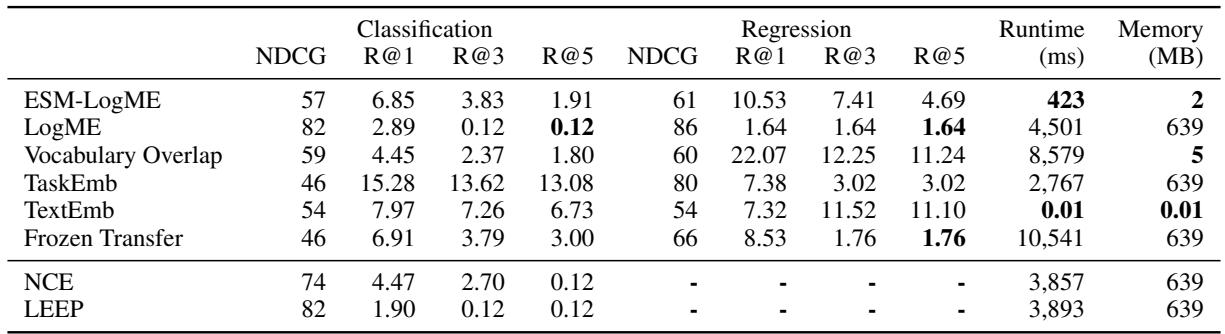
Table 1 tells the complete story:
- Ranking Performance (Regret@5): ESM-LogME achieves a score of 1.91 (classification). This is very close to the heavy LogME score of 0.12. In plain English, transferring from the top 5 picks of ESM-LogME yields 97% of the performance you’d get if you exhaustively searched the whole pool.
- Runtime: Look at the “Runtime” column. ESM-LogME takes 423 ms per task. Standard LogME takes 4,501 ms. That is a 10x speedup.
- Memory: This is the most shocking stat. ESM-LogME requires 2 MB of memory. Standard LogME requires 639 MB. That is effectively the difference between storing a song and storing a CD-ROM.
The Reality of Transfer Gains
It is important to note that transfer learning isn’t magic—it doesn’t always help. The authors visualized the distribution of performance gains across different tasks.
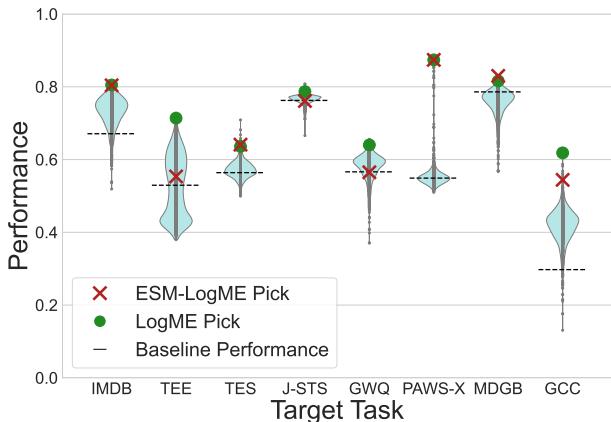
In Figure 3, the dashed line represents the baseline (no transfer learning).
- The Good News: For most tasks (like
TESandJ-STS), the majority of the “violin” shape is above the dashed line. This means picking a random intermediate task is usually better than nothing. - The Warning: For some tasks, picking a bad intermediate task actually hurts performance (the shape extends below the line).
- The Validation: The red “X” marks represent the task chosen by ESM-LogME. In almost all cases, the “X” is located at the very top of the distribution, indicating it successfully identified one of the best possible source tasks.
Why This Matters for Students and Practitioners
If you are a student working on a thesis or a practitioner in industry, you likely have limited GPU credits. You cannot afford to download 50 different 500MB models just to see which one might help your accuracy.
ESM-LogME changes the economics of transfer learning.
By reducing the representation of a “skill” (a fine-tuned task) to a simple linear map, it treats task transferability as a lightweight, modular component. It envisions a future where Model Hubs don’t just host heavy model weights, but also repositories of these tiny “Maps.”
Instead of searching for a needle in a haystack by moving the hay (heavy models), ESMs let you X-ray the haystack.
Conclusion and Future Implications
The paper “Less is More” provides a compelling argument for approximation in deep learning. We often assume that to get the best results, we need the most complex representations. This research proves that for the specific problem of Source Selection, a linear approximation captures enough signal to make highly accurate decisions.
The authors have released their code and a library to share these ESMs. This opens the door for a “Task Map Hub” where selecting the perfect transfer learning source takes seconds on a laptop, rather than days on a cluster.
Key Takeaways:
- Intermediate Task Transfer is powerful but historically hard to optimize due to the sheer number of choices.
- ESMs approximate the effect of fine-tuning using a simple linear layer, saving massive amounts of disk space and compute time.
- ESM-LogME is a selection workflow that is 10x faster and 278x more storage-efficient than current state-of-the-art methods, with minimal loss in selection accuracy.
- Simplicity Wins: Sometimes, a linear layer is all you need to navigate a complex embedding space.