](https://deep-paper.org/en/paper/2410.15609/images/cover.png)
Imagine you are asking your smart home assistant to “add cereal to the shopping list.” Instead, it dutifully adds “serial” to your list. While this is a minor annoyance for a user, for the underlying Artificial Intelligence, it is a catastrophic failure of understanding.
This phenomenon stems from errors in Automatic Speech Recognition (ASR). While modern Pre-trained Language Models (PLMs) like BERT or GPT are incredibly smart at understanding text, they are often trained on clean, perfect text. When they are fed messy, error-prone transcriptions from an ASR system, their performance nosedives.
To fix this, researchers typically use a technique called Speech Noise Injection (SNI)—intentionally training the AI on messy text so it gets used to it. But there is a catch: if you train an AI on the mistakes made by Google’s ASR, it might not understand the mistakes made by Amazon’s ASR. The errors are biased toward the specific system used during training.
In this post, we will dive deep into a research paper titled “Interventional Speech Noise Injection for ASR Generalizable Spoken Language Understanding.” The researchers propose a fascinating solution combining Causal Inference and Phonetic Awareness to create a model that is robust to any ASR system, not just the one it was trained on.
The Problem: The “Broken Telephone” of AI
In a typical Spoken Language Understanding (SLU) pipeline, the process looks like this:
- Audio: A user speaks.
- ASR: The computer converts audio to text.
- PLM: A language model processes the text to understand the intent.
The weak link is step 2. ASR systems produce phonetically similar but semantically different errors (e.g., “quarry” vs. “carry”).
To make the PLM robust, developers generate “pseudo-transcriptions.” They take clean text and artificially inject noise into it, mimicking ASR errors. However, different ASR systems make different mistakes based on their architecture and training data.
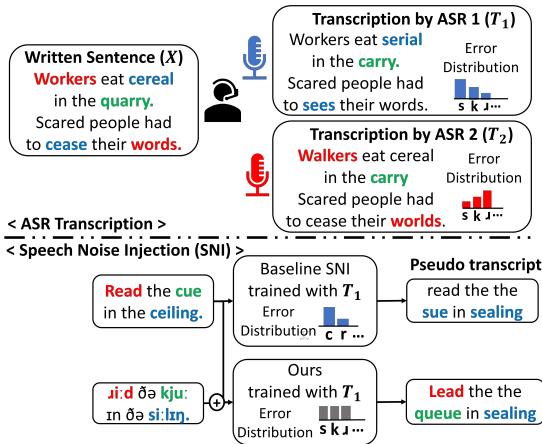
As shown in Figure 1, \(ASR_1\) (blue) might confuse “cereal” with “serial,” while \(ASR_2\) (red) might confuse “Read” with “Lead.” If we only train our noise injector on \(ASR_1\), our downstream model will never learn to handle the errors typical of \(ASR_2\).
The researchers argue that standard SNI methods are biased. They merely replicate the error distribution of a specific ASR system. The goal of this paper is to create Interventional SNI (ISNI), a method that generates “universal” noise plausible for any ASR system (\(ASR_*\)), ensuring the model generalizes well to unseen environments.
The Background: Why Current Methods Fail
Current approaches to Speech Noise Injection generally fall into two buckets:
- Text-to-Speech (TTS) Pipelines: Converting text to audio and back to text. This is slow and computationally expensive.
- Textual Perturbation: Swapping words based on a confusion matrix (a list of common errors).
The most advanced method is Auto-regressive Generation, where a model like GPT-2 is trained to predict how an ASR would mess up a sentence. While effective, it suffers from the bias mentioned above. It learns the specific bad habits of the ASR it was trained on.
If you deploy your voice assistant in a new environment or switch your ASR provider, your Spoken Language Understanding model might fail because the “noise” it encounters is different from the “noise” it practiced on.
The Core Method: Interventional SNI (ISNI)
The researchers tackled this problem using two innovative concepts: Causal Intervention (to remove bias) and Phoneme-Awareness (to ensure realism).
1. The Causal Perspective
To understand why standard models are biased, we have to look at the “Cause and Effect” of errors.
In a real ASR setting (Figure 2a below), the written text (\(X\)) determines the audio (\(A\)), which influences the transcription (\(T\)). The error (\(Z\)) acts as a mediator.
However, when researchers collect training data for SNI (Figure 2b), they usually filter the data. They only keep pairs of (Text, Transcription) where an error actually occurred. This creates a “backdoor path” or a non-causal correlation. The model learns that “if this word is present, an error must occur,” based solely on the specific ASR used for data collection.
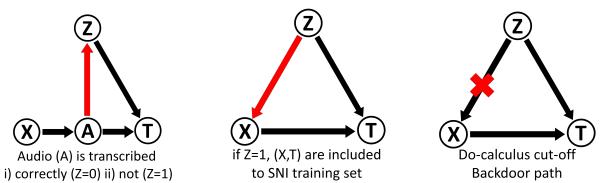
Figure 2 illustrates this clearly:
- (a) The natural flow of ASR transcription.
- (b) The flawed flow of standard SNI training. The selection of data creates a dependency (\(Z \rightarrow X\)).
- (c) The ISNI approach. The researchers use a concept called do-calculus.
The Intervention (Do-Calculus)
The goal is to cut the non-causal link between the text (\(X\)) and the error occurrence (\(Z\)). In simpler terms, we want to stop the model from only generating errors on words that DeepSpeech (for example) struggles with. We want it to be able to simulate an error on any word that might be difficult for some ASR system.
Mathematically, this changes the probability estimation from a standard conditional probability to an interventional one.
The standard SNI likelihood looks like this:
\[ P ( t _ { i } ^ { k } | x ^ { k } ) = \sum _ { z ^ { k } } P ( t _ { i } ^ { k } | x ^ { k } , z ^ { k } ) P ( z ^ { k } | x ^ { k } ) . \]Here, the probability of an error (\(z\)) depends on the specific input word (\(x\)) according to the training ASR’s bias.
The Interventional likelihood (ISNI) changes this to:

By applying the \(do(x^k)\) operator, the researchers treat the error variable \(z\) as an independent switch. They effectively say: “Suppose we force an error to happen here. What would it look like?” This removes the bias of the original ASR system, allowing the model to corrupt words that the original ASR might have transcribed correctly, but a different ASR might not.
2. The Architecture: Constrained Decoding
How does the model actually generate these errors? They utilize a Constrained Decoder.
The process works as follows (visualized in Figure 3):
- Input: The clean text \(X\).
- Constraint (\(Z\)): A binary signal. If \(Z=0\), the model copies the word. If \(Z=1\), the model must generate a noise word.
- Output: The pseudo-transcription \(T\).
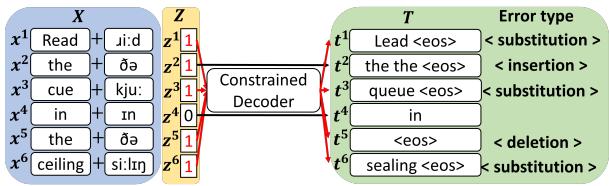
In Figure 3, look at the word “cue” (\(x^3\)). The system sets \(z=1\) (force error). The constrained decoder then generates “queue” (\(t^3\)). This is a substitution error. Look at “Read” (\(x^1\)). The decoder generates “Lead.”
By controlling \(P(z)\) explicitly (using a hyperparameter rather than learning it from biased data), the model can simulate a wide variety of error rates and patterns, effectively creating a “Universal ASR” simulation.
3. Phoneme-Aware Generation
Removing bias is great, but random noise is useless. If the word “Cat” is replaced with “Refrigerator,” the model learns nothing useful because ASR systems don’t make that kind of mistake. ASR errors are phonetic—they sound like the original word.
To ensure the generated noise is “ASR-Plausible” (it sounds right), the researchers injected phonetic knowledge into the model.
Phoneme Embeddings
Standard language models use “Word Embeddings” (representing meaning). ISNI adds “Phoneme Embeddings” (representing sound).
The encoder input combines word information with pronunciation information:

Here, \(M_{word}\) is the meaning and \(M_{ph}\) is the pronunciation. The parameter \(\lambda_w\) balances the two. This teaches the model that “Cereal” and “Serial” share the same phonetic embedding, even if their meanings are different.
Phonetic Similarity Loss
Finally, to force the model to generate phonetically accurate errors, they introduced a specific loss function during training. They calculate the Phoneme Edit Distance between the original word and the generated noise.
If the model generates a noise word that sounds nothing like the original, the Phonetic Similarity Loss penalizes it.

This ensures that when the intervention forces an error (\(z=1\)), the result is a word that sounds very similar to the input (e.g., cue \(\rightarrow\) queue), making the noise realistic for any ASR system.
Experiments and Results
The true test of this method is the Zero-Shot setting.
- Training: The SNI model is trained using errors from DeepSpeech (an older, RNN-based ASR).
- Testing: The SLU model is tested on transcriptions from completely different ASR systems (like LF-MMI TDNN or Unknown commercial systems).
If ISNI works, it should prepare the SLU model for these unseen ASRs better than baselines trained on DeepSpeech.
Dataset 1: ASR GLUE
ASR GLUE is a benchmark for natural language understanding tasks (like sentiment analysis and logic inference) performed on noisy speech transcripts.
Table 2 below compares three models:
- NoisyGen: The standard, biased baseline.
- ISNI (Ours): The proposed method.
- Noisy-Gen (In Domain): A theoretical “cheat” model trained on the same ASR used for testing.

Key Takeaway: Look at the “SST2” (Sentiment Analysis) and “QNLI” columns. ISNI (Ours) consistently outperforms the standard NoisyGen. In some cases (like SST2 Medium noise), it even rivals the “In Domain” model. This proves that ISNI successfully generalized beyond the specific errors of DeepSpeech.
Dataset 2: DSTC10 Track 2
This dataset focuses on task-oriented dialogue systems (e.g., searching for knowledge in a conversation). This is much harder because specific keywords (entities) matter immense.

Key Takeaway:
- KS (Knowledge Selection): Look at the R@1 (Recall at 1) column. ISNI achieves 66.43, significantly higher than the baseline NoisyGen (57.10) and the previous state-of-the-art TOD-DA (60.51).
- RG (Response Generation): The BLEU scores (B@1, B@2) for ISNI are nearly double the baselines.
This indicates that because ISNI was trained to expect “universal” phonetic errors, it was much better at retrieving the correct information even when the input was garbled by an unknown ASR system.
Does the Intervention Matter?
The researchers performed an ablation study (removing parts of the model to see what breaks).
- Removing Phoneme-Awareness caused a massive drop in performance (pseudo-transcripts stopped sounding like the original words).
- Removing Intervention (the causal cut) caused a drop in retrieval tasks, proving that simply copying the error distribution of the training set is not enough for generalization.
Conclusion
The paper “Interventional Speech Noise Injection for ASR Generalizable Spoken Language Understanding” presents a significant step forward for robust AI. By viewing ASR errors through the lens of Causal Inference, the authors identified a subtle but critical bias in how we currently train voice assistants.
Their solution, ISNI, teaches models not just to memorize specific mistakes, but to understand the nature of phonetic errors. By combining do-calculus to break bias and phonetic embeddings to ensure realism, they created a noise injection system that prepares AI for the unpredictable reality of spoken language.
For students and engineers entering the field of SLU, the lesson is clear: robustness isn’t just about more data; it’s about the right data. Understanding the causal mechanisms behind your data generation can be the difference between a fragile demo and a production-ready system.
This blog post summarizes the research by Yeonjoon Jung et al. from Seoul National University and Yanolja.