](https://deep-paper.org/en/paper/2410.16770/images/cover.png)
Introduction
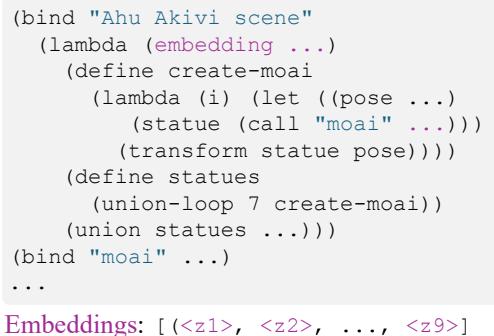
How do you describe a scene? It sounds like a simple question, but try to be precise. Imagine you have just returned from a trip to Easter Island and you want to describe the famous Ahu Akivi site to a friend. You might say, “There are seven moai statues in a row, facing the same direction.”
Your friend asks, “What is a moai?” You reply, “It’s a monolithic human figure carved from stone, with a large head and no legs.” “Do they look exactly the same?” “No,” you hesitate. “They share the same structure, but each has a slightly different weathered texture and distinct identity.”
This scenario highlights a fundamental disconnect in how we represent the visual world. Natural language is excellent for high-level semantics (“moai”), but it struggles with precise spatial arrangements (“seven in a row”) and often fails to capture the subtle visual identity of specific instances (the unique texture of this specific stone).
In the world of Computer Vision and 3D generation, this problem is the bottleneck between a good image and a controllable, high-fidelity 3D scene. We have tools that are good at one aspect but rarely all three.
In this post, we are diving deep into a paper titled “The Scene Language: Representing Scenes with Programs, Words, and Embeddings” by researchers from Stanford University and UC Berkeley. They propose a novel representation that doesn’t choose between these modalities but combines them.
As shown in Figure 1, this new “Scene Language” allows for the generation of complex 3D scenes where users can edit the code to change the layout or swap embeddings to change the artistic style—all inferred from text or images.
Background: The Trilemma of Scene Representation
To understand why “Scene Language” is such a significant step forward, we first need to look at the limitations of existing methods. A complete scene representation needs to capture three types of information:
- Structural Knowledge: The joint distribution of instances. For example, “statues in a row” or “chairs around a table.” This is relational and hierarchical.
- Category-Level Semantics: What things are. The concept of a “chair” or a “tree.”
- Instance-Level Intrinsics: The specific identity. The exact grain of wood on the table or the specific lighting on a leaf.
Modern AI has attacked these problems in isolation:
- Programs: Procedural generation and shape programs (like ShapeAssembly) are fantastic at structure. They can define loops, repetitions, and symmetry. However, they are usually “blind”—they deal with cuboids and primitives, lacking realistic texture and appearance.
- Scene Graphs: These represent scenes as nodes (objects) and edges (relations). While they capture “A is on top of B,” they are often too coarse. They miss the precise geometric details and the subtle visual “vibes” of an object.
- Neural Embeddings (Latents): Generative models (like Stable Diffusion) use high-dimensional vectors to capture incredible visual detail. However, these latent spaces are unstructured. You cannot easily reach into a latent vector and say, “move the third object five units to the left.”
The authors of this paper argue that none of these alone is sufficient. We need a hybrid.
The Core Method: The Scene Language
The researchers introduce Scene Language, a representation denoted as \(\Phi(s)\). It integrates three modalities to cover the gaps the others leave behind.
As illustrated in Figure 2, the Scene Language represents a scene using a tuple of three components. Formally, it is defined as:

Let’s break down these three pillars:
- \(W\) (Words): These are phrases in natural language (e.g., “pawn”, “board”) that denote the semantic class of an entity. They provide the high-level “what.”
- \(P\) (Program): This is a set of functions that encode the structure. It specifies the existence of entities, their hierarchy, and their spatial relations (extrinsics).
- \(Z\) (Embeddings): These are neural embeddings that capture the low-level visual details and specific identities (intrinsics).
1. The Program (\(P\)) and Structure
The program is the skeleton of the scene. It describes how parts come together to form wholes. In the Scene Language, the program consists of Entity Functions.
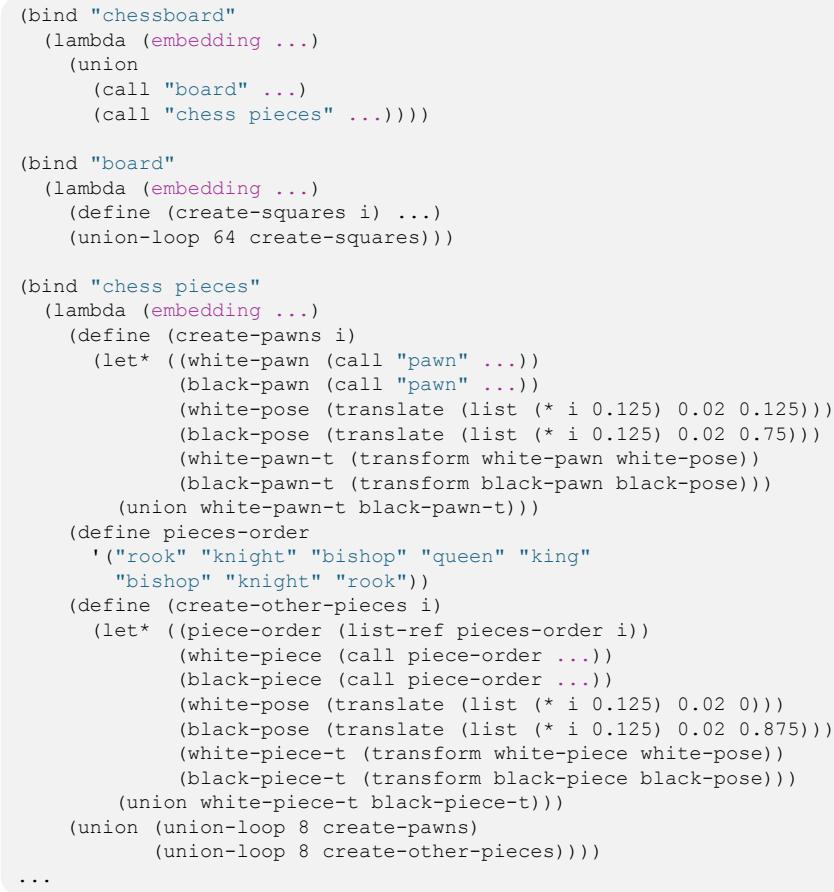
An entity function, denoted as \(f_w\), defines a class of entities (labeled by the word \(w\)). It takes neural embeddings as input and outputs a specific entity \(h\). Crucially, this is recursive. An object (like a chessboard) is made of sub-objects (squares and pieces), which are made of primitives.
The recursive definition of an entity function is mathematically formalized as:

Let’s decode this equation:
- \(\Psi_{\text{union}}\): This operation composes multiple sub-entities into a single parent entity.
- \(\Psi_{\text{transform}}\): This applies a spatial pose (translation, rotation, scale), denoted as \(t^{(i)}(z)\), to a sub-entity.
- Recursion: The sub-entity \(h^{(i)}\) is itself the result of another entity function \(f_{w^{(i)}}\).
This structure naturally reflects the hierarchical nature of the real world. A “dining set” isn’t just a bag of pixels; it’s a table and chairs. A “chair” is legs, a seat, and a back. The program \(P\) captures this explicit dependency structure.
2. The Embeddings (\(Z\)) and Visual Identity
While the program defines where things are and what they are logically, the embeddings define how they look.
The system uses CLIP embeddings (\(Z_{\text{CLIP}}\)). These are powerful because they bridge text and images. An embedding \(z\) captures specific attributes—like “mahogany wood” or “rusty metal”—that are hard to code explicitly in a program but easy for a neural network to understand.
By parameterizing the entity functions with these embeddings, the Scene Language allows for “infinite” variations of a structural theme. You can reuse the structural code for “statues in a row” but swap the embedding \(z\) from “stone moai” to “golden robot,” and the scene updates instantly while keeping the layout.
3. The Domain-Specific Language (DSL)
To make this actionable, the researchers realized the Scene Language as a Domain-Specific Language (DSL) in Python. This DSL includes macros that map to the mathematical operations we discussed:
union: Composes entities.transform: Applies pose matrices.union-loop: A programmatic loop (e.g., “repeat this column 4 times”), which captures structural regularity.call: Retrieves a function bound to a word and applies it to embeddings.
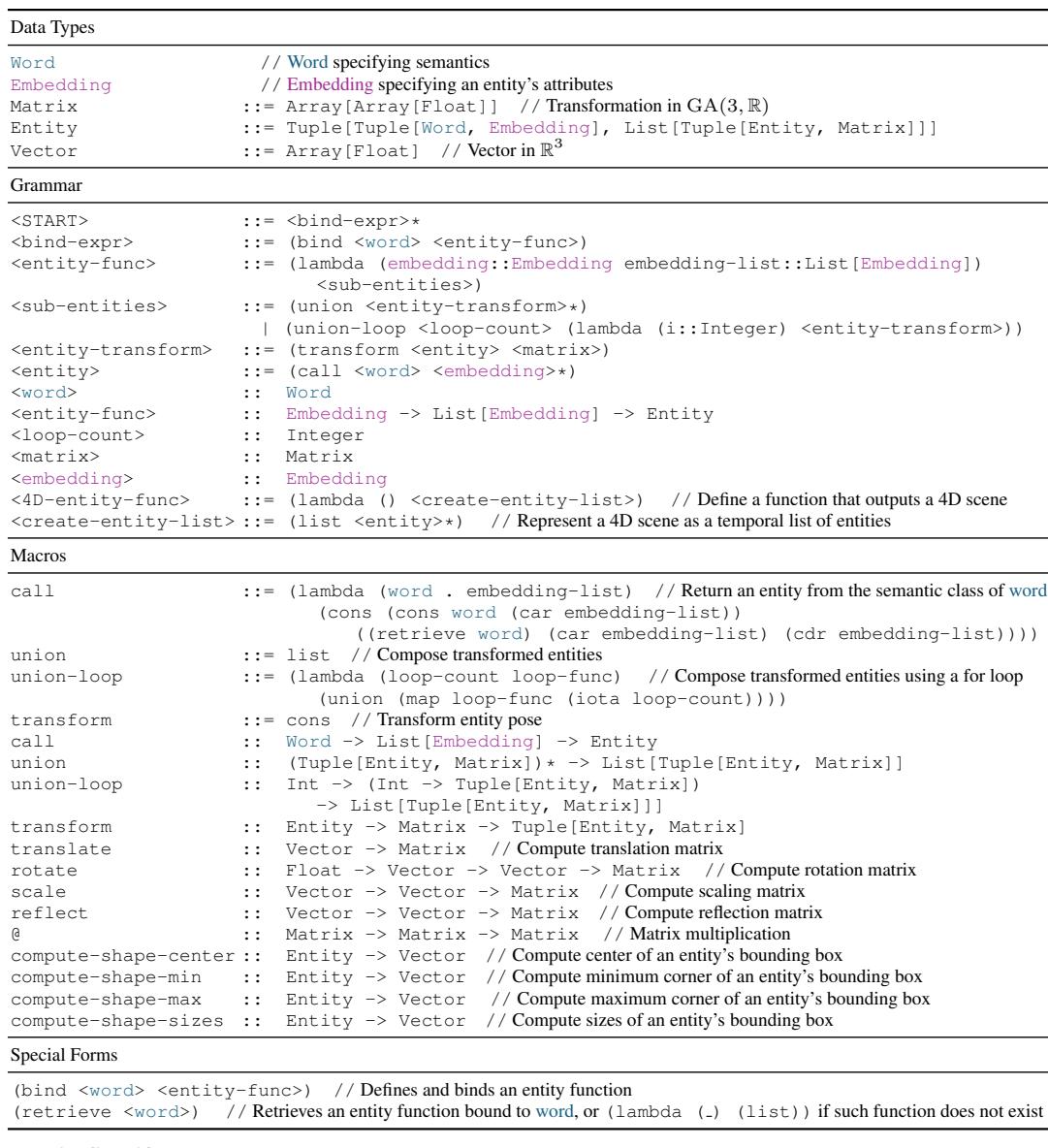
Table 5 (above) details the grammar. This is not just theoretical; it looks like Lisp-style or Python-style code. For example, a function to create a row of objects might look like (union-loop 7 create-moai), making the scene structure human-readable and editable.
Rendering: From Code to Pixels
Once we have a Scene Language representation \(\Phi(s)\), how do we turn it into an image? This process is called Rendering.
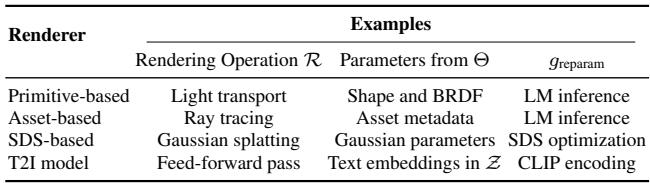
The framework is designed to be renderer-agnostic. It treats the rendering engine as a module.

As shown in Figure 3, the process has distinct steps:
- Program Execution: The interpreter runs the program \(P\) with embeddings \(Z\). This unrolls the loops and function calls into a static Computation Graph or entity tree (Figure 3b).
- Reparameterization: This is the clever part. The generic entities need to be translated into the specific language of the graphics engine.
- Rendering Operation (\(\mathcal{R}\)): The engine takes the parameters and produces the image.
The paper demonstrates this with several different renderers, summarized in Table 2:
Case Study: 3D Gaussian Splatting (SDS-Based)
One of the most impressive implementations in the paper uses 3D Gaussian Splatting optimized via Score Distillation Sampling (SDS).
In this setup:
- Primitives: The “leaves” of the entity tree are represented as clusters of 3D Gaussians (ellipsoids).
- Optimization: The system optimizes the parameters of these Gaussians so that, when rendered, they match the CLIP embeddings \(z\) associated with them.
- Math: The rendering operation \(\mathcal{R}\) follows the standard Gaussian Splatting formulation:

And importantly, because the Scene Language handles transformations explicitly, a transformed object \(G_t\) is mathematically derived by applying the transformation matrix \(t\) to the Gaussian parameters (mean and covariance):

This means the neural network doesn’t have to “learn” to rotate an object. The program handles the rotation mathematically, and the neural network focuses on the texture and shape.
The optimization minimizes a loss function (\(\mathcal{L}\)) that combines SDS loss (ensuring the image looks like the text description) with geometric regularization:

The result? Crisp, 3D-consistent scenes where the structure is enforced by code, but the appearance is generated by modern diffusion models.
Inference: “Training-Free” Generation
Here is perhaps the most modern twist in the paper: How do you get the Scene Language code in the first place? You don’t train a massive new network to output code. You simply ask a Large Language Model (LLM).
The authors propose a training-free inference module. They feed a pre-trained LLM (like GPT-4 or Claude) the DSL specifications and a few examples. Then, given a text prompt (e.g., “A chessboard set up for a game”), the LLM writes the Python script that defines the structure.
- For Text inputs: The LLM hallucinates the program structure and suggests words for the embeddings.
- For Image inputs: The system uses vision-language models to segment the image, identify objects, and then optimize embeddings (via Textual Inversion) to match the visual style of the input image.
This leverages the “common sense” reasoning of LLMs. An LLM knows that a “table” usually has four legs and a flat top, so it writes a program with a union-loop for the legs.
Experiments & Results
The researchers evaluated the Scene Language across several tasks: text-prompted generation, image-prompted generation, and scene editing.
1. Text-Prompted Generation
The primary comparison was against MVDream (a direct text-to-3D method without structural representation) and GraphDreamer (which uses scene graphs).
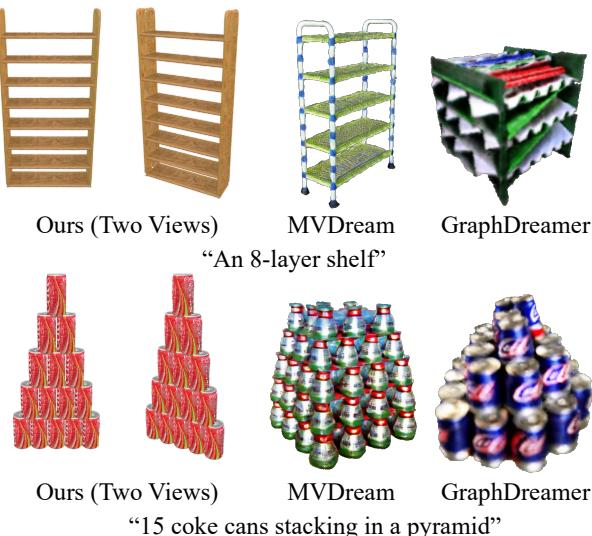
Look at Figure 4. The prompt “15 coke cans stacking in a pyramid” is a stress test for counting and structure.
- MVDream creates a messy pile. It understands “cans” but not the precise geometry of a pyramid.
- GraphDreamer builds a structure, but often fails on the exact count or arrangement because scene graphs are too abstract.
- Ours (Scene Language): Generates a precise, mathematical pyramid. Because the LLM wrote a loop to stack them, the structure is perfect.
Quantitative results (Table 3, implicitly referenced via visual results) showed that Scene Language significantly outperformed baselines in counting accuracy and alignment with user prompts.
2. Consistency Across Renderers
One of the coolest features is the ability to swap renderers. The same program can be rendered as a high-fidelity Gaussian Splat, a blocky Minecraft build, or a vector-like Mitsuba rendering.
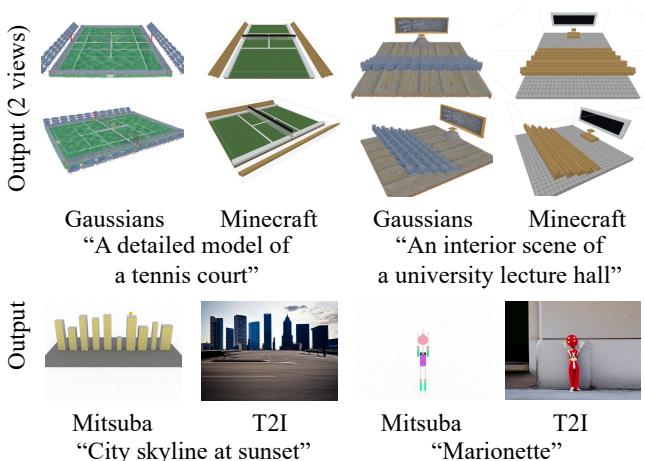
Figure 5 shows this versatility. Whether it’s a tennis court or a lecture hall, the structural integrity remains identical across different visual domains.
3. Scene Editing
This is where the “Language” part shines. Because the scene is represented as code, editing is intuitive.
- Instruction: “Make the branching structure trinary.”
- Action: The LLM modifies the
loopcount in the code from 2 to 3.
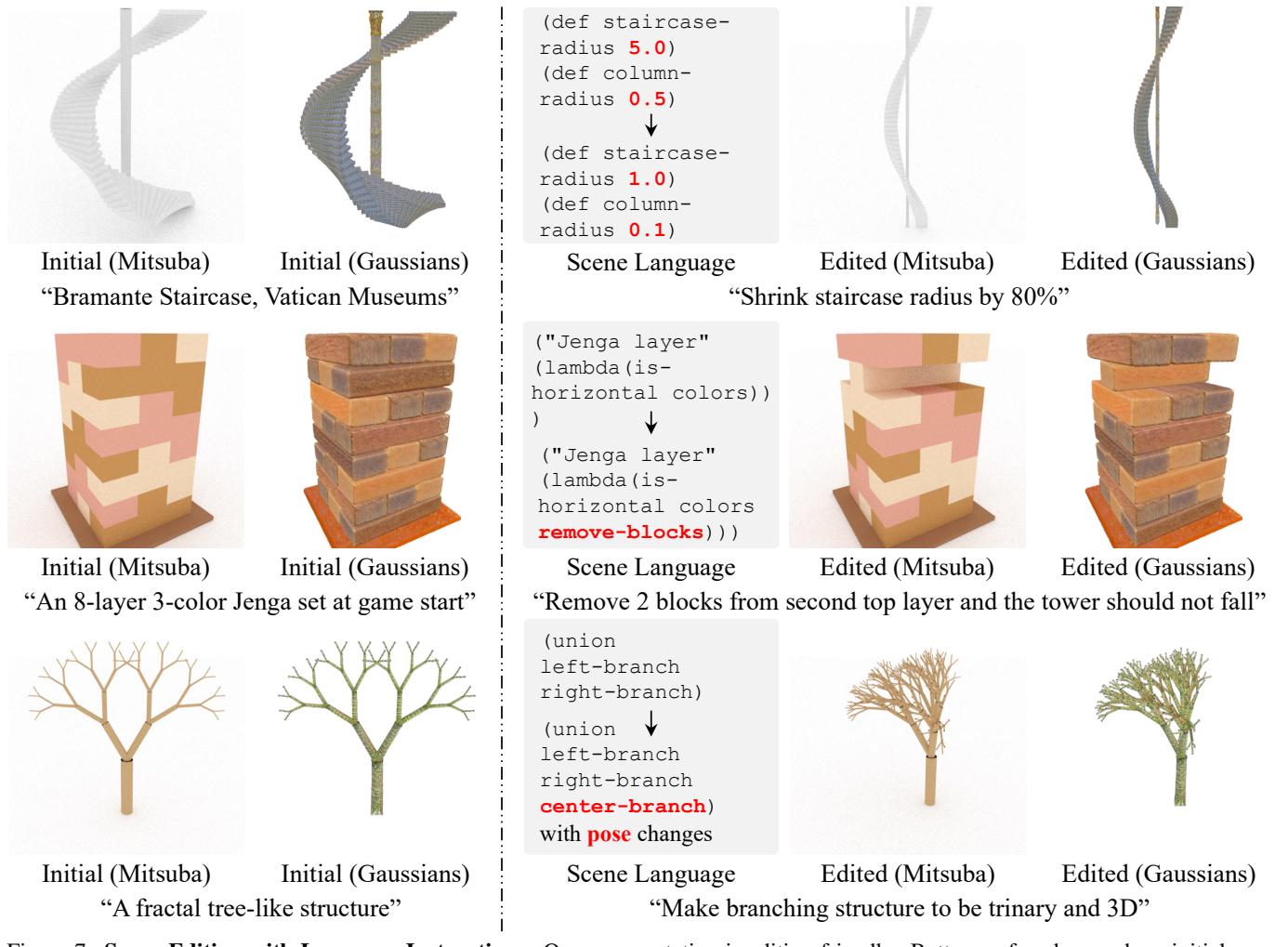
In Figure 7 (top), the user asks to “shrink staircase radius by 80%.” In a pixel-based generative model, this might distort the stairs or ruin the texture. In Scene Language, it’s just a parameter change in the script. The stairs shrink, but the texture and lighting (the embeddings) remain perfectly consistent.
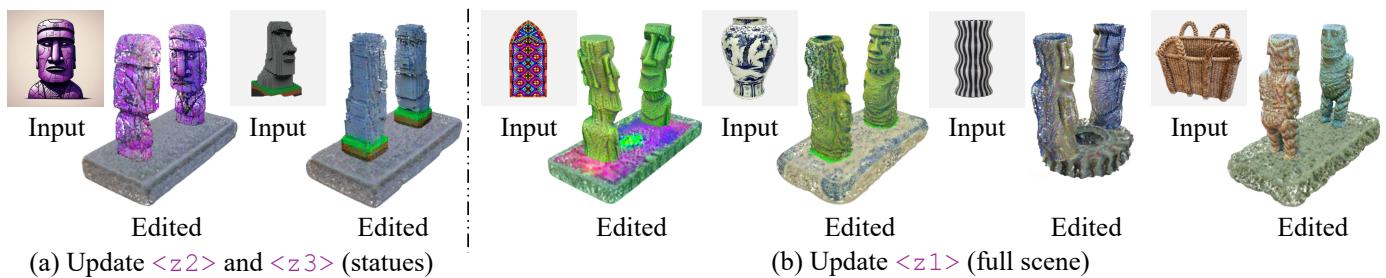
They also demonstrated Image-Based Editing (Style Transfer). By swapping the embedding \(z\) of a specific object with a new embedding derived from a user’s photo, they can change the style of just the “moai statues” while leaving the platform unchanged.
4. 4D Generation (Animation)
The representation also supports time. By adding a time parameter to the transformation matrices in the program, the system can generate 4D scenes (3D + Time).
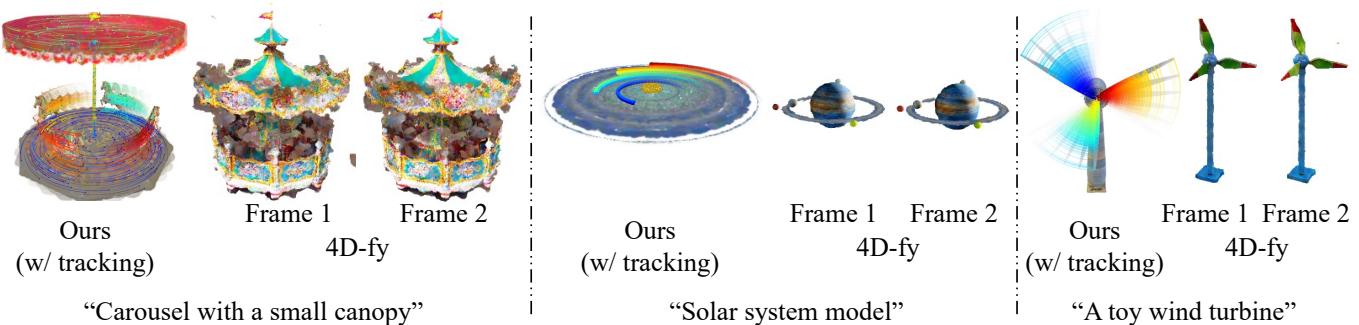
Figure 6 shows a moving carousel and a wind turbine. Because the motion is defined programmatically (e.g., rotation_matrix(time * speed)), the movement is smooth and physically plausible, unlike the “wobbly” motion often seen in video generation models.
Conclusion & Implications
The “Scene Language” paper makes a compelling case for neuro-symbolic AI in computer vision. It suggests that we shouldn’t rely solely on the “black box” of neural networks for everything.
By decoupling Structure (handled by Programs/LLMs), Semantics (handled by Words), and Appearance (handled by Embeddings), we get the best of all worlds:
- Precision: Code guarantees straight lines, exact counts, and perfect symmetry.
- Fidelity: Neural embeddings provide photorealistic textures that hand-coded assets lack.
- Controllability: Users can edit the scene by changing the text, the code, or the reference image.
This work paves the way for “Inverse Graphics” pipelines where we can deconstruct the real world into editable code, essentially turning reality into a programmable engine. For students and researchers, it highlights an exciting direction: thinking of generation not just as pixel prediction, but as program synthesis.