](https://deep-paper.org/en/paper/2410.18385/images/cover.png)
Introduction
Imagine building a search engine for a brand-new medical database or a collection of legal precedents in a foreign language. You have millions of documents, but you have a major problem: zero users. Without a history of user queries (the things people type into the search bar), how do you teach your search algorithm what “relevance” looks like?
This is the challenge of Zero-Shot Information Retrieval (IR). Modern search engines rely heavily on “Dense Retrieval” models—neural networks that understand semantic meaning. However, these models need massive amounts of training data (pairs of questions and answers) to work well. When you drop them into a new domain without fine-tuning, their performance usually collapses.
The standard industry fix is synthetic data generation. Developers take a document and use a Large Language Model (LLM) to “hallucinate” a question that might lead to that document. They then train the search engine on these synthetic pairs. While effective, this approach has a flaw: it treats every document in isolation.
In the real world, concepts are connected. A user’s query often touches upon ideas scattered across multiple related documents. By training on single-document/single-query pairs, models fail to capture the broader context and distribution of the new domain.
In this post, we will deep-dive into a novel solution proposed in the paper “Link, Synthesize, Retrieve: Universal Document Linking for Zero-Shot Information Retrieval.” The researchers introduce Universal Document Linking (UDL), an algorithm that intelligently groups related documents before generating synthetic queries. This seemingly simple step creates richer, more complex training data that allows small, efficient models to outperform massive LLMs in zero-shot scenarios.
The Background: The Zero-Shot Fine-Tuning Loop
To understand why UDL is necessary, we first need to understand the current standard for training IR models in new domains.
When you possess a corpus of documents (like a set of scientific papers) but no queries, the standard workflow is Query Augmentation. You feed your documents into a generative model (like T5 or GPT), and it spits out synthetic queries. You then use these pairs to fine-tune your retrieval model (like BERT).
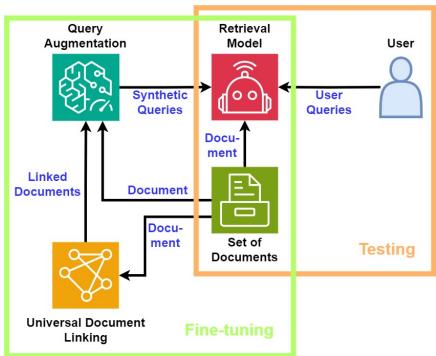
As shown in Figure 1, the process creates a feedback loop. The “Query Augmentation” block generates data to train the “Retrieval Model.” The goal is for the retrieval model to learn the specific language distribution of the new documents so it can handle future “User Queries.”
The “Single-Document” Bottleneck
The problem identified by the authors is that merely increasing the volume of synthetic queries doesn’t necessarily improve performance. Why? Because standard augmentation links a synthetic query to exactly one document.
However, in datasets like NFCorpus (medical) or ArguAna (debates), a real user’s question might be relevant to several documents that share a topic. If a model is only trained to map a specific query to a specific isolated document, it fails to learn the semantic relationships between documents. It creates a rigid retrieval system that struggles with the ambiguity and interconnectedness of real-world information.
The Core Method: Universal Document Linking (UDL)
The researchers propose UDL to break this bottleneck. Instead of generating queries immediately, UDL first acts as a “matchmaker,” finding and linking documents that should be treated as a unit. Synthetic queries are then generated from these linked document pairs.
The genius of UDL lies in its adaptability. It doesn’t use a “one size fits all” approach to link documents. Instead, it dynamically decides how to measure similarity based on the specific characteristics of the dataset.
The algorithm follows three distinct steps:
- Decision of Similarity Model: Should we match documents based on keywords (Lexical) or meaning (Semantic)?
- Decision of Similarity Score: How strict should we be when linking documents?
- Link and Generate: Create the links and generate new queries.
Step A: Choosing the Similarity Model via Entropy
How do you decide if two documents are similar? You generally have two options:
- TF-IDF (Lexical): Matches documents based on shared exact words. Good for documents with unique names or specific identifiers (e.g., “COVID-19,” “AstraZeneca”).
- Pre-trained LM (Semantic): Matches documents based on meaning, even if words differ. Good for contextual similarity.
UDL automates this choice using Shannon Entropy. The algorithm calculates the entropy for terms across the dataset.
- High Entropy (>1): These are common words distributed uniformly across many documents (e.g., “the,” “new,” “has”). If a dataset is dominated by these terms, TF-IDF becomes noisy and ineffective.
- Low Entropy (<1): These are unique, distinguishing terms (e.g., “swearing,” “intermediate,” “pulse”).
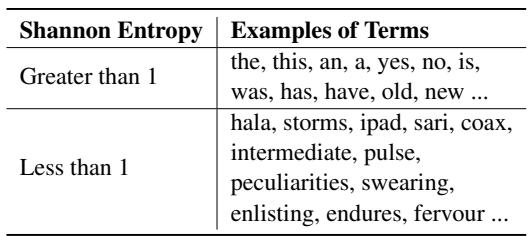
Table 12 illustrates this concept. If the algorithm detects that the “uncertainty” (entropy) of terms in the dataset is high (meaning the documents are full of generic terms), it switches to a Pre-trained Language Model (LM) for semantic matching. If the dataset allows for distinct lexical separation, it sticks to TF-IDF.
This dynamic selection ensures that UDL captures the “unique flavor” of the dataset, whether it’s a dry technical manual or a conversational forum.
Step B: The NER-Based Threshold
Once the model (TF-IDF or LM) is chosen, UDL must decide a threshold score: At what point do we consider two documents “linked”?
A fixed threshold doesn’t work because some domains are “general” (broad topics, easier to link) while others are “specialized” (highly specific jargon, risky to link incorrectly).
To solve this, UDL employs Named Entity Recognition (NER). The system compares the vocabulary overlap of the dataset against two reference NER models:
- General NER (\(N_g\)): Trained on general web text (identifies people, countries, dates).
- Specialized NER (\(N_s\)): Trained on scientific and medical texts (identifies chemicals, genes, diseases).
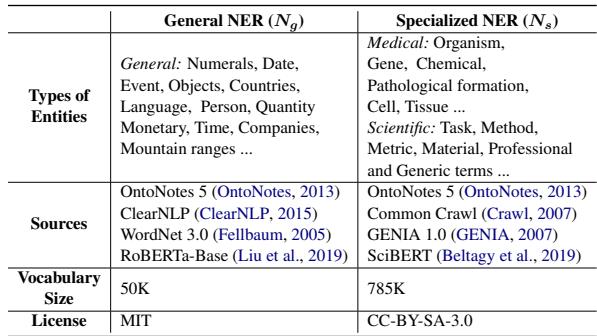
As detailed in Table 9, the Specialized NER has a much larger vocabulary suited for technical claims. UDL calculates a decision score (\(D_T\)) based on which NER model recognizes more keywords in the dataset.
The logic is formalized in the following equation:
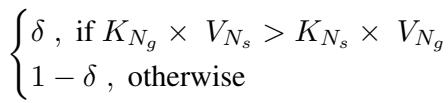
Here is the breakdown of this logic:
- \(K\): Number of keywords found in the documents.
- \(V\): Vocabulary size of the NER model.
- If the General NER dominates: The dataset is likely broad (e.g., Quora). The algorithm lowers the barrier to linking (uses a lower threshold \(\delta\)), encouraging diverse connections.
- If the Specialized NER dominates: The dataset is technical (e.g., Medical). The algorithm raises the barrier (uses a higher threshold \(1 - \delta\)), ensuring only very closely related documents are linked to avoid creating misleading training data.
Step C: Linking and Synthesizing
With the model selected and the threshold set, UDL links the documents. If Document A and Document B are linked, they are concatenated. The query generation model then reads this combined context and generates a synthetic query that applies to both.
The impact on the quality of synthetic queries is profound.
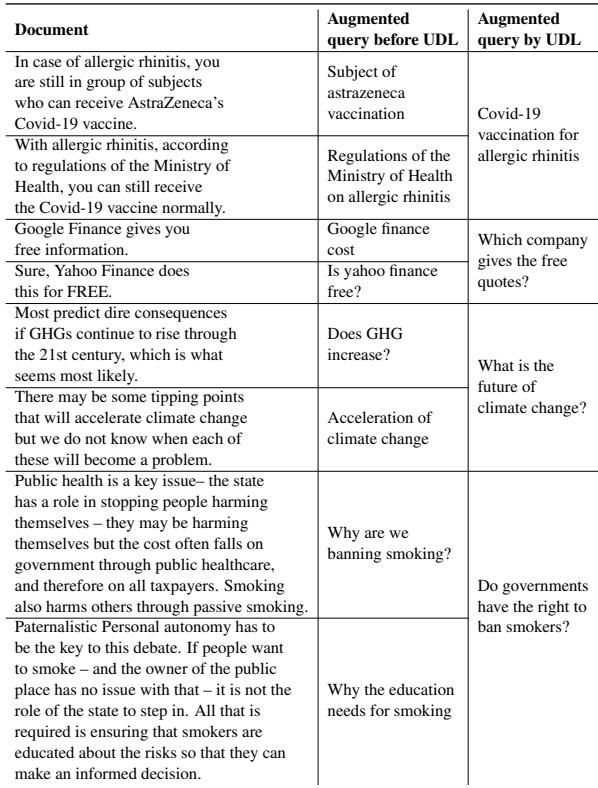
Table 1 shows the difference.
- Without UDL: The query is hyper-specific to one sentence (e.g., “Subject of AstraZeneca vaccination”).
- With UDL: The query becomes broader and more natural (e.g., “Covid-19 vaccination for allergic rhinitis”).
By linking documents about “Google Finance” and “Yahoo Finance,” UDL generates a comparative query: “Which company gives the free quotes?” This type of query is much closer to what a human would actually search for, forcing the retrieval model to learn better representations during fine-tuning.
Experiments and Results
The authors tested UDL across 10 diverse datasets, including medical (NFCorpus), scientific (SciFact), and argumentative (ArguAna) domains, as well as non-English datasets (German, Vietnamese).
1. Outperforming Standard Augmentation
The primary question is whether UDL produces better fine-tuning data than standard methods. The results suggest a resounding yes.
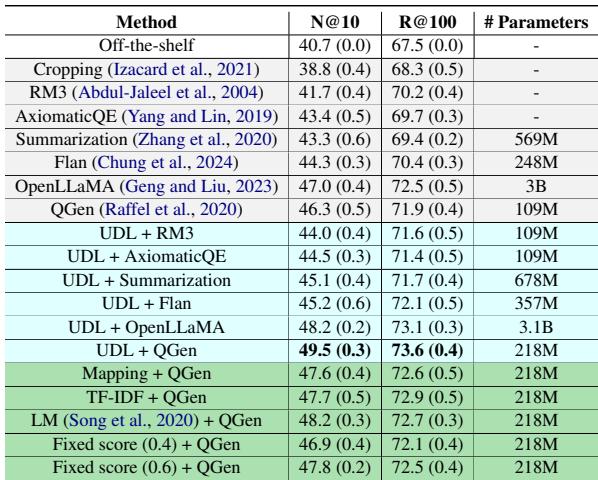
Table 2 compares UDL against various baselines (like simple cropping, summarization, and using massive LLMs like OpenLLaMA).
Key takeaways from the results:
- Efficiency: The combination of UDL + QGen (using a small T5 base model, ~218M parameters) outperforms OpenLLaMA (3 billion parameters). This is a massive finding for resource-constrained environments. You don’t need a GPU cluster to get SOTA performance; you just need smarter data preparation.
- Consistency: UDL improves performance across almost every augmentation method it is paired with.
2. Better Ranking Distribution
It’s not just about getting the right document; it’s about ranking it high enough for the user to see.
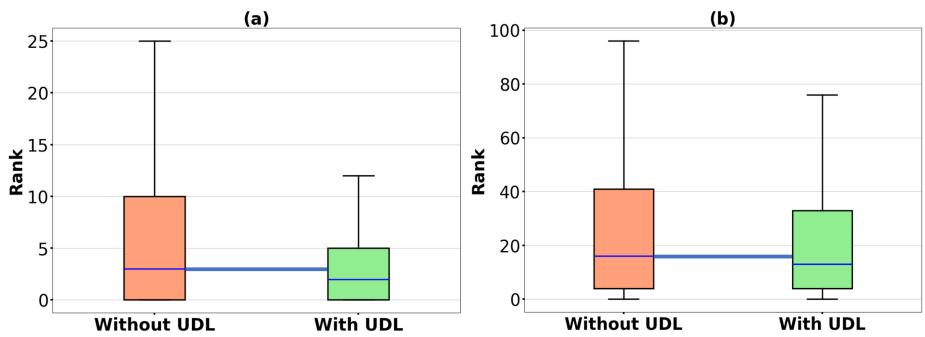
Figure 2 visualizes the rank distribution of relevant documents.
- Plot (a) - Single Links: Even for single document retrieval, UDL (right box) creates a tighter distribution with a lower median rank (lower is better in search) compared to training without UDL (left box).
- Plot (b) - Multiple Links: The improvement is even more visible here. The “spread” of the data (the whiskers) is much smaller with UDL, meaning the model is less likely to bury relevant documents deep in the search results (outliers).
3. Generalization Across Domains and Languages
One of the strongest claims of UDL is its “Universality.” The authors demonstrate that UDL adapts correctly to different languages without needing language-specific tuning.
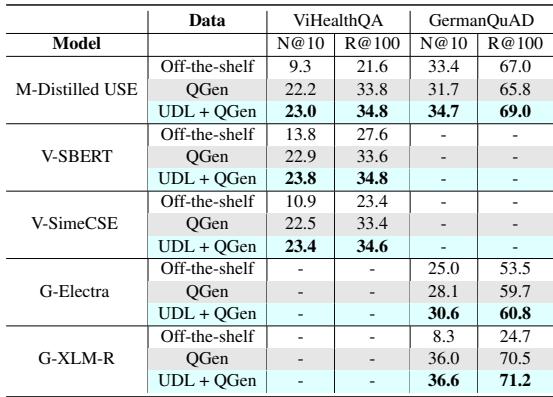
As shown in Table 4, applying UDL to Vietnamese (ViHealthQA) and German (GermanQuAD) datasets consistently improves performance (N@10 and R@100 scores) over the “Off-the-shelf” and standard “QGen” baselines. This confirms that the entropy and NER-based logic holds up even when the language changes.
4. Comparison with State-of-the-Art (SOTA)
Finally, how does a standard model fine-tuned with UDL stack up against sophisticated, highly engineered SOTA models?

Table 6 reveals that UDL (fine-tuning All-MPNet) achieves the highest scores in N@10 (46.7) and R@100 (58.0), beating specialized architectures like SPLADE++, Contriever, and DRAGON+. This is remarkable because UDL is not a new model architecture; it is a data processing technique applied to an existing model.
Conclusion & Implications
The research presented in “Link, Synthesize, Retrieve” offers a valuable lesson for the AI industry: Data quality often trumps model size.
While the current trend is to throw larger and larger Language Models at zero-shot problems, this paper demonstrates that smarter data curation—specifically, understanding the relationships between documents—can yield better results with a fraction of the compute power.
Key Takeaways:
- Context Matters: Isolated documents create isolated, narrow synthetic queries. Linking documents creates queries that better reflect human intent.
- Dynamic Adaptability: Using Entropy and NER allows the algorithm to “self-tune” to the specific jargon and structure of any new domain, from medical texts to shopping catalogs.
- Efficiency: UDL allows small models (200M parameters) to outperform giant foundational models (3B+ parameters) in retrieval tasks.
For students and practitioners in Information Retrieval, UDL represents a shift from “model-centric” improvements to “data-centric” AI. By simply connecting the dots between documents before training, we can build search engines that are far more robust, accurate, and capable of handling the unknown.